
ᐅ Is it possible to have a connection box for TV (satellite) and LAN?
Created on: 11 Oct 2022 00:45
N
netzplan
Hello everyone,
I haven’t really found an outlet for TV (satellite) and LAN. However, Jung offers a "Smart TV outlet."
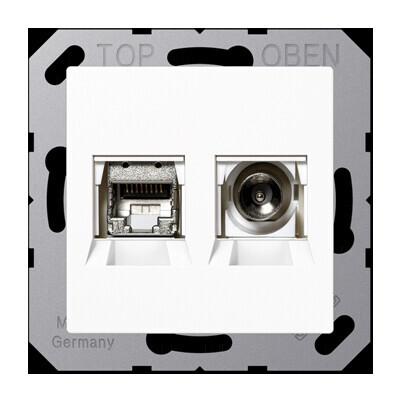
Is the right connector intended for cable TV or Unitymedia? Do you know of a similar outlet with a satellite connection for an F-type connector?
I haven’t really found an outlet for TV (satellite) and LAN. However, Jung offers a "Smart TV outlet."
Is the right connector intended for cable TV or Unitymedia? Do you know of a similar outlet with a satellite connection for an F-type connector?
Patricck schrieb:
preferably not directly behind the unitWhere then? I was thinking of placing them at 105cm (41 inches), assuming that both wall mounting and placement on a lowboard would work fine at 105cm (41 inches).
The box is basically in the wrong place for connecting, and in the case of closing it off, it’s a real headache.
We usually install two empty boxes with a conduit connection going down. Most of the time, there’s a sideboard or something in front anyway.
Or, in my case, through the wall into the pantry.
We usually install two empty boxes with a conduit connection going down. Most of the time, there’s a sideboard or something in front anyway.
Or, in my case, through the wall into the pantry.
X
xMisterDx20 Oct 2022 17:03Quite interesting. While the industry tends to build everything as decentralized as possible, preferring to install a small switch and run one data cable instead of 4 or 8, in homes the opposite approach is often taken, with walls being covered in cables...
It is much more energy-efficient to operate an 8-port switch in the home automation room (HAR) and, for example, a 4-port switch in the living room for the TV that only runs when needed (8 hours a day, if at all), rather than running a 24- or 48-port switch in the HAR 24/7.
For those bringing up the electronic waste argument: producing 500m (1,640 feet) of CAT7 cable instead of 50m (164 feet) also requires resources first...
It is much more energy-efficient to operate an 8-port switch in the home automation room (HAR) and, for example, a 4-port switch in the living room for the TV that only runs when needed (8 hours a day, if at all), rather than running a 24- or 48-port switch in the HAR 24/7.
For those bringing up the electronic waste argument: producing 500m (1,640 feet) of CAT7 cable instead of 50m (164 feet) also requires resources first...
R
RotorMotor20 Oct 2022 17:09Everyone as they need and prefer. For me, it wouldn’t be an option to install many small switches everywhere and manage each one individually...
And this setup only works if you always turn the switch behind the TV on and off.
And this setup only works if you always turn the switch behind the TV on and off.
Have you actually done comparison tests on energy consumption?
The fewer ports active on my 24-port switch, the less power it draws from the supply. I initially connected the meter and measured 6.5 watts. I believe about 6 ports were active. I can’t imagine that one or several small switches would use significantly less power.
Whether you prefer a central or decentralized setup also depends on the use case. With a central setup, it’s easier to avoid creating a bottleneck quickly. When using a decentralized switch, you shouldn’t overlook the uplink. You might need to size it larger accordingly.
The fewer ports active on my 24-port switch, the less power it draws from the supply. I initially connected the meter and measured 6.5 watts. I believe about 6 ports were active. I can’t imagine that one or several small switches would use significantly less power.
Whether you prefer a central or decentralized setup also depends on the use case. With a central setup, it’s easier to avoid creating a bottleneck quickly. When using a decentralized switch, you shouldn’t overlook the uplink. You might need to size it larger accordingly.
xMisterDx schrieb:
It’s quite interesting. While the industry tends to build as decentralized as possible—using a small switch and running one data cable instead of four or eight—in house construction, they do the opposite and cover their walls with cables...
It is much more energy-efficient to operate an 8-port switch in the home automation room (HAR) and, for example, a 4-port switch in the living room for the TV that only runs when needed (8 hours a day, if at all), rather than running a 24- or 48-port switch 24/7 in the HAR.
And for those who bring up the electronic waste argument: producing 500m (1640 feet) of CAT7 cable instead of 50m (164 feet) also has an environmental impact... Switch behind switch is all well and good, but it doesn’t really improve things. Ping times also increase; two or three switches are okay, but more than that is just a makeshift solution. From an energy perspective, it’s not really sensible.
Everything should be centralized at one point with a switch sized as needed—problem solved.
Similar topics