
ᐅ Floor Plan Design for a Single-Family Home / Bungalow – 155 sqm
Created on: 16 Oct 2022 21:50
F
Frennie
Hello everyone,
We have been planning our own home for about a year now and have gone through many iterations (from basement to two-story, etc.). In the end, we want to build a bungalow and would appreciate some critical feedback and suggestions. So far, we have created the floor plan ourselves, but we will hand it over to the building company afterward. Thank you!
Development Plan / Restrictions
Plot size – 1,056 sqm (0.26 acres)
Slope – 2 m (6.6 ft) drop over 35 m (115 ft)
Site coverage ratio – 0.4 (according to §17 Federal Land Utilization Ordinance WR)
Floor area ratio – 1.2 (according to §17 Federal Land Utilization Ordinance WR)
Building setback line and boundaries – 4 m (13 ft) from property line
Adjacent development – NW, N, NE
Number of parking spaces – 2
Number of floors – 1
Roof style – gable or hipped roof with two small dormers + triangular windows facing SW
Architectural style – bungalow, because the plot is large enough, children within sight and hearing range, barrier-free possible
Orientation – SW (like neighboring houses)
Maximum heights / restrictions – 9 m (30 ft) height / 4 m (13 ft) to neighboring properties
Other specifications – roof pitch 25-40°
Owners’ Requirements
Style, roof form, building type – timber frame construction, bungalow with exposed roof beams in living and bedrooms (except entrance area + technical room, possibly to create storage space)
Basement, floors – no basement
Number of people, ages – 33, 29, <1 planned, planned
Space requirements on ground floor / upper floor // rooms
Office use: family or home office? – both, current home office not necessary but possibly in future
Guests per year – 6
Open or closed architecture – closed
Traditional or modern style – modern
Open kitchen, kitchen island – kitchen island and separable kitchen with sliding door
Number of dining seats – 6-8
Fireplace – no
Music / stereo wall – no
Balcony, roof terrace – covered terrace between dormers
Garage, carport – garage (not prefab – timber frame with gable roof as additional storage area) with adjacent shed/workshop
Kitchen garden, greenhouse – kitchen garden
Other wishes / special features / daily routine, including reasons why something should or should not be included
- Living area should not exceed 155 sqm (1,668 sq ft) (cost factor)
House Design
Who created the plan – do-it-yourself – floor plan DIY
What do you like in particular? Why? – separation of living and sleeping areas, covered terrace and entrance, small dormers and high ceilings due to exposed roof beams
What do you dislike? Why? – possibly the office is too small? Technical/utility room large enough
Personal price limit including equipment: 500,000 €
Preferred heating system: photovoltaics + battery with air-to-water heat pump + underfloor heating
If you have to give up certain features / expansions
-can you do without: actually all rooms should be as planned
-can’t do without: -
Why is the design as it is now? For example
After many iterations with a draftsman from a construction company and different styles (single-family house with two floors, with or without basement), we tried to fit all our wishes ourselves into one floor plan.
What do you think makes it particularly good or bad? – That’s the question for you 😉
What is the most important / fundamental question about the floor plan summarized in 130 characters?
Critical feedback, thoughts, and suggestions regarding major issues, feasibility, and practicality.
Best regards
Frennie
We have been planning our own home for about a year now and have gone through many iterations (from basement to two-story, etc.). In the end, we want to build a bungalow and would appreciate some critical feedback and suggestions. So far, we have created the floor plan ourselves, but we will hand it over to the building company afterward. Thank you!
Development Plan / Restrictions
Plot size – 1,056 sqm (0.26 acres)
Slope – 2 m (6.6 ft) drop over 35 m (115 ft)
Site coverage ratio – 0.4 (according to §17 Federal Land Utilization Ordinance WR)
Floor area ratio – 1.2 (according to §17 Federal Land Utilization Ordinance WR)
Building setback line and boundaries – 4 m (13 ft) from property line
Adjacent development – NW, N, NE
Number of parking spaces – 2
Number of floors – 1
Roof style – gable or hipped roof with two small dormers + triangular windows facing SW
Architectural style – bungalow, because the plot is large enough, children within sight and hearing range, barrier-free possible
Orientation – SW (like neighboring houses)
Maximum heights / restrictions – 9 m (30 ft) height / 4 m (13 ft) to neighboring properties
Other specifications – roof pitch 25-40°
Owners’ Requirements
Style, roof form, building type – timber frame construction, bungalow with exposed roof beams in living and bedrooms (except entrance area + technical room, possibly to create storage space)
Basement, floors – no basement
Number of people, ages – 33, 29, <1 planned, planned
Space requirements on ground floor / upper floor // rooms
- Entrance area, shower/WC, bathroom, living-dining area, central kitchen, pantry, master bedroom, child 1, child 2, child 3, office, technical room, covered entrance, covered terrace
- Separated sleeping area accessed through hallway
- Central kitchen with island and access to terrace and roof windows, kitchen separable from living area with sliding door
- Children’s rooms all roughly equal in size (with possibility for bunk beds thanks to exposed roof beams)
- Technical and utility room: air-to-water heat pump, photovoltaics, battery storage, washing machine, and all other necessary connections/distribution (well away from main living areas)
- Office: soundproofed area
Office use: family or home office? – both, current home office not necessary but possibly in future
Guests per year – 6
Open or closed architecture – closed
Traditional or modern style – modern
Open kitchen, kitchen island – kitchen island and separable kitchen with sliding door
Number of dining seats – 6-8
Fireplace – no
Music / stereo wall – no
Balcony, roof terrace – covered terrace between dormers
Garage, carport – garage (not prefab – timber frame with gable roof as additional storage area) with adjacent shed/workshop
Kitchen garden, greenhouse – kitchen garden
Other wishes / special features / daily routine, including reasons why something should or should not be included
- Living area should not exceed 155 sqm (1,668 sq ft) (cost factor)
House Design
Who created the plan – do-it-yourself – floor plan DIY
What do you like in particular? Why? – separation of living and sleeping areas, covered terrace and entrance, small dormers and high ceilings due to exposed roof beams
What do you dislike? Why? – possibly the office is too small? Technical/utility room large enough
Personal price limit including equipment: 500,000 €
Preferred heating system: photovoltaics + battery with air-to-water heat pump + underfloor heating
If you have to give up certain features / expansions
-can you do without: actually all rooms should be as planned
-can’t do without: -
Why is the design as it is now? For example
After many iterations with a draftsman from a construction company and different styles (single-family house with two floors, with or without basement), we tried to fit all our wishes ourselves into one floor plan.
What do you think makes it particularly good or bad? – That’s the question for you 😉
What is the most important / fundamental question about the floor plan summarized in 130 characters?
Critical feedback, thoughts, and suggestions regarding major issues, feasibility, and practicality.
Best regards
Frennie
Well, your current plan for a bungalow with an exposed roof truss is more expensive per square meter, plus the exterior landscaping is more elaborate.
A smaller foundation slab and smaller roof areas without the exposed roof truss are more cost-effective.
What view? The ground floor of your bungalow is about 1.2 meters (4 feet) above the base slab of the basement. That doesn’t really make much difference.
The kitchen is connected to the garden/patio.
A smaller foundation slab and smaller roof areas without the exposed roof truss are more cost-effective.
What view? The ground floor of your bungalow is about 1.2 meters (4 feet) above the base slab of the basement. That doesn’t really make much difference.
The kitchen is connected to the garden/patio.
ypg schrieb:
Roughly and generally speaking, from low to high price segment: (...) Thank you for the clarification. We weren’t aware that a bungalow really ends up at the high end of the list...
ypg schrieb:
It’s also an issue if you choose a complex roof structure instead of relevant square meters—that basically means a hipped roof. A U-shape with exposed beams, etc., will probably cost you roughly 20,000–25,000 (USD equivalent) more, and you lose storage space as well as living space under the roof. (...) You now have a design where many areas are too small. That’s not the way to build a more affordable house. Thanks again. It seems you really have to build as “unspectacular” as possible to save costs—no frills. After the quote of 750,000 €, we approached it thinking: “How can we save as many square meters as possible to avoid blowing the budget?”
ypg schrieb:
For the floor plan you need at least: (...) 172 square meters (1,849 square feet)
If you include stairs, add roughly 10 square meters (108 square feet) plus some hallway space. Phew, those estimates are realistic, yes. That’s how quickly you get to so many square meters.

I don’t think the previous design from #50 is bad at all. However, I would leave out the basement and instead include a large utility room plus laundry on the upper floor. I would also like to keep the captain’s gable. If it is allowed at that height, I would plan it accordingly. I would arrange the rooms a bit differently though. For example, like this:
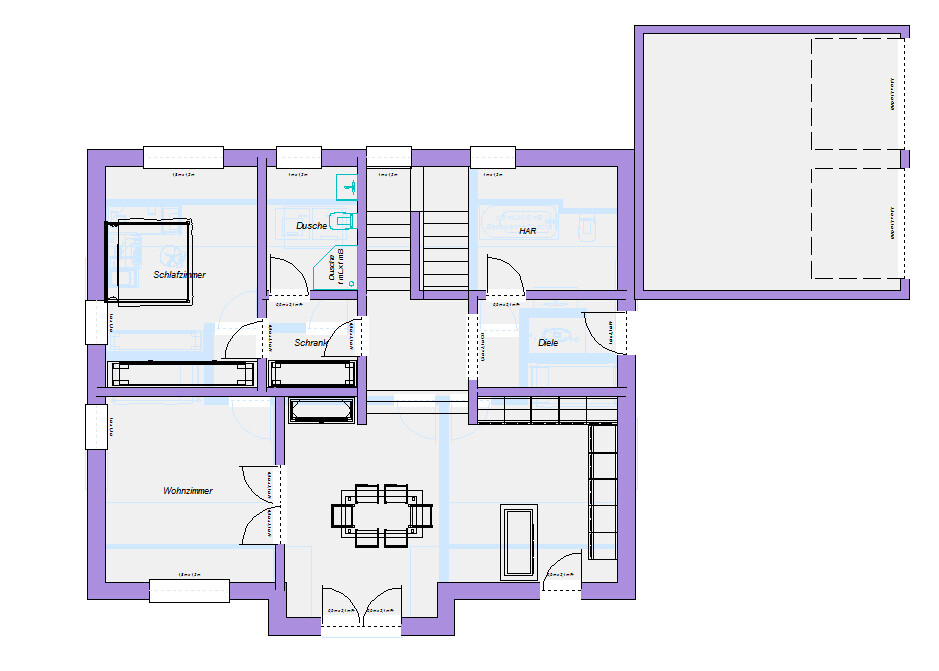
To accommodate the slope, I would plan two steps from the hallway down to the dining area. I would compensate for this mini split level by having a higher ceiling in the living area.
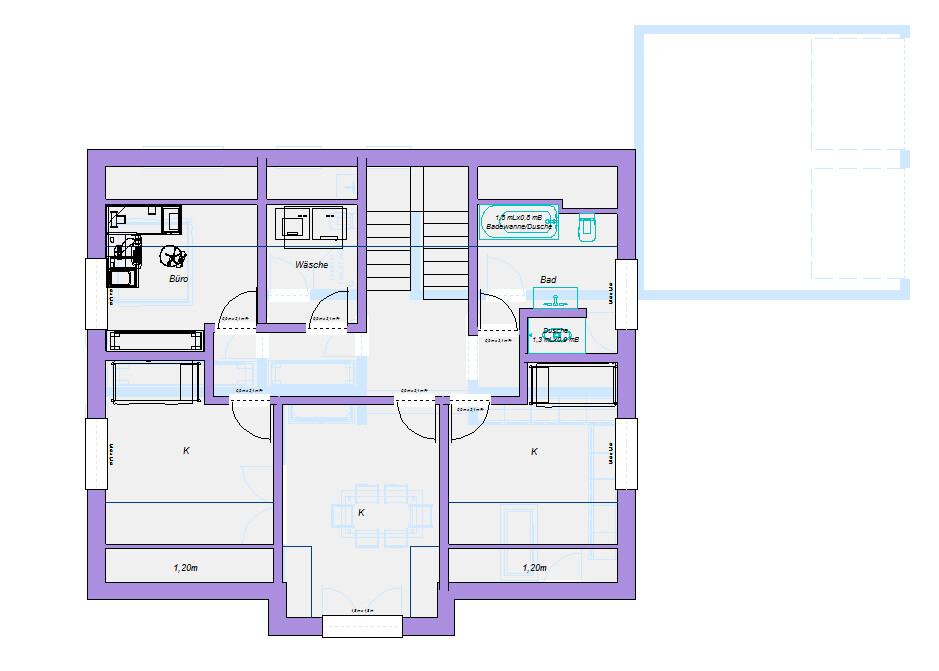
On the upper floor, I would build the knee wall up to 1.20m (4 feet), if only 0.50m (1.6 feet) is really possible otherwise.
I have to admit, I find the height regulations from the zoning plan quite inconsistent. I would discuss with the local authority whether a higher knee wall could be approved if the building is constructed without a basement. The question is whether the total height could simply be raised up to 9m (30 feet). I think that would also create a harmonious appearance with the neighboring buildings.
To accommodate the slope, I would plan two steps from the hallway down to the dining area. I would compensate for this mini split level by having a higher ceiling in the living area.
On the upper floor, I would build the knee wall up to 1.20m (4 feet), if only 0.50m (1.6 feet) is really possible otherwise.
I have to admit, I find the height regulations from the zoning plan quite inconsistent. I would discuss with the local authority whether a higher knee wall could be approved if the building is constructed without a basement. The question is whether the total height could simply be raised up to 9m (30 feet). I think that would also create a harmonious appearance with the neighboring buildings.
K a t j a schrieb:
I hope I read it correctly: the slope drops 2.60 m (8.5 feet) from north to south across your property? Otherwise, please correct me – which corner is your highest point?I tried to illustrate it graphically using contour lines. The highest point is in the north. The lowest is in the south.
Measured heights from the Bayernatlas roughly show:
The slope between the outermost points (property boundaries) is even about 4.8 m (15.7 feet).
If you leave a building setback of around 4 m (13 feet) on each side next to the neighbors, it decreases to about 2.8 m (9.2 feet).
And the potential building area would only cover about 1.5 m (4.9 feet).
However, it’s unfortunately not very accurate to determine this solely from the Bayernatlas.
@ypg, could you possibly access something like this as well? 🙂
Frennie schrieb:
I tried to represent it graphically using contour lines. The highest point is in the north, and the lowest in the south.
Measured elevations via Bayernatlas roughly show:
The slope between the outermost points (property boundaries) is about 4.8m (15.7 ft).
If you set back about 4m (13 ft) from the neighbors' boundaries, it decreases to approximately 2.8m (9.2 ft).
And the potential building area would only have about 1.5m (4.9 ft) of elevation difference.
However, this cannot be determined very precisely using Bayernatlas.
@ypg, is there any way you can access something like this? 🙂 No. I actually only found the neighboring house through a “search.”
I can only do floor plans myself… 😉
You should hire a surveyor. Alternatively, there are apps or devices, like a hose level, to measure elevations yourself. Some forum members have done their own measurements—check YouTube for examples. The weather is still good right now.
By the way: are both of you answering under the same account?
K a t j a schrieb:
I don’t think the previous design from #50 is bad at all. However, I would leave out the basement and instead have a large utility/storage room plus laundry on the upper floor. I’d also like to keep the captain’s gable. If it’s allowed at that height, I would plan it that way. I would, however, arrange the rooms a bit differently. For example, like this:
[ATTACH alt="EG.jpg"]75631[/ATTACH]
To accommodate the slope, I would plan two steps down from the hallway to the dining area. I’d simply compensate for the small split level by having a higher ceiling in the living area.
[ATTACH alt="DG.jpg"]75632[/ATTACH]
On the upper floor, I would box in the knee wall up to 1.20m (4 feet), if only 0.50m (1.6 feet) is really possible there.
I have to say, I find the height restrictions in the development plan to be quite inconsistent. I would discuss with the local authority whether it’s possible to have a higher knee wall if building without a basement. The question is whether the total height can simply be raised up to 9m (29.5 feet). I think that would also create a harmonious appearance in relation to the neighboring buildings. It looks amazing!! It feels spacious, and the mini split level is a really smart way to work with the slope! How many square meters (square feet) is the total area? And I guess you’d need specialists for the mini split, right? So that would mean at least two separate foundations?
Thanks for your thorough inspiration! 😉
Similar topics