
ᐅ U-values provided by the energy consultant are not verifiable.
Created on: 8 Oct 2022 13:42
J
JaiBee07Hello everyone,
During a detailed heating load calculation for my fully renovated house, questions arose regarding the U-values provided by the energy consultant, as they seem inconsistent. Unfortunately, the documentation does not specify the assumed wall construction.
Here are the values:
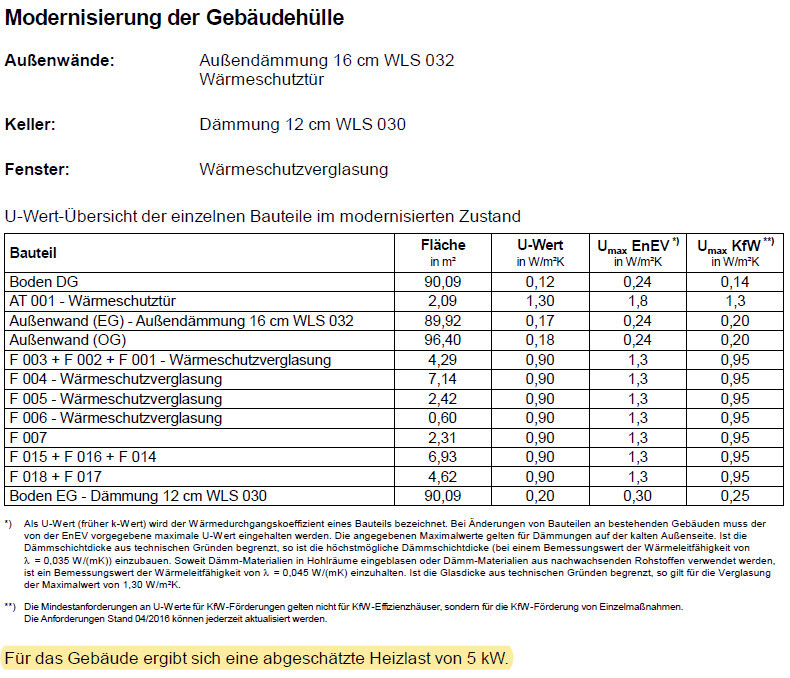
Let’s take the example of the external wall on the upper floor: a U-value of 0.18 W/m²K was calculated.
According to the construction drawings, the wall consists of 24 cm (9.5 inches) Ytong W PP2 blocks and the energy consultant’s suggested 16 cm (6.3 inches) of WLS 032 insulation using EPS.
When I recalculate this in, for example, Ubakus, deliberately excluding both the interior and exterior plaster to consider the worst case, I get a U-value of 0.132.
I can’t find it right now in the many documents, but somewhere a thermal bridge allowance of 0.05 W/m²K was specified.
Can someone with deeper expertise explain where this large difference between 0.18 and 0.132 comes from?
Thank you
During a detailed heating load calculation for my fully renovated house, questions arose regarding the U-values provided by the energy consultant, as they seem inconsistent. Unfortunately, the documentation does not specify the assumed wall construction.
Here are the values:
Let’s take the example of the external wall on the upper floor: a U-value of 0.18 W/m²K was calculated.
According to the construction drawings, the wall consists of 24 cm (9.5 inches) Ytong W PP2 blocks and the energy consultant’s suggested 16 cm (6.3 inches) of WLS 032 insulation using EPS.
When I recalculate this in, for example, Ubakus, deliberately excluding both the interior and exterior plaster to consider the worst case, I get a U-value of 0.132.
I can’t find it right now in the many documents, but somewhere a thermal bridge allowance of 0.05 W/m²K was specified.
Can someone with deeper expertise explain where this large difference between 0.18 and 0.132 comes from?
Thank you

i_b_n_a_n schrieb:
I seem to remember: if no explicit individual calculation of thermal bridges is done, there is this standard surcharge (which must be applied). Yes, that would correspond quite well to the 0.05 value. However, I originally didn’t think this surcharge would be applied to every single value. Especially since the upper floor was newly added and has no extensions at all.
For the ground floor, I could still understand it because of the entrance and basement stairs.
An energy consultant is, after all, there to PROVIDE ADVICE ;-)
Maybe it makes sense for you to calculate the cold bridges individually? For example, I had a very good blower door test result (around 0.43), which allowed me to use more cost-effective insulation in the floor construction (because the overall system must achieve a certain value in order to meet the target, in my case a passive house)...
Maybe it makes sense for you to calculate the cold bridges individually? For example, I had a very good blower door test result (around 0.43), which allowed me to use more cost-effective insulation in the floor construction (because the overall system must achieve a certain value in order to meet the target, in my case a passive house)...
JaiBee07 schrieb:
Yes, the 0.05 value would also be quite accurate. However, I originally didn’t think this surcharge was applied to every value. Especially since the upper floor was newly added without any extensions.
I could still understand it for the ground floor because of the entrance and basement stairs.The thermal bridge surcharge is applied to the entire heat-transferring building envelope area, excluding opaque components like windows.
The surcharge is 0.1 W/m²K if thermal bridges are not considered separately, and 0.05 W/m²K if they are analyzed in detail. Alternatively, a detailed calculation of individual thermal bridges can be performed. However, this only makes sense in borderline cases, for example, if it results in qualifying for a higher funding level. This is not the case in your situation.
This value covers all irregularities in the wall construction that do not consist exactly of 24 cm (9.5 inches) YTong WPP 2, such as window lintels and ring beams, as well as geometrically caused thermal bridges like external corners, which have higher heat transfer rates than a straight wall.
And always keep in mind:
You can prove whatever you want mathematically, but it won’t affect the actual heating demand.
Similar topics