
Hello everyone,
My husband and I attended a home exhibition today featuring a local timber house builder (Schleswig-Holstein) and there we learned about the Vestaxx window heating system.
Is there anyone here who has experience with the Vestaxx window heating?
At first, it sounds unusual to have the heating integrated into the windows. For the triple-glazed windows, a nanotechnology-based, invisible layer is applied to the inner surface of the innermost pane, which warms the glass up to 40 degrees Celsius (104°F) via infrared and heats the room. The warmth actually felt very comfortable, and the windows were completely cold on the outside (today’s temperature was below 10 degrees Celsius (50°F)). Allegedly, the Vestaxx window heating transfers 92% of its heat to the room, and the Technical University of Berlin has tested this Vestaxx window heating system and rated it positively. It appears to have been on the market only recently.
Overall, I find this quite interesting. It is significantly cheaper than other heating systems, allows individual control of each room, and unlike underfloor heating, it is very responsive.
Of course, this only makes sense in a low-energy house (the timber builder mainly constructs 40+ standard homes), as the system runs on electricity. In that case, the Vestaxx window heating is said to consume very little power.
This is my impression from the expo; of course, they want to sell the system.
What are your experiences with Vestaxx? Have you heard of this system before? Could it be an alternative to conventional heating? Does it have a future?
My husband and I attended a home exhibition today featuring a local timber house builder (Schleswig-Holstein) and there we learned about the Vestaxx window heating system.
Is there anyone here who has experience with the Vestaxx window heating?
At first, it sounds unusual to have the heating integrated into the windows. For the triple-glazed windows, a nanotechnology-based, invisible layer is applied to the inner surface of the innermost pane, which warms the glass up to 40 degrees Celsius (104°F) via infrared and heats the room. The warmth actually felt very comfortable, and the windows were completely cold on the outside (today’s temperature was below 10 degrees Celsius (50°F)). Allegedly, the Vestaxx window heating transfers 92% of its heat to the room, and the Technical University of Berlin has tested this Vestaxx window heating system and rated it positively. It appears to have been on the market only recently.
Overall, I find this quite interesting. It is significantly cheaper than other heating systems, allows individual control of each room, and unlike underfloor heating, it is very responsive.
Of course, this only makes sense in a low-energy house (the timber builder mainly constructs 40+ standard homes), as the system runs on electricity. In that case, the Vestaxx window heating is said to consume very little power.
This is my impression from the expo; of course, they want to sell the system.
What are your experiences with Vestaxx? Have you heard of this system before? Could it be an alternative to conventional heating? Does it have a future?

Vestaxx GmbH schrieb:
... A heat pump house will never become a plus-energy house, and payback is no longer even a topic...
Nonsense: As proof, here are my current daily figures: (KfW40+ / Passive house with brine-water heat pump – about 130m² (1400 sq ft) semi-detached house with 2 residential units, 3 people)
6.5 kWp system at 45° tilt, oriented 100% south, 3.9 kWh battery.
Bonus: My car (BEV) has driven 11,744 km (7,300 miles) since November as well! At around 18 kWh per 100 km (62 miles), that adds even more + (energy surplus).
So far, I haven’t said anything on the topic. But I also used to think that with a passive house I wouldn’t need much heating. I thought I would just add a few infrared panels disguised as pictures or mirrors, and that would do it. But the biggest demand is not heating energy, it’s hot water preparation. That’s why I cannot accept your consumption figures. What twisted world or parallel universe do those come from?
P.S. Of course, I was lucky with all the subsidies for KfW40+, but even otherwise, the “break-even” point for electric heating comes faster than you can imagine. Photovoltaics MUST be considered independently! These pointless references to a DIN standard with its so important “total cost accounting” for private builders is nonsense. If you actually do a complete total cost calculation over 20 years, electric heating cannot win. I’m hearing from acquaintances about first contracts at 65 cents per kWh :-(
Vestaxx GmbH schrieb:
Underfloor heating pipes are subject to constant expansion and contraction. Although only by a few millimeters, leaks can develop over the years.
Pumps, compressors, and valves are naturally more prone to failure and need to be replaced more often. The parts may not be very expensive, but replacing them can easily cost 800 - 1000 € (approximately 850 - 1060 USD). This always needs to be taken into consideration.
... I have heard of cracked heating cables on car windows more often than leaking underfloor heating pipes. But that might just be my personal observation bubble. Are there reliable statistics on this (failure of underfloor heating and failure of window heating)? Because glass and the heating cables attached to (or embedded in) it have different coefficients of thermal expansion...
V
Vestaxx GmbH9 Oct 2022 16:53RotorMotor schrieb:
Oh man, the same nonsense again about justifying the inefficient heating system using photovoltaics...
Instead of addressing my calculation directly, it's suddenly ignored that with the air-to-water heat pump there is also a photovoltaic system, even though we already agreed that it always makes sense.
It would be just as valid to say: I have €25,000 and buy an electric car, saving thousands of euros on diesel.
That is nonsense! Such investments must be evaluated strictly separately.
It’s a cheap trick to keep pretending that a photovoltaic system can only be afforded with direct electric heating.
With every message, this company becomes less credible to me!I’m laughing out loud – you have no more arguments, and anyone who calculates the payback period for a photovoltaic system as 100 years – like you did in one of your recent posts – should first educate themselves instead of doing such nonsense.
So far, it’s not clear to ME why you deduct €5,000 for a BWWP and €10,000 for window heating from a €40,000 investment in an air-to-water heat pump and then continue calculating with €25,000. You are mixing apples and oranges divided by bananas = Cairo! 😳
Where is it – strictly speaking – that an air-to-water heat pump ALWAYS comes with photovoltaic at the same investment cost?
At some point, you agreed to the heat pump system and trusted your heating engineer. He now has your money and is happy. You are trying to justify it here – but failing miserably.
What in my calculation is wrong??? I know: it simply doesn’t suit YOU! Which parts should be STRICTLY SEPARATED from each other? You can, if you want, separate everything strictly, but the total amount in the end is always the same.
I thought it would be possible to argue with you based on clear numbers. Now you accuse me of trickery – in other words, fraud! That’s outrageous! And it doesn’t do this forum any good.
People here want to learn and share experiences. You only have experience with the heat pump and no clue about window heating. It comforts me that in the past probably people like you mocked the heat pump as voodoo – but it still prevailed. However, every system eventually becomes outdated in the evolving market.
I’m reminded of the saying, “If you don’t know, you should just ...”
We – as the supposedly so “unreliable” company – have many customers who confirm the above calculation with consumption figures. But they are probably all crazy or even paid by us.
Scientists and energy consultants also confirm the above calculation – only ROTORMOTOR is much smarter than everyone else.
Before you claim that we are an unreliable company, you should start by being reliable yourself.
I never said that direct electric heating is more energy efficient than a heat pump and therefore have no reason to gloss over anything.
I will observe here a bit longer and only respond to genuine, factual contributions and questions.
V
Vestaxx GmbH9 Oct 2022 17:15i_b_n_a_n schrieb:
Nonsense: As proof, here are my current daily figures: (KfW40+ / Passive house with brine-to-water heat pump – a well-insulated semi-detached house of about 130m² (1400 sq ft) with 2 residential units, 3 people)
6.5 kWp system at 45° tilt, roof plane 100% south-facing, 3.9 kWh battery.
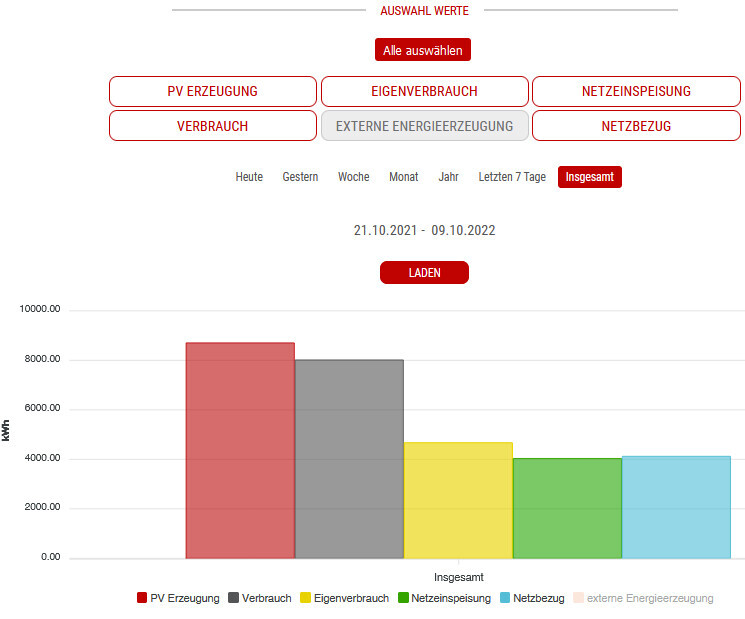
Bonus: My car (BEV) has also been powered by this system for 11,744 km (7,300 miles) since November! That adds roughly 18 kWh per 100 km (62 miles), plus surplus energy.
So far, I haven’t commented on this topic. But I also thought that in a Passive House you don’t need much heating. I'd just put some infrared panels as pictures or mirrors in the house, and that would be fine. But the biggest demand is not heating energy but hot water preparation. That’s why I can’t accept your consumption figures. From what warped world or parallel universe do those come?
P.S. Of course, I was lucky with all the subsidies for KfW40+, but even without those, the “break-even” point for electric heating is reached faster than you think. The photovoltaics MUST be considered independently! These useless references to a DIN standard with its “so important” full cost accounting for private builders are nonsense. When you do a complete full cost calculation over 20 years, electric heating can’t compete. I’m already hearing from acquaintances about initial rates of 65 cents per kWh (???).Great, and congratulations on your system. But you didn’t pay 40,000 € for it, so it isn’t comparable with my calculations. Also, I like to repeat: heat pump plus large photovoltaic system plus large battery = a system nearing full self-sufficiency. Unfortunately, not everyone can afford that nowadays.
You are absolutely right that heating energy demand in a Passive House is almost the smallest part. Only it is reduced to a quarter with a technology that costs 40,000 €. Using a cannon to kill a sparrow.
Hot water demand is calculated as 12.5 kWh/m² (1.16 kWh/sq ft) according to the Building Energy Act. In reality, it is much higher because it depends on the number of occupants, not on the area. Nevertheless, household electricity remains the highest energy demand. Reducing this demand by a quarter using a hot water heat pump is reasonable, especially since the hot water heat pump costs only 5,000 €.
When expert calculations (VDI 2067) are dismissed as nonsense, you’re implying you’re smarter than VDI experts. I wouldn’t claim that for myself.
Then why don’t you do a full cost calculation for both systems if you think you’re so clever?
Our system performs 2 to 3 times better after 20 years. Proof: watch the webinar!
V
Vestaxx GmbH9 Oct 2022 17:23i_b_n_a_n schrieb:
I have heard more often about cracked heating wires on car windows than about leaking underfloor heating pipes. But that is just my personal perception bubble. Are there any reliable figures on this (underfloor heating failure and window heating failure)? Because glass and the heating wires applied on (or embedded in?) it have different coefficients of thermal expansion...First of all, thanks for the factual contribution.What you are referring to are the heating wires glued onto car rear windows, which are more likely to break due to cleaning than from expansion. But anyway. Our heating layer is fully fused into the glass. The layer cannot separate from the glass. It is comparable to the coatings on, for example, smartphones or flat-screen displays.
Damages to underfloor heating systems are also quite rare, but when they do occur, the costs can be significant.

Vestaxx GmbH schrieb:
Basics of rotor motor:
150m² (1600 ft²) with 40 kWh/m²a (400 kWh/ft²/year) -> 6000 kWh/year heating energy demand / electricity price 35 cents/kWh / 4 people (assumed here)
What was forgotten? -> Domestic hot water (handled by the heat pump, of course) -> 4 people approx. 2000 kWh (12.5 kWh/m² then rounded up)
Household electricity for 4 people -> approx. 4000 kWhDear Managing Director,
I asked you a few days ago to present your numbers and calculations—as is proper for a business case—in table format, for example as a screenshot from spreadsheet software, here in the forum.
The fact that this has repeatedly not happened can, according to my suspicion, only have three reasons.
1. You are not proficient with such software and have no internal company experience to rely on.
2. You have ignored me in this forum and therefore cannot read my posts.
3. It is strategically more convenient for you to argue with elaborate rhetoric, such as the following gem. It produces a lot of text but does not clarify connections immediately, potentially misleading uninformed prospects with striking marketing claims.
Vestaxx GmbH schrieb:
What did I forget?
Oh, right.I have questions about this:
Vestaxx GmbH schrieb:
A heat pump house will never become an energy-plus house, and amortization is out of the question.Even with my poor photovoltaic system and no BEV, I have a clear energy surplus since installation. The calculation excluding the car is:
Produced: 8.6 MWh
Consumed: 7.1 MWh
all in the first year after moving in, including significant construction moisture.
Vestaxx GmbH schrieb:
I’m laughing my head off – he has no more arguments, and anyone calculating photovoltaic amortization over 100 years—as you did in one of your recent posts—should educate themselves first and not make such nonsense calculations.
[...]
only ROTORMOTOR is much smarter than all others.I am beginning to find this quite cheeky.
Vestaxx GmbH schrieb:
The problem is that in the end, the same total sum always results.I take it as positive that the heating system manufacturer has now come to the same conclusion. I have explained this in detail in this post
https://www.hausbau-forum.de/threads/vestaxx-fensterheizung-erfahrungen.41824/post-599311
and again here with financing options.
https://www.hausbau-forum.de/threads/vestaxx-fensterheizung-erfahrungen.41824/post-599382
It shows that the outcome is the same, each including photovoltaics, but with the security of switching to more efficient hydronic heating technology in the future.
Vestaxx GmbH schrieb:
I’m going to keep watching this here for a while and will only respond to genuinely serious, factual posts and questions.My entire contribution is serious and factual but is completely ignored by the provider. Also, the fact that in the foreseeable future the product will have a significantly worse climate impact than a heat pump—roughly 16-20 tons more CO2 due to the COP advantage of the heat pump—is disregarded. For this reason alone, I could not in good conscience purchase or recommend this system.
OWLer schrieb:
That’s exactly what bothers me, and that’s why I seriously addressed "Kill your darling." Apparently, this person is absolutely convinced of their product and clashes with anyone questioning it or raising concerns.
So, it annoyed me so much that I actually opened Excel.
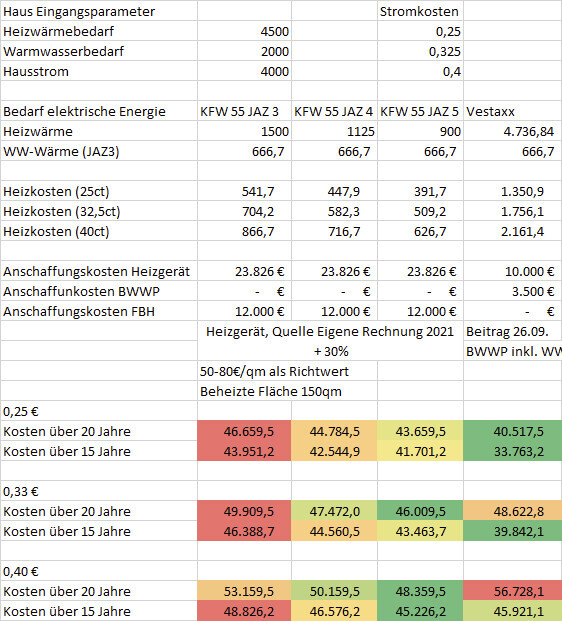
The results over typical financing periods, which correspond to the target lifespan of heat pumps, do not surprise me at all. I see all my theses and warnings about the system confirmed. If anyone asks me, I wouldn’t recommend the window heating system to anyone.
Since sustainability was mentioned, I also briefly cross-checked that roughly. CO2e for German steel assumed to be about 2.5 kg, PE underfloor pipes 17x2 with 2 kg CO2e. Production overhead estimated at a flat 25%.
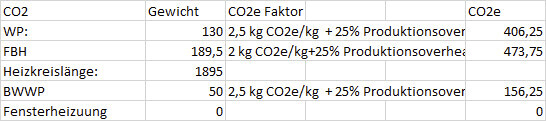
By the way, I’m also an engineer @Vestaxx GmbH and occasionally deal with CO2 footprint assessments at work, so I assert with my many years of expertise that these are good reference values.
What is problematic is, of course, the CO2e of the German grid mix. Before the war there were ambitious targets, but now with still operational East German lignite coal plants, I strongly doubt these will be met. I just assume our government will reach less than 25% of the 1990 target by 2040, 10 years late.
So I simply ran the electricity calculation. Unfortunately, I have serious doubts it will go that well!
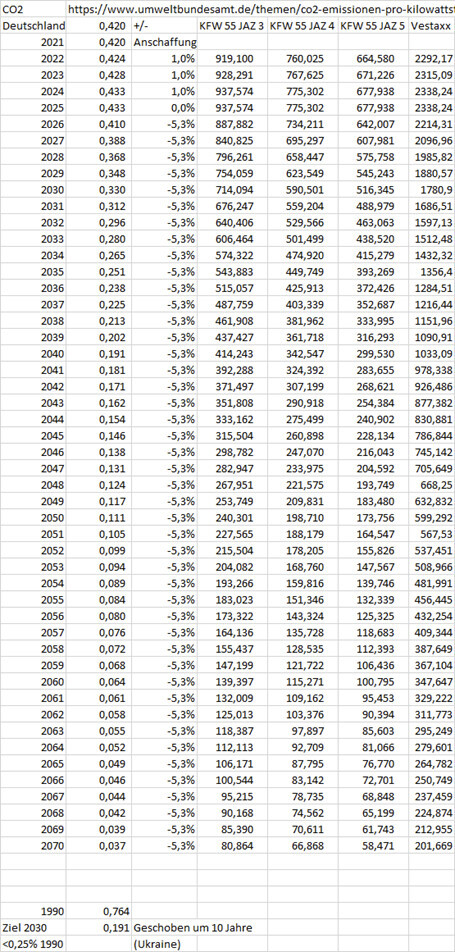
The very sobering result with my chosen input parameters is that over a 15-year period, 16 tons of CO2, including production emissions and operation, are released. The longer this continues, the worse the CO2 balance of the window heating becomes.

A significantly worse balance for the window heating system compared to a heat pump, naturally due to efficiency.
And now please don’t argue with the “free photovoltaics.” I have already refuted this argument with my first calculation. Over the financing period, there are no significant cost differences, so photovoltaics should be considered an add-on in both cases. Furthermore, note that from November to February, 63% of the day no photons from the sun reach the photovoltaic surfaces directly. Two-thirds of the heating is thus powered by the grid mix, and the remaining one-third is usually overcast so that even a 15 kWp south-facing photovoltaic system does not cover the house’s basic consumption without heating. A few sunny days can compensate for this provided no snow covers the modules.
Photovoltaics and heating must be strictly considered separately. Therefore, I find it highly misleading that advertising for this heating system includes “free photovoltaics.”
Since I haven’t had enough yet, I will now look at my heat load calculation and pose some further critical questions regarding heating the basement and my bathrooms, where I cannot install large window areas.And once again, for the record: It’s GRID MIX, GRID MIX, GRID MIX, GRID MIX, GRID MIX, GRID MIX, GRID MIX, GRID MIX... I honestly don’t know how many more times I need to repeat this mistake.
Similar topics