
Hello everyone,
My husband and I attended a home exhibition today featuring a local timber house builder (Schleswig-Holstein) and there we learned about the Vestaxx window heating system.
Is there anyone here who has experience with the Vestaxx window heating?
At first, it sounds unusual to have the heating integrated into the windows. For the triple-glazed windows, a nanotechnology-based, invisible layer is applied to the inner surface of the innermost pane, which warms the glass up to 40 degrees Celsius (104°F) via infrared and heats the room. The warmth actually felt very comfortable, and the windows were completely cold on the outside (today’s temperature was below 10 degrees Celsius (50°F)). Allegedly, the Vestaxx window heating transfers 92% of its heat to the room, and the Technical University of Berlin has tested this Vestaxx window heating system and rated it positively. It appears to have been on the market only recently.
Overall, I find this quite interesting. It is significantly cheaper than other heating systems, allows individual control of each room, and unlike underfloor heating, it is very responsive.
Of course, this only makes sense in a low-energy house (the timber builder mainly constructs 40+ standard homes), as the system runs on electricity. In that case, the Vestaxx window heating is said to consume very little power.
This is my impression from the expo; of course, they want to sell the system.
What are your experiences with Vestaxx? Have you heard of this system before? Could it be an alternative to conventional heating? Does it have a future?
My husband and I attended a home exhibition today featuring a local timber house builder (Schleswig-Holstein) and there we learned about the Vestaxx window heating system.
Is there anyone here who has experience with the Vestaxx window heating?
At first, it sounds unusual to have the heating integrated into the windows. For the triple-glazed windows, a nanotechnology-based, invisible layer is applied to the inner surface of the innermost pane, which warms the glass up to 40 degrees Celsius (104°F) via infrared and heats the room. The warmth actually felt very comfortable, and the windows were completely cold on the outside (today’s temperature was below 10 degrees Celsius (50°F)). Allegedly, the Vestaxx window heating transfers 92% of its heat to the room, and the Technical University of Berlin has tested this Vestaxx window heating system and rated it positively. It appears to have been on the market only recently.
Overall, I find this quite interesting. It is significantly cheaper than other heating systems, allows individual control of each room, and unlike underfloor heating, it is very responsive.
Of course, this only makes sense in a low-energy house (the timber builder mainly constructs 40+ standard homes), as the system runs on electricity. In that case, the Vestaxx window heating is said to consume very little power.
This is my impression from the expo; of course, they want to sell the system.
What are your experiences with Vestaxx? Have you heard of this system before? Could it be an alternative to conventional heating? Does it have a future?

A small addition regarding climate impact: considering the current grid mix and maximum photovoltaic support of one-third (as explained above "day length"), it would be worth calculating whether a gas heating system might actually be more climate-friendly. I could later convert it to a heat pump after 20 years using the existing underfloor heating/radiators, potentially saving twice as much.
At the beginning, I read that the "colleague" actually doesn’t have time. But you’re really putting in a lot of effort here.
How cold or warm are the floors with the perimeter heating?
Walking barefoot in the bathroom in the morning during winter, or even through the whole house?! 🙄
Even with underfloor heating, new buildings typically only reach around 25…26°C (77…79°F), but without it, the floor—especially tiles—is really freezing.
How cold or warm are the floors with the perimeter heating?
Walking barefoot in the bathroom in the morning during winter, or even through the whole house?! 🙄
Even with underfloor heating, new buildings typically only reach around 25…26°C (77…79°F), but without it, the floor—especially tiles—is really freezing.
driver55 schrieb:
How cold/warm are the floors with under-window heating?What a question 😉 I've always wanted to know. Are house slippers forbidden? 🤨 Or are only houses with underfloor heating being built nowadays... So many questions.- Such heating systems are practical, for example, in passive/plus energy homes or other buildings that require little and/or infrequent heating.
- Not everyone can or wants to pay for the most advanced home technology.
- Small split air conditioning units that can also be used for heating, combined with photovoltaic systems, are also an option.
W
WilderSueden7 Oct 2022 22:22profil65 schrieb:
- Such heating systems make sense, for example, in passive/plus energy or other buildings that require little and/or infrequent heating.
- Not everyone can or wants to pay for the maximum possible building technology.
I can accept the first point, but then the competition is air heating, infrared, or portable heaters from hardware stores. However, that is not the argument being made; instead, the discussion focuses on how one can afford photovoltaic systems. Obviously, those opting for a (near) passive house have enough funds for a large initial investment. The second point quickly turns into a Pyrrhic victory. Following the argument of "saving money," the new build according to the building energy law with a heat pump and photovoltaic system should be the winner—not the EH40 with window heating and photovoltaic system.
C
Christian 658 Oct 2022 00:12OWLer schrieb:
That’s exactly what I don’t like, and that’s why I directed my detailed comment to "Kill your darling". Here, someone seems absolutely convinced of their product and clashes with anyone who questions it or raises concerns.
So, this annoys me so much that I actually fired up Excel.
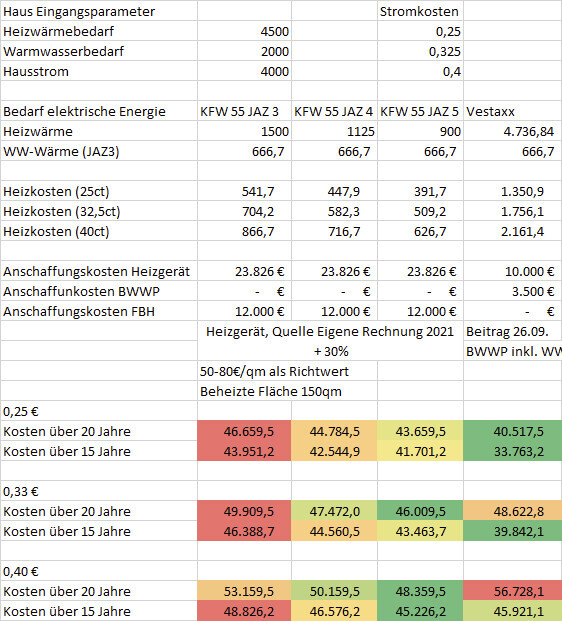
The result over typical financing periods, which also correspond to the expected service life of the heat pump, doesn’t surprise me at all. All my theses and warnings about the system are confirmed. If anyone asks me, I wouldn’t recommend the window heating system to anyone.
Since sustainability was also mentioned, I did a very rough check on that as well. I assumed CO2e for German steel at about 2.5kg, PE floor heating pipe 17x2 with 2kg CO2e. Production overhead was estimated with a flat 25%.
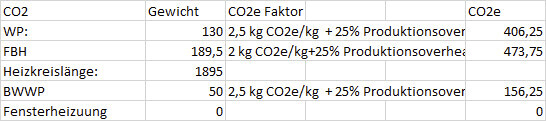
By the way, I’m also an engineer @Vestaxx GmbH and occasionally work on calculating CO2 footprints, so based on my long professional experience, I assert that these are solid reference values.
The problematic part is, of course, the CO2e of the German energy mix. There were ambitious goals before the war, but now, with former East German lignite power plants still running, I seriously doubt they will be met. I simply assume our government will only achieve less than 25% of the 1990 target by 2040, ten years later than planned.
So I calculated the electricity consumption. Unfortunately, I have very serious doubts that it will perform so well!
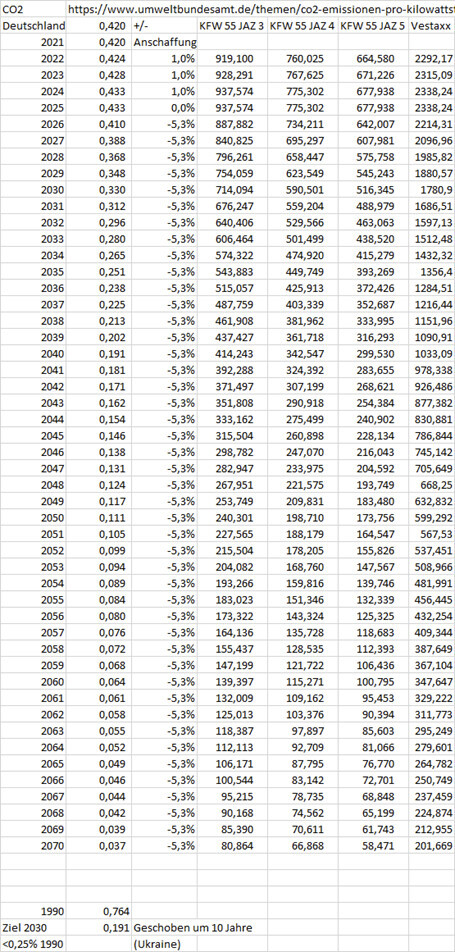
The very sobering result with the input parameters I chose is that over a 15-year period, 16 tons of CO2 are emitted, including production and operation. The longer it runs, the worse the CO2 balance of the window heating system becomes.

The carbon footprint of the window heating system is significantly worse compared to the heat pump, naturally due to efficiency.
And now please don’t argue with free photovoltaics. I already disproved that argument with the first calculation. Over the financing period, there are no significant cost differences, so photovoltaics should be considered as an add-on in both cases. Also keep in mind that from November to February, 63% of the day has no direct sunlight hitting the photovoltaic panels. So two-thirds of the time heating is powered by the energy mix, and the remaining one-third is usually so cloudy that even a 15 kWp south-facing photovoltaic system can’t cover the house’s basic consumption without heating. A few sunny days compensate for this—assuming there is no snow on the panels.
Photovoltaics and heating must be viewed strictly separately for this analysis. Therefore, in my opinion, it’s misleading to advertise the heating system using free photovoltaics.
Since I’m not done yet, I’m about to look at my heating load calculation again and raise some critical questions regarding heating the basement and bathrooms, where I can’t install large windows. So, you’re assuming in your calculation that the heat pump with underfloor heating costs €23,000 (about $23,000) more than the window heating system?
Did I understand that correctly?
So, you save €23,000 on initial construction costs and could spend the money on something else??
Or you don’t pay interest on it??
Well, then everything is clear.
C
Christian 658 Oct 2022 00:25I had to calculate this in my head just now:
so then I would save about €16,000 in interest over 20 years?
Or am I miscalculating? I assumed an interest rate of 3.5%.
so then I would save about €16,000 in interest over 20 years?
Or am I miscalculating? I assumed an interest rate of 3.5%.
Similar topics