
ᐅ Interior door significantly warped after installation
Created on: 14 Sep 2022 11:45
C
C.beckmann1986C
C.beckmann198614 Sep 2022 11:45Hello everyone,
I need your advice on an issue that’s been bothering me lately.
We moved into our new house at the end of last year (new development via a developer). As requested, the interior doors were not installed at the handover but were supposed to be installed later by us after finishing all our own work.
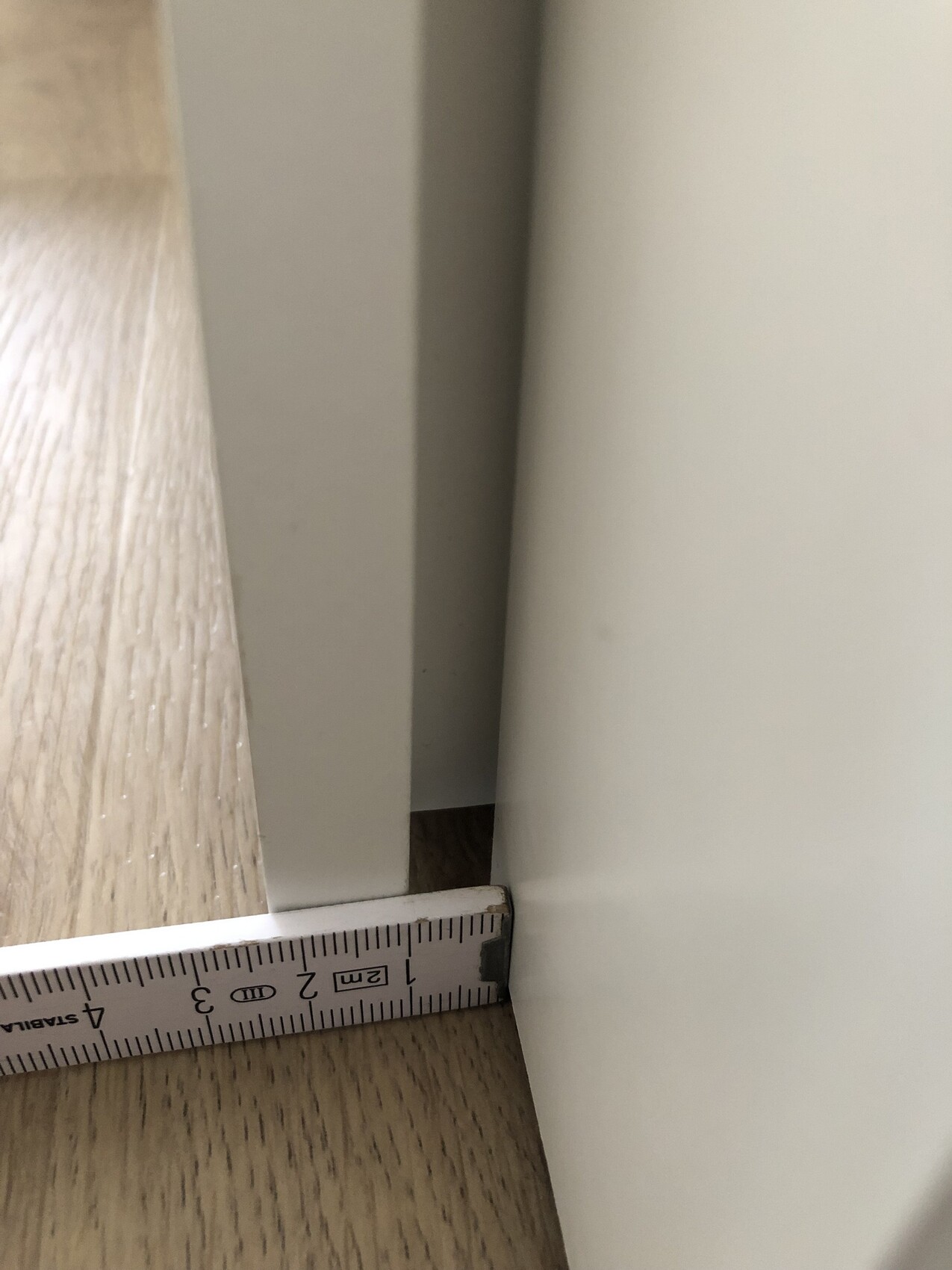
The interior doors were therefore installed by us at the beginning of this year as the final trade (rooms were painted, floors laid). I also confirmed the apparently proper installation of all doors with the fitter. A few months later, we discovered that one interior door (from the living room to the basement) is noticeably warped. The door is flush with the lock but visibly bowed at the top and bottom (like a U shape – see photo).
We reported this via the developer’s defect portal, and the issue was passed on to the door company. Without even looking at the door or consulting with us, the defect was coldly rejected.
Reason given:
The door was obviously fine at the time of installation, and a factory defect is ruled out since only one door is affected. They assumed improper handling by the customer (wrong storage of the door, not following climatic conditions, etc.) and therefore claimed no responsibility. Also, warping of up to 4 mm (0.16 inches) is considered acceptable.
Only after our repeated requests did someone from the company come out to at least inspect the door on-site. The fitter confirmed a warping of 9 mm (0.35 inches). Nevertheless, the defect is still being denied with the above explanation.
Our arguments that it is completely unrealistic to permanently remove an interior door in a new house (where all work is now finished), especially the basement door with a small child in the household, or do anything else with it, were completely ignored.
We were simply offered a new interior door at our own cost.
Of course, the developer immediately agreed with this statement and also rejected the defect claim.
Now I’m a bit at a loss. It’s a case of one statement against another, but I believe this is a demonstrable defect and we have definitely done nothing wrong, especially since the other 13 interior doors are not warped like this.
Can the company really get away with this so easily, and do we have to bear the loss? Every other trade has inspected reported defects and repaired them accordingly.
I would appreciate hearing about any experiences you might have.
Thank you very much,
Christian
I need your advice on an issue that’s been bothering me lately.
We moved into our new house at the end of last year (new development via a developer). As requested, the interior doors were not installed at the handover but were supposed to be installed later by us after finishing all our own work.
The interior doors were therefore installed by us at the beginning of this year as the final trade (rooms were painted, floors laid). I also confirmed the apparently proper installation of all doors with the fitter. A few months later, we discovered that one interior door (from the living room to the basement) is noticeably warped. The door is flush with the lock but visibly bowed at the top and bottom (like a U shape – see photo).
We reported this via the developer’s defect portal, and the issue was passed on to the door company. Without even looking at the door or consulting with us, the defect was coldly rejected.
Reason given:
The door was obviously fine at the time of installation, and a factory defect is ruled out since only one door is affected. They assumed improper handling by the customer (wrong storage of the door, not following climatic conditions, etc.) and therefore claimed no responsibility. Also, warping of up to 4 mm (0.16 inches) is considered acceptable.
Only after our repeated requests did someone from the company come out to at least inspect the door on-site. The fitter confirmed a warping of 9 mm (0.35 inches). Nevertheless, the defect is still being denied with the above explanation.
Our arguments that it is completely unrealistic to permanently remove an interior door in a new house (where all work is now finished), especially the basement door with a small child in the household, or do anything else with it, were completely ignored.
We were simply offered a new interior door at our own cost.
Of course, the developer immediately agreed with this statement and also rejected the defect claim.
Now I’m a bit at a loss. It’s a case of one statement against another, but I believe this is a demonstrable defect and we have definitely done nothing wrong, especially since the other 13 interior doors are not warped like this.
Can the company really get away with this so easily, and do we have to bear the loss? Every other trade has inspected reported defects and repaired them accordingly.
I would appreciate hearing about any experiences you might have.
Thank you very much,
Christian
S
SaniererNRW12314 Sep 2022 13:04C.beckmann1986 schrieb:
A few months later, we have now noticed that an interior door (from the living room to the basement) has warped significantly. Is the basement heated, or is it an unheated ("cold") basement? An unheated basement combined with a low-quality door can cause this.
Otherwise, this is not normal. How much has the new door leaf warped?
 KingJulien14 Sep 2022 16:03
Yeah, the industry must be doing (still) too well. Such arrogance is outrageous.
If the door is considered "substandard" for the installation location, the builder shouldn’t install it. At least not without first having a liability waiver signed.
And since it’s about the basement stair door, I don’t think that’s the issue.
Maybe you have temperature and relative humidity readings from both sides and can use those to argue your case.
Or hint at causing bad "publicity" online.
That could of course be the “problem” — that the stress isn’t proportional to the value.
If the door is considered "substandard" for the installation location, the builder shouldn’t install it. At least not without first having a liability waiver signed.
And since it’s about the basement stair door, I don’t think that’s the issue.
Maybe you have temperature and relative humidity readings from both sides and can use those to argue your case.
Or hint at causing bad "publicity" online.
SaniererNRW123 schrieb:
What is the cost of the new door leaf?
That could of course be the “problem” — that the stress isn’t proportional to the value.
C
C.beckmann198614 Sep 2022 18:47So, the basement is also heated, and there was no significant temperature difference. Of course, I can’t prove that.
Clearly, a new door slab doesn’t cost the earth—around 120 euros (about $130). But honestly, it’s about the principle for me. We have nothing to be blamed for, yet we’re supposed to cover the damage. It just can’t be that easy. However, a lawyer or expert report isn’t really the solution either. Although I would say, if the lawyer sends a letter, a new door slab will be provided as a gesture of goodwill.
Clearly, a new door slab doesn’t cost the earth—around 120 euros (about $130). But honestly, it’s about the principle for me. We have nothing to be blamed for, yet we’re supposed to cover the damage. It just can’t be that easy. However, a lawyer or expert report isn’t really the solution either. Although I would say, if the lawyer sends a letter, a new door slab will be provided as a gesture of goodwill.
KingJulien14 Sep 2022 19:01Yes, I can imagine that too. As I said, if you don’t mind causing a bit of fuss, go ahead. You have my full moral support 😉
C.beckmann1986 schrieb:
But honestly, for me it’s about the principle. Lawyers live off personal principles.
C.beckmann1986 schrieb:
But a lawyer or expert can’t be the solution either. Although I would say, if the lawyer writes a letter, a new door leaf is provided as a “gesture of goodwill.” A lawyer’s letter from my copyright lawyer cost €75 plus VAT 12 years ago. Just calculate that yourself. It won’t stay with just one letter.
Just try it, but please not through that online platform, rather an official defect notification with a deadline (you can google what that is and how it works. It requires a specific format because it’s legally regulated).
Argument: how could only one door warp during storage when the other 12 doors didn’t, despite identical storage conditions?
Similar topics