
ᐅ Roof Pitch and Knee Wall Height When Planning a Flat Dormer
Created on: 11 Sep 2022 10:26
E
epinephrin
Now I finally dare to ask a question, as my ability to visualize often lets me down...
We are currently planning the floor layout for a solid construction with a general contractor. The regulations in the development plan are as follows:
Floor area ratio 0.4
Plot ratio 0.8
2 full stories allowed – ridge height 8.80 m (29 ft)
Any roof type allowed (except barrel and pagoda roofs)
Gable roof 30–45 degrees, hip roof 25–35 degrees permitted
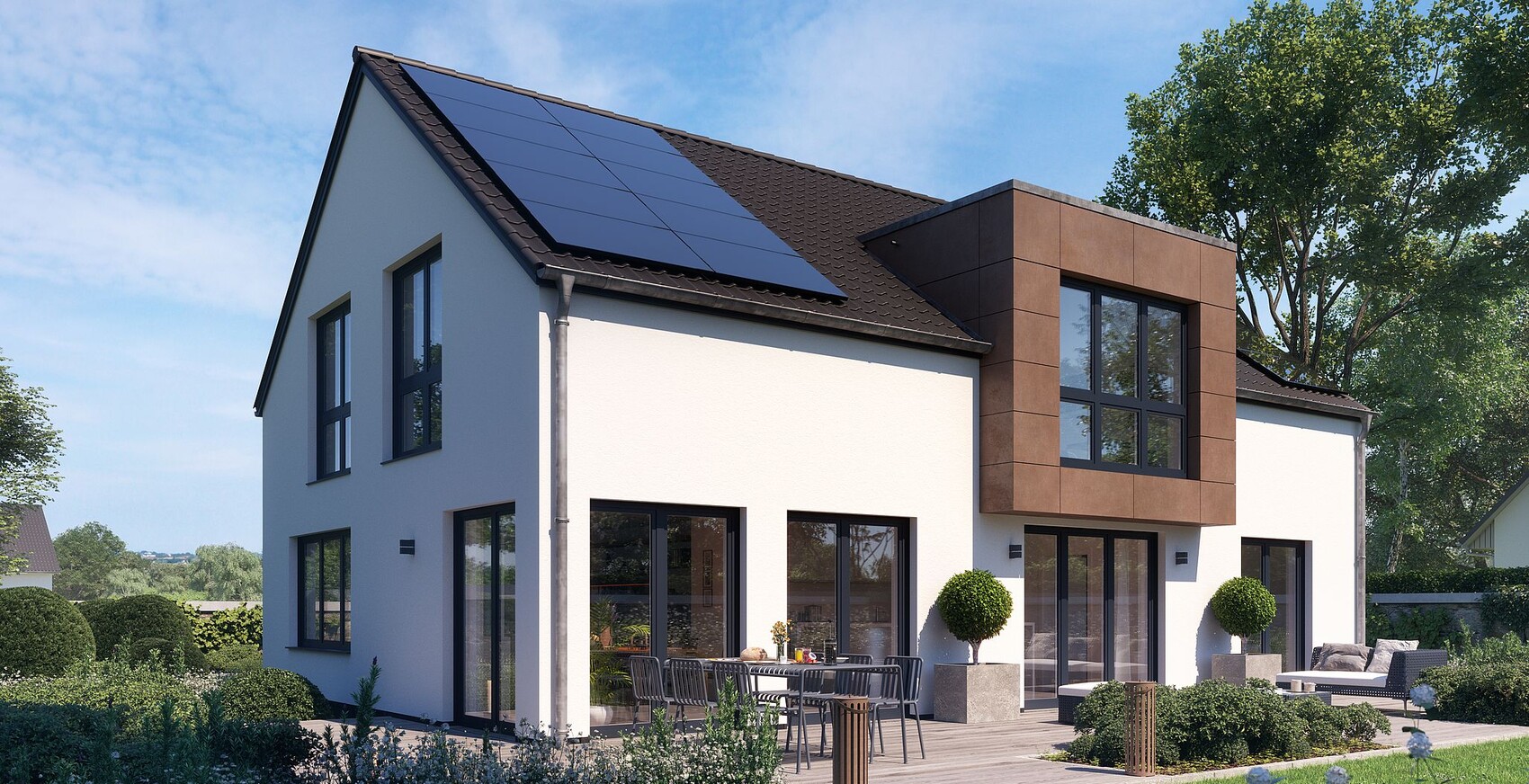
After initially having a rather long wish list (open space, window seat, bay window/dormer, open straight staircase) for about 165–170 sqm (1780–1830 sq ft) of living space, we have already made some compromises. What remains is the desire for a dormer with a window seat on the upper floor (similar to the example photo).
Now the question arises regarding the optimal ceiling height and roof pitch. Our general contractor has been trying to convince us to go with 2 full stories (for practical reasons?). For us, however, 2 full stories would only fit a city villa style; a gable roof starting at 30° on a 2-story house looks very bulky to me. Am I right? I can’t quite imagine how a 25-degree hip roof would look with such a dormer.
So, in my view, for the roof with dormer, the only options are:
We are currently stuck in our thoughts; we have looked at different knee wall heights and roof pitches, but we are unsure which would be the most suitable for the dormer. Our general contractor is very practical and, as mentioned, would prefer 2 full stories (for furnishing reasons) plus at least a 30° roof pitch for the use of a cold attic space. But wouldn’t that just be a bulky box?
I’m looking forward to hearing the opinions of the forum experts here... 🙂
We are currently planning the floor layout for a solid construction with a general contractor. The regulations in the development plan are as follows:
Floor area ratio 0.4
Plot ratio 0.8
2 full stories allowed – ridge height 8.80 m (29 ft)
Any roof type allowed (except barrel and pagoda roofs)
Gable roof 30–45 degrees, hip roof 25–35 degrees permitted
After initially having a rather long wish list (open space, window seat, bay window/dormer, open straight staircase) for about 165–170 sqm (1780–1830 sq ft) of living space, we have already made some compromises. What remains is the desire for a dormer with a window seat on the upper floor (similar to the example photo).
Now the question arises regarding the optimal ceiling height and roof pitch. Our general contractor has been trying to convince us to go with 2 full stories (for practical reasons?). For us, however, 2 full stories would only fit a city villa style; a gable roof starting at 30° on a 2-story house looks very bulky to me. Am I right? I can’t quite imagine how a 25-degree hip roof would look with such a dormer.
So, in my view, for the roof with dormer, the only options are:
- Gable roof with a minimum pitch of 30° + knee wall height 1.8 m (or higher?)
- Gable roof with a steep pitch of 45° and knee wall height 0.8–1 m
- Hip roof pitch 25° with 2 full stories or 1.5 stories with a high knee wall
We are currently stuck in our thoughts; we have looked at different knee wall heights and roof pitches, but we are unsure which would be the most suitable for the dormer. Our general contractor is very practical and, as mentioned, would prefer 2 full stories (for furnishing reasons) plus at least a 30° roof pitch for the use of a cold attic space. But wouldn’t that just be a bulky box?
I’m looking forward to hearing the opinions of the forum experts here... 🙂
E
epinephrin12 Sep 2022 17:2511ant schrieb:
... to understand your methodology: “taken from / derived from a model” / “dice cup / coffee grounds oracle” / “we have it now, plus improvement margin” ? ...
... does it mean: if the banker frowns, it gets reduced in x-percent increments?Primarily, we looked at some model homes and specifically the room sizes. Children’s rooms and bedrooms compared to what we currently live in. Kitchen and living areas are not easy to assess since everything is currently separate and too small. We also need space to accommodate a piano. For the wardrobe, we need room for four people with more than one pair of shoes per season.Recently, we calculated costs of about 3000 €/m2 (around 280 USD per square foot) for the Leipzig metropolitan area and arrived at about 165–170 m2 (1780–1830 square feet). The banker gave the green light for this in spring. We will find out this week how this stands with the current developments…
E
epinephrin12 Sep 2022 17:31K a t j a schrieb:
I find a 30° roof on a two-story building quite appealing and not bulky. It also depends on what else is around. If there are mostly bungalows, it looks different than if all buildings are two-story. If I had the choice, I would also build two full stories. Maybe I would reduce the eave height to 2m or 1.80m (6.6 ft or 5.9 ft) on the side walls to make it more aesthetically pleasing.
Your example picture also shows a two-story building in my opinion—if you like it that way, then build it like that. I still have the “window issue” mentioned by 11ant in mind regarding the 1.80m (5.9 ft). 😎
The example photo attached probably has a pitch around 37 degrees and a knee wall height of 152 cm (5.0 ft). What would that correspond to roughly for a kneewall height?
I am quite uncertain about building two stories. Unfortunately, we lack the experience to visually assess the height of the resulting houses in the development area.

epinephrin schrieb:
Besides, we still need to accommodate a piano. A piano – that will make @chrisw81 happy 🙂 and it fits well with a zigzag wall *smile*
epinephrin schrieb:
Recently, we calculated with about 3000€/m2 (outer Leipzig area) and that gives us roughly 165–170 sqm (1776–1829 sq ft). The banker gave the green light for that in spring. We will find out this week how current developments affect that… The approach “budget divided by expected price per square meter equals possible house size” regularly fails and usually leads to additional financing by reducing the building area. This is a painful process, especially when working with a “semi-final” floor plan.
epinephrin schrieb:
The example photo attached apparently has a 37-degree pitch and a 152 cm (5 feet) knee wall. What kind of knee wall height is that roughly? As shown, it is more likely to be a 152 cm (5 feet) knee wall, and probably no separate wall plate (Drempel). Having both one after the other sometimes occurs in bathrooms—but much more common is the mistaken assumption that these two terms are equivalent, when they actually mean opposite things. I have explained both in the “Building Glossary.”
https://www.instagram.com/11antgmxde/
https://www.linkedin.com/company/bauen-jetzt/

It's hard to give you specific advice on that. Usually, the requirements are planned first. Among other things, this determines the ratio between the ground floor and the upper floor. I always look at the end of a floor plan to see what the house wants to look like from the outside.
E
epinephrin12 Sep 2022 22:04K a t j a schrieb:
It’s hard to give you definite advice on that. Usually, you first plan the requirements. Among other things, this determines the ratio between the ground floor and upper floor.
I always look at the very end of a floor plan to see how the house is intended to look from the outside. Is this what is meant here: ?
Ground floor
- Living / dining 40 sq m (430 sq ft)
- Kitchen 14 sq m (150 sq ft)
- Work room 10 sq m (110 sq ft)
- Technical / utility room 10 sq m (110 sq ft)
- Shower toilet 3 sq m (32 sq ft)
- Hall / wardrobe 13 sq m (140 sq ft)
—> 90 sq m (970 sq ft)
Upper floor
- Bedroom 13 sq m (140 sq ft)
- Walk-in closet 9 sq m (97 sq ft)
- Bathroom 13 sq m (140 sq ft)
- Child 1 17 sq m (183 sq ft)
- Child 2 17 sq m (183 sq ft)
- Reading nook (around bay window / dormer) 3 sq m (32 sq ft)
—> 72 sq m (775 sq ft)
+ U-shaped landing staircase
11ant schrieb:
A piano – that will make @chrisw81 happy 🙂 and fits well with a zigzag wall *smile*
The method "budget divided by expected price per square meter equals possible house size" regularly fails and usually leads to additional financing due to shrinking floor area. That’s a painful process when done with a "semi-final" floor plan. I’ve read about the zigzag wall somewhere before. Is it worth looking for it? 🙂
I’ve seen so many supposed recommendations here on the forum with those 3000-3500 €/sq m (per square meter). On the internet, I found a different calculation basis, which was 2200 €/sq m (per square meter) pure building costs + 15% additional construction costs (related to building costs) + 5% landscaping costs (related to building costs) + 20,000 euros for fixtures and fittings. But that turned out even cheaper, so I discarded it right away. How do you estimate the approximate living area that the budget allows if architects are so often off...? Should I trust the general contractor? 😎
W
WilderSueden12 Sep 2022 22:23epinephrin schrieb:
For us, two full stories would only be compatible with a townhouse; a gable roof with a pitch of 30° on two full stories feels extremely bulky to me.That sounds pretty much like our house. Two full stories, a 30-degree gable roof, and the attic used as a basement replacement. You can forget about the extension. Neighbors have already told me that we are building very large... but it’s only about 130 sq m (1400 sq ft), including the extension.When it comes to roof pitch, don’t forget that the attic has the insulation for the top floor ceiling and the ridge beam on top. It feels like a lot less space than it looks like on the plans.
epinephrin schrieb:
Should I trust the general contractor? 😎The difference between a general contractor’s estimate and an architect’s is that the general contractor has to deliver for the agreed price. So, the price is usually less of an issue there; it’s more about the construction specifications.Similar topics