
Hello everyone,
I would like to ask for your advice. We are currently deciding which flooring to install in our open-plan living area. It is certain that we want tiles in the kitchen and hardwood flooring in the living area. However, we are unsure where to separate these two sections.
- Idea 1: A dividing line at the recessed wall, but the problem is that by the kitchen window there would be both tiles and hardwood
- Idea 2: Tiles in an L-shape around the kitchen, extending 1.20 m (4 feet) from the wall
Which option do you think is better, or do you have any other suggestions? Changing the floor plan or similar modifications are not possible. 😉
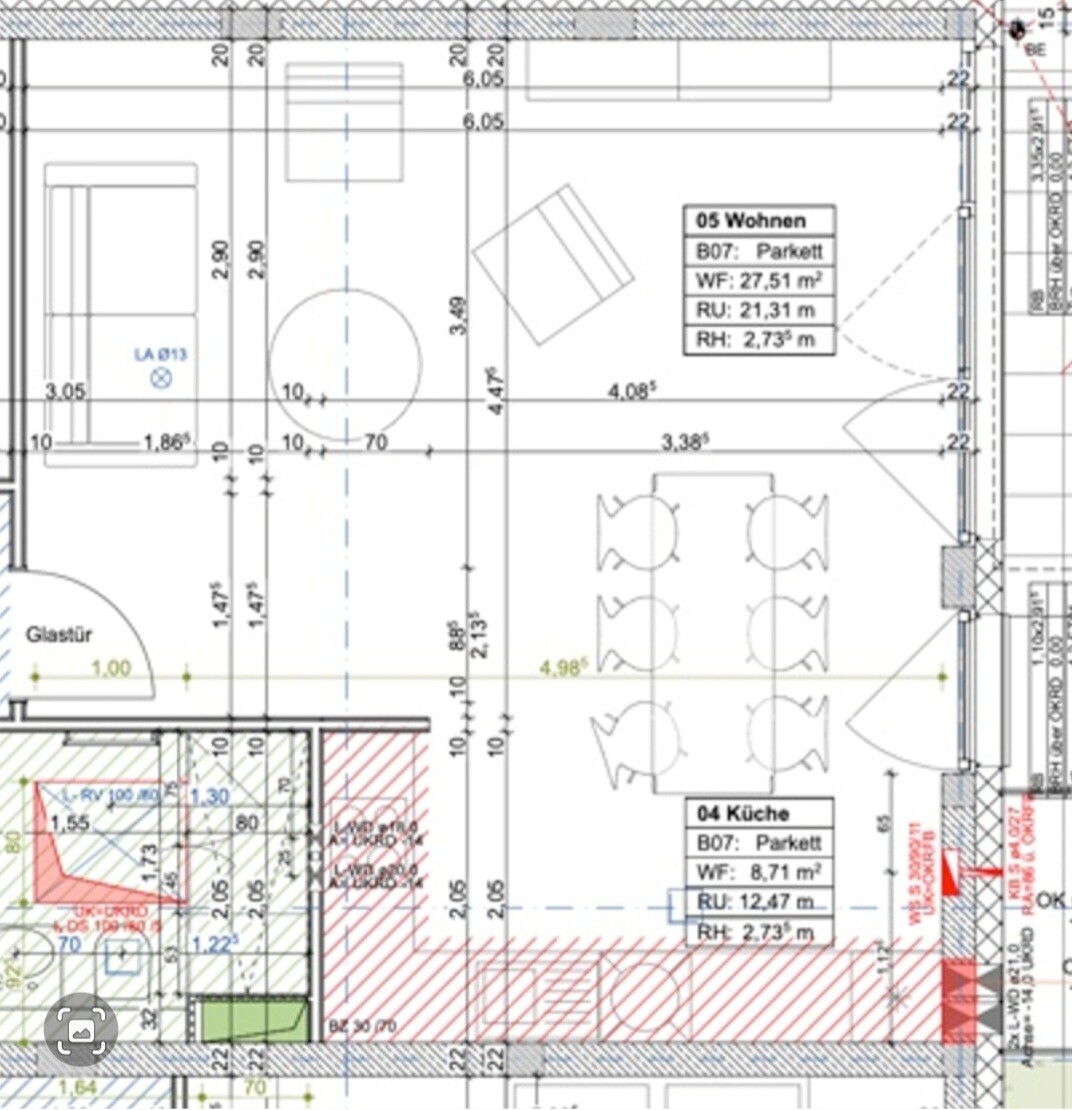
Thanks in advance.
I would like to ask for your advice. We are currently deciding which flooring to install in our open-plan living area. It is certain that we want tiles in the kitchen and hardwood flooring in the living area. However, we are unsure where to separate these two sections.
- Idea 1: A dividing line at the recessed wall, but the problem is that by the kitchen window there would be both tiles and hardwood
- Idea 2: Tiles in an L-shape around the kitchen, extending 1.20 m (4 feet) from the wall
Which option do you think is better, or do you have any other suggestions? Changing the floor plan or similar modifications are not possible. 😉
Thanks in advance.
C
Costruttrice12 Sep 2022 11:40I agree with Snowy; that would also look strange on the window. In this case, in my opinion, there is no logical separation line for two types of flooring. I would also go with wood entirely in this situation.
M
Myrna_Loy12 Sep 2022 17:17We have a dog who keeps its bowls in the kitchen – I’m really glad we have tiles there because sometimes the area around the bowls looks like a pigsty. Water often ends up around the bowls, and I don’t want to start using placemats or plastic mats to protect the wood. Of course, the downside is that anything fragile breaks really badly on tiles. Yesterday, I would have preferred having a wooden floor when the jar of pickles fell out of the fridge.
Myrna_Loy schrieb:
We have a dog whose bowls are kept in the kitchen – I’m really glad we have tiles there because sometimes it looks like a pigsty around the bowls. Water often spills around them as well, and I don’t want to start using placemats and plastic mats to protect the wood. The downside, of course, is that anything fragile breaks very easily on tile. Yesterday, I would have preferred a wooden floor when a jar of pickles fell out of the fridge.I understand, that’s quite reasonable in your case. But it’s more of an exception 🙂 I certainly didn’t imagine dogs with pigsties and suicide-prone pickle jars 😉
netuser schrieb:
I understand, in your case that’s certainly understandable. But it’s more of an exception 🙂
At least, I wasn’t thinking about dogs with pig troughs and suicide-prone throat glasses 😉 For us, for example, it’s not an exception: I see little spots on our fairly sandstone-resistant tiles every day that I can wipe away with a damp cloth. These spots don’t come from animals, but from things like drinks being carried from the kitchen to the living room or terrace… or garden work where I come inside with moist hands, or while cooking when some “fresh” juice spills or splashes, or yes, sometimes something is dropped (it makes the same mess on both parquet and tiles)… or watering plants… or wet socks… or even a dirty shoe… dripping laundry, cleaning windows… All of this is unavoidable, but you can’t interrupt your work often enough to wipe it all away immediately.
Personally, I wouldn’t voluntarily choose parquet flooring in the kitchen or in front of the terrace door. Even though everyone says you can just wipe everything up. I’m sure that you _could_… but do you actually do it? Can you see it right away? Do you have both hands free? The thought of stopping what you’re doing to go back and wipe? Everyone is free to do that if they want. I’m glad that my tiles look tough and I can postpone wiping up as necessary until I have time for it.
And yes: with a relatively small area and a break in the flooring without clear separation of the “functional zones,” you should avoid mixing floors. It tends to reduce the sense of space and only causes drawbacks.
M
Myrna_Loy13 Sep 2022 13:34Most people today still choose oiled wood – which is actually more delicate if you don’t regularly re-oil it and especially pay attention to keeping the protective layer intact in high-traffic areas, wiping up any spills immediately. In the US, wood floors are usually sealed with coatings, sometimes even two coats of two-component (2K) varnish, to achieve a durable surface. But that is a matter of personal preference.
Similar topics