
ᐅ Design of iDM heat pump with respect to COP (Coefficient of Performance)
Created on: 26 Aug 2022 11:21
A
Araknis
Hello.
Let’s assume a well-insulated new building with approximately 200 m² (2,150 sq ft) and a heating load of around 7 kW. So far, I have assumed that the heat pump should be appropriately sized and that oversizing it would be disadvantageous. Now, I’m looking at the datasheet of my preferred iDM heat pump, the iPump A, and I found the following:
Based on my previous understanding, the suitable model would be the iDM iPump A 2-7, which can modulate between 2.06 and 7.55 kW. The next larger model, the A 3-11, operates between 2.80 and 10.20 kW and, according to opinions I’ve heard so far, would actually be too big.
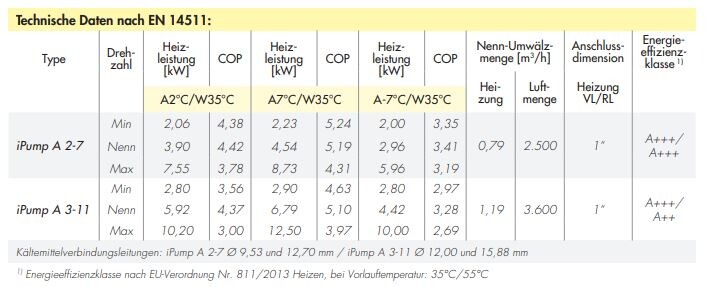
However, when I look at this table, the COP for the larger heat pump at lower loads is noticeably better than running the smaller one at full capacity. So, the larger version would be better for my situation, right?
Or am I missing something?
Let’s assume a well-insulated new building with approximately 200 m² (2,150 sq ft) and a heating load of around 7 kW. So far, I have assumed that the heat pump should be appropriately sized and that oversizing it would be disadvantageous. Now, I’m looking at the datasheet of my preferred iDM heat pump, the iPump A, and I found the following:
Based on my previous understanding, the suitable model would be the iDM iPump A 2-7, which can modulate between 2.06 and 7.55 kW. The next larger model, the A 3-11, operates between 2.80 and 10.20 kW and, according to opinions I’ve heard so far, would actually be too big.
However, when I look at this table, the COP for the larger heat pump at lower loads is noticeably better than running the smaller one at full capacity. So, the larger version would be better for my situation, right?
Or am I missing something?
R
RotorMotor26 Aug 2022 11:24First of all, I don’t interpret it like that from the table. However, it is difficult to compare because only different values are given there.
And you should design it for 90% of the time, not for 10%, let alone 1% of the usage.
And you should design it for 90% of the time, not for 10%, let alone 1% of the usage.
G
Gecko19276 Sep 2022 22:34Is this topic still relevant?
I know that in specialized forums it is often recommended to choose the smallest possible heat pump because it modulates better at low levels.
My IDM iPump 3-13 rattles like a ship diesel at over 10 kW (11 hp), so I have limited it to 50% maximum power.
Perhaps a smaller heat pump is more efficient in this range, but I assume that a smaller compressor has to run at a higher frequency and therefore makes significantly more noise than a larger unit running at reduced capacity.
With ventilation systems, people usually choose the larger model and run the (larger) fans at lower speeds.
I know that in specialized forums it is often recommended to choose the smallest possible heat pump because it modulates better at low levels.
My IDM iPump 3-13 rattles like a ship diesel at over 10 kW (11 hp), so I have limited it to 50% maximum power.
Perhaps a smaller heat pump is more efficient in this range, but I assume that a smaller compressor has to run at a higher frequency and therefore makes significantly more noise than a larger unit running at reduced capacity.
With ventilation systems, people usually choose the larger model and run the (larger) fans at lower speeds.
S
SaniererNRW1236 Sep 2022 22:40Gecko1927 schrieb:
Perhaps a smaller heat pump in this range is more efficient, but I assume that a smaller compressor has to run at a higher frequency and therefore makes significantly more noise than a larger one running at reduced capacity. Since a heat pump usually operates almost exclusively at partial load (including the slightly smaller-than-calculated heat pump), this "problem" only occurs on a few days per year when it is extremely cold.
Similar topics