
Hello,
I am looking for a comprehensive smart home platform that can integrate devices from different manufacturers.
So far, I have come across the following options:
Home Assistant
OpenHAB
ioBroker
Which of these platforms is the best or most widely used?
It is important to me that it runs stably and allows for creating good automations.
Additionally, there should be a smartphone app available that can be used on the go to control the smart home or at least check the status of devices remotely.
Are all of these programs open source and available for free?
Which of these platforms would you recommend, or should we perhaps consider WiButler or Homee, which also support various wireless standards?
I am looking for a comprehensive smart home platform that can integrate devices from different manufacturers.
So far, I have come across the following options:
Home Assistant
OpenHAB
ioBroker
Which of these platforms is the best or most widely used?
It is important to me that it runs stably and allows for creating good automations.
Additionally, there should be a smartphone app available that can be used on the go to control the smart home or at least check the status of devices remotely.
Are all of these programs open source and available for free?
Which of these platforms would you recommend, or should we perhaps consider WiButler or Homee, which also support various wireless standards?
TaiiTvv schrieb:
The electrician described the star wiring as a very large effort for which he needs much more time. That is definitely extra work. However, he would have the same with Fee@Home. The wiring is the same there, if I am not completely mistaken.
TaiiTvv schrieb:
From your messages, I gathered that switchable sockets are basically useless, or did I misunderstand? Well, I also don’t see the point in making all sockets switchable from the start. There are some use cases though, for example, in our setup these are switchable:
- Living room, to control the lighting inside the cabinet with scenes (crawling behind the cabinet to press the button would also work, but it’s not very smart ;-) )
- Bathroom, where one socket per unit is switchable for an electric towel warmer (which we probably will never need).
- Bathroom sockets for charging the electric toothbrush only during the day ;-)
Admittedly, purely switchable sockets are more like a gimmick. Switching combined with power measurement is what’s really useful (and to my knowledge, Busch-Jaeger actuators cannot do this, for example):
- TV and AV receiver sockets are switchable and turn off automatically after a certain time in standby mode.
- Microwave socket is switched on when the door opens via a reed contact and turns off again after use.
- Washing machine and dryer sockets are switchable and notify when the device is finished (I still want to implement this) or switch off the power.
- Refrigerator power consumption can be measured and an alarm can indicate whether it is on (or has been off for too long).
Besides, there are many threads with ideas and experiments for sockets here and in the KNX user forum. Think in advance about which sockets you want to make switchable and why, and wire the other rooms as described above with 5-core or 7-core cables. I have to admit, we did not do this consistently on the upper floor, and so far nothing is missing, but we also don’t have the certainty that everything will be possible.

Modern TVs should not be disconnected from the power supply. There are processes running in standby mode that require power, such as the regeneration cycle of OLEDs. This is also mentioned in the manual. The status of the TV for further automation can often be accessed in other ways.
As for the microwave, I would like to see the calculation of how many years it can comfortably stay on standby before the switched outlet with wiring has paid off.
As for the microwave, I would like to see the calculation of how many years it can comfortably stay on standby before the switched outlet with wiring has paid off.
I still haven’t found a useful purpose for the electrical outlets.
The outlet for the towel radiator could be interesting, but do you even need to turn on the towel radiator in a KFW55 energy-efficient house with underfloor heating? The bathroom should already be warm enough, right?
The outlets for the washing machine and dryer are important, but we planned to get a washing machine and dryer (from Bosch or Siemens) that can be controlled via an app, which also shows the remaining cycle time. Our kitchen appliances are also Bosch and compatible within the same app.
I’m considering whether we should just have the outlets installed in a conventional way (to save costs) or go with the option of 5x1.5mm cable to later be able to control 2 outlets/groups separately.
The outlet for the towel radiator could be interesting, but do you even need to turn on the towel radiator in a KFW55 energy-efficient house with underfloor heating? The bathroom should already be warm enough, right?
The outlets for the washing machine and dryer are important, but we planned to get a washing machine and dryer (from Bosch or Siemens) that can be controlled via an app, which also shows the remaining cycle time. Our kitchen appliances are also Bosch and compatible within the same app.
I’m considering whether we should just have the outlets installed in a conventional way (to save costs) or go with the option of 5x1.5mm cable to later be able to control 2 outlets/groups separately.
@Araknis
I’m not saying that it has to be done, it was just a question of what you CAN do. There was one channel left unused, and until I find another use for it, I’m turning off the MW ;-)
For the TV, I have a 15-minute delay after it reaches standby. But yes, I will check that again.
I’m not saying that it has to be done, it was just a question of what you CAN do. There was one channel left unused, and until I find another use for it, I’m turning off the MW ;-)
For the TV, I have a 15-minute delay after it reaches standby. But yes, I will check that again.
I will consider this and ask the electrician for the price difference.
I have attached our floor plan and marked a few things.
Red = Lights
Green = Switches with bus cable
I hope you can give me some more practical tips to consider for the KNX installation.
Do we really need that many switches?
Do we need occupancy sensors?
Do occupancy sensors even make sense if we have a large dog? (Bernese Mountain Dog, 50 kg (110 lbs)) The dog is allowed everywhere and would probably always trigger the occupancy sensors.
What else are we missing or could improve?
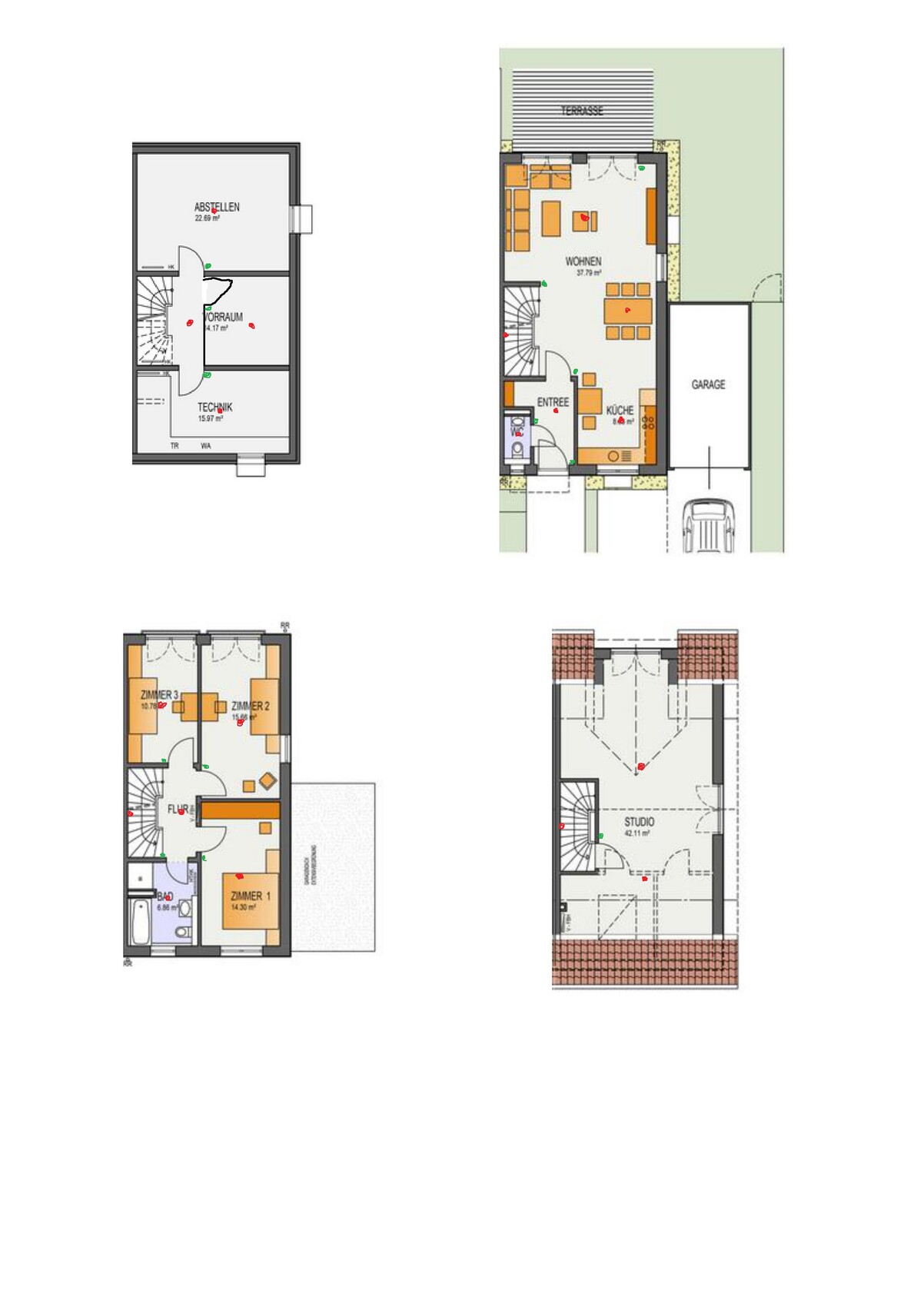
I have attached our floor plan and marked a few things.
Red = Lights
Green = Switches with bus cable
I hope you can give me some more practical tips to consider for the KNX installation.
Do we really need that many switches?
Do we need occupancy sensors?
Do occupancy sensors even make sense if we have a large dog? (Bernese Mountain Dog, 50 kg (110 lbs)) The dog is allowed everywhere and would probably always trigger the occupancy sensors.
What else are we missing or could improve?