
Hello everyone,
We have a terrace and a surrounding walkway around our house made of precast concrete slabs and want to replace them with more attractive slabs. To save costs, I plan to do the work myself.
My plan for the base is to remove 5-10 cm (2-4 inches) of the current gravel-sand subbase and apply a new layer of gravel. For aesthetic reasons, we are leaning towards using porcelain stoneware tiles, loosely laid on gravel bedding. What is your opinion on this: will the tiles constantly shift, or can this be done properly?
I am currently planning without steps, which means we need to compensate for small differences in height. We would design the terrace itself with a slope of 1-2% away from the house. The connected walkways also have a slope of about 2% away from the terrace. Is it easy to manage this with loose-laid gravel (considering there will be an edge between the terrace and the walkway)? In the sketch, I have indicated the terrace, walkways, and slopes (with arrows).
What do you think, does this make sense? Do you perhaps have a better idea on how to solve this?
Thank you very much and best regards
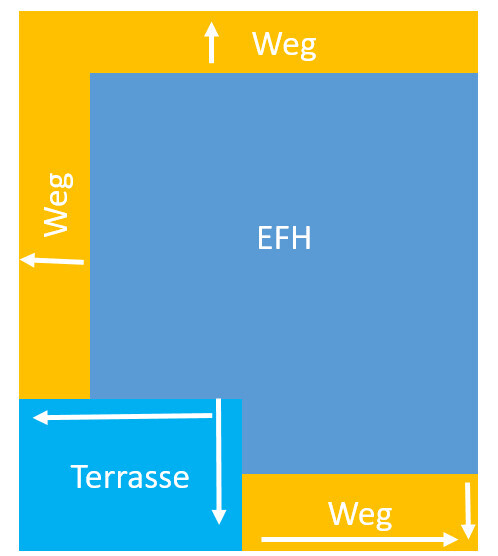
We have a terrace and a surrounding walkway around our house made of precast concrete slabs and want to replace them with more attractive slabs. To save costs, I plan to do the work myself.
My plan for the base is to remove 5-10 cm (2-4 inches) of the current gravel-sand subbase and apply a new layer of gravel. For aesthetic reasons, we are leaning towards using porcelain stoneware tiles, loosely laid on gravel bedding. What is your opinion on this: will the tiles constantly shift, or can this be done properly?
I am currently planning without steps, which means we need to compensate for small differences in height. We would design the terrace itself with a slope of 1-2% away from the house. The connected walkways also have a slope of about 2% away from the terrace. Is it easy to manage this with loose-laid gravel (considering there will be an edge between the terrace and the walkway)? In the sketch, I have indicated the terrace, walkways, and slopes (with arrows).
What do you think, does this make sense? Do you perhaps have a better idea on how to solve this?
Thank you very much and best regards
evelinoz schrieb:
Somehow I can’t picture the plot. Is there a Google image? Or how many meters (feet) is it from the left side of the house to the property boundary? What else is there besides that patch of grass? How many meters (feet) is it from the bottom edge of the house to the property boundary? How big is the existing terrace? At the moment, it doesn’t look very inviting. A better site plan would help. Thank you for the feedback. I’m working on a clearer overview than the ugly PowerPoint slide. I hoped to find a good free tool for this, but I haven’t found anything really good that also lets you plan the laying pattern. So I’ll sketch something myself. Or do you know of any good tools?
schlukkl schrieb:
Thank you for the feedback. I’m working on a clearer overview than the ugly PowerPoint slide. I was hoping to find a good free tool for this, but I haven’t found anything really effective where you can also plan the laying pattern. So I’ll sketch something myself. Or do you know of a good one? I believe there are more than enough tools available for this. The problem with most of these tools is usually the learning curve. Even if it’s not steep, it’s often too time-consuming for a one-time use. PowerPoint is actually quite powerful in this regard. Laying patterns can often be found directly from many manufacturers and suppliers of panels; if you like one of those, it could be an option to roughly insert those images into the layout or something similar.
Are you aiming for a highly detailed and precise sketch?
deezey schrieb:
Hi and sorry for the delayed reply.
Thanks for the pictures. Okay, doing it all over again is understandable – but generally, I’m not really a fan of exposed aggregate concrete 🙂.
Are the lawn edging stones being replaced as well?
You definitely need some type of edge restraint (curbstone, wedge, adhesive, fixed bedding supports, etc.) to prevent the slabs in the outermost row from shifting.
The lawn is currently higher than the path itself, right?
Anyway, everything will have to be removed first. Then I would really look at the condition of the base layer to see if it’s still good.
It would be quite unfortunate if you put in a lot of effort now and the slabs end up settling a lot.
Do you currently have a level access to the terrace, or is there a step from the door onto the terrace?
Depending on the required heights in general, it might make sense to adjust the subbase accordingly to compensate for height differences.
That might not be so simple, as there are finished light wells etc. that need to be taken into account.
How big are the current height differences?
Where the path and terrace meet, you could try to adjust the slope to level out the heights.
But as mentioned, a few details are still missing. What size slabs are you considering?
Best regards,
Paddy Thank you very much for the detailed response and ideas.
Thanks for the pictures. Okay, doing everything anew makes sense – and we feel the same about exposed aggregate concrete. ;-)
You definitely need some type of edge restraint (curbstone, wedge, adhesive, fixed bedding supports, etc.) to prevent the slabs in the outermost row from shifting.
We plan to use curbstones with concrete wedges. What do you think about stainless steel edge profiles?
We can’t quite find matching edging stones for the light-colored terrace slabs.
The lawn is currently higher than the path itself, right?
Correct. The paths will all be made significantly narrower, so hopefully that will help to balance it out.
Anyway, everything will have to be removed first. Then I would really look at the condition of the base layer to see if it’s still good.
It would be quite unfortunate if you put in a lot of effort now and the slabs end up settling a lot.
Definitely! What would you look out for? One problem is that there’s quite a bit of weeds on the path, which I’d like to remove. But then I guess part of the base layer would need to be disturbed.
Do you currently have level access to the terrace, or is there a step from the door onto the terrace?
Depending on the required heights in general, it might make sense to adjust the subbase to compensate for height differences.
That might not be so simple, as there are finished light wells, etc., that have to be considered.
How big are the current height differences?
Where the path and terrace meet, you could try to adjust the slope in order to level out the heights.
We want to try this in the planning now.
1. The terrace currently has no slope. Towards the path, it will get a 1% slope, so the terrace will be 4–5cm (1.5–2 inches) lower at the path than it is now.
2. The path is about 5cm (2 inches) lower than the grass.
In the end, the height difference should not be quite as big. I estimate about 5cm (2 inches) from light well to terrace. I would try to compensate for that.
But as mentioned, a few details are still missing. What size slabs are you considering?
The slabs we currently have in mind come in 60x60cm (24x24 inches) and 120x60cm (48x24 inches). My wife prefers rectangular slabs; I’m still unsure whether I can manage to install the larger slabs (with help). I suppose leveling is more difficult the bigger the slabs are, right?
Do you have an opinion on cross/bonded/half-bonded (running bond) patterns? With the gravel bedding supports, a cross pattern might make sense, but with the rectangular slabs, I imagine a running bond pattern might look nicer than a cross pattern.
deezey schrieb:
I believe there are more than enough tools available for this. The problem with these tools is usually the learning curve; even if it's not steep, it’s often too time-consuming for a one-time use. PowerPoint is actually quite powerful. Many manufacturers and suppliers of tiles provide laying patterns, so if you like one of those, it could be an option to roughly insert the images into the pathway design or something similar.
Are you looking to create a precise/exact sketch? Ideally, I would like to plan the exact laying pattern (including cutting of the tiles) for both the pathway and the terrace, including the precise positioning of the edging stones as well as height differences in 3D to visualize the slope. I have only found height difference functionality in RoomArranger, but it lacks other features.
For now, I think I will start with PowerPoint and indicate the height differences through labeling.
Hello everyone,
I have now started removing the old slabs and found beneath them a layer of about 30cm (12 inches) of sand (little to no fine material) mixed with gravel, as well as a layer of about 3m (10 feet) of gravel.
You can see the sand-gravel mixture in the pictures:
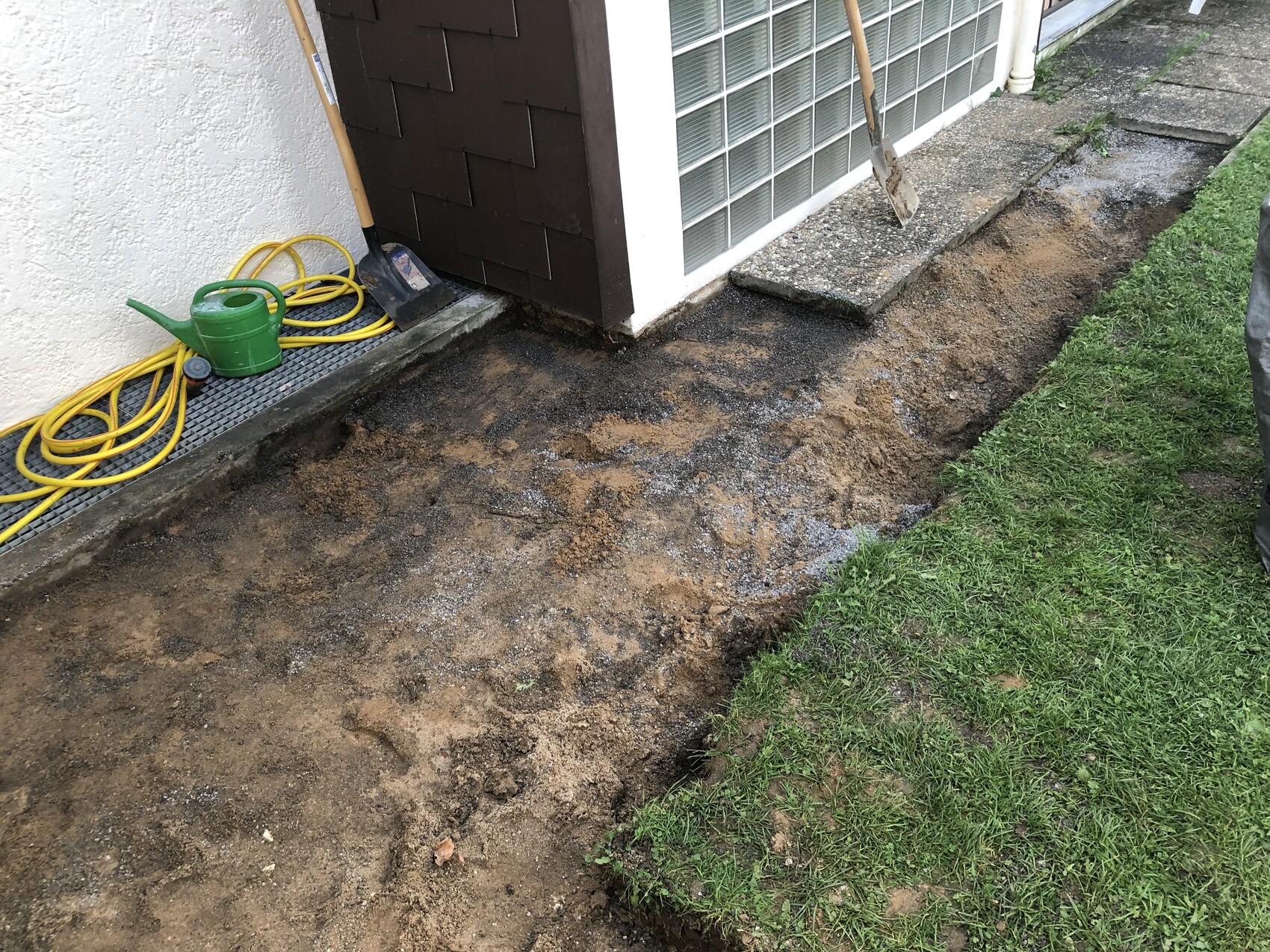
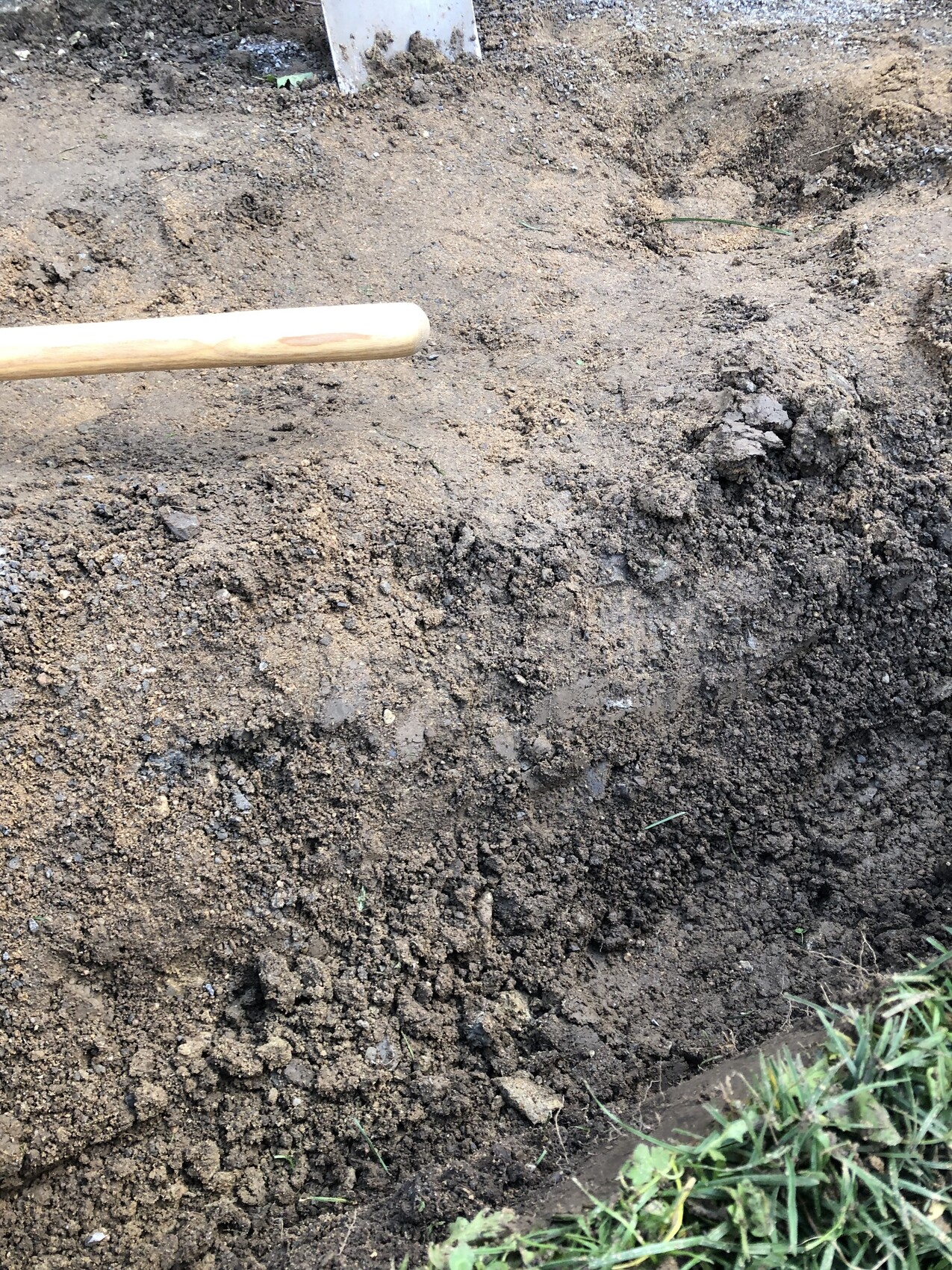
Apparently, there is no dedicated frost protection or base layer.
I am working in the path area, not the terrace.
How would you proceed? Is it necessary to excavate everything and re-install from scratch?
Best regards
I have now started removing the old slabs and found beneath them a layer of about 30cm (12 inches) of sand (little to no fine material) mixed with gravel, as well as a layer of about 3m (10 feet) of gravel.
You can see the sand-gravel mixture in the pictures:
Apparently, there is no dedicated frost protection or base layer.
I am working in the path area, not the terrace.
How would you proceed? Is it necessary to excavate everything and re-install from scratch?
Best regards
schlukkl schrieb:
Hello everyone,
I have now started removing the old slabs and found beneath them a layer of about 30cm (12 inches) of sand (with little to no fine particles) mixed with gravel, as well as a roughly 3m (10 feet) layer of gravel.
You can see the sand-gravel mix in the pictures:
[ATTACH alt="terrassenplanung-mit-umlaufendem-weg-und-leichtem-gefaelle-599938-2.jpg"]75501[/ATTACH][ATTACH alt="terrassenplanung-mit-umlaufendem-weg-und-leichtem-gefaelle-599938-1.jpg"]75500[/ATTACH]
Apparently, there is no dedicated frost protection or base layer.
I am referring to the area of the path, not the terrace.
How would you proceed? Is it necessary to excavate everything and rebuild?
Best regardsHello,
Yes, I think that would be the best approach here. Excavating and installing a new, clean base layer.
Since you are already undertaking the effort.
Best regards,
Paddy
Similar topics