
ᐅ Floor plans for a single-family house with a separate apartment, 280 m² on a compact 320 m² plot
Created on: 29 Aug 2022 11:51
M
medow1982M
medow198229 Aug 2022 11:51Hello everyone,
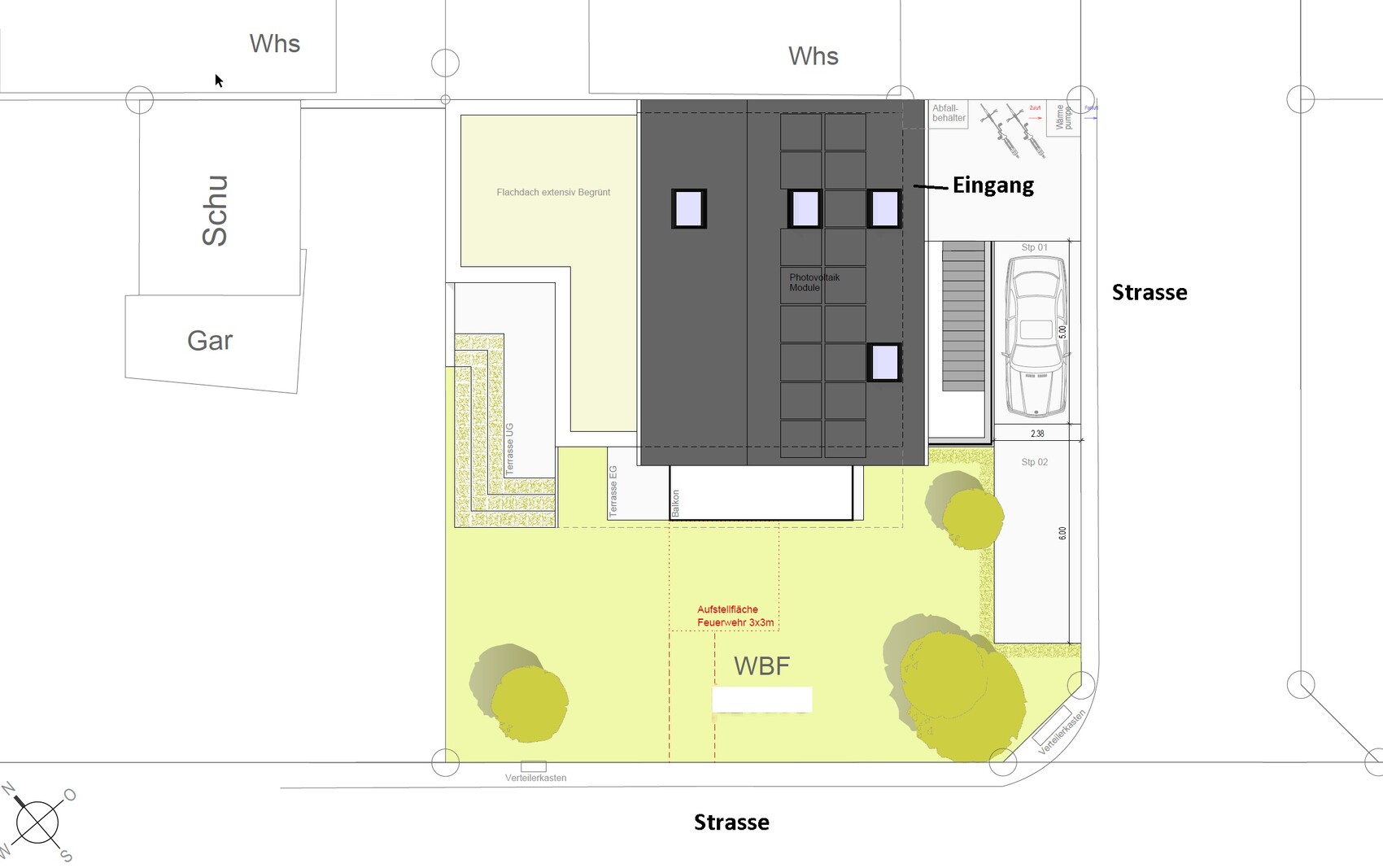
attached is our project with a request for suggestions for improvement, especially regarding the interior layout. The building permit application is currently in process, so please avoid complete redesign proposals for the building envelope, entrance, etc. Doors and walls can still be adjusted inside.
And yes, we are fully aware that this is a small constrained plot with limited garden space, but this is all we have here and we’re happy with it!
Development Plan/Restrictions
Plot size: 310 m2 (3,337 sq ft)
Number of parking spaces: 2
Number of floors: 1.5–2
Roof type: 45-degree gable roof
Orientation: SW
Additional requirements: Must be attached to neighbors and adapted accordingly. Changes to roof shape, knee wall height, number of floors, etc. are not possible!
Owners’ Requirements
Style, roof type, building type: Attached house, adapted to neighbors. This is restricted. Open floor plan. Flexible for aging occupants.
Basement, floors: Basement = self-contained apartment according to regional building codes, with separate entrance for permanent rental in the basement.
Number of occupants, ages: 2 adults + 2 children (4 and 1 year old), basement apartment: either 2 people or a shared office for 2 to max. 6 people
Space requirements on ground and upper floors: at least 120 m2 (1,292 sq ft). We have 165 m2 (1,776 sq ft) + 18 m2 (194 sq ft), so more than needed.
Office: Family use or home office? All three desired. One mixed-use room for home office and guests planned on the ground floor.
Guest sleepers per year: maximum 2, 1–3 times per year
Modern construction style
Open kitchen, kitchen island: possibly
Number of dining seats: 1
Fireplace: no
Balcony: yes, roof terrace: no due to neighbors
Garage, carport: no, only 2 parking spaces and storage rooms on the floors. One parking space will be realized with grass pavers and a sliding gate so that the garden visually appears larger.
House Design
Who designed the plan: 2 years of our own planning, final design approved by an architect as feasible.
- Planner from a construction company: yes
- Architect: yes
What do you particularly like? Why: We planned 3 separate living units so that we can live on the ground floor as we get older and the kids move upstairs or we can rent it out. A barrier-free ground floor was very important to us. In case of emergency, we can also rent out the ground and upper floors. Only the basement apartment is planned for rental; ground and upper floors for own use.
Estimated cost according to architect/planner: approx. 1 million €
Preferred heating system: Air-to-water heat pump, split system for cost reasons. 8 kWp solar system, 2 centralized ventilation systems. Basement made of concrete + Styrodur insulation, ground and upper floors with Poroton T7-MW 36.5 bricks. Soundproofing and increased living space were priorities, and unfortunately, we no longer qualify for KfW40+ funding. We simply didn’t have enough time for the KfW40+ NH standard because interest rates have risen sharply.
If you have to give up something, which details or expansions?
- Can give up: definitely the garage. We don’t own a car and use car sharing, which works well for the family. We can occasionally use a garage and shed on the neighboring property.
- Cannot give up: terrace, garden, balcony
Why is the design as it is now?
For example, standard design from planner? No, everything developed by us. Strong restrictions due to attachment to neighbors and limits on ridge height, roof shape, and height of the adjoining building. “Wish for” options are hardly possible here since the house must be attached to the neighbor.
Which wishes did the architect implement? Most of them.
What do you think makes it particularly good or bad? We have a very small plot and limited freedom in terms of shape, but in our opinion, we made the best of it. For cost reasons, we omitted Gutex insulation in the roof. We only have the attic peak, the bathroom, and one room with a sloping ceiling (knee wall height 1.38 m (4 ft 6 in)).
According to the site manager, this should not lead to extreme overheating, but we might still install it depending on feedback. The attic is open and connected to the ventilation system, so air in the basement will be mixed via the heat exchanger anyway. My parents also don’t have Gutex insulation in their prefab home from the 1980s, and yes, the attic gets quite warm but not over 35°C (95°F). We planned to compensate with blinds but are still unsure.
Additionally, we plan to convert the kitchen on the ground floor into a living room as we age and relocate the kitchen accordingly. Everything is optional, and planned with flexible plumbing. In the basement, we might still plan another room but are unsure of the location.
What is the most important/basic question about the floor plan in 130 characters?
Is the size of the bathroom and hallway sufficient, or should we have it adjusted?
In the basement, we will add a south-facing window on the left side to brighten the basement apartment. This will reduce privacy and garden space but should please the basement occupants.

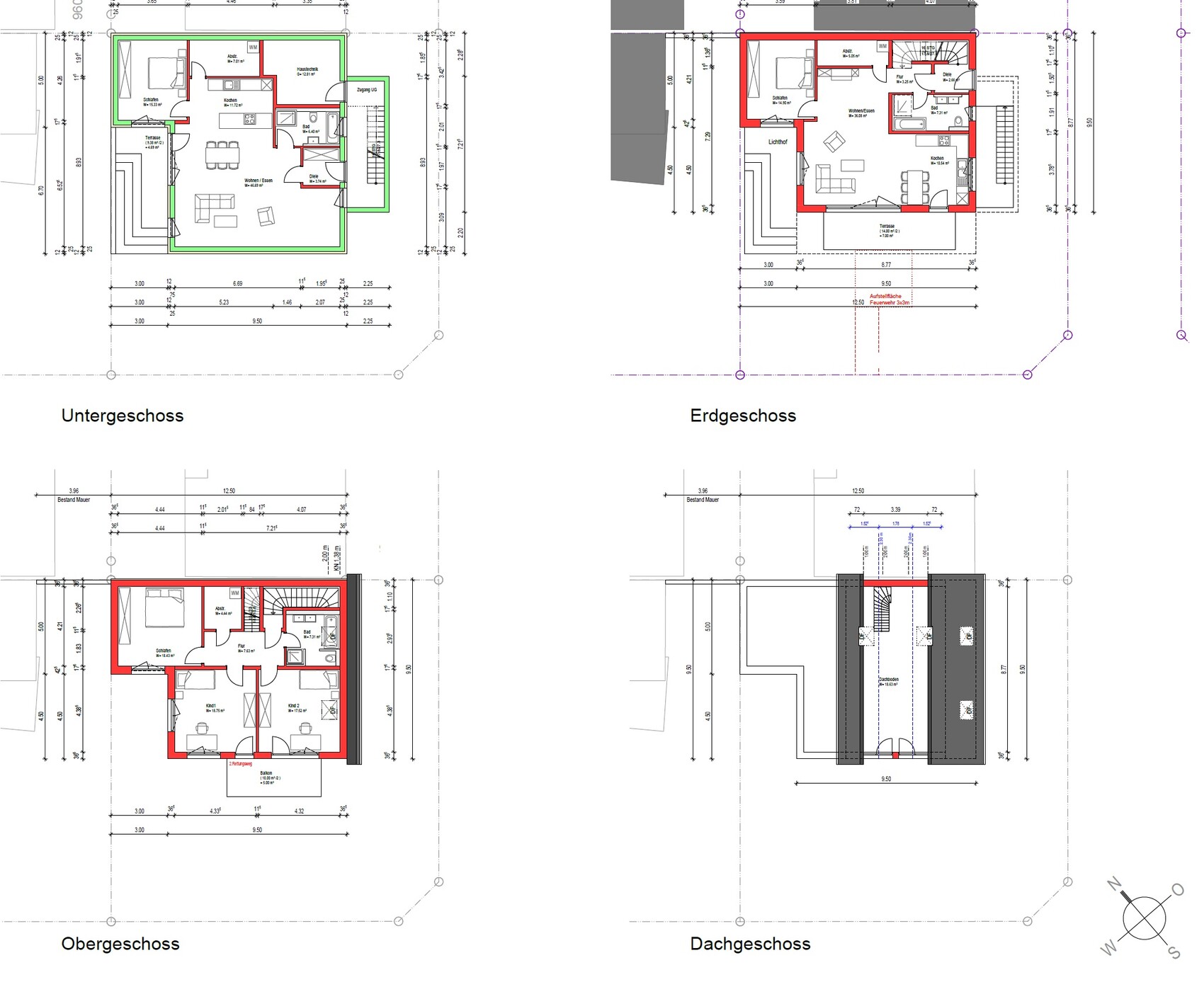
attached is our project with a request for suggestions for improvement, especially regarding the interior layout. The building permit application is currently in process, so please avoid complete redesign proposals for the building envelope, entrance, etc. Doors and walls can still be adjusted inside.
And yes, we are fully aware that this is a small constrained plot with limited garden space, but this is all we have here and we’re happy with it!
Development Plan/Restrictions
Plot size: 310 m2 (3,337 sq ft)
Number of parking spaces: 2
Number of floors: 1.5–2
Roof type: 45-degree gable roof
Orientation: SW
Additional requirements: Must be attached to neighbors and adapted accordingly. Changes to roof shape, knee wall height, number of floors, etc. are not possible!
Owners’ Requirements
Style, roof type, building type: Attached house, adapted to neighbors. This is restricted. Open floor plan. Flexible for aging occupants.
Basement, floors: Basement = self-contained apartment according to regional building codes, with separate entrance for permanent rental in the basement.
Number of occupants, ages: 2 adults + 2 children (4 and 1 year old), basement apartment: either 2 people or a shared office for 2 to max. 6 people
Space requirements on ground and upper floors: at least 120 m2 (1,292 sq ft). We have 165 m2 (1,776 sq ft) + 18 m2 (194 sq ft), so more than needed.
Office: Family use or home office? All three desired. One mixed-use room for home office and guests planned on the ground floor.
Guest sleepers per year: maximum 2, 1–3 times per year
Modern construction style
Open kitchen, kitchen island: possibly
Number of dining seats: 1
Fireplace: no
Balcony: yes, roof terrace: no due to neighbors
Garage, carport: no, only 2 parking spaces and storage rooms on the floors. One parking space will be realized with grass pavers and a sliding gate so that the garden visually appears larger.
House Design
Who designed the plan: 2 years of our own planning, final design approved by an architect as feasible.
- Planner from a construction company: yes
- Architect: yes
What do you particularly like? Why: We planned 3 separate living units so that we can live on the ground floor as we get older and the kids move upstairs or we can rent it out. A barrier-free ground floor was very important to us. In case of emergency, we can also rent out the ground and upper floors. Only the basement apartment is planned for rental; ground and upper floors for own use.
Estimated cost according to architect/planner: approx. 1 million €
Preferred heating system: Air-to-water heat pump, split system for cost reasons. 8 kWp solar system, 2 centralized ventilation systems. Basement made of concrete + Styrodur insulation, ground and upper floors with Poroton T7-MW 36.5 bricks. Soundproofing and increased living space were priorities, and unfortunately, we no longer qualify for KfW40+ funding. We simply didn’t have enough time for the KfW40+ NH standard because interest rates have risen sharply.
If you have to give up something, which details or expansions?
- Can give up: definitely the garage. We don’t own a car and use car sharing, which works well for the family. We can occasionally use a garage and shed on the neighboring property.
- Cannot give up: terrace, garden, balcony
Why is the design as it is now?
For example, standard design from planner? No, everything developed by us. Strong restrictions due to attachment to neighbors and limits on ridge height, roof shape, and height of the adjoining building. “Wish for” options are hardly possible here since the house must be attached to the neighbor.
Which wishes did the architect implement? Most of them.
What do you think makes it particularly good or bad? We have a very small plot and limited freedom in terms of shape, but in our opinion, we made the best of it. For cost reasons, we omitted Gutex insulation in the roof. We only have the attic peak, the bathroom, and one room with a sloping ceiling (knee wall height 1.38 m (4 ft 6 in)).
According to the site manager, this should not lead to extreme overheating, but we might still install it depending on feedback. The attic is open and connected to the ventilation system, so air in the basement will be mixed via the heat exchanger anyway. My parents also don’t have Gutex insulation in their prefab home from the 1980s, and yes, the attic gets quite warm but not over 35°C (95°F). We planned to compensate with blinds but are still unsure.
Additionally, we plan to convert the kitchen on the ground floor into a living room as we age and relocate the kitchen accordingly. Everything is optional, and planned with flexible plumbing. In the basement, we might still plan another room but are unsure of the location.
What is the most important/basic question about the floor plan in 130 characters?
Is the size of the bathroom and hallway sufficient, or should we have it adjusted?
In the basement, we will add a south-facing window on the left side to brighten the basement apartment. This will reduce privacy and garden space but should please the basement occupants.
M
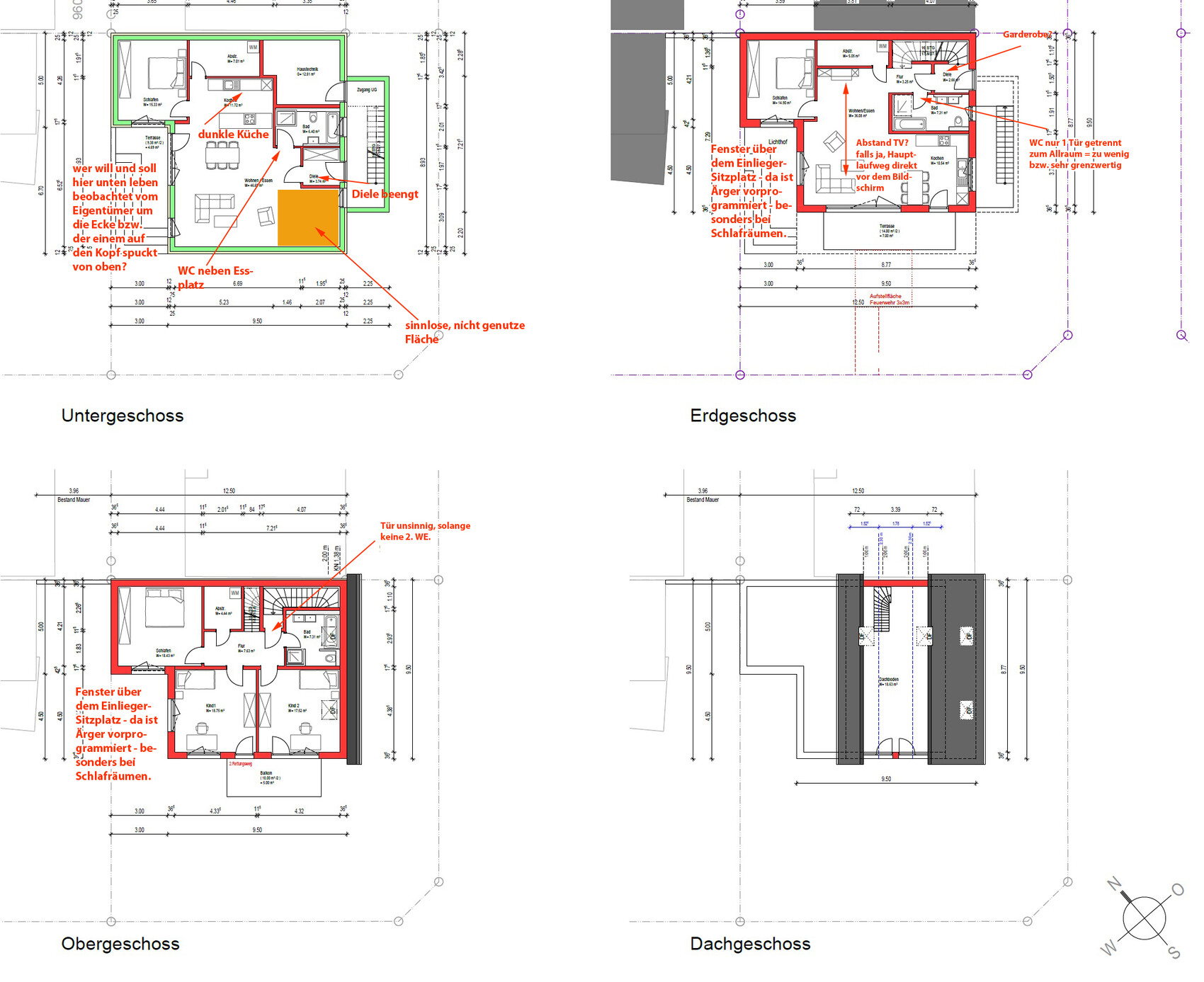
medow198229 Aug 2022 12:09Hi Sol, thanks for the suggestion. I don’t quite understand the issue with the toilet. All our toilet bowls are located along the edge of the room near the window, and the bathrooms are planned there as well. I understand the concern about the odor, but in our case, there is still the hallway and some walking distance towards the dining area, so hopefully the smell will dissipate by then. 🙂
In the basement, we could swap the storage room with the bathroom, which would put it farther away, but then the bathroom wouldn’t have a window, which wouldn’t be ideal either. Also, this way all the water lines for the washing machine, kitchen, and bathroom are more or less directly above each other, which we like because it reduces noise when running water and, in case of a leak, any damage is limited to one area. Still, thanks—hopefully, others will share their suggestions too.
In the basement, we could swap the storage room with the bathroom, which would put it farther away, but then the bathroom wouldn’t have a window, which wouldn’t be ideal either. Also, this way all the water lines for the washing machine, kitchen, and bathroom are more or less directly above each other, which we like because it reduces noise when running water and, in case of a leak, any damage is limited to one area. Still, thanks—hopefully, others will share their suggestions too.
On the ground floor, I don’t find it problematic, but in the basement, the bathroom is too close to the dining table for my taste. It’s a seamless transition. Regardless of where exactly the toilet is located in the bathroom.
One more question: What is the stair door on the upper floor intended for?
Since the hallway on the ground floor has its own door to the living area, which keeps cooking smells and noise out, is the function of the upper floor door limited to separating the upper floor from the entrance door?
I would leave it out, as I don’t see any added benefit, and it would probably annoy me from the second day onwards because I couldn’t leave it open due to the rather narrow hallway.
One more question: What is the stair door on the upper floor intended for?
Since the hallway on the ground floor has its own door to the living area, which keeps cooking smells and noise out, is the function of the upper floor door limited to separating the upper floor from the entrance door?
I would leave it out, as I don’t see any added benefit, and it would probably annoy me from the second day onwards because I couldn’t leave it open due to the rather narrow hallway.
M
medow198229 Aug 2022 13:25Hi Sol, yes, you’re right about the basement level. It might be possible to eliminate the walk-in closet and instead position the toilet door directly in the entrance area.
The door on the upper floor is only meant to separate the three residential units and will only be relevant if they are used or rented out separately in the future. We won’t use this door on the upper floor if we occupy the ground and upper floors ourselves, so we will probably just remove it from its hinges. It will likely be moved slightly toward the back near the stairwell to prevent it from opening widely into the hallway. The kitchen connections on the upper floor are planned to be concealed within the masonry in the room opposite the bathroom, so it’s possible to install a kitchen there later on as an option. These optional kitchen connections caused only minor additional costs and it would be difficult or much more expensive to add them afterward.
The door on the upper floor is only meant to separate the three residential units and will only be relevant if they are used or rented out separately in the future. We won’t use this door on the upper floor if we occupy the ground and upper floors ourselves, so we will probably just remove it from its hinges. It will likely be moved slightly toward the back near the stairwell to prevent it from opening widely into the hallway. The kitchen connections on the upper floor are planned to be concealed within the masonry in the room opposite the bathroom, so it’s possible to install a kitchen there later on as an option. These optional kitchen connections caused only minor additional costs and it would be difficult or much more expensive to add them afterward.

Some points have already been made. As always, the question arises about the usefulness of the accessory apartment. Sharing this tiny plot of land with someone else, in my opinion (sorry for that), is simply ridiculous. A standard basement would definitely have been useful for bikes and such. Where is the tenant supposed to park—only one car each? Will they throw their trash into your bin?
The rest here:
The rest here:
Similar topics