
Hello,
We recently purchased a detached house and are currently renovating the attached kitchen. When removing the plaster, the lower masonry started to crumble. It can be removed quite easily with a hammer, so I suspect that the former exterior wall might be unstable.
Should I have a bricklayer or mason take a look at it?
Best regards, Jens
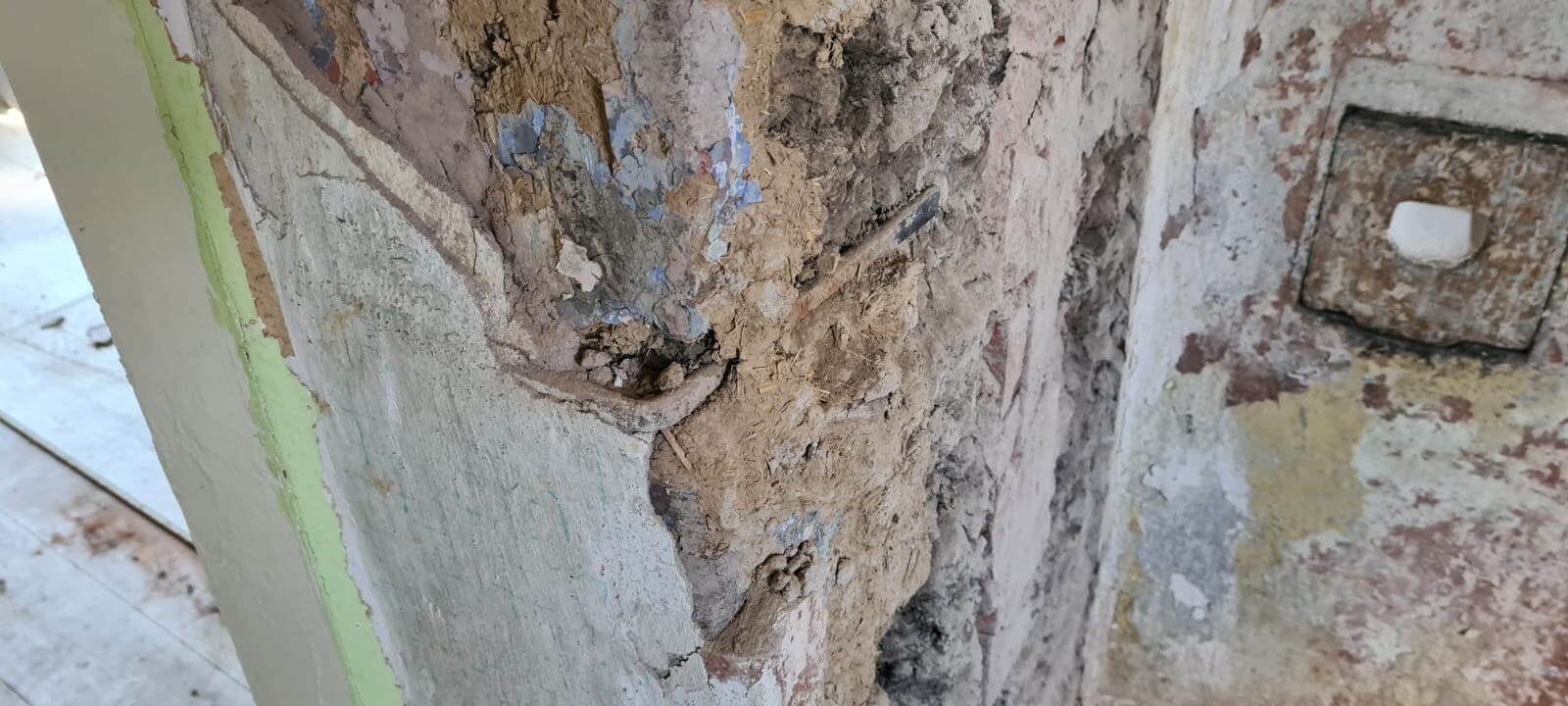
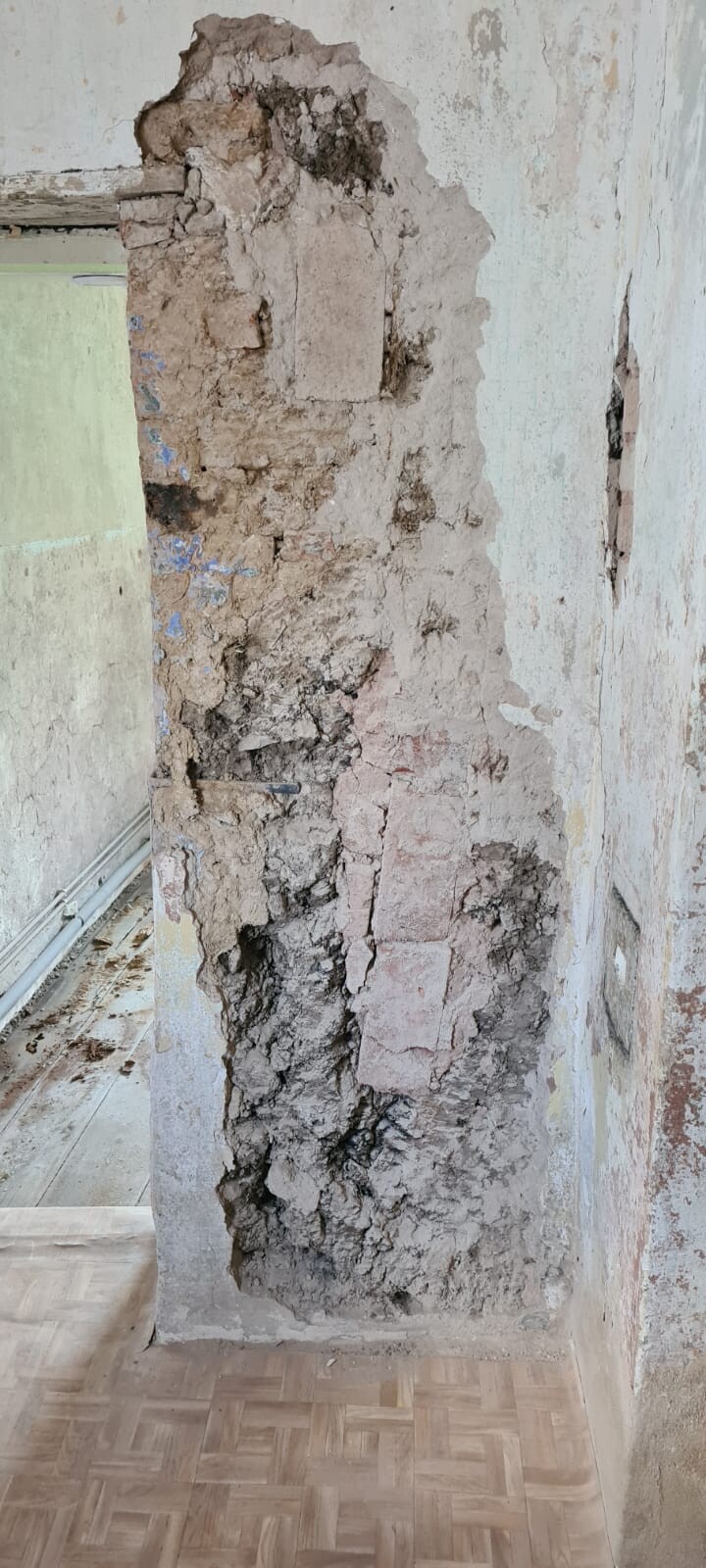
We recently purchased a detached house and are currently renovating the attached kitchen. When removing the plaster, the lower masonry started to crumble. It can be removed quite easily with a hammer, so I suspect that the former exterior wall might be unstable.
Should I have a bricklayer or mason take a look at it?
Best regards, Jens

It’s really a question of what exactly we are looking at here.
Maybe it’s just my perception, but I find it difficult to tell from the picture whether this is actually the “masonry” or not.
I’m not an expert, but I have seen a few older houses that were renovated.
The question for me would be: is this wall load-bearing at all?
What is behind what we can see? Is there going to be a proper wall behind it, or something load-bearing like timber framing?
It wouldn’t be unusual for someone to have just slapped something together with whatever materials were available (due to lack of money or materials).
Maybe it’s just my perception, but I find it difficult to tell from the picture whether this is actually the “masonry” or not.
I’m not an expert, but I have seen a few older houses that were renovated.
The question for me would be: is this wall load-bearing at all?
What is behind what we can see? Is there going to be a proper wall behind it, or something load-bearing like timber framing?
It wouldn’t be unusual for someone to have just slapped something together with whatever materials were available (due to lack of money or materials).
J
Jens Kaufmann16 Aug 2022 16:44This used to be an exterior wall, so it should be load-bearing.
The room behind it is an extension and was used as a laundry room.
So far, I have only penetrated about 10cm (4 inches) deep into the "masonry" because I was afraid it might collapse on me.
The room behind it is an extension and was used as a laundry room.
So far, I have only penetrated about 10cm (4 inches) deep into the "masonry" because I was afraid it might collapse on me.
Jens Kaufmann schrieb:
That is a former exterior wall. It should therefore be load-bearing. There will probably be some timber framing somewhere. Is the wall fully exposed on both sides?
If it is timber framing, it might be that you are cutting through the wrong spot and apart from the "filler" material, there is nothing else, because it is just infill.
J
Jens Kaufmann16 Aug 2022 16:55face26 schrieb:
Then there will probably be some timber framing somewhere. Is the wall exposed and open on both sides?
If it’s timber framing, you might be drilling in the wrong spot and find nothing but loose filler material. Yes, I briefly used the hammer drill on the other side, where you could immediately see clay and straw. However, my wife shouted at me to stop because on the side shown in the photo some material had started to crumble down, and she was afraid something might collapse...
Since then, everything has been on hold.
Yes, I can only repeat myself. Perhaps the house is much older than you thought (the original house). It was quite common for the original building to be a small timber-framed house. The timber frame was often filled in with clay and straw. Over the decades, there were usually three extensions built, and the exterior walls frequently became interior walls. Sometimes the wall dimensions no longer align properly, so the gaps were filled with whatever materials were available. This often included reusing demolition debris.
But all of this is just speculation.
I can get you some braces to shore up and open the wall further. Or, as you suggest, you might want to bring in a specialist after all.
But all of this is just speculation.
I can get you some braces to shore up and open the wall further. Or, as you suggest, you might want to bring in a specialist after all.
J
Jens Kaufmann16 Aug 2022 17:13face26 schrieb:
Yes, I can only repeat myself. Maybe the house is even older than you thought (the original building). It was not uncommon for the original structure to be a small timber-framed house. The timber frame was often filled in with clay and straw. Then, over the decades, three extensions were added, and often the exterior wall then became an interior wall. Sometimes the wall dimensions no longer align perfectly, so the walls were filled in with whatever materials were available. This sometimes included reusing demolition debris.
But this is all just speculation.
I can provide some props to support the structure and open the wall further. Or, as you said, bring in a professional after all.I will send a photo to my building inspector and ask him. If necessary, he will want to take a look himself.
Thanks for the help so far!
Similar topics