
ᐅ Fiber optic connection is being installed – should the existing multi-utility conduit be used?
Created on: 9 May 2022 16:39
V
Vrumfondel
Hello everyone,
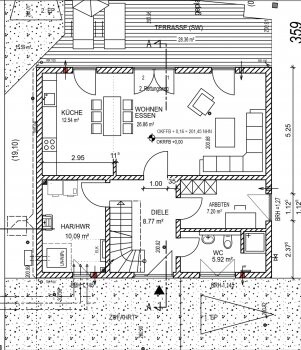
Our village will be connected with fiber optic this year, and I’m wondering where the cable should best enter our house.
To explain: on the left side of the house, there is directly the street (a 40cm (16 inches) splash protection strip, edged with concreted curbs, then a 1-meter (39 inches) gravel road surface, followed by the single-lane street). At the bottom side is the paved driveway/parking space.
According to the fiber provider, the connection should be done as follows:
House connections are very often installed using a so-called no-dig method, so that no trenching is necessary. This means that an underground drilling machine or a directional boring (mole or flush pipe) is used to “shoot” or drill under the ground to the house in order to lay an empty conduit. This only requires two access pits: one at the street to connect the house connection to the main line and one directly at the house. If this trenchless method is not possible, in rare cases open trenching is used. All work is done at a depth of about 60cm (24 inches). Later, the fiber cable is blown into this empty conduit in a separate step.
No worries! The front garden or paved driveway usually will not be affected. If they are, everything will be restored to its original condition.
In the basement or ground floor, a small hole will be drilled through the outer wall so the fiber cable can enter the house interior. This hole will be properly sealed.
From initial reports in neighboring villages, it seems more likely that the construction workers arrive suddenly and never use directional boring ;-)
So here’s my consideration:
Can or may the workers use the still unused element of the multi-utility house entry point? Since that is the standard way to get utility lines into the house, that would seem obvious, right?
Alternatively, they could drill directly from the street side, above the sink on the bottom wall — as long as they manage it precisely enough not to hit any water pipes :-8
In the technical room, both positions would be fine for us. On the bottom wall there are the multi-utility box, water meter, armored box, and telephone connection installed. So there is still plenty of space for the house transfer point and network termination device—assuming the fiber provider has no further requirements regarding the distance to these installations.
What are the pros and cons of each option?
Thank you very much!
Our village will be connected with fiber optic this year, and I’m wondering where the cable should best enter our house.
To explain: on the left side of the house, there is directly the street (a 40cm (16 inches) splash protection strip, edged with concreted curbs, then a 1-meter (39 inches) gravel road surface, followed by the single-lane street). At the bottom side is the paved driveway/parking space.
According to the fiber provider, the connection should be done as follows:
House connections are very often installed using a so-called no-dig method, so that no trenching is necessary. This means that an underground drilling machine or a directional boring (mole or flush pipe) is used to “shoot” or drill under the ground to the house in order to lay an empty conduit. This only requires two access pits: one at the street to connect the house connection to the main line and one directly at the house. If this trenchless method is not possible, in rare cases open trenching is used. All work is done at a depth of about 60cm (24 inches). Later, the fiber cable is blown into this empty conduit in a separate step.
No worries! The front garden or paved driveway usually will not be affected. If they are, everything will be restored to its original condition.
In the basement or ground floor, a small hole will be drilled through the outer wall so the fiber cable can enter the house interior. This hole will be properly sealed.
From initial reports in neighboring villages, it seems more likely that the construction workers arrive suddenly and never use directional boring ;-)
So here’s my consideration:
Can or may the workers use the still unused element of the multi-utility house entry point? Since that is the standard way to get utility lines into the house, that would seem obvious, right?
Alternatively, they could drill directly from the street side, above the sink on the bottom wall — as long as they manage it precisely enough not to hit any water pipes :-8
In the technical room, both positions would be fine for us. On the bottom wall there are the multi-utility box, water meter, armored box, and telephone connection installed. So there is still plenty of space for the house transfer point and network termination device—assuming the fiber provider has no further requirements regarding the distance to these installations.
What are the pros and cons of each option?
Thank you very much!
M
motorradsilke9 Aug 2022 22:32xMisterDx schrieb:
Same.
The penetration must be properly sealed; otherwise, all damages and consequential damages are the responsibility of the contractor who worked last.
Because even in court, unlike before:
Rule one:
Whoever worked last is at fault
Rule two:
Whoever worked last and does not want to be blamed must prove otherwise beyond doubt (with expensive expert reports)... Yes, of course, and what speaks against sealing them correctly? The building penetration must be sealed properly anyway when they drill a hole in the wall for the cable.
Sealing the multi-utility conduit, which is one meter (3 feet) away from the house, should also be easier than sealing a hole directly in the house. As you wrote, there are special seals for that.
We have this issue coming up as well. For me, it is clear that the fiber optic cable should go through the multi-utility conduit. Otherwise, they simply won’t install the fiber.
X
xMisterDx9 Aug 2022 22:34motorradsilke schrieb:
Yes, of course, and what is wrong with sealing it properly? The wall penetration must be sealed as well when they drill a hole in the wall for the cable.
Sealing the multi-duct, which is located one meter (3 feet) away from the house, should also be easier than sealing a hole directly in the building. As you mentioned, there are special seals for that.
We are facing the same issue. And for me, it is clear that the cable should go through the multi-duct. Otherwise, they just won’t install fiber optic. There is nothing against it if you find a skilled tradesperson to do it.
And that brings us full circle.
Have a nice evening.

In my case, the utility company would have used the multi-service conduit if I had installed the small empty duct myself, and they would have only needed to blow through the fiber. After seeing how the utility company sometimes left roads and other surfaces in a poor state, and having the chance to watch the paving workers up close (from my office window), I lost confidence in their work quality. Besides, I decided to have a second, alternative FTTH connection installed. Water, electricity, the casing for my geothermal borehole, and the fiber were already in place, so I considered the risk of damage by the utility company to be too high. Moreover, I did not want to deal with their probably extensive legal department in case anything went wrong.
N
Neubau202210 Aug 2022 08:41motorradsilke schrieb:
Yes, of course, and what speaks against sealing it properly? The house entry point must be sealed as well when they drill a hole in the wall for the cable.
Sealing the multi-utility conduit, which is located about one meter (3 feet) away from the house, should be easier than sealing a hole directly in the building. As you mentioned, there are special seals for this purpose.
We are facing this issue too. For me, it is clear that the cables should run through the multi-utility conduit. Otherwise, they simply won’t install fiber optic. We have now had the copper cable (Telecom) installed through the multi-utility conduit. If fiber optic becomes available to us at some point (in the year 20xx), can it be routed through the same multi-utility conduit, or will the copper cable be removed and replaced by a fiber optic connection?
M
motorradsilke10 Aug 2022 08:44Neubau2022 schrieb:
We have now installed the copper cable (Telecom) through the multi-conduit system. If we get fiber optic in the future (in the year 20xx), can it be installed through the same multi-conduit, or will the copper cable be removed and replaced by the fiber optic connection instead?I don’t think it will be the latter. It wouldn’t matter for us anyway since our telecom junction box is located in the garage and no one knows where the cable runs from there;)N
Neubau202210 Aug 2022 08:49motorradsilke schrieb:
I don’t think that’s the case. For us, it doesn’t matter since our main telecom connection is in the garage and nobody knows where the cables run;) That’s the question. For us, the telecom, electrical, and wastewater/water lines run from the property boundary to the house. Now, power cables still need to be laid for the gate and the pedestrian entrance. How is the landscape gardener (who digs; the electrician installs the cables) supposed to know where each cable has been laid? Wastewater/water shouldn’t be a problem since those are buried deeper. But the electrical and telecom cables... Do you get a plan showing where the cables are located?
Similar topics