
ᐅ Fiber optic connection is being installed – should the existing multi-utility conduit be used?
Created on: 9 May 2022 16:39
V
Vrumfondel
Hello everyone,
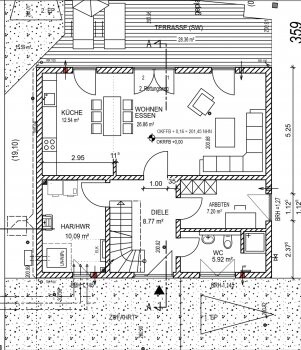
Our village will be connected with fiber optic this year, and I’m wondering where the cable should best enter our house.
To explain: on the left side of the house, there is directly the street (a 40cm (16 inches) splash protection strip, edged with concreted curbs, then a 1-meter (39 inches) gravel road surface, followed by the single-lane street). At the bottom side is the paved driveway/parking space.
According to the fiber provider, the connection should be done as follows:
House connections are very often installed using a so-called no-dig method, so that no trenching is necessary. This means that an underground drilling machine or a directional boring (mole or flush pipe) is used to “shoot” or drill under the ground to the house in order to lay an empty conduit. This only requires two access pits: one at the street to connect the house connection to the main line and one directly at the house. If this trenchless method is not possible, in rare cases open trenching is used. All work is done at a depth of about 60cm (24 inches). Later, the fiber cable is blown into this empty conduit in a separate step.
No worries! The front garden or paved driveway usually will not be affected. If they are, everything will be restored to its original condition.
In the basement or ground floor, a small hole will be drilled through the outer wall so the fiber cable can enter the house interior. This hole will be properly sealed.
From initial reports in neighboring villages, it seems more likely that the construction workers arrive suddenly and never use directional boring ;-)
So here’s my consideration:
Can or may the workers use the still unused element of the multi-utility house entry point? Since that is the standard way to get utility lines into the house, that would seem obvious, right?
Alternatively, they could drill directly from the street side, above the sink on the bottom wall — as long as they manage it precisely enough not to hit any water pipes :-8
In the technical room, both positions would be fine for us. On the bottom wall there are the multi-utility box, water meter, armored box, and telephone connection installed. So there is still plenty of space for the house transfer point and network termination device—assuming the fiber provider has no further requirements regarding the distance to these installations.
What are the pros and cons of each option?
Thank you very much!
Our village will be connected with fiber optic this year, and I’m wondering where the cable should best enter our house.
To explain: on the left side of the house, there is directly the street (a 40cm (16 inches) splash protection strip, edged with concreted curbs, then a 1-meter (39 inches) gravel road surface, followed by the single-lane street). At the bottom side is the paved driveway/parking space.
According to the fiber provider, the connection should be done as follows:
House connections are very often installed using a so-called no-dig method, so that no trenching is necessary. This means that an underground drilling machine or a directional boring (mole or flush pipe) is used to “shoot” or drill under the ground to the house in order to lay an empty conduit. This only requires two access pits: one at the street to connect the house connection to the main line and one directly at the house. If this trenchless method is not possible, in rare cases open trenching is used. All work is done at a depth of about 60cm (24 inches). Later, the fiber cable is blown into this empty conduit in a separate step.
No worries! The front garden or paved driveway usually will not be affected. If they are, everything will be restored to its original condition.
In the basement or ground floor, a small hole will be drilled through the outer wall so the fiber cable can enter the house interior. This hole will be properly sealed.
From initial reports in neighboring villages, it seems more likely that the construction workers arrive suddenly and never use directional boring ;-)
So here’s my consideration:
Can or may the workers use the still unused element of the multi-utility house entry point? Since that is the standard way to get utility lines into the house, that would seem obvious, right?
Alternatively, they could drill directly from the street side, above the sink on the bottom wall — as long as they manage it precisely enough not to hit any water pipes :-8
In the technical room, both positions would be fine for us. On the bottom wall there are the multi-utility box, water meter, armored box, and telephone connection installed. So there is still plenty of space for the house transfer point and network termination device—assuming the fiber provider has no further requirements regarding the distance to these installations.
What are the pros and cons of each option?
Thank you very much!

It is possible that this could be rejected for liability reasons, especially if the cable (or the orange conduit for the attic) is to be installed afterwards and deviates from the company’s standard procedure. The workload also allows for orders to be declined (at other times, orders can of course also be rejected...).
X
xMisterDx9 Aug 2022 21:32Rule number one:
"The last one to work on it is to blame"
Rule number two:
---
No. If the customer requests something that contradicts DIN, VDE, TAB, or any other regulations, or puts the contractor/worker liable for any consequences... see rule number one... then it won’t be done. Even if the decision is based purely on the contractor’s experience or principles.
My electrician refused to install an outlet at the window next to the bathroom because with a typical Christmas lights set, the bathtub could be reached... according to DIN, VDE, etc. such an outlet would have been completely compliant, with all required clearances observed... but he didn’t do it because he knows of cases where children brought the lights into the bathtub... bang.
"The last one to work on it is to blame"
Rule number two:
---
motorradsilke schrieb:
It’s up to you to tell them where to install it. Ideally, you should clear the trench for the utility connection beforehand.
No. If the customer requests something that contradicts DIN, VDE, TAB, or any other regulations, or puts the contractor/worker liable for any consequences... see rule number one... then it won’t be done. Even if the decision is based purely on the contractor’s experience or principles.
My electrician refused to install an outlet at the window next to the bathroom because with a typical Christmas lights set, the bathtub could be reached... according to DIN, VDE, etc. such an outlet would have been completely compliant, with all required clearances observed... but he didn’t do it because he knows of cases where children brought the lights into the bathtub... bang.
M
motorradsilke9 Aug 2022 22:08xMisterDx schrieb:
Rule number one:
"Whoever was last is to blame"
Rule number two:
---
No. If the client requests something that violates DIN, VDE, TAB, or any other standards, or puts the executing contractor/worker at liability for all consequences... see rule number one... then they will not do it. Even if it is based only on experience or the contractor’s principle.
My electrician didn’t want to install an outlet by the window next to the toilet because with a typical Christmas light you could reach the bathtub... according to DIN, VDE, etc., such an outlet would have been completely compliant, all distances observed... but he refused because he knew of cases where children took the lights into the tub... Boom. DIN is only a recommendation.
Whether there is a regulation against it in the case of multi-utility connection introduction has not yet been clarified.
It’s unfortunate to be so dependent on tradespeople. It should actually be the other way around; as the client, I should decide what is done. I also accept the responsibility, as long as it is within legal boundaries. Normally, one would say, then I just hire a tradesperson who does it the way I want, but that currently doesn’t work.
X
xMisterDx9 Aug 2022 22:11If you, as a customer, take full responsibility for any possible damage, every craftsman will be more than willing to install the equipment in the multi-utility duct.
But you won’t do that—in court at the latest, the "I’m an amateur, THEY are the professional" argument will come into play...
And that brings us to DIN standards as a recommendation. They only apply as long as you can prove that your solution meets DIN or better.
Good luck if you just push a cable into a DIN conduit that is already occupied. No expert on this planet will consider that as "DIN or better."
But you won’t do that—in court at the latest, the "I’m an amateur, THEY are the professional" argument will come into play...
And that brings us to DIN standards as a recommendation. They only apply as long as you can prove that your solution meets DIN or better.
Good luck if you just push a cable into a DIN conduit that is already occupied. No expert on this planet will consider that as "DIN or better."
M
motorradsilke9 Aug 2022 22:16xMisterDx schrieb:
If you as a client take full responsibility for any potential damage, every contractor will gladly install the equipment into the multi-service duct.
But you won’t do that; sooner or later in court, the “I’m a layperson, HE is the expert” argument comes up...
And that brings us to the DIN standard as a recommendation. This only applies as long as you can prove that your solution meets DIN or a higher standard.
Good luck if you just push a cable through a DIN conduit that’s already occupied. No expert on this planet will consider that “DIN or better.” This was about an open conduit, not an occupied one.
X
xMisterDx9 Aug 2022 22:19motorradsilke schrieb:
This was about a free penetration, not a covered one.Same here.
The penetration must be properly sealed; otherwise, all damages and consequential damages are the responsibility of the tradesperson who worked on it last.
Because even in court, contrary to earlier statements:
Rule one:
Whoever worked on it last is at fault.
Rule two:
Whoever worked on it last and wants to avoid blame must prove it beyond doubt (with expensive expert reports)...
Similar topics