
ᐅ Certificate of Non-Encumbrance / Negative Certificate in Land Purchase
Created on: 5 Aug 2022 17:33
M
meingrundstück
What has been your experience with the negative certificate / negative clearance when purchasing a plot of land?
This type of certificate confirms that a municipality does not intend to exercise its pre-emptive right to purchase the property. The application for the negative certificate is usually handled by the appointed notary. The municipality charges a fee for issuing the certificate, which varies from one municipality to another. Attached is a sample.
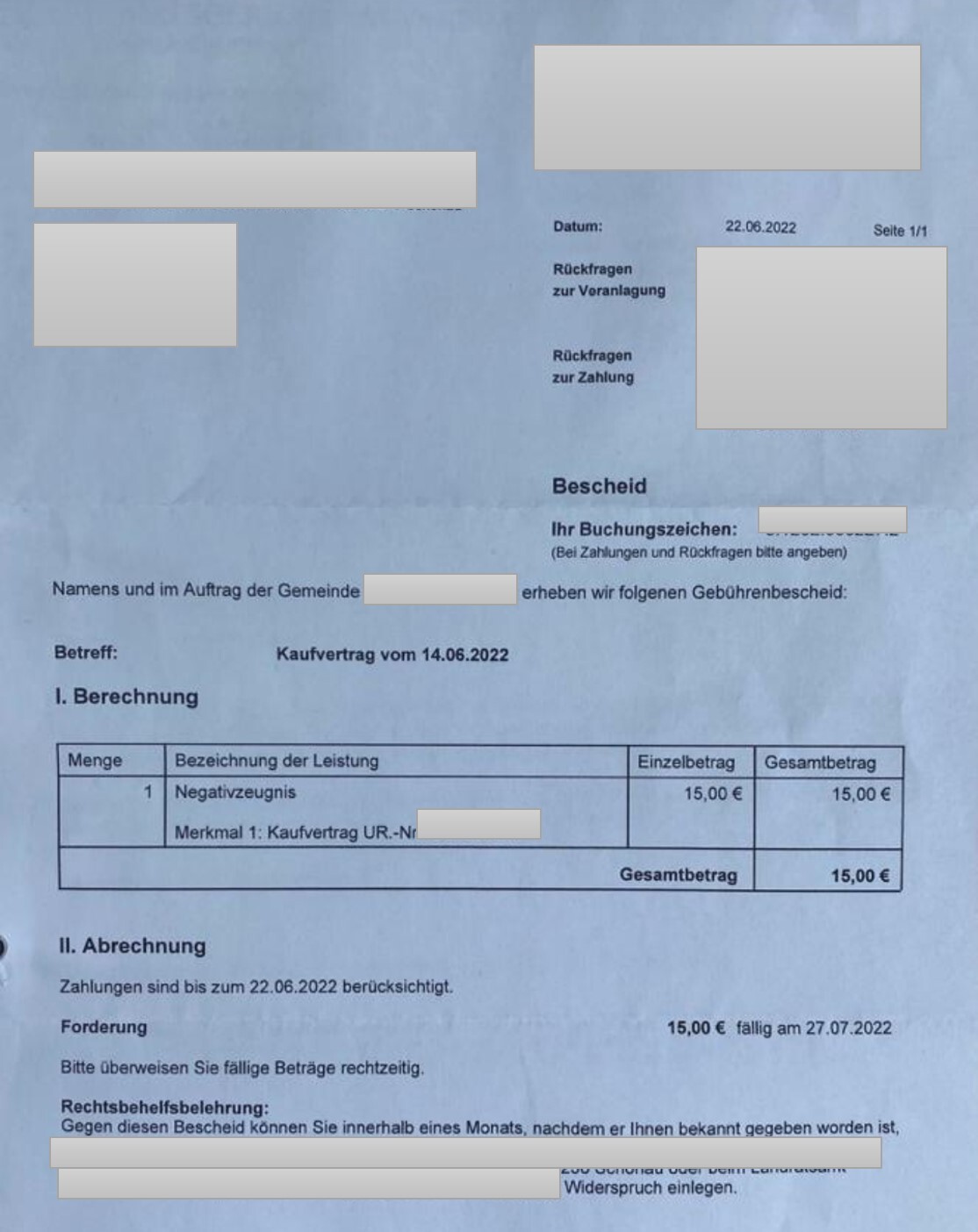
This type of certificate confirms that a municipality does not intend to exercise its pre-emptive right to purchase the property. The application for the negative certificate is usually handled by the appointed notary. The municipality charges a fee for issuing the certificate, which varies from one municipality to another. Attached is a sample.
Stainless schrieb:
Is this legally possible? Have you tried to take legal action against it? Given the current cost and interest rate situation, this could become problematic.
Normally, the right of first refusal must be well justified and also approved by the city or municipal council.It is quite common for municipalities to require a building obligation within 3 years (or similar) to be included in the purchase contract.S
Schwabe238 Aug 2022 03:30Yosan schrieb:
It is quite common for municipalities to require that a building obligation within 3 years (or similar) is included in the purchase contract. Yes, but only when the municipality or city sells the plot, not in a private sale. Using the right of first refusal to pressure builders is something rather "special."
Schwabe23 schrieb:
Yes, but not in a private sale, only when the municipality or city sells the land. Exercising the pre-emption right to pressure builders is quite something "special."No, it is actually quite common even in private sales. Municipalities want to prevent plots from being casually passed down among relatives and friends over generations, in case some distant cousin of the great-grandchild eventually wants to develop it, while in the meantime it could already have been built on multiple times.S
Stainless8 Aug 2022 17:22Schwabe23 schrieb:
It was really exciting for us! The municipality only waived their right of first refusal if we signed an additional building obligation. We had no choice but to sign it, which now, with the current cost increases, forces us to build. What would happen if construction doesn’t start within the deadline? Can the municipality still enforce the original agreement afterwards?
In which area was this roughly? Feel free to send a private message.
S
Schwabe238 Aug 2022 17:25District Biberach in BW. They could then buy back the plot of land at the original purchase price. However, the tax and notary fees would likely remain a loss.
A
Axolotl-neu8 Aug 2022 17:48Schwabe23 schrieb:
District of Biberach in BW. They could then buy back the property at the original purchase price. However, you would likely be left with the tax and notary costs.Perhaps some clarification: 1. Since the Land Development Act of 2021, municipalities have improved options to exercise their right of first refusal (right of pre-emption).
2. The deadline is now three months.
3. If you buy above market value (usually determined based on the standard land value plus adjustments), the municipality can set a lower purchase price when exercising its right of first refusal—but not below market value.
4. The consequence of the right of first refusal is that a new purchase contract is concluded between the seller and the municipality. There is no transfer of the contract you signed with the buyer. That contract is unwound.
==> Regarding your comment about costs: You owe no taxes since you did not actually purchase the property. Whether you can recover the notary fees is not yet definitively settled. However, the Federal Court of Justice (BGH) has ruled that the municipality must reimburse the broker fees, so there are at least good chances for recovery.
5. The buyer of a property has under certain conditions the right to prevent the exercise of the right of first refusal. They must then commit to complying with the municipality’s goals (such as building within x years, meeting certain ecological requirements, or other conditions). In practice, detailed agreements to avert the right are often made in the form of public-law contracts, which (unlike unilateral statements to avert) frequently go beyond the legally required purpose of averting and also provide security for the municipalities in case of performance failures.