
ᐅ Savings from photovoltaic system, battery storage, and electricity cloud
Created on: 4 Aug 2022 10:12
D
DaGoodness
In the construction cost thread, the topic of the usefulness of battery storage, energy cloud services, etc., came up recently.
So, here is a dedicated discussion thread on this subject.
Since May 2020, I have had a 10 kWp (kilowatt peak) system on my roof and a 10 kWh (kilowatt-hour) battery storage in the utility room. Additionally, since August 2020, I have been using an energy cloud service provided by the company Senec (EnBW).
With this service, the electricity fed into the grid during summer is credited to an account and can be drawn again in winter at favorable conditions. The general opinion on this topic everywhere is that it is not worthwhile. The same applies to the question of whether to have storage or not.
Therefore, I made a cost breakdown for myself and compared my current expenses with different scenarios such as "energy cloud service or regular electricity tariff," "photovoltaic system with and without storage," and the costs "completely without a photovoltaic system."
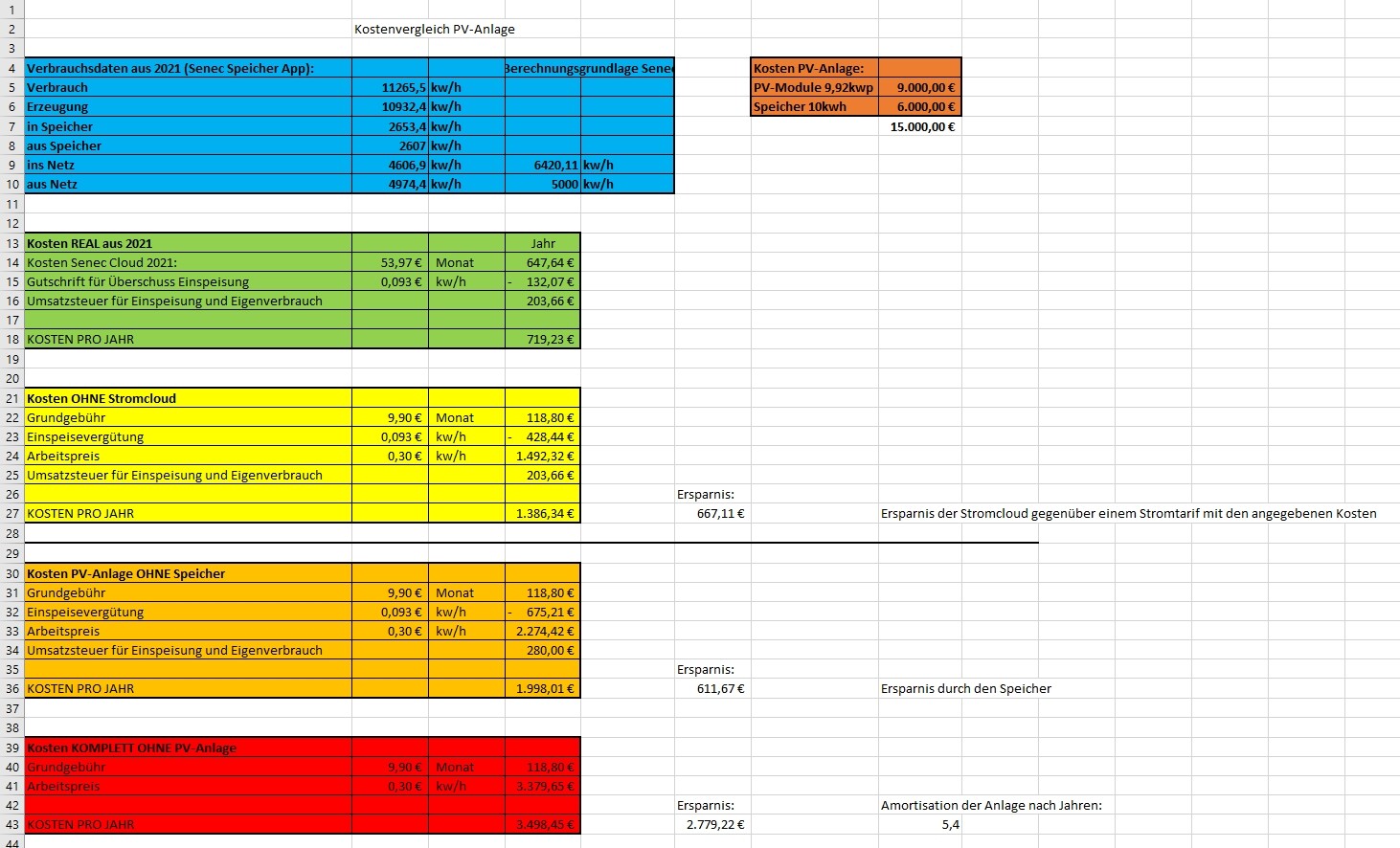
Attached you will find my breakdown.
Looking forward to an active discussion.
So, here is a dedicated discussion thread on this subject.
Since May 2020, I have had a 10 kWp (kilowatt peak) system on my roof and a 10 kWh (kilowatt-hour) battery storage in the utility room. Additionally, since August 2020, I have been using an energy cloud service provided by the company Senec (EnBW).
With this service, the electricity fed into the grid during summer is credited to an account and can be drawn again in winter at favorable conditions. The general opinion on this topic everywhere is that it is not worthwhile. The same applies to the question of whether to have storage or not.
Therefore, I made a cost breakdown for myself and compared my current expenses with different scenarios such as "energy cloud service or regular electricity tariff," "photovoltaic system with and without storage," and the costs "completely without a photovoltaic system."
Attached you will find my breakdown.
Looking forward to an active discussion.
N
Neubau20224 Aug 2022 14:32DaGoodness schrieb:
Please excuse the incorrect term. Just ignore the slash 🙄
I'll try to simplify it.
Thanks to the photovoltaic system, battery storage, and energy cloud, my total costs last year were 719.23.
If I hadn’t had the energy cloud and instead had a standard electricity tariff with a 9.90€ (about $10.50) monthly base fee and a usage price of 30 cents per kWh, I would have paid 1,386.34€, which is 667.11€ more. So in this case, the energy cloud would be cheaper.
If I hadn’t had the battery storage, I would have fed more electricity back to the grid and also needed to draw more from it. That would have resulted in additional costs of 611.67€.
If I hadn’t had any photovoltaic system at all, assuming again the electricity price of a 9.90€ (about $10.50) base fee and 30 cents per kWh, I would have paid a total of 3,498.45€. So that would mean a savings of 2,779.22€ in one year.
With an investment of 15,000€, the system would thus pay for itself after 5.4 years. Without the battery storage, the cost of purchasing the storage itself, which is then avoided, as well as maintenance costs, are still missing. Probably the same applies with and without Senec.
D
DaGoodness4 Aug 2022 14:46OWLer schrieb:
I actually didn’t find any contradictions in the screenshot. It seems to make sense to you now. How secure is the base fee for the coming years? Is it contractually fixed? Of course, prices at Senec are also adjusted annually. Just last month, we received a notice that the monthly fee will increase by 6€ per month (about $6.50). Compared to price hikes from other providers, that still seems quite reasonable. The provider of a coworker recently increased the base fee from 10€ to 30€ per month (about $11 to $33), and the consumption rate from 30 cents to 35 cents per kWh.
OWLer schrieb:
But your break-even point looks forced out of the electricity meter no matter what. I personally find the regular emptying of the water tank just for fun quite questionable, and then reheating it with the heating element? Why?
Not to mention that the kids are growing up thinking electricity and, especially, hot water are always free and available. They will thank you later when they get their first utility bill adjustment in their own apartment. That’s definitely open for discussion, and I completely agree there’s potential to save. But it’s not quite as bad as it might have sounded. Our kids don’t do that every time they shower, but it does happen occasionally. Our children are 8 and 4 years old, and they still like to bring toys and play while showering. I shower every morning, my wife showers every morning, and given the current weather, I take another shower in the evening. That naturally consumes a fair amount of water, which then has to be reheated by the heat pump or heating elements.
We do explain to the kids that all this costs money. 😉
Neubau2022 schrieb:
Without a storage tank, you also save the purchase costs of the storage as well as maintenance costs. The same probably applies to solutions with and without Senec storage. That’s true. The purchase costs would of course be eliminated. Based on my calculations, the storage tank would save about 600€ annually (around $650), so you could say it pays for itself after about 10 years.
For me, this means the storage system only really makes financial sense if it’s used for more than 10 years.
Since it’s often said that storage tanks don’t pay off, it naturally depends on the price of the storage unit itself. I think mine was simply very affordable.
I don’t have experience with maintenance costs yet. The system is just a bit over 2 years old, and so far, no maintenance has been necessary. Actually, shouldn’t such a system be maintenance-free? Of course, any repair work that might come up during operation would have to be factored into the calculations afterward.
N
Neubau20224 Aug 2022 15:52DaGoodness schrieb:
Of course, Senec also adjusts their prices annually. Just last month, we received a letter stating that the monthly fee will increase by €6 (about $6.50). Compared to the price hikes from other providers, though, this still seems reasonable. A colleague’s supplier has raised their basic monthly fee from €10 (about $11) to €30 (about $33), and the consumption price from €0.30 (30 cents) to €0.35 (35 cents) per kWh.
This is certainly open to discussion, and I fully agree that there is potential to save. But it’s not as bad as it might sound. It’s not like the kids shower every time with excess usage, but it does happen. Our children are now 8 and 4 years old, and they often take toys into the shower and play while showering. I shower every morning, my wife showers every morning, and with the current weather, I also shower again in the evening. That obviously uses a lot of water, which then needs to be reheated by the heat pump or the heating rods.
And we do explain to our kids that this all costs money. 😉
That’s true. The initial purchase cost would of course be eliminated. With savings of about €600 (around $650) annually from the storage system according to my calculation, you could say that the system pays for itself after around 10 years.
I have calculated for myself that the storage system would be worthwhile if it is used for more than 10 years.
There is often talk that storage systems aren’t worth it. Of course, this also depends on the price of the storage system. I think mine was very inexpensive.
I have no experience with maintenance costs so far. The system is just over 2 years old, and nothing has needed maintenance up to now. These systems are supposed to be maintenance-free, aren’t they? Any repairs that might occur would, of course, have to be factored back into the overall calculation afterwards. Storage capacity decreases over time. That should also be taken into account. Then you end up with 11-12 years. The question is whether the storage systems last that long.
D
DaGoodness4 Aug 2022 16:33Senec guarantees 100% storage capacity for 20 years.
It’s basically quite simple. My storage system currently has 4 batteries, each with a capacity of 3.28 kWh, so actually 13.12 kWh in total.
However, I can only use 10 kWh at any time. To ensure the 100% capacity over 20 years, Senec gradually releases more of the actually available storage capacity as it decreases over time, so it can always guarantee 10 kWh usable capacity.
It’s basically quite simple. My storage system currently has 4 batteries, each with a capacity of 3.28 kWh, so actually 13.12 kWh in total.
However, I can only use 10 kWh at any time. To ensure the 100% capacity over 20 years, Senec gradually releases more of the actually available storage capacity as it decreases over time, so it can always guarantee 10 kWh usable capacity.

I have three batteries installed, which totals 9.84 kWh. Senec states a capacity of 7.5 kWh. They always leave a buffer to ensure the guaranteed capacity over the warranty period. This is not a problem and actually better than the opposite. I believe I read that the warranty lasts for 10 years.
In our case, we also received a subsidy from the regional government, which made the decision to choose a storage system easier. So far, the cloud solution works very well for us, despite the €5.00 increase this month. And since the contract can be canceled annually, there is no risk.
Quote from the Senec website: 100% capacity guarantee for the first 10 years
In our case, we also received a subsidy from the regional government, which made the decision to choose a storage system easier. So far, the cloud solution works very well for us, despite the €5.00 increase this month. And since the contract can be canceled annually, there is no risk.
Quote from the Senec website: 100% capacity guarantee for the first 10 years
Similar topics