
ᐅ Savings from photovoltaic system, battery storage, and electricity cloud
Created on: 4 Aug 2022 10:12
D
DaGoodnessD
DaGoodness4 Aug 2022 10:12In the construction cost thread, the topic of the usefulness of battery storage, energy cloud services, etc., came up recently.
So, here is a dedicated discussion thread on this subject.
Since May 2020, I have had a 10 kWp (kilowatt peak) system on my roof and a 10 kWh (kilowatt-hour) battery storage in the utility room. Additionally, since August 2020, I have been using an energy cloud service provided by the company Senec (EnBW).
With this service, the electricity fed into the grid during summer is credited to an account and can be drawn again in winter at favorable conditions. The general opinion on this topic everywhere is that it is not worthwhile. The same applies to the question of whether to have storage or not.
Therefore, I made a cost breakdown for myself and compared my current expenses with different scenarios such as "energy cloud service or regular electricity tariff," "photovoltaic system with and without storage," and the costs "completely without a photovoltaic system."
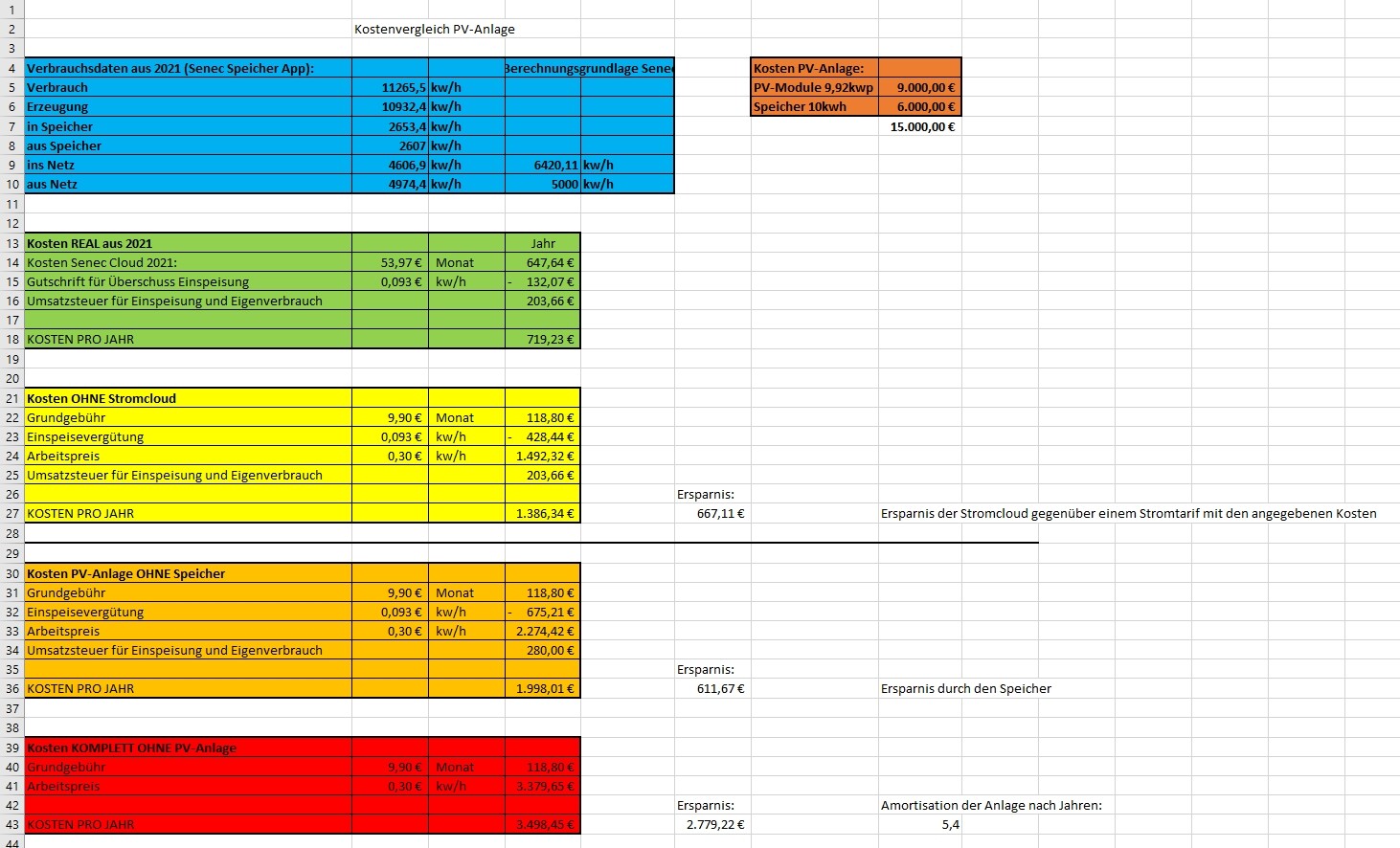
Attached you will find my breakdown.
Looking forward to an active discussion.
So, here is a dedicated discussion thread on this subject.
Since May 2020, I have had a 10 kWp (kilowatt peak) system on my roof and a 10 kWh (kilowatt-hour) battery storage in the utility room. Additionally, since August 2020, I have been using an energy cloud service provided by the company Senec (EnBW).
With this service, the electricity fed into the grid during summer is credited to an account and can be drawn again in winter at favorable conditions. The general opinion on this topic everywhere is that it is not worthwhile. The same applies to the question of whether to have storage or not.
Therefore, I made a cost breakdown for myself and compared my current expenses with different scenarios such as "energy cloud service or regular electricity tariff," "photovoltaic system with and without storage," and the costs "completely without a photovoltaic system."
Attached you will find my breakdown.
Looking forward to an active discussion.
R
RotorMotor4 Aug 2022 11:52I haven’t checked the bills yet, but your consumption seems very high to me. How is that possible?
D
DaGoodness4 Aug 2022 12:01Yes, the energy consumption is quite high.
This includes standard household electricity, heat pump, and electric car charging.
In the summer, additional loads like the pool and an air conditioning unit in the bedroom are added. In winter, I also run a 1600W (1.6 kW) convection heater when I am in the attic (almost daily).
We also have a very high water usage of about 200m³ (7060 cubic feet), simply because we shower a lot. Especially the kids tend to stay in the shower until the hot water tank is empty :P
The heating elements obviously consume more electricity due to the high hot water demand.
There is definitely potential for savings, that is correct. However, regarding the costs, I currently do not see any urgent need to take action.
This includes standard household electricity, heat pump, and electric car charging.
In the summer, additional loads like the pool and an air conditioning unit in the bedroom are added. In winter, I also run a 1600W (1.6 kW) convection heater when I am in the attic (almost daily).
We also have a very high water usage of about 200m³ (7060 cubic feet), simply because we shower a lot. Especially the kids tend to stay in the shower until the hot water tank is empty :P
The heating elements obviously consume more electricity due to the high hot water demand.
There is definitely potential for savings, that is correct. However, regarding the costs, I currently do not see any urgent need to take action.
D
DaGoodness4 Aug 2022 13:30driver55 schrieb:
I can’t follow the explanations, and whenever I see kW/h, I stop reading anyway… Please excuse the incorrect term. Just ignore the slash 🙄
I’ll try to simplify it.
Thanks to the photovoltaic system, battery storage, and electricity cloud service, my total costs last year were 719.23 euros.
Without the electricity cloud service and using a standard electricity tariff with a 9.90€ (approximately $10.50) monthly basic fee and a consumption rate of 30 cents per kWh (kilowatt-hour), I would have paid 1,386.34 euros, which is 667.11 euros more. So in this case, the electricity cloud is cheaper.
Without the battery storage, I would have fed more electricity back into the grid and also had to draw more from it. This would have resulted in additional costs of 611.67 euros.
If I had no photovoltaic system at all, assuming again the electricity price of a 9.90€ (approximately $10.50) basic monthly fee and 30 cents per kWh, I would have paid 3,498.45 euros in total. That equals a savings of 2,779.22 euros in one year.
With an investment of 15,000 euros, the system would have paid for itself in 5.4 years.

I didn’t actually find any contradictions in the screenshot. It seems to make sense to you now. How secure is the basic fee for the coming years? Is that contractually fixed?
Especially in 2022, enbw can sell your electricity on the market well above the feed-in tariff. I don’t think that would have worked the same way in 2020.
I still see your break-even point as being artificially forced from the electricity meter no matter what. Personally, I find regularly emptying the hot water tank just for fun pretty questionable, and then reheating it with the heating rods? Why?
Not to mention that the kids are being shown that electricity—and especially hot water—is always free and available. They’ll be thanking you later when they get their first utility bill adjustment after moving into their own place.
Especially in 2022, enbw can sell your electricity on the market well above the feed-in tariff. I don’t think that would have worked the same way in 2020.
DaGoodness schrieb:
In winter, I run a 1600W convection heater when I’m in the attic (almost daily).
We also have a very high water consumption of about 200m³ (260 cubic yards), since we simply shower a lot. Especially the kids sometimes stay in the shower until the hot water tank runs out :P
The heating rods then naturally consume more electricity again due to the high hot water consumption.
I still see your break-even point as being artificially forced from the electricity meter no matter what. Personally, I find regularly emptying the hot water tank just for fun pretty questionable, and then reheating it with the heating rods? Why?
Not to mention that the kids are being shown that electricity—and especially hot water—is always free and available. They’ll be thanking you later when they get their first utility bill adjustment after moving into their own place.
Similar topics