
ᐅ Single-Family House Floor Plan 147 m² – Opinions, Feedback, and Suggestions for Improvement?
Created on: 8 Jul 2022 12:14
I
Ilski30
Hello fellow home builders,
We have been working on the planning of our single-family home for a while now and believe we have found a solution that suits us quite well. The structural engineer/architect from our general contractor has implemented everything strictly according to our wishes and ideas, offering little to no suggestions or improvements from their side. As laypersons, it is difficult for us to assess whether we have really made the best choices. Therefore, we would like to benefit from your experience and expertise and are looking forward to your honest opinions and possible improvement suggestions.
Development plan/restrictions
Plot size: 327 m2
Slope: no
Floor area ratio: none (§34 based on neighboring buildings)
Building window, building line, and boundary: The current design fully occupies the building window (except for the terrace area) at 10.15m*8.9 m (33.3 ft * 29.2 ft)
Number of parking spaces: 1
Number of floors: 1.5 (knee wall height 1.5m (5 ft)) + basement
Roof type: gable roof 40-45° (currently planned at 40°), a hipped roof would have been nice but is probably not possible due to the nature of the neighboring buildings
Style: no specific preference. Should be visually appealing. Rather modern.
Orientation: Terrace faces west
Maximum height/limits: Eaves height 4.85 m (15.9 ft), ridge height 8.57 m (28.1 ft) (these are the data from a preliminary building permit. The current design is 14 cm (5.5 inches) and 18 cm (7 inches) taller respectively)
Additional requirements: Heat pump + possibly central ventilation system
Homeowners’ requirements
Style: somewhat modern/appealing
Roof type: gable roof (hipped roof apparently not possible. We could submit the building application with a hipped roof on a whim, but it seems too risky. It would likely cause significant delays)
Building type: single-family house
Basement: yes
Floors: 3 or effectively 2.5
Number of occupants, ages: 2 small children + 2 adults
Space requirements on ground floor and upper floor: normal – 2 children’s rooms + master bedroom + office
Office: family use or home office? Office is absolutely necessary (two people working from home a lot)
Overnight guests per year: few and rare (can be accommodated in the office if needed)
Open or closed architecture: open living/dining area with kitchen. Kitchen should ideally not be too visible.
Conservative or modern construction: as long as it is functional, both are fine
Open kitchen, kitchen island: yes to both
Number of dining seats: mostly 4, with option to expand to 8–10 people
Fireplace: no
Music/stereo wall: possibly a feature wall planned
Balcony, roof terrace: no
Garage, carport: carport + bicycle/tool shed at the back planned, but placement is not yet final. Open to ideas here.
Other wishes/particulars/daily routine, including reasons for preferences or rejections:
House design
Planning by:
-architect/structural engineer of our general contractor.
Heating technology: heat pump and possibly a central ventilation system (still undecided. What is your opinion on this?), conduit installed for future photovoltaic system installation
What do you particularly like? Why?
What do you not like? Why?
What is the most important/basic question about the floor plan summarized in 130 characters?
We are interested in your opinion on the floor plan. What is good? What is not so good and should be changed? What worked well for you?
We appreciate any hint or suggestion, no matter how small.
Thanks in advance and best regards!
We have been working on the planning of our single-family home for a while now and believe we have found a solution that suits us quite well. The structural engineer/architect from our general contractor has implemented everything strictly according to our wishes and ideas, offering little to no suggestions or improvements from their side. As laypersons, it is difficult for us to assess whether we have really made the best choices. Therefore, we would like to benefit from your experience and expertise and are looking forward to your honest opinions and possible improvement suggestions.
Development plan/restrictions
Plot size: 327 m2
Slope: no
Floor area ratio: none (§34 based on neighboring buildings)
Building window, building line, and boundary: The current design fully occupies the building window (except for the terrace area) at 10.15m*8.9 m (33.3 ft * 29.2 ft)
Number of parking spaces: 1
Number of floors: 1.5 (knee wall height 1.5m (5 ft)) + basement
Roof type: gable roof 40-45° (currently planned at 40°), a hipped roof would have been nice but is probably not possible due to the nature of the neighboring buildings
Style: no specific preference. Should be visually appealing. Rather modern.
Orientation: Terrace faces west
Maximum height/limits: Eaves height 4.85 m (15.9 ft), ridge height 8.57 m (28.1 ft) (these are the data from a preliminary building permit. The current design is 14 cm (5.5 inches) and 18 cm (7 inches) taller respectively)
Additional requirements: Heat pump + possibly central ventilation system
Homeowners’ requirements
Style: somewhat modern/appealing
Roof type: gable roof (hipped roof apparently not possible. We could submit the building application with a hipped roof on a whim, but it seems too risky. It would likely cause significant delays)
Building type: single-family house
Basement: yes
Floors: 3 or effectively 2.5
Number of occupants, ages: 2 small children + 2 adults
Space requirements on ground floor and upper floor: normal – 2 children’s rooms + master bedroom + office
Office: family use or home office? Office is absolutely necessary (two people working from home a lot)
Overnight guests per year: few and rare (can be accommodated in the office if needed)
Open or closed architecture: open living/dining area with kitchen. Kitchen should ideally not be too visible.
Conservative or modern construction: as long as it is functional, both are fine
Open kitchen, kitchen island: yes to both
Number of dining seats: mostly 4, with option to expand to 8–10 people
Fireplace: no
Music/stereo wall: possibly a feature wall planned
Balcony, roof terrace: no
Garage, carport: carport + bicycle/tool shed at the back planned, but placement is not yet final. Open to ideas here.
Other wishes/particulars/daily routine, including reasons for preferences or rejections:
House design
Planning by:
-architect/structural engineer of our general contractor.
Heating technology: heat pump and possibly a central ventilation system (still undecided. What is your opinion on this?), conduit installed for future photovoltaic system installation
What do you particularly like? Why?
- Good layout and room distribution. Easy to furnish.
What do you not like? Why?
- Exterior dimensions of the house are unfortunately not flexible because spacing rules must be followed. It might only be possible to make it longer, which would reduce garden space.
- Kitchen and dining area could be a bit larger. However, this would likely come at the expense of the cloakroom and guest WC. The guest WC could probably be made about 25cm (10 inches) narrower if the positions of the toilet and washbasin were swapped.
- No natural light in the stairwell or hallway. Possibly install a window here?
- Would a different staircase design create more space? Probably, but it would also cause major changes to the floor plan.
- Cloakroom may be very small. We also have difficulty imagining how this will feel later. The planned pipe routing for wastewater and ventilation in the cloakroom currently takes up quite a lot of space. Maybe swapping cloakroom and guest WC could help?
- The architect has included some very large windows. For example, the office has a 1.76m (5.8 ft) wide window. We wonder if this is necessary, especially given the view is just the driveway and neighbor’s house. What do you think about window sizes?
- The shower has two solid side walls, which may make it quite dark. Currently, daylight only comes from the front. How do you handle shower width? What did you choose?
- The carport location is not ideal. We would have to reverse along a 15m (49 ft) long driveway. Perhaps better to place it on the south side and keep the bike shed in the current position?
- Room layout and window positioning in the basement. Would you keep it this way?
What is the most important/basic question about the floor plan summarized in 130 characters?
We are interested in your opinion on the floor plan. What is good? What is not so good and should be changed? What worked well for you?
We appreciate any hint or suggestion, no matter how small.
Thanks in advance and best regards!

Yes, I suspected as much. Walls with a thickness of 32cm (13 inches) are a bit of a shortcut. I would recommend increasing to at least 40cm (16 inches) to be safe. Of course, that will be noticeable inside.
The maneuvering area is also planned as expected. Accordingly, the parking space should be located on the south side. This is unfortunate, especially considering the sun, but it cannot be changed. The crucial question here is the roof or cover. If you want the car to stay dry, you’d need to come to an agreement with the neighbor. Anything else, in my opinion, is not worth it. This also affects how much light you can get from the south and ultimately the whole design. Is the seller of the plot also your builder or general contractor?
Regarding the draft: this was put together quickly and is only meant as a suggestion. Windows and doors are always just examples and roughly sketched. If you want it differently, feel free to change as you like. Everything is allowed as long as the house stays stable. Or put another way: the structural engineer always has the final say.
With the current information or what’s still missing, the orientation (especially of the kitchen) would be adjusted to the conditions. Perhaps you mirror the layout or place the kitchen directly on the terrace.
About the questions:
The U-shaped staircase is planned with a total width of 2.20m (7 ft 3 in). That’s one of the narrowest staircases, but it is a very small house after all. Still, it’s a decent dimension. The length depends on the floor-to-ceiling height. It shouldn’t be deeper than around 2.10m (6 ft 11 in). For playing around with stairs, google “Treppe 1x1” if you have time and interest.
The small wall next to the kitchen island is load-bearing and is supposed to support the wall and ceiling above. Since not much more than a column is needed for that, I included a window just for aesthetics — if it were me, I’d add a floral pattern on the glass (that would be something for @ypg 😉). This way, it stays light and open, yet somewhat separated from the living area. You can also plan just a column if the wall is in the way. Maybe you could even manage without a column, but I doubt it. I adapted the width to the island. In the plan, that’s 85cm (33 inches).
The living area is about 4m (13 ft) deep. That’s a standard good size for small houses. In your floor plan, it’s closer to 5m (16 ft). That is of course nice, but it causes tight spots elsewhere. The goal is to distribute space sensibly so everything feels right. A huge living room isn’t very useful if the kitchen is cramped off to the side. Ultimately, it’s also a matter of priorities and budget. You would immediately gain a lot more space if the office moved to the basement. For that, you’d need a light well, which should be carefully considered due to limited space on the plot. But it’s not impossible. I’d probably even plan an outside stairway to the basement if at all possible.
@ypg Do you know if exterior basement stairs are considered secondary structures or if they might be exempt from the 3m (10 ft) setback rule?
The maneuvering area is also planned as expected. Accordingly, the parking space should be located on the south side. This is unfortunate, especially considering the sun, but it cannot be changed. The crucial question here is the roof or cover. If you want the car to stay dry, you’d need to come to an agreement with the neighbor. Anything else, in my opinion, is not worth it. This also affects how much light you can get from the south and ultimately the whole design. Is the seller of the plot also your builder or general contractor?
Regarding the draft: this was put together quickly and is only meant as a suggestion. Windows and doors are always just examples and roughly sketched. If you want it differently, feel free to change as you like. Everything is allowed as long as the house stays stable. Or put another way: the structural engineer always has the final say.
With the current information or what’s still missing, the orientation (especially of the kitchen) would be adjusted to the conditions. Perhaps you mirror the layout or place the kitchen directly on the terrace.
About the questions:
The U-shaped staircase is planned with a total width of 2.20m (7 ft 3 in). That’s one of the narrowest staircases, but it is a very small house after all. Still, it’s a decent dimension. The length depends on the floor-to-ceiling height. It shouldn’t be deeper than around 2.10m (6 ft 11 in). For playing around with stairs, google “Treppe 1x1” if you have time and interest.
The small wall next to the kitchen island is load-bearing and is supposed to support the wall and ceiling above. Since not much more than a column is needed for that, I included a window just for aesthetics — if it were me, I’d add a floral pattern on the glass (that would be something for @ypg 😉). This way, it stays light and open, yet somewhat separated from the living area. You can also plan just a column if the wall is in the way. Maybe you could even manage without a column, but I doubt it. I adapted the width to the island. In the plan, that’s 85cm (33 inches).
The living area is about 4m (13 ft) deep. That’s a standard good size for small houses. In your floor plan, it’s closer to 5m (16 ft). That is of course nice, but it causes tight spots elsewhere. The goal is to distribute space sensibly so everything feels right. A huge living room isn’t very useful if the kitchen is cramped off to the side. Ultimately, it’s also a matter of priorities and budget. You would immediately gain a lot more space if the office moved to the basement. For that, you’d need a light well, which should be carefully considered due to limited space on the plot. But it’s not impossible. I’d probably even plan an outside stairway to the basement if at all possible.
@ypg Do you know if exterior basement stairs are considered secondary structures or if they might be exempt from the 3m (10 ft) setback rule?
K a t j a schrieb:
32 cm (12.6 inches) walls are a bit of a shortcut. I would recommend increasing that to at least 40 cm (16 inches) just to be safe. Of course, that will be noticeable on the inside. We thought that as long as the building meets the Building Energy Act requirements, this would be the better option for us. KfW incentives no longer exist anyway, and dedicating extra living space just for insulation seemed wasteful. According to the general contractor, the savings on heating costs between complying with the Building Energy Act and achieving KfW55 standards are negligible. What other benefits would thicker walls provide? Moisture protection because the walls don’t get as cold, perhaps?
K a t j a schrieb:
The maneuvering area is, as expected, officially planned as such. Accordingly, the parking space should be placed on the south side. It’s unfortunate because of the sun, but it can’t be changed. The crucial question is whether the parking should be covered. If you want to keep the car dry, you would have to come to an agreement with the neighbor. Everything else, in my opinion, is nonsense. This also affects how much light you can get from the south and ultimately the overall planning. Is the land seller also your builder or general contractor? I’ve sketched out the two possible options again here. In option A, the carport or parking space is on the south side. What I find particularly disadvantageous is that quite a bit of garden area is lost, and from the living room or kitchen you would be looking directly at a parked car. I’m still undecided whether maneuvering will be easier than in option B (carport/parking space on the north side). I marked possible driving paths in red. Either you have to drive quite far through and then reverse into the parking spot, or somehow park directly forwards.
Of course, in option B (carport on the north side), driving in and out is also a bit inconvenient since reversing is necessary, but you retain the garden area on the south side and could even place a garden door there. This way, the designated maneuvering areas are not compromised. Or am I overlooking something important here? We also considered that the car doesn’t necessarily need to be covered. This would allow more light into the house entrance area. The downside, of course, is access to the bike/tool shed when the car is parked. However, with a 4 m (13 feet) wide driveway, there should still be enough space to pass the car on the left. What do you think? By the way, is the bike shed in its current location really sensible? The choice between these two variants is really not easy. We also have to plan somewhere for trash containers, but I’m not sure yet where they can or should be placed… 🤨 Maybe at the lower corner of the house, on the right? So, at the southeast corner.
K a t j a schrieb:
The U-shaped staircase is planned with a total width of 2.20 m (7.2 feet). That’s one of the narrowest staircases, but it is a very small house after all. Still, that’s a good dimension. The length is determined by the floor height. It shouldn’t be much lower than 2.10 m (6.9 feet). For playing on stairs, google “Treppe 1x1” if you have time and interest.
The small wall next to the kitchen island is load-bearing and is intended to support the wall and ceiling above. Since it doesn’t require much more than a column, I added a window there. Simply for aesthetics—if it were me, I’d have a floral pattern in the glass (that would be something for @ypg 😉). This keeps it light and airy while still somewhat shielding from the living area. You can also design it as just a column if the wall gets in the way. Maybe it’s possible without a column, but I doubt it. The width matches the island. It’s 85 cm (33 inches) in the plan. Thanks again for the measurements @K a t j a. I redrew your design based on those and placed some of our furniture.
Ground Floor and First Floor
The area for the living/dining/kitchen space has turned out quite generous at 42.6 m² (458 sq ft) 🙂 I actually like the solution with the small partition wall. Depending on the sofa's orientation, you don’t look directly at the kitchen island. After all, things aren’t always tidy and put away 😉 Our highboard fits in quite well too (on the short side of the kitchen island).
The children’s rooms upstairs are also very spacious now, which we really like! The bedroom is definitely large enough for us. We played around a bit with the bedroom door placement to be able to position a large wardrobe on the left wall. The sloping ceiling at the bottom wall gets in the way there. I’m not sure whether this angled wall makes sense or if it’s a short-sighted idea. Regarding the bathroom, we need to think about the layout of the shower and bathtub. Maybe a corner bathtub would have advantages here.
Stairs
I have a few questions about the stairs. You placed the basement stairs on the kitchen side, @K a t j a. Are there specific rules or advantages, or could it be swapped so that you enter the basement from the hallway? Also, I wanted to ask at what height (e.g., relative to the upper floor level) the additional window by the staircase landing will be positioned?
Basement
I think there isn’t much room for flexibility in the basement design since the layout is defined by the walls above. We’re not sure whether the utility/technical room is a bit too small now. We actually want to use it for drying laundry as well. 😉 Also, I’m not fully clear on how the water connections for the kitchen would be routed, since it’s now on the opposite side. 😀
K a t j a schrieb:
You would have a lot more space immediately if the office is moved to the basement. That requires a light well, which needs to be carefully considered due to limited space on the plot. But it’s not impossible. I would probably even plan an external staircase to the basement if possible. There’s definitely enough space in the basement for an office, but I have no idea where we could fit a light well on our tiny plot. I’m afraid an external staircase would also take up quite a lot of space 🙁 Of course, you can work with artificial light, but given the amount of time spent working, that’s not really ideal. I agree, though, that an office in the basement would really relieve the living/kitchen area situation. A larger hallway would also be possible then.
As far as I know, the minimum requirements of the energy-saving regulations are already so high that a 32cm (12.6 inches) wall probably won’t be sufficient. Only your general contractor knows the exact wall structure they will use. Just ask them.
Only you can decide whether to change the staircase direction. Generally, when children are involved, it’s advisable to separate living spaces from bedrooms for more quiet. It’s usually less about the kids making noise and more about the clattering of dishes by the parents when the kids are already in bed. With a knee wall height of 1.50m (4 feet 11 inches), I positioned the window at the stairs almost at floor level—about 20cm (8 inches) high. But these are things you have to decide for yourselves. You should look at and try out window sizes and heights in other houses of similar size. This is also what your architect is there for—to advise you.
I wasn’t too rigid about the bedroom closet. I have a 2m (6 feet 6 inches) wardrobe up to the sloped ceiling. The rest were highboards. Sloped walls are not really my preference and are more of a last resort. People often place a highboard in front of the bed instead of a wardrobe to have a spot for a screen. But of course, that’s your decision.
I would always plan the basement last. It needs to fit in with the rest. We can review that again once you’ve finished planning the other floors. I had planned a laundry chute in the bathroom, which should of course lead all the way down to the laundry room.
Only you can decide whether to change the staircase direction. Generally, when children are involved, it’s advisable to separate living spaces from bedrooms for more quiet. It’s usually less about the kids making noise and more about the clattering of dishes by the parents when the kids are already in bed. With a knee wall height of 1.50m (4 feet 11 inches), I positioned the window at the stairs almost at floor level—about 20cm (8 inches) high. But these are things you have to decide for yourselves. You should look at and try out window sizes and heights in other houses of similar size. This is also what your architect is there for—to advise you.
I wasn’t too rigid about the bedroom closet. I have a 2m (6 feet 6 inches) wardrobe up to the sloped ceiling. The rest were highboards. Sloped walls are not really my preference and are more of a last resort. People often place a highboard in front of the bed instead of a wardrobe to have a spot for a screen. But of course, that’s your decision.
I would always plan the basement last. It needs to fit in with the rest. We can review that again once you’ve finished planning the other floors. I had planned a laundry chute in the bathroom, which should of course lead all the way down to the laundry room.
Ilski30 schrieb:
I have marked possible driving routes in red. Does the right of way apply beyond the 3 meters (10 feet)? If there is a neighbor’s fence there, a smooth curve is not possible.
Here is a proposal with an office in the basement and a light well facing south (north is to the right on the plan):
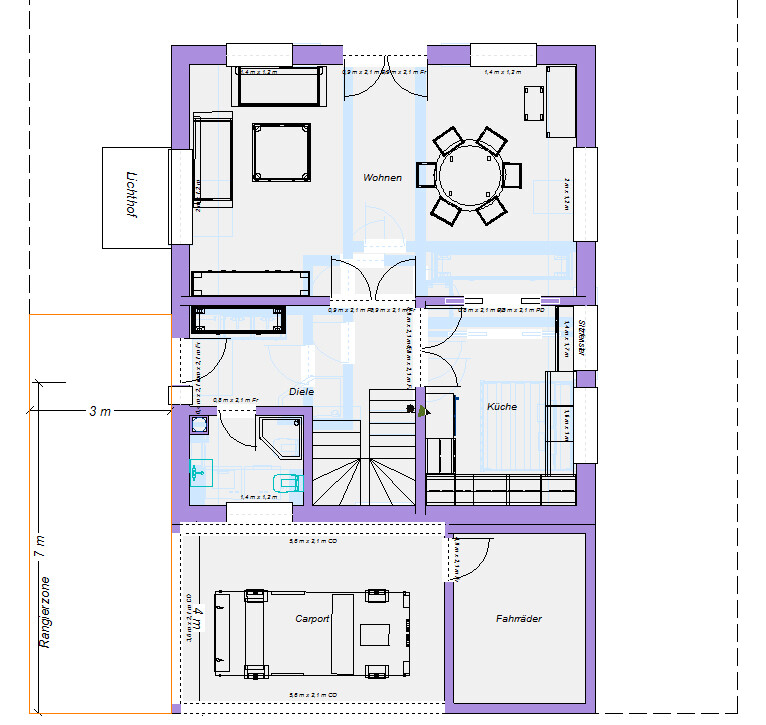

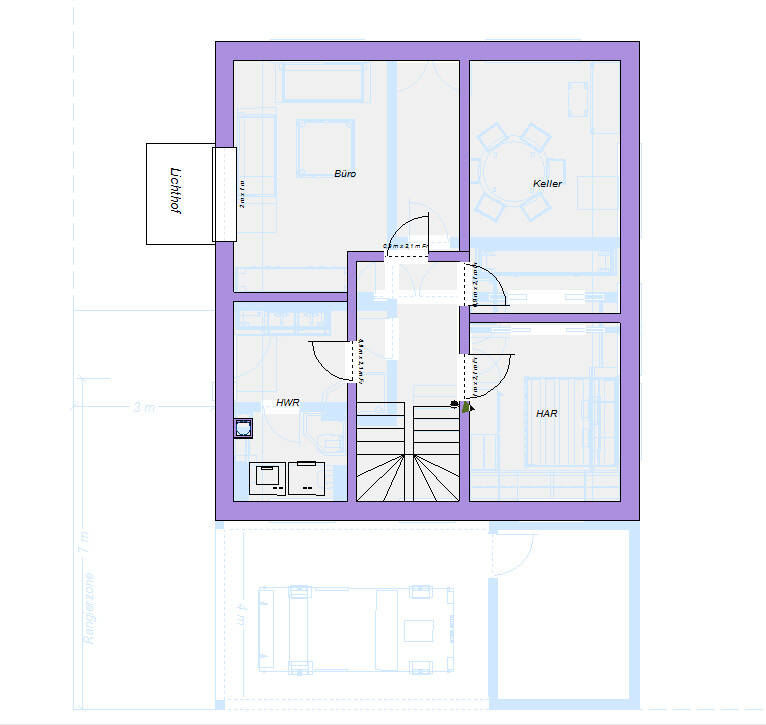
If you are already digging the basement, creating a light well is quite easy. Since the rooms in the basement have a ceiling height of 2.44 m (8 feet), and you are not entirely sure what all will go down there, I would try to place the office downstairs. Of course, the office would need underfloor heating, and you should also find out how the office insulation can be implemented. In return, you gain a nice area for living space and kitchen on the ground floor.
The plot is small and requires some compromises. In the example, I positioned the bike shed directly next to the carport, creating a 9 x 4 m (30 x 13 feet) space for the car and bicycles. As a result, the kitchen only has windows facing north. That’s a bit unfortunate, but to make up for it, I added a window seat.
Also, I would use the otherwise unusable turning area to locate the main entrance here, keeping pathways short.
At first, I had the kitchen facing south and the entrance on the north side, but that layout is simply too wasteful and impractical here. Possibly, you might also need to swap the heating system room (HAR) and the utility room in the basement. However, the laundry chute must remain where it is.
One remaining question is the structural stability. The walls are quite irregularly distributed. It might be necessary to use at least some light partition walls (drywall) in the upper floor.
If you are already digging the basement, creating a light well is quite easy. Since the rooms in the basement have a ceiling height of 2.44 m (8 feet), and you are not entirely sure what all will go down there, I would try to place the office downstairs. Of course, the office would need underfloor heating, and you should also find out how the office insulation can be implemented. In return, you gain a nice area for living space and kitchen on the ground floor.
The plot is small and requires some compromises. In the example, I positioned the bike shed directly next to the carport, creating a 9 x 4 m (30 x 13 feet) space for the car and bicycles. As a result, the kitchen only has windows facing north. That’s a bit unfortunate, but to make up for it, I added a window seat.
Also, I would use the otherwise unusable turning area to locate the main entrance here, keeping pathways short.
At first, I had the kitchen facing south and the entrance on the north side, but that layout is simply too wasteful and impractical here. Possibly, you might also need to swap the heating system room (HAR) and the utility room in the basement. However, the laundry chute must remain where it is.
One remaining question is the structural stability. The walls are quite irregularly distributed. It might be necessary to use at least some light partition walls (drywall) in the upper floor.
Many thanks @K a t j a for your ideas, drafts, and especially your time. Sorry for the late reply.
This is definitely a very interesting suggestion from you. If I understand correctly, we would have to do without the dormer with this solution, right? How does it work with the light well? Does the 3m (10 feet) distance rule to the neighbor also apply there, or is it exempt? A separate kitchen also has its advantages. Now we have the difficult choice 😉
Last Monday, we had your first draft worked out by our builder. I think it has improved enormously compared to what we had before. We now have a practical hallway, the kitchen is nicely spacious, and the children’s rooms upstairs are also quite generous. I have attached the new drawings. The carport is still shown in the elevations, but we are considering leaving it out and keeping only the bicycle/tool shed on the north side. The car doesn’t necessarily need to be covered, and there is usually a spot free on the street anyway. And if no space is available or if we need to load the car, we could still park it in front of the entrance. The green strip on the south side could then be used entirely as a garden from the end of the turning area.
A few open questions remain about the attached floor plan. For example, in the living room, the small wall to the right of the kitchen island creates a rather narrow passage between the stairs and the island. It may also be possible to build without this small supporting wall. This would require the living room ceiling to be slightly more solid. We are still waiting for our builder’s response about any additional costs this would involve. It would, of course, make the living room much more open and spacious.
We also need to consider whether the laundry shaft could be moved slightly toward the bathtub. From my point of view, it’s not ideal so close to the toilet. But maybe that impression is deceptive. Furthermore, we still need to decide whether the door of the north-facing children’s room should be moved slightly downwards. This would create a somewhat more symmetrical look in the hallway, although the current solution is probably better for the room itself.
It might also be possible to combine this floor plan with the light well proposed by @K a t j a.
Well, please have a look. Maybe you’ll spot something else. We appreciate any advice that brings us closer to our final floor plan 🙂
Best regards
This is definitely a very interesting suggestion from you. If I understand correctly, we would have to do without the dormer with this solution, right? How does it work with the light well? Does the 3m (10 feet) distance rule to the neighbor also apply there, or is it exempt? A separate kitchen also has its advantages. Now we have the difficult choice 😉
Last Monday, we had your first draft worked out by our builder. I think it has improved enormously compared to what we had before. We now have a practical hallway, the kitchen is nicely spacious, and the children’s rooms upstairs are also quite generous. I have attached the new drawings. The carport is still shown in the elevations, but we are considering leaving it out and keeping only the bicycle/tool shed on the north side. The car doesn’t necessarily need to be covered, and there is usually a spot free on the street anyway. And if no space is available or if we need to load the car, we could still park it in front of the entrance. The green strip on the south side could then be used entirely as a garden from the end of the turning area.
A few open questions remain about the attached floor plan. For example, in the living room, the small wall to the right of the kitchen island creates a rather narrow passage between the stairs and the island. It may also be possible to build without this small supporting wall. This would require the living room ceiling to be slightly more solid. We are still waiting for our builder’s response about any additional costs this would involve. It would, of course, make the living room much more open and spacious.
We also need to consider whether the laundry shaft could be moved slightly toward the bathtub. From my point of view, it’s not ideal so close to the toilet. But maybe that impression is deceptive. Furthermore, we still need to decide whether the door of the north-facing children’s room should be moved slightly downwards. This would create a somewhat more symmetrical look in the hallway, although the current solution is probably better for the room itself.
It might also be possible to combine this floor plan with the light well proposed by @K a t j a.
Well, please have a look. Maybe you’ll spot something else. We appreciate any advice that brings us closer to our final floor plan 🙂
Best regards
Similar topics