
ᐅ Hole of 160 mm diameter for a steel column in the terrace slab with a minimum edge distance
Created on: 30 Jun 2022 19:08
E
Ert2022Hello everyone,
We are planning to cover our terrace with porcelain stoneware tiles measuring 60x60 cm (24x24 inches), 20 mm (0.8 inches) thick, installed on pedestals, and are currently deciding on the ideal laying pattern. We have two questions:
1. There is a steel column on the terrace that supports the overhanging upper floor. Does the cutout for this column have to be placed exactly on a tile joint, or is it possible to drill the hole more centrally and later glue back the piece that was cut out to fit the tile, as shown in the attached sketch? What options are there for making the cut from the edge to the hole as narrow as possible so that the replacement piece fits back in as seamlessly as possible?
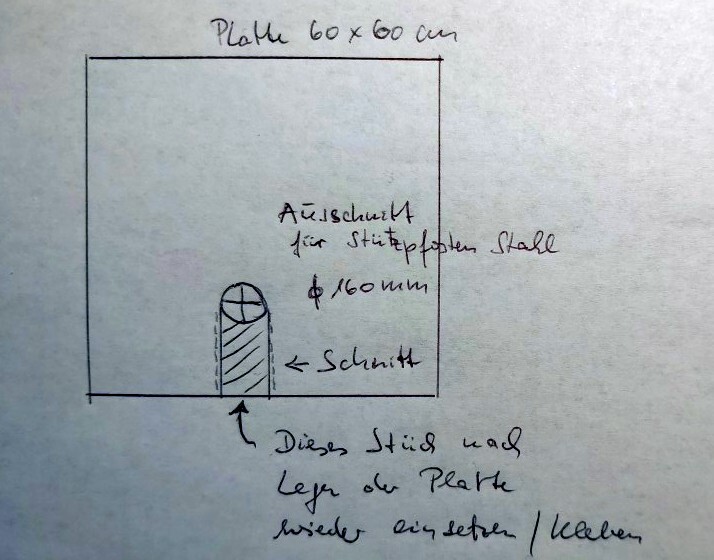
Alternatively, could the hole be drilled and then the tile broken along the axis toward the hole (instead of sawing, to avoid material loss), and after inserting the replacement piece, glued back together? Is this feasible with 20 mm (0.8 inches) thick tiles?
Who would be able to make such holes or cuts?
2. How wide should the tile pieces at the edges be at a minimum? For example, if we start laying with whole tiles on one side, the pieces left over at the other end would be about 8 cm (3 inches) wide. Can this work with pedestals, or would the narrow pieces simply need to be glued?
Looking forward to your advice,
Ertmann
We are planning to cover our terrace with porcelain stoneware tiles measuring 60x60 cm (24x24 inches), 20 mm (0.8 inches) thick, installed on pedestals, and are currently deciding on the ideal laying pattern. We have two questions:
1. There is a steel column on the terrace that supports the overhanging upper floor. Does the cutout for this column have to be placed exactly on a tile joint, or is it possible to drill the hole more centrally and later glue back the piece that was cut out to fit the tile, as shown in the attached sketch? What options are there for making the cut from the edge to the hole as narrow as possible so that the replacement piece fits back in as seamlessly as possible?
Alternatively, could the hole be drilled and then the tile broken along the axis toward the hole (instead of sawing, to avoid material loss), and after inserting the replacement piece, glued back together? Is this feasible with 20 mm (0.8 inches) thick tiles?
Who would be able to make such holes or cuts?
2. How wide should the tile pieces at the edges be at a minimum? For example, if we start laying with whole tiles on one side, the pieces left over at the other end would be about 8 cm (3 inches) wide. Can this work with pedestals, or would the narrow pieces simply need to be glued?
Looking forward to your advice,
Ertmann
The sketch is a bit misleading because the opening will end up twice as large...
I would lay the panels so that the opening is split evenly between two, creating two half-circles. These should also be positioned around the middle section.
Is a traditional cross joint planned here?
Then you need to start with 34 cm (13 inches). The last piece would also be 34 cm (13 inches).
For the depth of the terrace, you have to align it with the column.
First step: determine the exact measurements of the terrace and the position of the column, then draft and calculate accordingly.
I would lay the panels so that the opening is split evenly between two, creating two half-circles. These should also be positioned around the middle section.
Is a traditional cross joint planned here?
Ert2022 schrieb:
For example, if I start with whole tiles on one side, there will be 8 cm (3 inches) wide pieces left at the other end.
Then you need to start with 34 cm (13 inches). The last piece would also be 34 cm (13 inches).
For the depth of the terrace, you have to align it with the column.
First step: determine the exact measurements of the terrace and the position of the column, then draft and calculate accordingly.
B
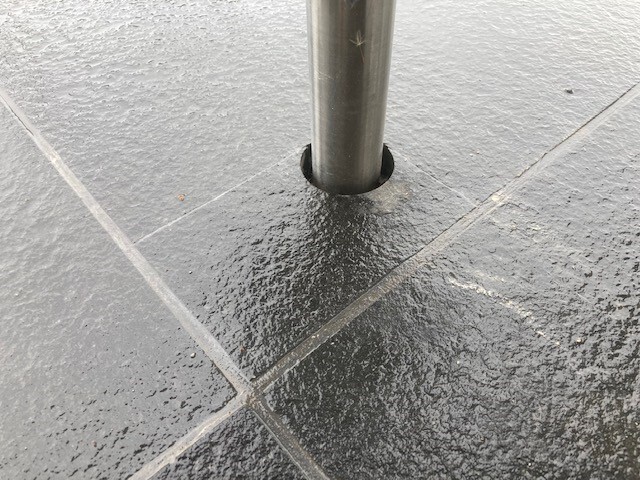
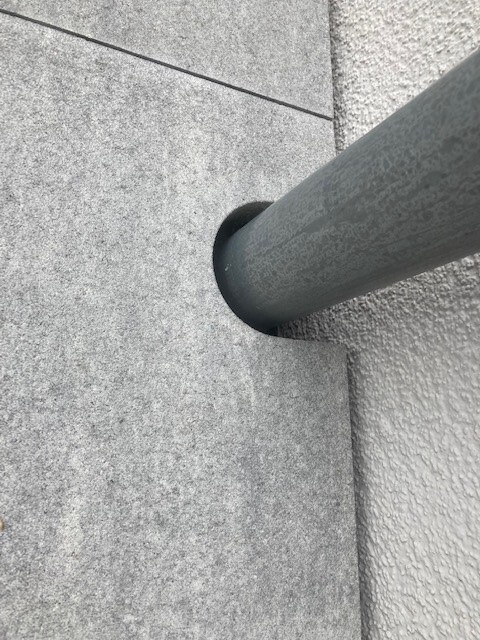
borderpuschl1 Jul 2022 15:11I had all my panels cut with a water jet. Exact to the millimeter, and for your application, see photo 1, about 1mm (0.04 inches) cut.
Similar topics