
Hello everyone,
I would like to ask the experts for an assessment of our offer (A1, A2, A3) – as far as it is technically and financially feasible.
We want to fully cover the south side of the roof (total 6.4 kWp (kilowatt peak)) without storage. Since we will also be getting a heat pump (SG ready), we want to supply it with photovoltaic power.
The system can be installed directly at the beginning of September, right after the roofer’s work is finished. It will be handled and carried out by an acquaintance who is always available to support us with advice and assistance. We are newcomers in this field ourselves.
With a total net cost of 10,000 €, I calculate an average of €1,562.50 per kWp.
Title 02 in the summary refers to the Home Manager, not to the energy storage (which I had removed from the offer, as it was originally included).
I look forward to your feedback.
Best regards,
Christian
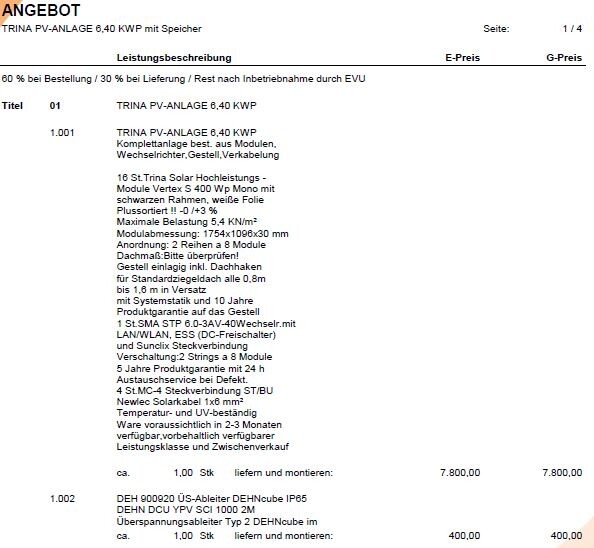
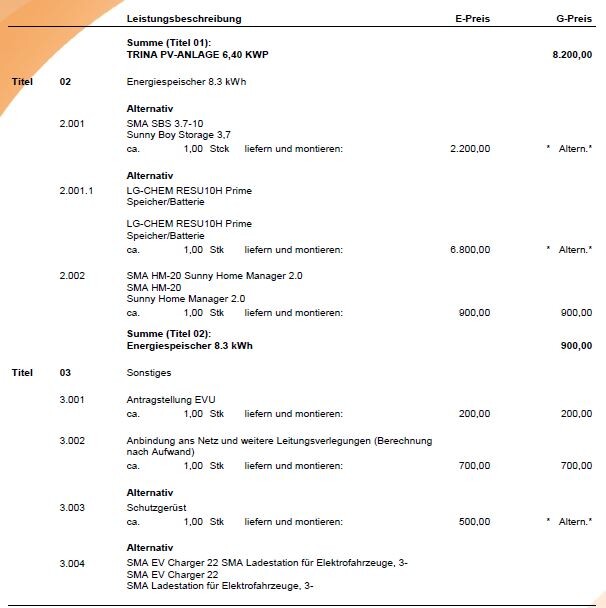
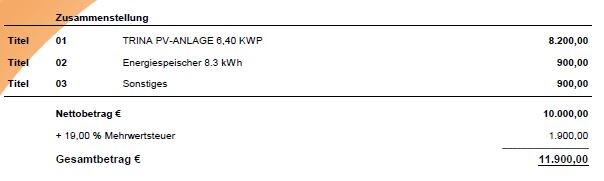
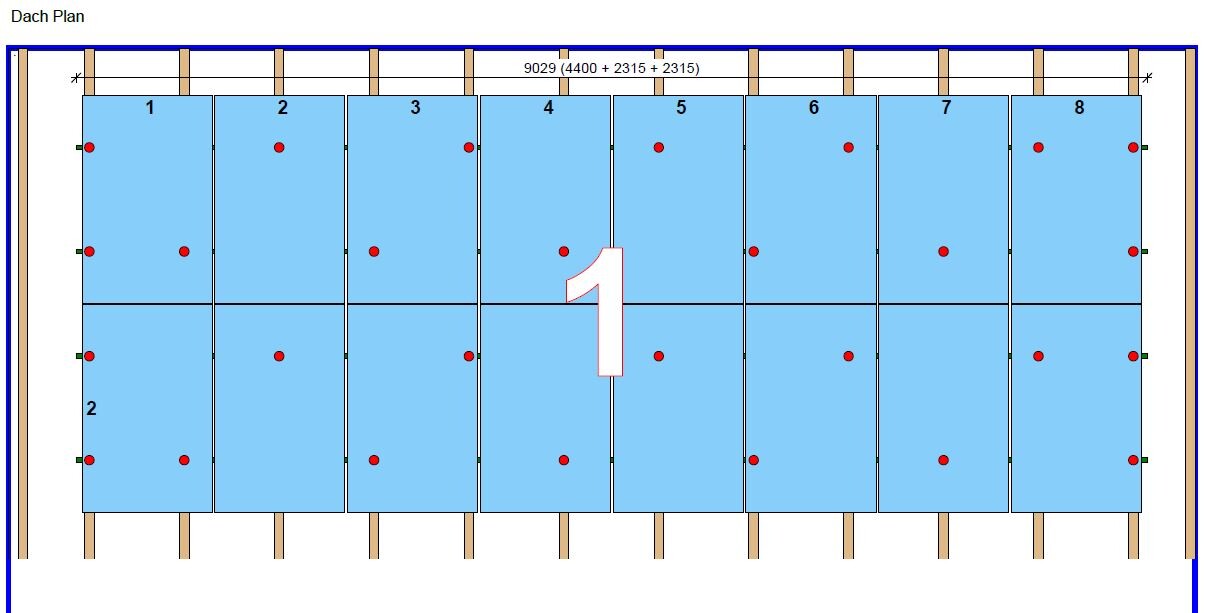
I would like to ask the experts for an assessment of our offer (A1, A2, A3) – as far as it is technically and financially feasible.
We want to fully cover the south side of the roof (total 6.4 kWp (kilowatt peak)) without storage. Since we will also be getting a heat pump (SG ready), we want to supply it with photovoltaic power.
The system can be installed directly at the beginning of September, right after the roofer’s work is finished. It will be handled and carried out by an acquaintance who is always available to support us with advice and assistance. We are newcomers in this field ourselves.
With a total net cost of 10,000 €, I calculate an average of €1,562.50 per kWp.
Title 02 in the summary refers to the Home Manager, not to the energy storage (which I had removed from the offer, as it was originally included).
I look forward to your feedback.
Best regards,
Christian
D
Deliverer15 Jun 2022 14:17Not negative, just realistic. ;-)
The tax office saves itself the effort of reviewing your property just to find out that you don’t owe any taxes.
Tax on profits only starts from 400.xx euros. So it basically never happens. And even if it does, I’d rather pay taxes on profits than make sure I don’t make any profit in the first place.
The tax office saves itself the effort of reviewing your property just to find out that you don’t owe any taxes.
Tax on profits only starts from 400.xx euros. So it basically never happens. And even if it does, I’d rather pay taxes on profits than make sure I don’t make any profit in the first place.
So, I have reported taxable profits every year with a relatively small photovoltaic system (6.8 kWp). I can already see an advantage there. Many are put off by the tax issue, so I think it’s good to remove that barrier.
Calculating the profit from a photovoltaic system is as simple as writing it on the proverbial beer coaster. I don’t think the tax office really saves much effort there. But okay.
Calculating the profit from a photovoltaic system is as simple as writing it on the proverbial beer coaster. I don’t think the tax office really saves much effort there. But okay.
D
Deliverer15 Jun 2022 14:50Then the system is old.
With current system prices and feed-in tariffs, you really have to push hard to surpass the tax-free allowance (after depreciation!). If you add a battery storage, you won’t escape losses anyway. ;-)
And I forgot about the utility companies: Their interest has always been to prevent the energy transition. That’s why, through intense lobbying by the CDU, the 10 kWp (kilowatt peak) threshold was introduced. It served no purpose other than limiting the size of private installations. Then it was abolished because people realized it was unpopular to let the world go to ruin – and half a year later, a new threshold was introduced. This time “in favor” of the system owner. Mission accomplished again.
The fact that both limits were only perceived limits didn’t stop thousands from exceeding them.
Stop focusing on trivial matters. We absolutely need EVERY roof (and some fields as well) within the next 10 years! Ownership (of a large roof) does come with some responsibility. And if the privileged (those with large roofs) don’t take action, then who will?
With current system prices and feed-in tariffs, you really have to push hard to surpass the tax-free allowance (after depreciation!). If you add a battery storage, you won’t escape losses anyway. ;-)
And I forgot about the utility companies: Their interest has always been to prevent the energy transition. That’s why, through intense lobbying by the CDU, the 10 kWp (kilowatt peak) threshold was introduced. It served no purpose other than limiting the size of private installations. Then it was abolished because people realized it was unpopular to let the world go to ruin – and half a year later, a new threshold was introduced. This time “in favor” of the system owner. Mission accomplished again.
The fact that both limits were only perceived limits didn’t stop thousands from exceeding them.
Stop focusing on trivial matters. We absolutely need EVERY roof (and some fields as well) within the next 10 years! Ownership (of a large roof) does come with some responsibility. And if the privileged (those with large roofs) don’t take action, then who will?
Evolith schrieb:
...although no profit is possible up to at least 15 kWp, especially at current prices. As long as you stay below 10 kWp, you can treat it as a hobby and avoid complications.The problem is that these losses would reduce your income tax if you don’t treat it as a hobby. Your advice is like telling someone not to file an income tax return even though they would get a refund.Deliverer schrieb:
650 kWh/kWp is usually not bad. A year ago, it was clearly economically viable. Currently, prices have increased quite a bit, which makes it a little more challenging.
As soon as there is a heat pump in the house, every kWp is worthwhile (even on the north side). When it’s cloudy, every orientation performs about the same. And in winter, that is known to happen quite often.
In general, it makes sense to install the full system at once rather than adding to it every few years. Each time you do that, you have to cover the "one-time effort" again, plus an additional inverter.
The latter doesn’t cost more just because you add the north side. But if you need a second inverter later because you realize 6.4 kWp is far too small, that will cost you around €2000 extra. Plus more paperwork for registration, plus electrician fees.
If the south side currently costs €1500, adding an extra 3 kWp will lower the cost to about €1400 per kWp. Each additional kWp on the north side should only cost about €900. Then it’s worthwhile.
Where you can save money: a meter replacement is free. Anyone who says otherwise is lying. And the commissioning is done ONLY by the electrician from the solar installer. Your grid operator can come by if they want, but they do NOT get paid for this. It’s all clearly stated in the Renewable Energy Act and MsbG.
And let me say, speaking from nearly 30 kWp of experience: ANY photovoltaic system is too small! Quick update: I contacted the electrician again. He optimized his plan and now comes to 9.6 kWp for the south roof. The price per kWp is €1468 net > I have already accepted the offer!!
Now I have the question whether I should opt for the small business regulation or for regular taxation? In the latter case, I will probably be cheaper overall, but the effort (at least initially) is higher. Basically, I tend toward the more convenient option, but then I have to pay for the system purchase (as well as possibly maintenance, repairs, etc.) including VAT. On the surface, this seems correct, or have I misunderstood something?
Best regards
Christian
D
Deliverer16 Jun 2022 11:29No, that’s correct. In almost all cases, standard taxation ends up being more cost-effective. However, using the small business regulation (KUR) involves less administrative effort. You don’t have to prepare a simplified profit and loss statement (EÜR) if your system is below 10 kWp.
For a purely south-facing roof, you should ensure that the system is limited to 70% output, meaning you install an energy meter that restricts feed-in to a maximum of 70%, while allowing you to consume any surplus yourself.
The peak production can then be effectively used for water heating around 1 p.m., practically eliminating losses due to the output limitation.
For a purely south-facing roof, you should ensure that the system is limited to 70% output, meaning you install an energy meter that restricts feed-in to a maximum of 70%, while allowing you to consume any surplus yourself.
The peak production can then be effectively used for water heating around 1 p.m., practically eliminating losses due to the output limitation.
Similar topics