
Hello,
we are planning the garden for our new build and have now reached the stage of deciding on the lawn.
We want to edge the lawn with mowing guides (about 24cm (9.5 inches) wide) and have the lawn regularly maintained by a robotic mower later.
What would you recommend: laying sod or sowing the lawn from seed ourselves? We have about 150m² (1,615 sq ft) of lawn area.
Which grass type would be suitable for us?
The lawn should be low-maintenance and resilient (it shouldn’t dry out quickly in summer or become waterlogged during heavy rain).
Most of the lawn is in full sun with little shade (south-west facing).
The lawn should also withstand regular walking and running (for when children play or with the dog).
The house handover is planned for February or March 2023.
I hope you can help me (I’m not very experienced with this).
we are planning the garden for our new build and have now reached the stage of deciding on the lawn.
We want to edge the lawn with mowing guides (about 24cm (9.5 inches) wide) and have the lawn regularly maintained by a robotic mower later.
What would you recommend: laying sod or sowing the lawn from seed ourselves? We have about 150m² (1,615 sq ft) of lawn area.
Which grass type would be suitable for us?
The lawn should be low-maintenance and resilient (it shouldn’t dry out quickly in summer or become waterlogged during heavy rain).
Most of the lawn is in full sun with little shade (south-west facing).
The lawn should also withstand regular walking and running (for when children play or with the dog).
The house handover is planned for February or March 2023.
I hope you can help me (I’m not very experienced with this).
P
Pwnage6193 Jun 2022 08:51I have made a sketch of our house and garden.
We plan to enlarge the terrace later and want to build a patio roof.
The patio roof will be about 4 x 5 meters (13 x 16 feet), possibly 4 x 6 meters (13 x 20 feet) since our house is 6 meters (20 feet) wide.
We want to enlarge the terrace so that we have both shade and sun there.
The table, chairs, and sun loungers are intended to remain permanently on the terrace (the sun loungers possibly only temporarily placed on the lawn).
We want to extend the terrace in depth. If we extend the terrace further to the right, the patio roof would cast a shadow there (this is my first thought).
We don’t know the exact size of the terrace yet and find it hard to imagine. Since we want to do this later anyway, we will observe it live in the garden to see how much space we really need.
@haydee That’s why I asked whether an automatic irrigation system using drinking water is really worth it, or if it’s just wasteful and manual watering with a hose would be better (we plan to install a 25–30 meter (82–98 feet) long hose reel on the wall).
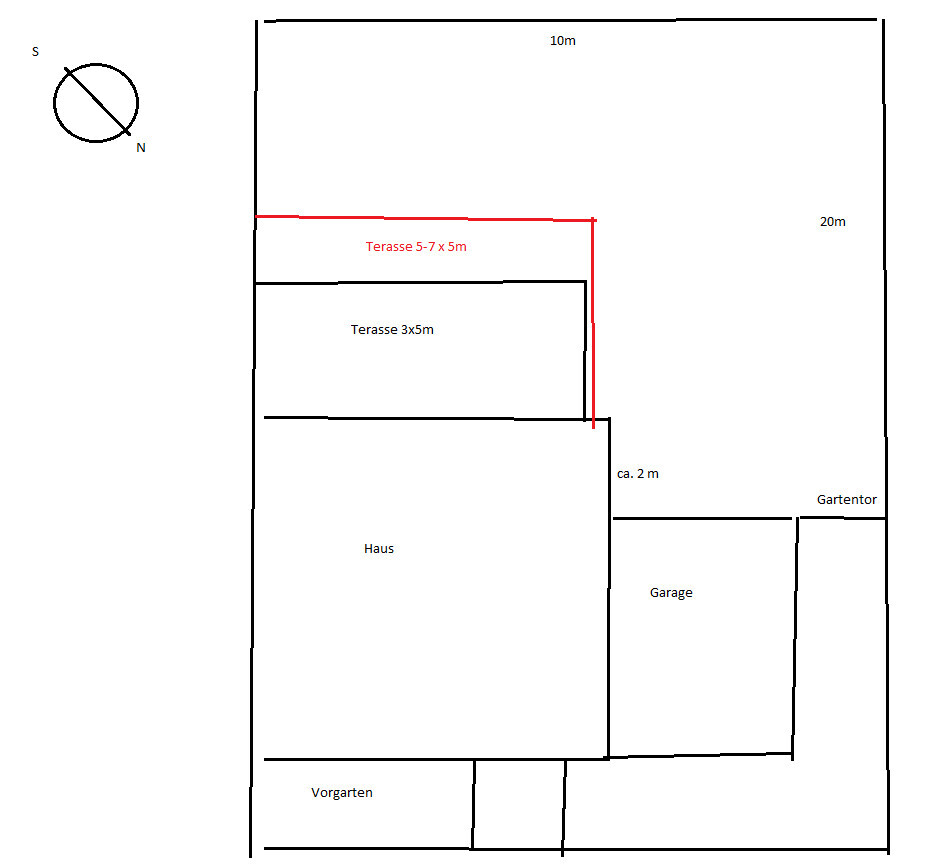
We plan to enlarge the terrace later and want to build a patio roof.
The patio roof will be about 4 x 5 meters (13 x 16 feet), possibly 4 x 6 meters (13 x 20 feet) since our house is 6 meters (20 feet) wide.
We want to enlarge the terrace so that we have both shade and sun there.
The table, chairs, and sun loungers are intended to remain permanently on the terrace (the sun loungers possibly only temporarily placed on the lawn).
We want to extend the terrace in depth. If we extend the terrace further to the right, the patio roof would cast a shadow there (this is my first thought).
We don’t know the exact size of the terrace yet and find it hard to imagine. Since we want to do this later anyway, we will observe it live in the garden to see how much space we really need.
@haydee That’s why I asked whether an automatic irrigation system using drinking water is really worth it, or if it’s just wasteful and manual watering with a hose would be better (we plan to install a 25–30 meter (82–98 feet) long hose reel on the wall).
M
Myrna_Loy3 Jun 2022 08:52haydee schrieb:
@rick2018 installed a huge cistern and manages without tap water.
Take a look at his thread. Definitely worth reading and watching.Rick’s setup really needs a disclaimer for forum newcomers: “This is surely the best and most elegant solution, but probably unaffordable for most people.” 🙂
The advantage of non-automatic irrigation and a lawn that isn’t mowed by robot is that you become more aware of what you actually have. A water guzzler that requires maintenance. In my opinion, it hardly has anything to do with nature when you use technology and equipment in your garden that are all manufactured consuming resources and eventually turn into hazardous waste after ten to fifteen years. Achieving a 150 m² (1,615 sq ft) area that is green and walkable or playable can be done with less effort. Our lawn: lots of clover, hardy grass, violets and anemones in spring, always green even during longer dry periods. Watering happens maybe once in August with a sprinkler, mowing every two to three weeks depending on the weather. The children walk barefoot at their own risk, and wear sandals when the clover is blooming.
What you need depends on what you want.
A lawn like @rick2018’s with a robot mower and automatic irrigation, or a lawn like the one @Myrna_Loy described—that one doesn’t need irrigation or a robot. I have no idea how often Rick’s sprinkler system runs; watering with a garden hose once every few days isn’t enough.
A terrace that’s 3 meters (10 feet) deep is a bit small for a seating area. Lounge chairs won’t fit. Try drawing everything in. If you add a roof, be careful not to block too much light inside.
Check your zoning plan (building permit / planning permission) to see if it includes a list of plants and other requirements for the outdoor area.
@Myrna_Loy, of course the house that @rick2018 built is on a different level. But his posts are worth reading because they’re well thought out. I like how he approached the project and how he shared his experience.
A lawn like @rick2018’s with a robot mower and automatic irrigation, or a lawn like the one @Myrna_Loy described—that one doesn’t need irrigation or a robot. I have no idea how often Rick’s sprinkler system runs; watering with a garden hose once every few days isn’t enough.
A terrace that’s 3 meters (10 feet) deep is a bit small for a seating area. Lounge chairs won’t fit. Try drawing everything in. If you add a roof, be careful not to block too much light inside.
Check your zoning plan (building permit / planning permission) to see if it includes a list of plants and other requirements for the outdoor area.
@Myrna_Loy, of course the house that @rick2018 built is on a different level. But his posts are worth reading because they’re well thought out. I like how he approached the project and how he shared his experience.

The most water-efficient way to irrigate is in the early morning hours. The soil is cool, and evaporation is still low. This is also beneficial for lawn health, as the grass doesn’t stay wet for long, reducing the risk of fungal or mold growth.
Quickly running the hose over the lawn is not sufficient. Even with small lawns, this takes time, and almost no one does it early in the morning anyway.
With this layout, you need a few more sprinklers. You could skip the irrigation timer and manually switch the system on and off by turning the faucet. But again, early morning is best.
This lawn area is easy to water. Materials cost about 500€ (roughly $540) and then you’re done. How often you use it and whether you are allowed to is another matter. For a new installation, you simply lay the pipes on the base soil. It’s very simple and fast.
However, I would still talk to the builder about whether a rainwater cistern would be possible. You save on stormwater fees and have water available for irrigation. At the same time, it helps relieve the sewer system during heavy rain...
Quickly running the hose over the lawn is not sufficient. Even with small lawns, this takes time, and almost no one does it early in the morning anyway.
With this layout, you need a few more sprinklers. You could skip the irrigation timer and manually switch the system on and off by turning the faucet. But again, early morning is best.
This lawn area is easy to water. Materials cost about 500€ (roughly $540) and then you’re done. How often you use it and whether you are allowed to is another matter. For a new installation, you simply lay the pipes on the base soil. It’s very simple and fast.
However, I would still talk to the builder about whether a rainwater cistern would be possible. You save on stormwater fees and have water available for irrigation. At the same time, it helps relieve the sewer system during heavy rain...
P
Pwnage6193 Jun 2022 10:25A 3x5 m (10x16 ft) terrace is standard.
The terrace roof should be 4x5-6 m (13x16-20 ft) with frosted glass.
The new terrace will probably be 6-7x5-6 m (20-23x16-20 ft).
This means the roof will cover the full width and 4 m (13 ft) in depth.
The new terrace will be 5 or 6 m (16 or 20 ft) wide and 6 or 7 m (20 or 23 ft) deep.
So, 4 m (13 ft) of the depth is covered, and 2-3 m (6.5-10 ft) of the terrace remains uncovered.
I hope I explained that clearly.
Unfortunately, a cistern is not possible for us.
However, all plots (it’s a large housing development) will have a soakaway.
The development plan doesn’t specify much except that rock gardens are forbidden (which we didn’t want anyway).
The terrace roof should be 4x5-6 m (13x16-20 ft) with frosted glass.
The new terrace will probably be 6-7x5-6 m (20-23x16-20 ft).
This means the roof will cover the full width and 4 m (13 ft) in depth.
The new terrace will be 5 or 6 m (16 or 20 ft) wide and 6 or 7 m (20 or 23 ft) deep.
So, 4 m (13 ft) of the depth is covered, and 2-3 m (6.5-10 ft) of the terrace remains uncovered.
I hope I explained that clearly.
Unfortunately, a cistern is not possible for us.
However, all plots (it’s a large housing development) will have a soakaway.
The development plan doesn’t specify much except that rock gardens are forbidden (which we didn’t want anyway).
Similar topics