
Hello,
I am currently building with aerated concrete blocks and slightly missed the height. I set 3 blocks a bit lower by about 3mm (0.12 inches).
I brought the 4th block back to the same height as the other blocks.
Should I compensate for the 3mm (0.12 inches) gap with mortar from above, or is it also possible to adjust this with thin-bed mortar?
I am currently building with aerated concrete blocks and slightly missed the height. I set 3 blocks a bit lower by about 3mm (0.12 inches).
I brought the 4th block back to the same height as the other blocks.
Should I compensate for the 3mm (0.12 inches) gap with mortar from above, or is it also possible to adjust this with thin-bed mortar?

Are we seriously talking about a full 3mm (0.12 inches) here? The building would eventually collapse if it stayed that skewed :p
And now seriously: a typical bricklayer is happy as long as they don’t cross the property boundaries. 3mm (0.12 inches) is more like steel construction tolerances.
And now seriously: a typical bricklayer is happy as long as they don’t cross the property boundaries. 3mm (0.12 inches) is more like steel construction tolerances.

Peug408 schrieb:
Should I level the 3mm (about 1/8 inch) gap with mortar from above, or is it okay to use thin-bed mortar for that? At first, I held back on this because I didn’t feel expert enough in this specific matter to give you a practical answer from my toolbox. However, after reading the reply
i_b_n_a_n schrieb:
Seriously, is this really about a full 3mm (about 1/8 inch)? The building would collapse later if it stays that uneven :p
And seriously: a regular mason is happy as long as he doesn’t cross the property boundaries. 3mm are more like steel construction tolerances. I feel the need to express my sympathy: yes, in my view, your question deserves to be taken seriously (and answered properly). Because it seems to me that you already correctly suspect that 3mm (or now four instead of just one) joint thickness might require a different type of "mortar." Using 6mm (about 1/4 inch) instead of 3mm (about 1/8 inch)—as would be typical for aerated clay blocks—with the same bed joint mortar would be a different matter than in your case with aerated concrete blocks at 4mm (about 5/32 inch) instead of 1mm (about 1/32 inch). Even with aerated clay blocks, I believe the mortar under the first layer is usually not the same as above. I’m tagging a professional for the discussion @Jann St 🙂
https://www.instagram.com/11antgmxde/
https://www.linkedin.com/company/bauen-jetzt/
P.S.: Is this about your construction site "in the south of Russia"? If so, the local temperature conditions there should also be taken into account when considering the requirements of the building materials...
https://www.instagram.com/11antgmxde/
https://www.linkedin.com/company/bauen-jetzt/
https://www.instagram.com/11antgmxde/
https://www.linkedin.com/company/bauen-jetzt/
Yes, this concerns my house in southern Russia, which I am building on my own.
The temperature is already 16°C (61°F) at 7 a.m., and from 2 p.m. it reached 31°C (88°F). I’m afraid it will get even warmer in the next few days, and the mortar dries quickly. However, I’m not sure whether this is due to the heat, the aerated concrete blocks, or the mortar itself.
I simply add more water, but after 10 minutes it’s still so dry that the blocks can be pressed down by one centimeter (0.4 inch) with about 20 taps.
So far, it’s going quite well. I chose the size 625x250x300 millimeters (25x10x12 inches). The blocks are called WKBlok from wkb-systems, which is supposed to be a German manufacturer. I originally wanted ytong, but those are only available in Moscow, and driving 1300 kilometers (800 miles) there is not worth it.
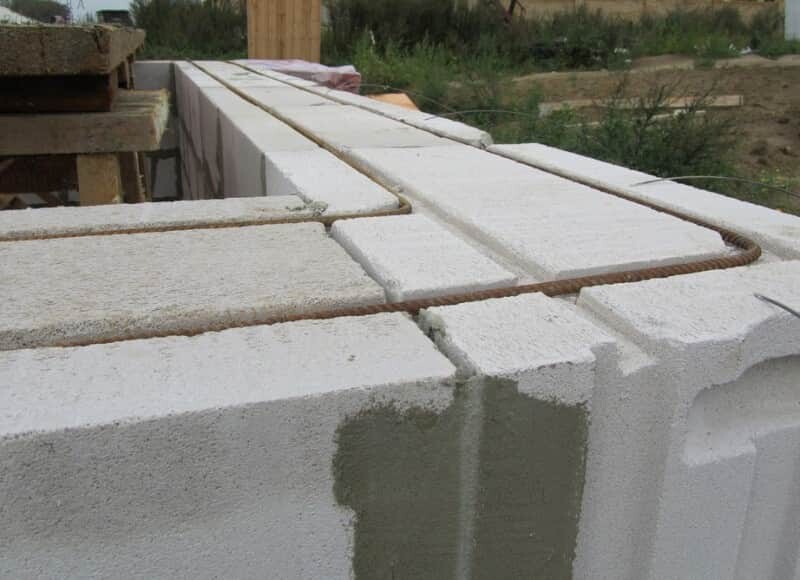
Now I have a question: here in Russia, they place reinforcement bars in the first rows up to the windows and then again from the windows to the top rows all around up to the ring beam. For this, they groove the blocks along the length, insert two reinforcement bars each, and then mortar them in.
In Germany, masonry reinforcement connectors are used.
Does this make sense or is it nonsense?
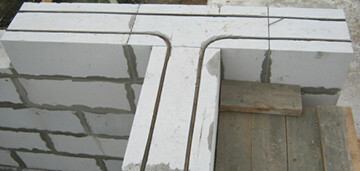
The method with masonry reinforcement connectors in the corners is certainly the simpler solution.
Below is an example of that.
The temperature is already 16°C (61°F) at 7 a.m., and from 2 p.m. it reached 31°C (88°F). I’m afraid it will get even warmer in the next few days, and the mortar dries quickly. However, I’m not sure whether this is due to the heat, the aerated concrete blocks, or the mortar itself.
I simply add more water, but after 10 minutes it’s still so dry that the blocks can be pressed down by one centimeter (0.4 inch) with about 20 taps.
So far, it’s going quite well. I chose the size 625x250x300 millimeters (25x10x12 inches). The blocks are called WKBlok from wkb-systems, which is supposed to be a German manufacturer. I originally wanted ytong, but those are only available in Moscow, and driving 1300 kilometers (800 miles) there is not worth it.
Now I have a question: here in Russia, they place reinforcement bars in the first rows up to the windows and then again from the windows to the top rows all around up to the ring beam. For this, they groove the blocks along the length, insert two reinforcement bars each, and then mortar them in.
In Germany, masonry reinforcement connectors are used.
Does this make sense or is it nonsense?
The method with masonry reinforcement connectors in the corners is certainly the simpler solution.
Below is an example of that.

Peug408 schrieb:
Now one more question: here, the Russians place reinforcing steel rods in the first rows up to the windows and then all around the last rows up to the ring beam.
For this, they mill channels along the blocks and insert two reinforcement bars each time. The Russians create a composite material from the glued blocks, which is probably better suited for the temperatures and loads.
I would rely on the Russian experience and have it done that way.
It can’t hurt, and frost and summer cause ground movement, so that’s why the steel rods work better.
Similar topics