
ᐅ Heating Concept Air-to-Water Heat Pump for Single-Family Home with 2 Occupants – Quote from Heating Contractor?
Created on: 24 Apr 2022 10:40
E
Elias_dee
Good morning,
from October 2022, we will be building a turnkey single-family house for 2 people. The basic conditions are:
- Air-to-water heat pump
- Possibly a photovoltaic system (not yet confirmed)
- Central ventilation system with heat recovery
- The house will be occupied by 2 people
- Ground floor + upper floor + basement (partly used as living space)
- No KFW funding, standard build according to the Building Energy Act, 36.5 cm (14 inches) brickwork
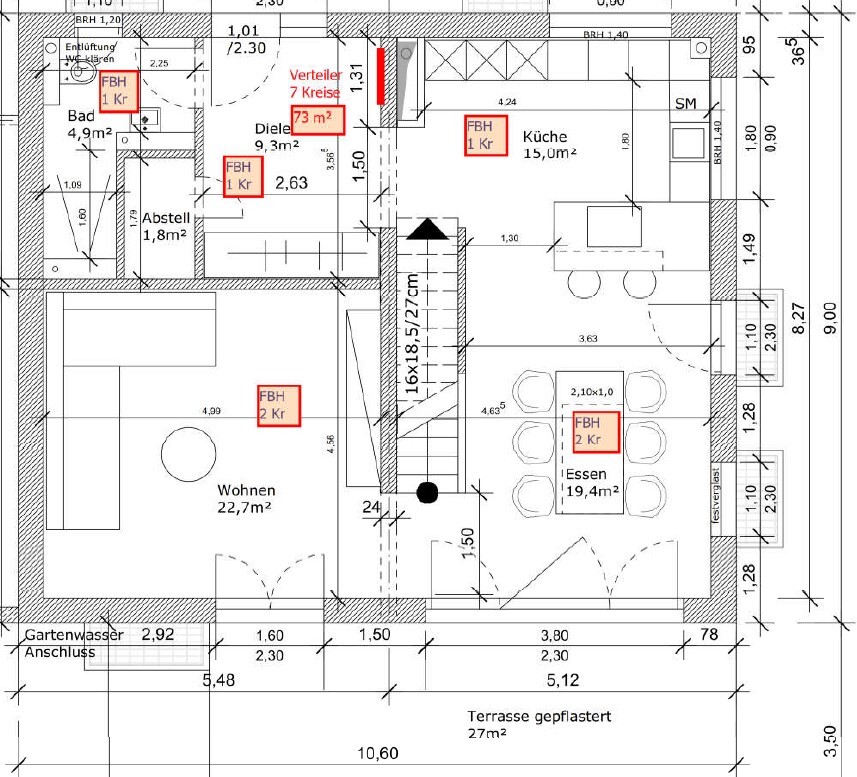
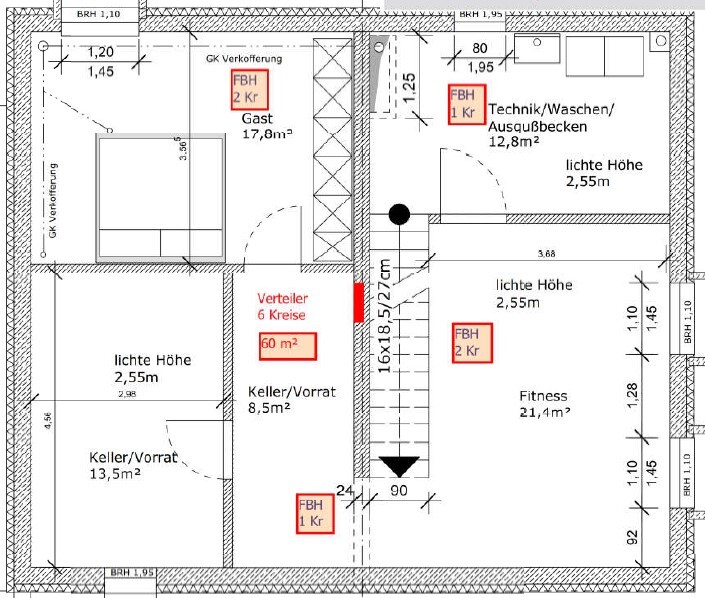
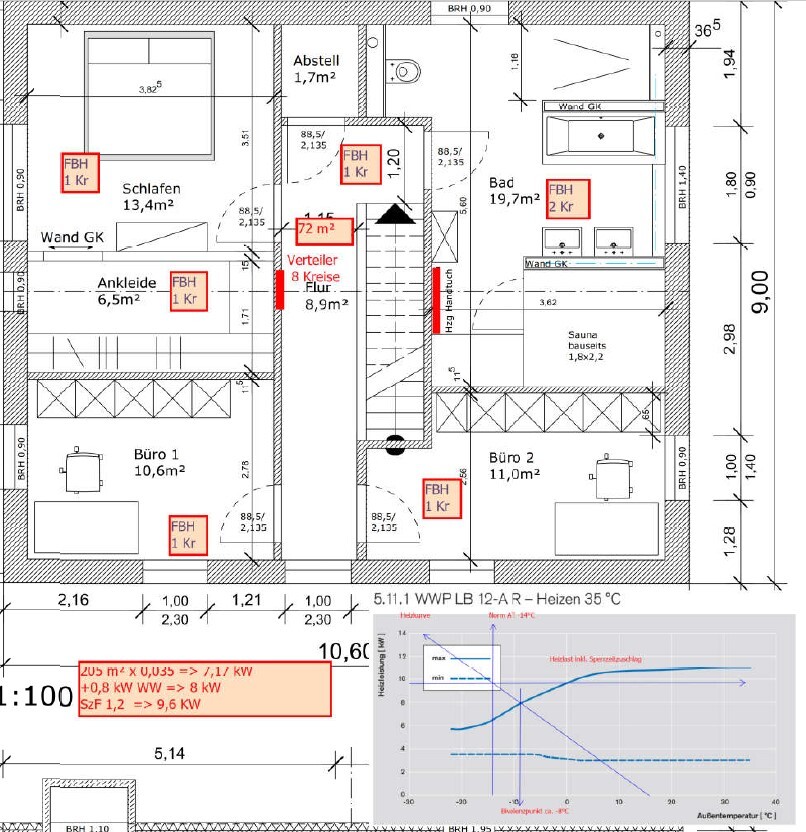
The general contractor sent me the calculation and planned circuits from the heating engineer; see attachment. The calculation was based on 205 m² (2206 sq ft) living area x 0.035 -> 7.17 kW + 0.8 kW for hot water --> 8 kW
Safety factor 1.2 --> 9.6 kW
Based on this plan, the heating engineer offered through the general contractor the following:
- Weishaupt Biblock WBB 12-A-RMD-AI
- Combined storage tank WKS 300/100LE / Unit / Bloc / C, 300-liter (79 US gallons) domestic hot water tank and 100-liter (26 US gallons) buffer storage
- 12 room thermostats
I have done some reading here and elsewhere and understand that individual room regulation is pointless and that the circuits should be designed for the corresponding temperature from the start (at least that’s how I understood it; please correct me if I’m wrong).
Also, opinions appear divided on the topic of buffer storage tanks, but the tendency is that they are rather unnecessary. Honestly, I haven’t yet fully understood why. I keep reading that this kind of design can cause an air-to-water heat pump to wear out quickly and lead to high electricity consumption. The safety factor seems to have been set quite high by the heating engineer as well.
Without solid expertise in this area, I would prefer not to get into a debate with the heating engineer. Could you advise me on how the system concept for our single-family house could be better designed?
Thank you very much in advance!
Best regards,
Elias
from October 2022, we will be building a turnkey single-family house for 2 people. The basic conditions are:
- Air-to-water heat pump
- Possibly a photovoltaic system (not yet confirmed)
- Central ventilation system with heat recovery
- The house will be occupied by 2 people
- Ground floor + upper floor + basement (partly used as living space)
- No KFW funding, standard build according to the Building Energy Act, 36.5 cm (14 inches) brickwork
The general contractor sent me the calculation and planned circuits from the heating engineer; see attachment. The calculation was based on 205 m² (2206 sq ft) living area x 0.035 -> 7.17 kW + 0.8 kW for hot water --> 8 kW
Safety factor 1.2 --> 9.6 kW
Based on this plan, the heating engineer offered through the general contractor the following:
- Weishaupt Biblock WBB 12-A-RMD-AI
- Combined storage tank WKS 300/100LE / Unit / Bloc / C, 300-liter (79 US gallons) domestic hot water tank and 100-liter (26 US gallons) buffer storage
- 12 room thermostats
I have done some reading here and elsewhere and understand that individual room regulation is pointless and that the circuits should be designed for the corresponding temperature from the start (at least that’s how I understood it; please correct me if I’m wrong).
Also, opinions appear divided on the topic of buffer storage tanks, but the tendency is that they are rather unnecessary. Honestly, I haven’t yet fully understood why. I keep reading that this kind of design can cause an air-to-water heat pump to wear out quickly and lead to high electricity consumption. The safety factor seems to have been set quite high by the heating engineer as well.
Without solid expertise in this area, I would prefer not to get into a debate with the heating engineer. Could you advise me on how the system concept for our single-family house could be better designed?
Thank you very much in advance!
Best regards,
Elias
E
Elias_dee24 Apr 2022 15:55@Deliverer: The heating engineer already mentioned that with just underfloor heating in the bathroom, it won't reach the target temperature of 24°C (75°F), so he included a towel radiator in his quote. That’s not necessarily a problem at first, I think, right?
But generally, I want to have a more professional calculation done. If the heating engineer can’t do it or doesn’t want to, I might be willing to spend some extra money to have an energy consultant calculate it (and then tell the heating engineer to implement it accordingly). That would be a feasible approach, wouldn’t it?
Since we are building with a general contractor, unfortunately, we are tied to exactly this heating installer.
But generally, I want to have a more professional calculation done. If the heating engineer can’t do it or doesn’t want to, I might be willing to spend some extra money to have an energy consultant calculate it (and then tell the heating engineer to implement it accordingly). That would be a feasible approach, wouldn’t it?
Since we are building with a general contractor, unfortunately, we are tied to exactly this heating installer.
B
Benutzer20024 Apr 2022 16:03Elias_dee schrieb:
I might just spend a bit more money and have an energy consultant run the calculations for me (and then tell the heating engineer to implement it that way). That would be a viable option, right?No! Hire a professional. An appropriate engineering firm that can also prepare the necessary documentation for waiving the ERR (Energy Saving Regulation). The costs are in the low hundreds of euros. But the heating installer must then build accordingly.E
Elias_dee24 Apr 2022 16:04Benutzer200 schrieb:
No! Hire a professional. A suitable engineering firm that can also provide you with the proper documentation for waiving the ERR. The costs are in the low hundreds of euros (€).
But the heating installer then has to build accordingly.What do you mean by engineering firm? Are there specialized engineering firms focused on heating system design? I thought an energy consultant should be able to do exactly that...?B
Benutzer20024 Apr 2022 18:18Energy Consultant:
An energy consultant can only calculate energy requirements but cannot design a heating system. For the demand calculation and system design, you also have to specify temperatures – the standard everywhere is usually 20 degrees Celsius (68°F). However, it’s better to use 22 degrees Celsius (72°F) for living areas and 24 degrees Celsius (75°F) for bathrooms.
Also, aim for the lowest possible flow temperature – a good standard is 30 degrees Celsius (86°F) flow with 26 degrees Celsius (79°F) return. With excellent insulation, even lower temperatures are possible. Heating pipes come in various sizes as well. A heat pump requires a high flow rate, so use at least a 16 mm (5/8 inch) pipe. Pipe spacing is also important; it should not exceed 10 cm (4 inches). The length of the heating circuits matters too.
An energy consultant cannot provide all this information.
Therefore, I recommend searching online for Ing. Heckmann. He is highly recommended in another community focused on building services engineering (you can find it quickly as well).
He is essentially the expert for DIY enthusiasts who tend to choose a Panasonic Aquarea (just as a side note) and handle installation themselves while focusing heavily on proper planning.
He can also provide you with a tailored document for waiving the ERR (energy saving regulations).
The total cost is transparent and only a few hundred euros. This is incomparable to the potential savings on heating costs and, of course, reduced material effort in terms of ERR (no materials, no installation, no additional electrical work).
An energy consultant can only calculate energy requirements but cannot design a heating system. For the demand calculation and system design, you also have to specify temperatures – the standard everywhere is usually 20 degrees Celsius (68°F). However, it’s better to use 22 degrees Celsius (72°F) for living areas and 24 degrees Celsius (75°F) for bathrooms.
Also, aim for the lowest possible flow temperature – a good standard is 30 degrees Celsius (86°F) flow with 26 degrees Celsius (79°F) return. With excellent insulation, even lower temperatures are possible. Heating pipes come in various sizes as well. A heat pump requires a high flow rate, so use at least a 16 mm (5/8 inch) pipe. Pipe spacing is also important; it should not exceed 10 cm (4 inches). The length of the heating circuits matters too.
An energy consultant cannot provide all this information.
Therefore, I recommend searching online for Ing. Heckmann. He is highly recommended in another community focused on building services engineering (you can find it quickly as well).
He is essentially the expert for DIY enthusiasts who tend to choose a Panasonic Aquarea (just as a side note) and handle installation themselves while focusing heavily on proper planning.
He can also provide you with a tailored document for waiving the ERR (energy saving regulations).
The total cost is transparent and only a few hundred euros. This is incomparable to the potential savings on heating costs and, of course, reduced material effort in terms of ERR (no materials, no installation, no additional electrical work).
Elias_dee schrieb:
among other things, swapping the kitchen with the living room), 🙄 But quite a few changes will still be necessary…
I am also thinking about the “relocation” of the front door to the office.
E
Elias_dee24 Apr 2022 21:48driver55 schrieb:
🙄
There will still be quite a few changes needed…
I’m mainly thinking about the “walk” from the front door to the office.As I said, the floor plan is finalized; we designed it according to our needs and requirements, and from our perspective, it fits well. You already expressed that you didn’t like it back in my planning thread. But luckily, we are designing for ourselves, not for you. 😉Similar topics