
ᐅ New construction of a settler-style house (semi-detached house)
Created on: 16 Apr 2022 17:28
S
Siedlerhaus22
Hello everyone,
We have been following this forum with interest for several years now and would like to share some information about our project.
Since our situation includes everything from a semi-detached house to demolition and heritage protection, we want to help some of you overcome any fears you might have about such plots.
A bit about us: we are both in our late twenties, self-employed, and both civil engineers. Despite this—or perhaps because of it—we deliberately decided not to organize or manage the project ourselves. We have outsourced all phases of the work to an architectural firm with whom we also collaborate professionally.
The Project
____________
Plot size: just under 600m2 (about 6,460 sq ft)
Existing structure: semi-detached house – a classic settler house
Building plans:
Single-family home
Almost 210m2 (about 2,260 sq ft) of living space
Double garage
Partial basement
Cost estimate - as of April 2022
Construction costs: €1,450,000
Plot including demolition: €750,000
Total costs: €2,200,000
Plus a budget of €350,000 for interior design including furniture and kitchen, specialist planners, and construction management
Objectives:
We wanted to live close to the city and both love the charm of settler houses. When this property became available unexpectedly, our original plan was to develop and market it as two separate units—but in the end, we discovered its potential as a single home.
Key features:
Acoustic ceilings throughout the house
Polished screed floors throughout
Cantilever staircase
Sauna
Kebony exterior cladding
Pool + whirlpool
Air conditioning
Central ventilation system
Gas fireplace
Outdoor kitchen
Wood-aluminum windows
Flush-mounted windows, doors, and baseboards
Floor-to-ceiling doors
Pellet heating system
Sonos speaker system throughout the house
KNX system controlling lighting, sound, blinds, heating, ventilation/air conditioning, pool, doors/windows
Current status:
Building permit obtained
Demolition approved
Trades contracted
Demolition of existing structure underway
Next step:
Start of earthworks and shell construction in May
If there is interest on your side, we would be happy to present this project here regularly in the form of a brief construction report—with pictures, setbacks, and challenges 🙂
Note about the floor plans:
Due to some structural considerations, we have now decided—contrary to the original submission—not to use a timber frame construction. The house will therefore be built with solid brick walls, 36.5cm (14 inches) thick, filled with wood fibers. Also, a few interior design adjustments have not yet been included—if there is interest in the project, we will of course provide updates! 🙂
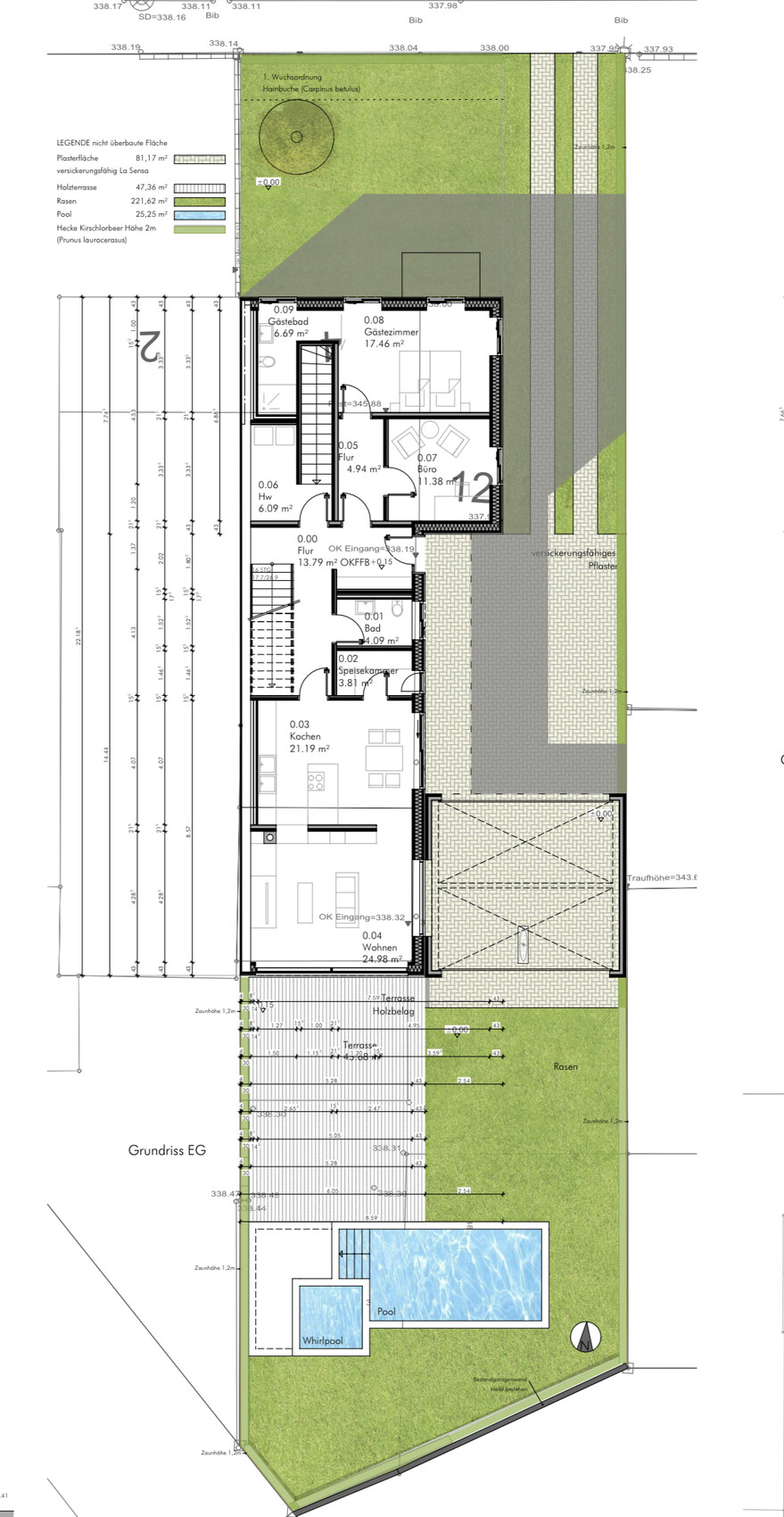
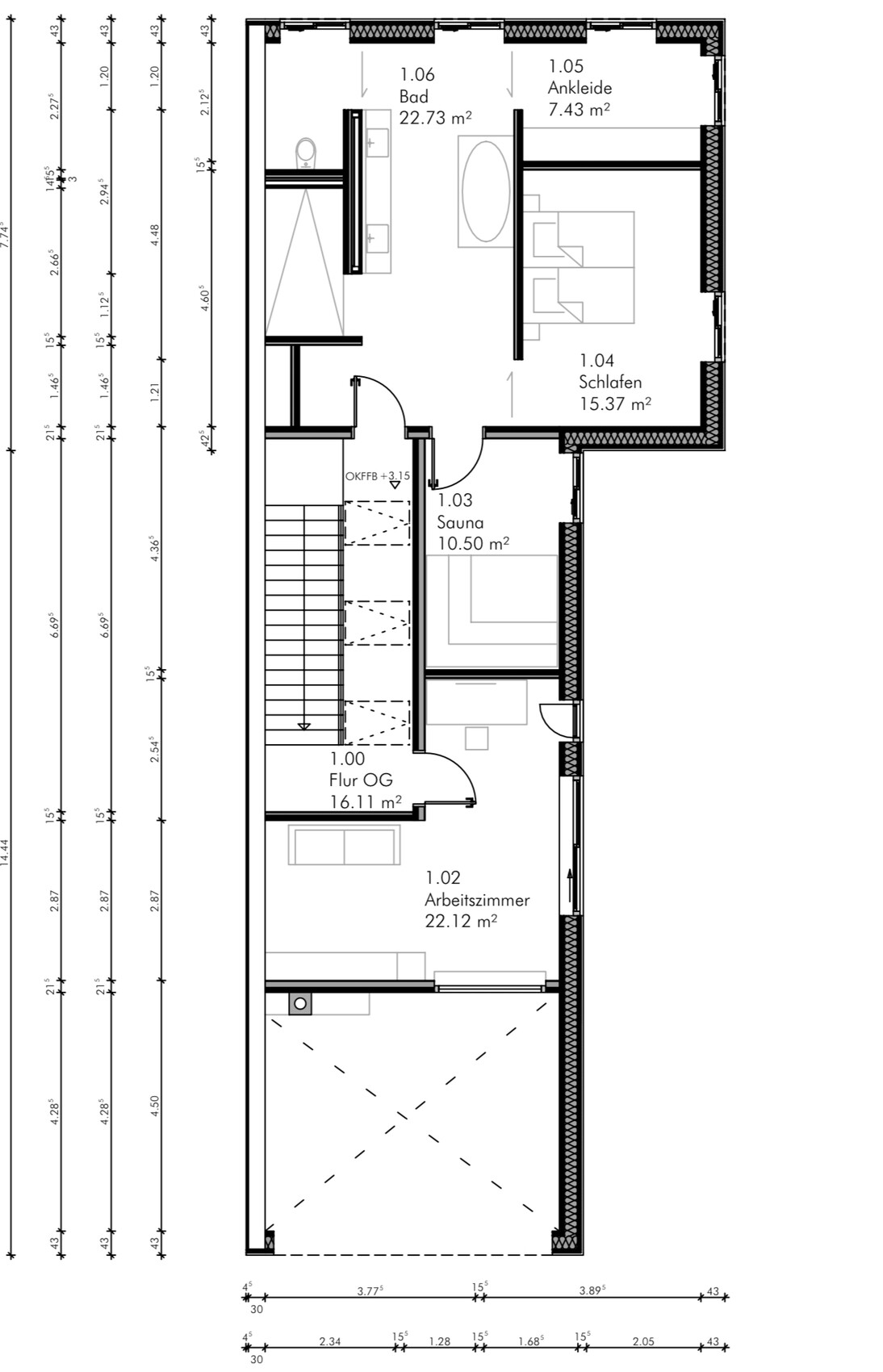
We have been following this forum with interest for several years now and would like to share some information about our project.
Since our situation includes everything from a semi-detached house to demolition and heritage protection, we want to help some of you overcome any fears you might have about such plots.
A bit about us: we are both in our late twenties, self-employed, and both civil engineers. Despite this—or perhaps because of it—we deliberately decided not to organize or manage the project ourselves. We have outsourced all phases of the work to an architectural firm with whom we also collaborate professionally.
The Project
____________
Plot size: just under 600m2 (about 6,460 sq ft)
Existing structure: semi-detached house – a classic settler house
Building plans:
Single-family home
Almost 210m2 (about 2,260 sq ft) of living space
Double garage
Partial basement
Cost estimate - as of April 2022
Construction costs: €1,450,000
Plot including demolition: €750,000
Total costs: €2,200,000
Plus a budget of €350,000 for interior design including furniture and kitchen, specialist planners, and construction management
Objectives:
We wanted to live close to the city and both love the charm of settler houses. When this property became available unexpectedly, our original plan was to develop and market it as two separate units—but in the end, we discovered its potential as a single home.
Key features:
Acoustic ceilings throughout the house
Polished screed floors throughout
Cantilever staircase
Sauna
Kebony exterior cladding
Pool + whirlpool
Air conditioning
Central ventilation system
Gas fireplace
Outdoor kitchen
Wood-aluminum windows
Flush-mounted windows, doors, and baseboards
Floor-to-ceiling doors
Pellet heating system
Sonos speaker system throughout the house
KNX system controlling lighting, sound, blinds, heating, ventilation/air conditioning, pool, doors/windows
Current status:
Building permit obtained
Demolition approved
Trades contracted
Demolition of existing structure underway
Next step:
Start of earthworks and shell construction in May
If there is interest on your side, we would be happy to present this project here regularly in the form of a brief construction report—with pictures, setbacks, and challenges 🙂
Note about the floor plans:
Due to some structural considerations, we have now decided—contrary to the original submission—not to use a timber frame construction. The house will therefore be built with solid brick walls, 36.5cm (14 inches) thick, filled with wood fibers. Also, a few interior design adjustments have not yet been included—if there is interest in the project, we will of course provide updates! 🙂
S
Siedlerhaus2216 Apr 2022 23:06Garten2 schrieb:
I’m curious why you chose a pellet heating system instead of geothermal drilling combined with photovoltaics.Hi! In our region, deep geothermal drilling is very difficult because it’s a karst area.
Additionally, our HVAC planner advised against it given the required heating load, especially in winter.
Originally, we wanted to connect fuel cells in series, but considering the current gas situation, we decided against it.
However, we do have photovoltaic panels installed on the roof! 🙂
Siedlerhaus22 schrieb:
We are aware that this project does not appeal to the general public. I like exotic designs, as long as they work.
Siedlerhaus22 schrieb:
Tabletop 2400x900mm (94x35 inches) Hmm, my old one was 1.10m (3 ft 7 in), my current one is 1.00m (3 ft 3 in)… as an eccentric host, I wouldn’t want it any narrower.
Siedlerhaus22 schrieb:
But don’t worry — the table fits in there. Of course it fits. But at what cost? Guests have to walk through the living room and kitchen to get to the bathroom. The host constantly has to take the same detour. I think there could have been a better use of the space.
The kitchen is also too small for my taste, the pantry door would work better from the hallway, and I would have moved the carport in front of the pantry/bathroom. The guest room and the hallway in front of it deserve some built-in storage behind the doors. Is this supposed to become a separate granny flat at some point?
I find the open bathroom acceptable to good — it’s not a household with children, so you can afford to be more daring. But I would have probably moved it sideways towards the top of the plan and placed the walk-in closet centrally in the “master” area. I think that would look more elegant.
The upstairs office, I would have designed as an open gallery space, overlooking the staircase.
Overall, I miss some sightlines that could have been emphasized more, so that residents feel a sense of exclusivity while living there. This could have been planned well along the length or part of the length of the house. A pity. Too many doors and door frames… again the dull, standard approach… all the creativity went into the open bathroom… 😉
Still: an interesting project!
But:
Siedlerhaus22 schrieb:
Tabletop: veneer That’s a deal breaker for me. That just reflects the level we’re dealing with here.
S
Siedlerhaus2216 Apr 2022 23:14Moving the carport or changing the exterior dimensions is not possible due to the ensemble protection.
I understand the considerations regarding the walkways—they definitely have pros and cons. For us, this was the ideal compromise.
It will not be a separate granny flat; we just wanted to be able to close off the guest area as much as possible.
Since the pantry is actually more of a back kitchen, we preferred direct access to the main kitchen.
I understand the considerations regarding the walkways—they definitely have pros and cons. For us, this was the ideal compromise.
It will not be a separate granny flat; we just wanted to be able to close off the guest area as much as possible.
Since the pantry is actually more of a back kitchen, we preferred direct access to the main kitchen.

Fuchsbau35 schrieb:
Are the chairs even to scale?Of course. If anything, the 50cm by 50cm (20 inches by 20 inches) dimensions are a bit small.When I push the chairs in, there’s just enough space to pass by. I have a 2-meter (79 inch) long and 1-meter (39 inch) wide table. In my opinion, you need about 1 meter (39 inches) of clearance all around. So the 2.4 meters (7 feet 10 inches) seems really tight. It might be possible, but definitely not spacious, which you would expect for that kind of investment.
Siedlerhaus22 schrieb:
Thank you for the sympathetic and cautionary comments *laughs*
But don’t worry – the table will fit in there.Yes, you can place it there, but you can’t really use it as a table of this shape should be used… with plenty of space around it. Here, there is barely any space at all. That makes the project as a “pleasing” design somewhat questionable. Yvonne has already explained the rest.Siedlerhaus22 schrieb:
Since the dining area is actually a back kitchen,But the back kitchen is also positioned more than suboptimally.Similar topics