
Hello everyone,
I have been an active but silent reader for quite some time.
Regarding the insulation between the rafters of the dormers in our new build, which I will be doing myself, a question has now come up about the best way to proceed.
Since a picture is worth a thousand words, I won’t bother describing it in detail.
I think it’s clear from the image that the "rafter depth" increases significantly due to the roof structure – up to about halfway into the room. That area marks the start of the attic, which is naturally easy to insulate.
But how would you approach the insulation between the rafters in the area where their thickness increases?
The insulation material will be ISOVER friction-fit mineral wool.
Best regards and happy Easter holidays
The Lickles
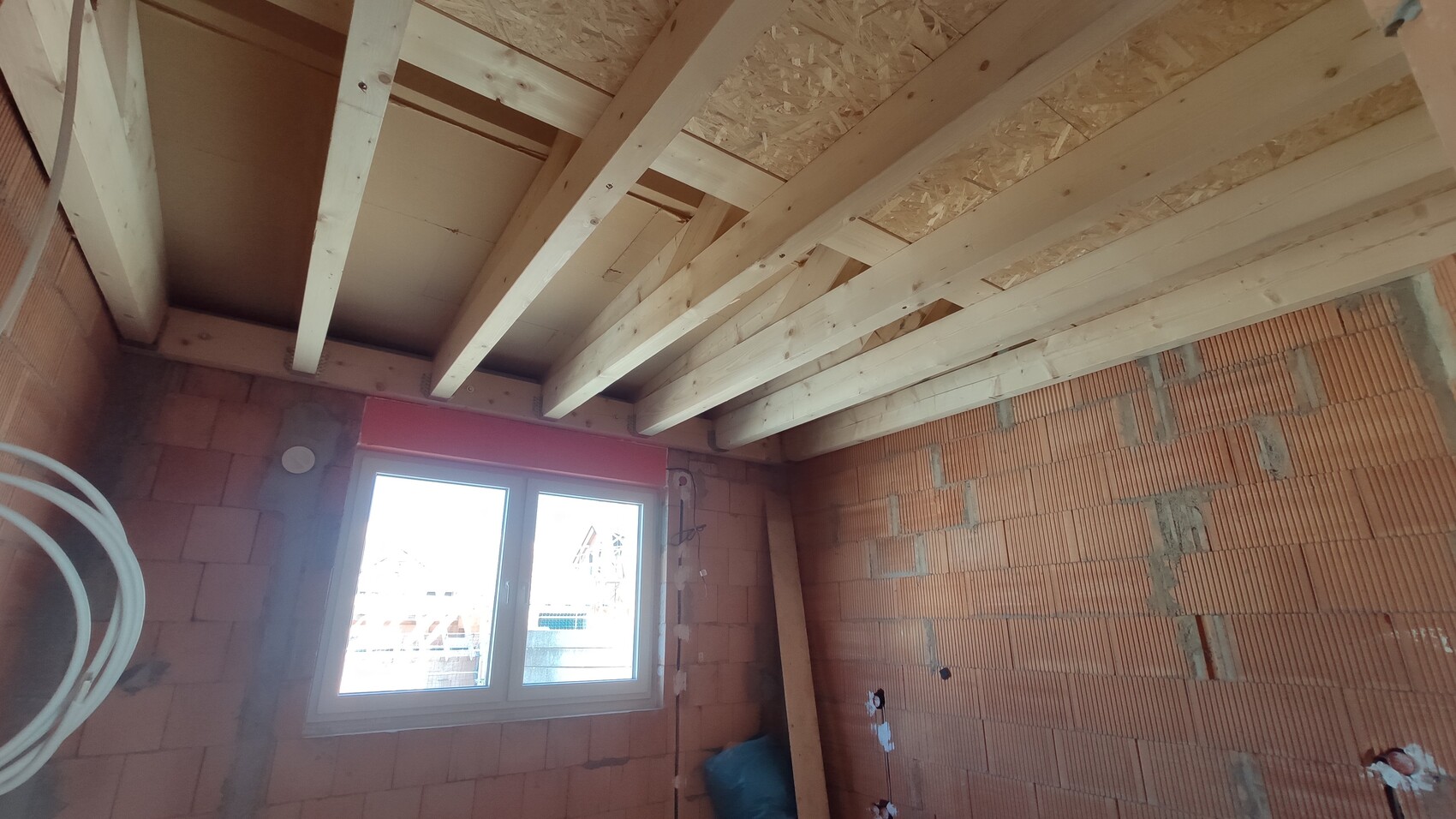
I have been an active but silent reader for quite some time.
Regarding the insulation between the rafters of the dormers in our new build, which I will be doing myself, a question has now come up about the best way to proceed.
Since a picture is worth a thousand words, I won’t bother describing it in detail.
I think it’s clear from the image that the "rafter depth" increases significantly due to the roof structure – up to about halfway into the room. That area marks the start of the attic, which is naturally easy to insulate.
But how would you approach the insulation between the rafters in the area where their thickness increases?
The insulation material will be ISOVER friction-fit mineral wool.
Best regards and happy Easter holidays
The Lickles

Lickles schrieb:
As a picture is worth a thousand words, I won’t try to describe it in detail.Then please add a cross-section drawing showing how the connection between the dormer and the attic works. By the way, I think it’s more likely a gable dormer.https://www.instagram.com/11antgmxde/
https://www.linkedin.com/company/bauen-jetzt/

Lickles schrieb:
Attached are additional details from which everything should be derived.Yes, and in such a way that your question is already answered: the entire length is planned to be continuously insulated with 22 cm (9 inches) thickness, leaving the wedge as a cavity. I notice the lack of ventilation behind it or a barrier to prevent condensation moisture from penetrating into the insulation material.https://www.instagram.com/11antgmxde/
https://www.linkedin.com/company/bauen-jetzt/
11ant schrieb:
Yes, and your question is already answered by this: the entire length is planned to be insulated continuously with a thickness of 22 cm (8.7 inches), leaving the wedge as an air cavity. I miss its "ventilation" or a barrier to prevent the ingress of condensing moisture into the insulation layer. That is fine.
Isolair wood fiber insulation is a breathable, multipurpose board that can be clad and rendered. Suitable for roof, internal, and external walls.
Similar topics