
ᐅ Building a Pre-Designed House – Minor Changes and Unintended Consequences
Created on: 28 Mar 2022 13:38
V
Vrumfondel
Hello everyone,
this thread is meant to be a collection of experiences from how we built a production house and made a few changes during the (floor plan) design phase, and now want to share the results and some unexpected side effects. This might serve as a reference for future homeowners in similar cases or at least provide some ideas to go through your own requested changes a couple of times in your head to make sure everything is thoroughly thought through. Of course, hindsight is always 20/20, and you might end up making “different” mistakes later on – but perhaps this list can still be helpful for some.
I’ll start:
We built a Town & Country Flair 125, in the version with a “guest bathroom with shower and an additional study” (no external links allowed, but easily found on the Town & Country homepage).
During the architect meeting, we discussed the following changes:
1. Front door extended with a fixed window panel in front of the stairs
2. Storage room removed, utility/technical room (HAR) enlarged by moving the partition wall between the hallway and utility room from the exterior wall to the kitchen wall
3. Door to the open-plan living area moved and replaced with a door featuring a glass panel, positioned flush with the front door
4. Relocated the pull-down attic staircase by about one meter (3 feet), and reversed its direction so that the stairs now lead towards the bathroom door, allowing a continuous path through the ground floor, upper floor, and attic.
Here are the “side effects”:
1. The light switches at the stairway are now about at the fourth or fifth step instead of above the first step. Since they were installed in the “standard” installation zone, they seem a bit low in that position. This takes some getting used to—at first it felt odd, but by now you don’t even notice it.
2. Good decision: the square footage in front of the storage/utility room would otherwise have been unused space in the hallway.
3. Two side effects: the space originally planned for a coat closet (even a small one) no longer exists. We now have a wall-mounted coat rack where the door to the open-plan living area used to be, which works for three people. The partition wall separating the kitchen countertop remained in its original position. It’s not 100% practical there and in hindsight, we might have moved or removed it altogether. Now a sideboard goes there, which at least makes it look reasonable. Looking back, this is a decision we would probably change.
4. No downsides.
Additionally, a few general notes about the Flair 125 (no changes here, but still worth sharing):
- The window sill height in the study is 1.27 meters (4 feet 2 inches). This likely comes from the L-shaped open-plan variant where this would be a kitchen window, and the height fits that purpose. In the study, this means that when sitting, you’re basically looking at a wall instead of out the window. Definitely something worth checking! A small consolation: with more and larger monitors these days, it’s easy to open the window above the desk without major modifications.
- We initially considered installing a stove with an external chimney pipe later on. In hindsight, I’m very happy we didn’t and won’t do so. In exactly that spot (in the pictures on the Town & Country page where the couch and TV furniture are) I would definitely plan for a window next time. That wall faces west, and getting more natural light there would definitely be worth losing some decoratable wall space.
- For the detail enthusiasts: we originally planned to mount the light switch in the upstairs hallway (on the small wall in the guest room) in the middle, so it would be equally accessible from the guest room and the bedroom (in our case, a child’s room). In reality, there is a stud profile right there in the wall. We saved some money and the guest just has to stretch their hand a little further until the light comes on.
- On every side of the house where there is an external wall outlet for an outdoor light (on our lot with the street lamp that’s only two sides; elsewhere it might be all four sides), we also had an outdoor electrical outlet installed. Although 25-meter (82-foot) extension cords can do the job, shorter cable runs are usually more convenient.
Those are my experiences—I’m curious if this topic sparks any interest here.
this thread is meant to be a collection of experiences from how we built a production house and made a few changes during the (floor plan) design phase, and now want to share the results and some unexpected side effects. This might serve as a reference for future homeowners in similar cases or at least provide some ideas to go through your own requested changes a couple of times in your head to make sure everything is thoroughly thought through. Of course, hindsight is always 20/20, and you might end up making “different” mistakes later on – but perhaps this list can still be helpful for some.
I’ll start:
We built a Town & Country Flair 125, in the version with a “guest bathroom with shower and an additional study” (no external links allowed, but easily found on the Town & Country homepage).
During the architect meeting, we discussed the following changes:
1. Front door extended with a fixed window panel in front of the stairs
2. Storage room removed, utility/technical room (HAR) enlarged by moving the partition wall between the hallway and utility room from the exterior wall to the kitchen wall
3. Door to the open-plan living area moved and replaced with a door featuring a glass panel, positioned flush with the front door
4. Relocated the pull-down attic staircase by about one meter (3 feet), and reversed its direction so that the stairs now lead towards the bathroom door, allowing a continuous path through the ground floor, upper floor, and attic.
Here are the “side effects”:
1. The light switches at the stairway are now about at the fourth or fifth step instead of above the first step. Since they were installed in the “standard” installation zone, they seem a bit low in that position. This takes some getting used to—at first it felt odd, but by now you don’t even notice it.
2. Good decision: the square footage in front of the storage/utility room would otherwise have been unused space in the hallway.
3. Two side effects: the space originally planned for a coat closet (even a small one) no longer exists. We now have a wall-mounted coat rack where the door to the open-plan living area used to be, which works for three people. The partition wall separating the kitchen countertop remained in its original position. It’s not 100% practical there and in hindsight, we might have moved or removed it altogether. Now a sideboard goes there, which at least makes it look reasonable. Looking back, this is a decision we would probably change.
4. No downsides.
Additionally, a few general notes about the Flair 125 (no changes here, but still worth sharing):
- The window sill height in the study is 1.27 meters (4 feet 2 inches). This likely comes from the L-shaped open-plan variant where this would be a kitchen window, and the height fits that purpose. In the study, this means that when sitting, you’re basically looking at a wall instead of out the window. Definitely something worth checking! A small consolation: with more and larger monitors these days, it’s easy to open the window above the desk without major modifications.
- We initially considered installing a stove with an external chimney pipe later on. In hindsight, I’m very happy we didn’t and won’t do so. In exactly that spot (in the pictures on the Town & Country page where the couch and TV furniture are) I would definitely plan for a window next time. That wall faces west, and getting more natural light there would definitely be worth losing some decoratable wall space.
- For the detail enthusiasts: we originally planned to mount the light switch in the upstairs hallway (on the small wall in the guest room) in the middle, so it would be equally accessible from the guest room and the bedroom (in our case, a child’s room). In reality, there is a stud profile right there in the wall. We saved some money and the guest just has to stretch their hand a little further until the light comes on.
- On every side of the house where there is an external wall outlet for an outdoor light (on our lot with the street lamp that’s only two sides; elsewhere it might be all four sides), we also had an outdoor electrical outlet installed. Although 25-meter (82-foot) extension cords can do the job, shorter cable runs are usually more convenient.
Those are my experiences—I’m curious if this topic sparks any interest here.
@Vrumfondel
Now I have to ask. Your retractable attic ladder runs parallel to the ridge direction. But doesn’t the ladder also align with the joists (running from eaves to eaves) in the roof structure? Or is the crossbeam missing accordingly?
My retractable attic ladder is installed parallel to the regular stairs, that is, between the joists.
Now I have to ask. Your retractable attic ladder runs parallel to the ridge direction. But doesn’t the ladder also align with the joists (running from eaves to eaves) in the roof structure? Or is the crossbeam missing accordingly?
My retractable attic ladder is installed parallel to the regular stairs, that is, between the joists.

Andre77 schrieb:
Your retractable attic ladder is installed parallel to the ridge direction. But doesn’t the ladder also align with the beams (running from eaves to eaves) of the roof framework? Or is the corresponding crossbeam missing there? A retractable attic ladder preferably opens near or along the ridge line. If its axis runs parallel to the ridge, it will naturally be perpendicular to the direction of the rafters (which usually run parallel to the ceiling joists). However, I think "alignment" is too strong a term here, since there is no direct structural connection. In a joisted ceiling between the upper floor and attic, this perpendicular orientation requires beam replacements, which you have already correctly noted. The way this is resolved here is generally considered favorable by most. Even if the ceiling between the upper floor and attic were concrete, it would usually be handled similarly.
Andre77 schrieb:
My attic ladder is installed parallel to the main staircase, i.e., between the crossbeams. The main staircase between the ground floor and upper floor is ideally positioned to run parallel to the ceiling joists / rafters / gables in a wooden beam ceiling. However, it is also longer and wider. Because of its length, a perpendicular orientation would usually require up to four beam replacements (whereas the attic ladder would need no more than two). This is also avoided because the width of the main staircase already necessitates a beam replacement.
https://www.instagram.com/11antgmxde/
https://www.linkedin.com/company/bauen-jetzt/
V
Vrumfondel31 Mar 2022 09:47Regarding the specific case – as the saying goes, a picture is worth a thousand words. To clarify: the beams and insulation, as well as the roughly installed cross battens and boarding, are provided by the builder.
I’m not sure if the opening for the retractable attic ladder is freely “adjustable.” Both discussed positions (ours and the one from the original plan) must definitely be feasible – I don’t even know if flipping the floor plan affects the roof truss. Rotating the installation direction of the ladder is not a problem at all.
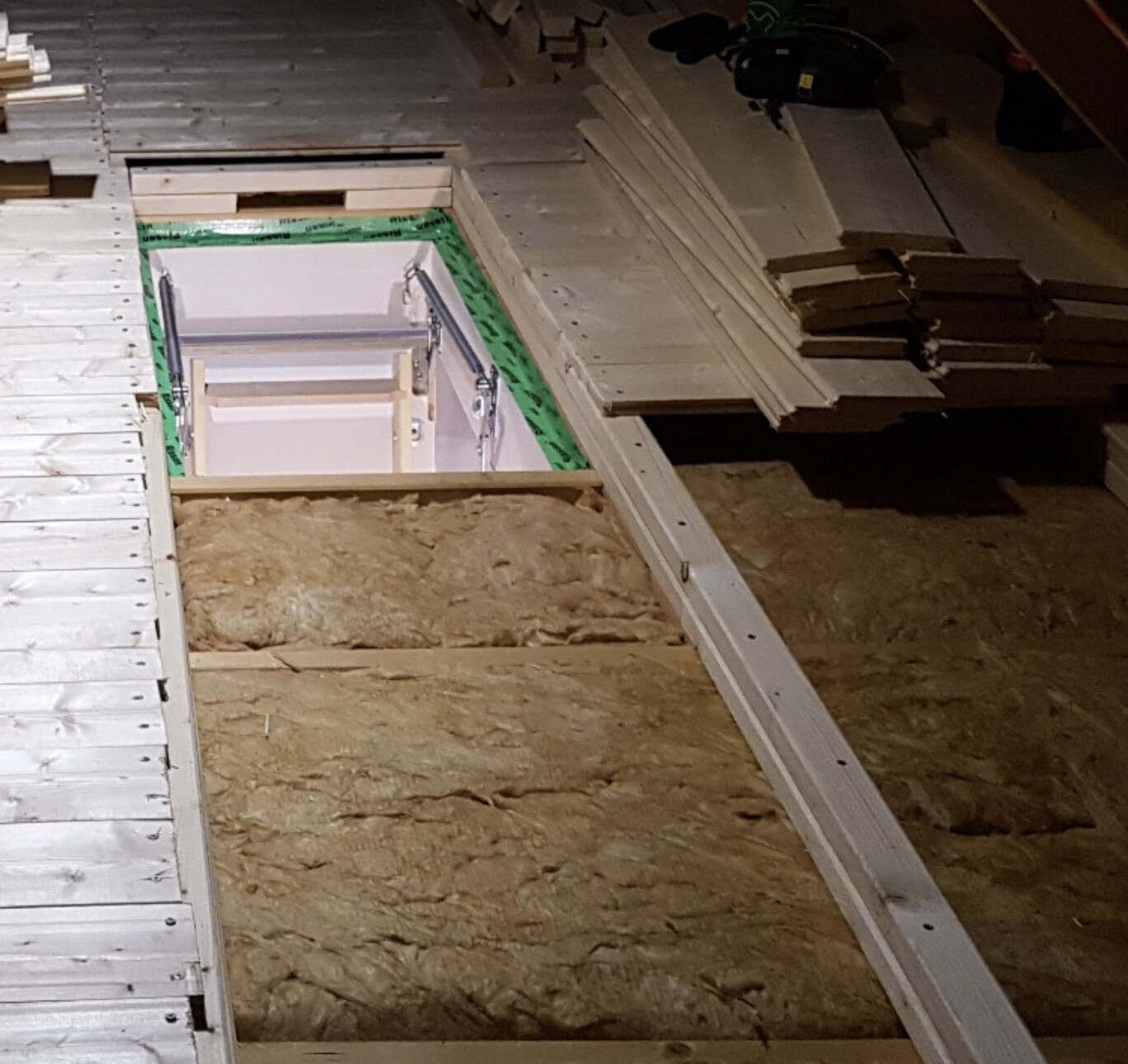
I’m not sure if the opening for the retractable attic ladder is freely “adjustable.” Both discussed positions (ours and the one from the original plan) must definitely be feasible – I don’t even know if flipping the floor plan affects the roof truss. Rotating the installation direction of the ladder is not a problem at all.
V
Vrumfondel31 Mar 2022 10:24No, they are generally spaced evenly. Unfortunately, I don’t have a photo of the whole area or any before the installation of the sheathing.
Basically, a "frame" is built around it – if you search for "stitch beam" or "cross beam," the first image in the search results (at least for me) is a still from a YouTube video that illustrates this quite clearly.
Basically, a "frame" is built around it – if you search for "stitch beam" or "cross beam," the first image in the search results (at least for me) is a still from a YouTube video that illustrates this quite clearly.
Vrumfondel schrieb:
A picture is worth a thousand words. In my estimation, what we see here are the ceiling joists placed perpendicular to the hatch with insulation fleece laid in between, and then parallel to the hatch (that is, crossing the top edges of the joists) a double battens framework serving as the substructure for the floorboards.
Andre77 schrieb:
Okay, it seems like your cross beams of the roof frame are spaced unevenly when looking from the bottom edge of the picture upwards toward the stairs. I don’t understand why you are linking the ceiling joists with the rafters—the ceiling is not part of the roof structure here (and certainly not the one between the attic and the roof space, nor is the one between the ground floor and attic in houses with traditional rafter construction up until about sixty years ago).
https://www.instagram.com/11antgmxde/
https://www.linkedin.com/company/bauen-jetzt/
Similar topics