
ᐅ Irrigation with a well – too much for an area of about 650 m²
Created on: 19 Mar 2022 12:38
A
ArthHaus
Hello everyone,
First of all, I want to apologize for not sharing the house building process with you in my other thread. Time flew by incredibly fast, and we moved in already in October 2021. So far, the construction went smoothly, and we now want to start working on the garden in May. Specifically, it’s about irrigation using a well. I have read other threads and I’m completely overwhelmed trying to figure out if the pump we had installed is even sufficient for our property, and if so, how we should plan the system.
Can you help me get started with the planning? This is the current situation:
Groundwater at around 2 m (6.5 feet). Drilled well about 7 m (23 feet) deep.
The installed pump is:
iWater eco3 4-60 62 m (203 feet), 3.6 m³/h (includes pressure switch, dry-run protection etc.)
Connected with PE pipe, 32 x 3.0 mm (1.25 x 0.12 inches)
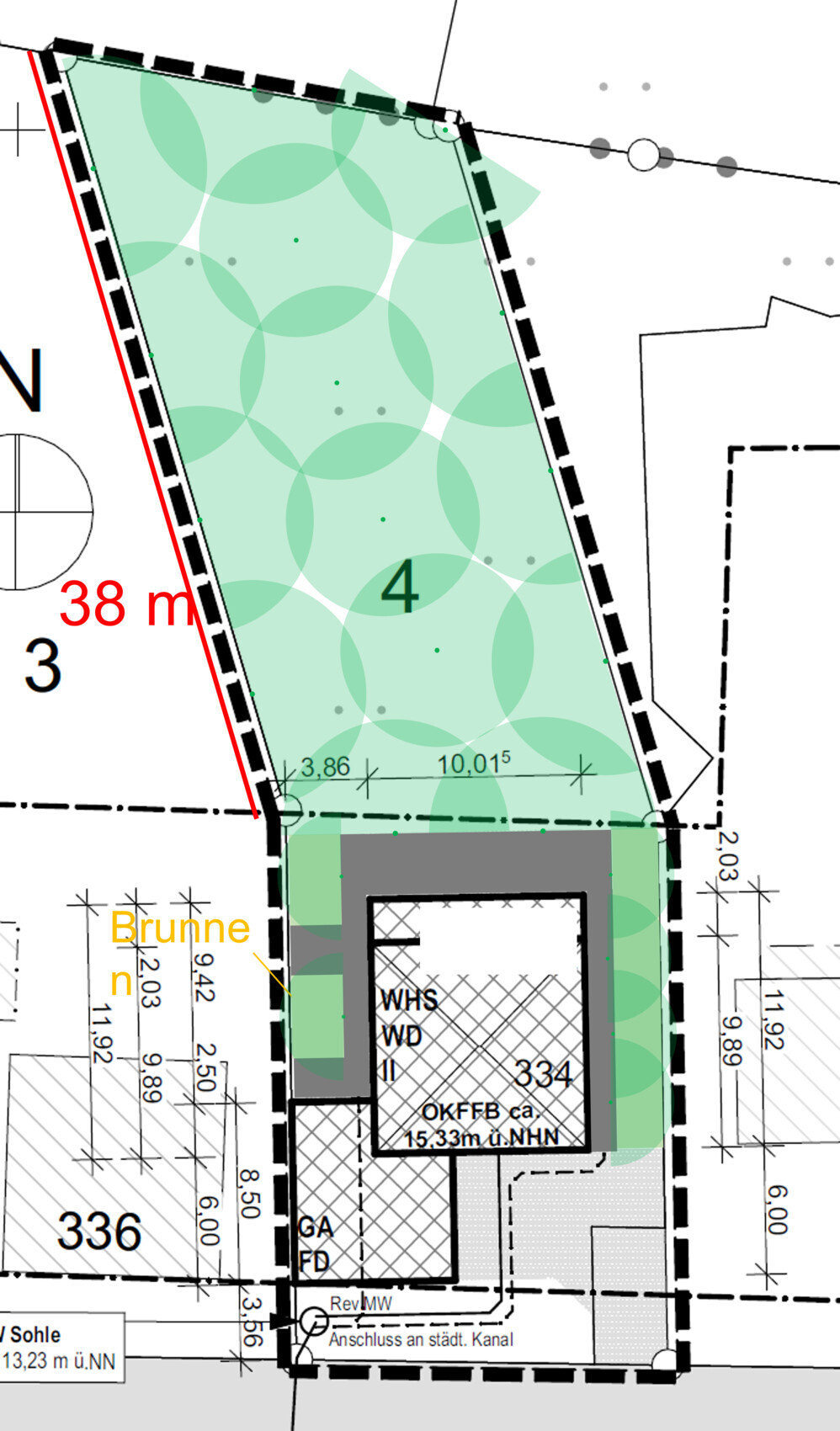
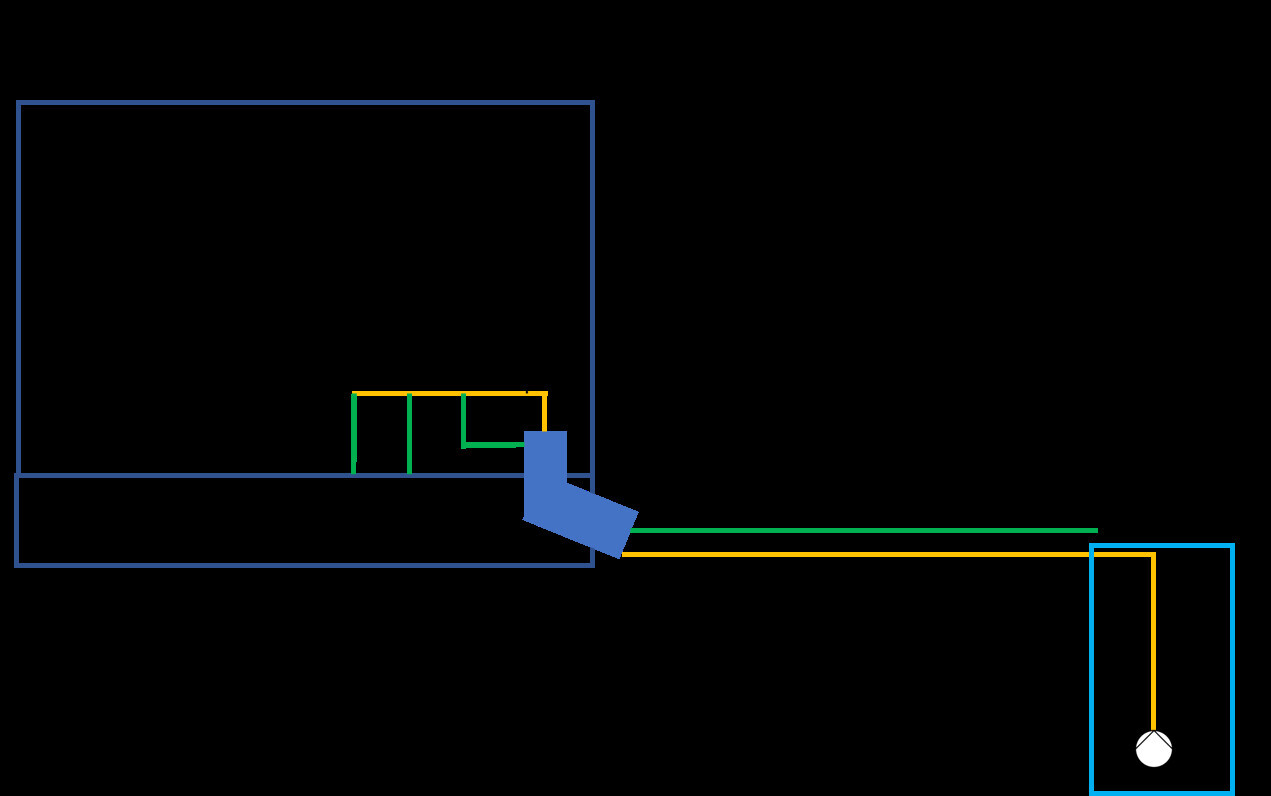
I’ve attached a drawing of the current installation. The plan is also to use the well water for 2 toilets, the washing machine, and 2 outdoor water outlets. The installation can be expanded inside the garage if needed. Attached is also a site plan, with the paved areas marked in gray and the planting beds in green. The backyard will initially be fully lawn for the next few years.
As a complete beginner, I thought I’d simply take the 35 mm (1.38 inch) pipe and put enough rotators on it to cover the entire area. Now, after reading other threads, I’m struggling to imagine how we can do this with the current pump capacity. The initial plan with one zone (as intended) would require a total of 11.83 m³/h, but my pump can only deliver 3.6 m³/h. If I understand correctly, I’d have to split it into 3 zones, right?
These are the rotators I’ve planned so far. This leaves some gaps in the middle — is it acceptable to leave these and hope the water reaches there somehow?
11 x MP 3500 (10 m (33 feet) radius, 180°) 8.22 m³/h
4 x MP 3000 (9.1 m (30 feet) radius, 360°) 3.30 m³/h
6 x MP 800 SR (3 m (10 feet) radius, 180°) 0.31 m³/h
As soon as I need multiple zones, the pipe entry probably won’t be sufficient anymore. I’ll have to try to get 4 x 35 mm (1.38 inch) pipes through the KG pipe. Mathematically that should work… Otherwise, the zone distribution would have to be moved outside. But I’d prefer to keep everything inside the garage.
I hope you can point me in the right direction.
Thank you!
First of all, I want to apologize for not sharing the house building process with you in my other thread. Time flew by incredibly fast, and we moved in already in October 2021. So far, the construction went smoothly, and we now want to start working on the garden in May. Specifically, it’s about irrigation using a well. I have read other threads and I’m completely overwhelmed trying to figure out if the pump we had installed is even sufficient for our property, and if so, how we should plan the system.
Can you help me get started with the planning? This is the current situation:
Groundwater at around 2 m (6.5 feet). Drilled well about 7 m (23 feet) deep.
The installed pump is:
iWater eco3 4-60 62 m (203 feet), 3.6 m³/h (includes pressure switch, dry-run protection etc.)
Connected with PE pipe, 32 x 3.0 mm (1.25 x 0.12 inches)
I’ve attached a drawing of the current installation. The plan is also to use the well water for 2 toilets, the washing machine, and 2 outdoor water outlets. The installation can be expanded inside the garage if needed. Attached is also a site plan, with the paved areas marked in gray and the planting beds in green. The backyard will initially be fully lawn for the next few years.
As a complete beginner, I thought I’d simply take the 35 mm (1.38 inch) pipe and put enough rotators on it to cover the entire area. Now, after reading other threads, I’m struggling to imagine how we can do this with the current pump capacity. The initial plan with one zone (as intended) would require a total of 11.83 m³/h, but my pump can only deliver 3.6 m³/h. If I understand correctly, I’d have to split it into 3 zones, right?
These are the rotators I’ve planned so far. This leaves some gaps in the middle — is it acceptable to leave these and hope the water reaches there somehow?
11 x MP 3500 (10 m (33 feet) radius, 180°) 8.22 m³/h
4 x MP 3000 (9.1 m (30 feet) radius, 360°) 3.30 m³/h
6 x MP 800 SR (3 m (10 feet) radius, 180°) 0.31 m³/h
As soon as I need multiple zones, the pipe entry probably won’t be sufficient anymore. I’ll have to try to get 4 x 35 mm (1.38 inch) pipes through the KG pipe. Mathematically that should work… Otherwise, the zone distribution would have to be moved outside. But I’d prefer to keep everything inside the garage.
I hope you can point me in the right direction.
Thank you!
rick2018 schrieb:
Forget square sprinklers immediately.
Either plan and install a proper system (Rainbird, Hunter…) or rather don’t install one at all. If you have a well, I would definitely recommend setting up an irrigation system. Excess water is returned directly to the source in a closed loop… Which is better? Rainbird or Hunter?
I’m not very experienced in this topic. I’ve only installed pipes and access points underground at my place.

Professional brands like Hunter and Rainbird are equally good and can be combined well. Please avoid Gardena. Its irrigation products are not of good quality, and after 1-2 years you will likely need to replace them. They are also more expensive... Please make sure to thoroughly research how irrigation should be properly planned.
rick2018 schrieb:
Professional brands like Hunter and Rainbird are equally good and can be combined well. Just don’t use Gardena. Their irrigation quality is not good, and you’ll have to replace it after 1-2 years. It’s also more expensive...
Please read up properly on how irrigation should be planned. Thanks, I know – unfortunately.
This is a special topic with many possibilities.
So far, I simply haven’t had the time for it, and since I’ll be starting the next new build project this late summer (as soon as the site development is finished), I won’t have time for this for the next two years either.
At the moment, I’m using Geka couplings and sector sprinklers. They branch off individually from the main line, a 1.5" PE pipe, via T fittings.
There are four units in the corners, and about 80m (260 feet) of drip hoses used to irrigate the front garden and flower beds.
Basically, I open the ball valve, the pump starts, and after about two hours, I close the valve again and the pump stops. Done.
It could be better, but for a fully automated system covering the garden, side areas, and front garden, it would surely take at least a week until everything runs smoothly – if that’s even enough! (as a non-expert)
Professional landscapers would probably be horrified, but this is good enough for me at the moment 😀
M
Myrna_Loy21 Mar 2022 11:44TmMike_2 schrieb:
Thanks, I know – unfortunately.
This is a complex topic with many options.
I simply haven’t had the time so far, and since I’ll be starting a new construction project this late summer (once the site utilities are completed), I probably won’t have time for this over the next two years either.
Currently, I’m using Geka couplings and sector sprinklers. They branch off individually from the main line, which is a 1.5" PE pipe, via T-fittings.
There are four units at the corners, and about 80m (260 feet) of drip hose in the front yard and flower beds for irrigation.
Basically, I just open the ball valve, the pump starts, and two hours later I close the valve and the pump switches off. Done.
It could be better, but setting up a fully automated system for the garden, side area, and front yard would definitely take at least a week to get everything running – if that’s even enough! (speaking as a non-expert)
Professional landscapers would probably be horrified, but this is enough for me at the moment 😀 We have an automated irrigation system for the office grounds and have a service technician come for a full day twice a year for spring and winter maintenance, plus usually one or two repair visits during the summer. What is really necessary and what is just for convenience, I have no idea.
We have several systems in operation. They are drained in autumn and started up again in spring, or we check whether all settings are still correct.
Depending on the plants, manual irrigation is either not possible at all or would require hiring staff. Less water is also needed because the amounts of precipitation are precisely known.
Depending on the plants, manual irrigation is either not possible at all or would require hiring staff. Less water is also needed because the amounts of precipitation are precisely known.
M
Myrna_Loy21 Mar 2022 13:22rick2018 schrieb:
We have several systems in operation. They are blown out in the fall and restarted in the spring, or checked to see if all settings are still correct.
Depending on the plants, manual watering is not always possible, or staff would need to be hired for it. Less water is also needed because the rainfall amounts are precisely known. ...and the water is better conserved and not lost to evaporation from leaves. It makes sense when the areas actually need it.
Similar topics