
Hello everyone,
We are currently working on building our single-family house. The building application has been submitted, and we promptly received the first letter from the building authority stating:
Rainwater must generally be infiltrated or directed into a nearby open water body, as long as this is possible without excessive effort and damage (§ 48 b Abs. 3 WG-BW).
After a phone consultation with the building authority, we were told that rainwater is not allowed to be discharged into the sewer system due to water protection zone III. The proposed solution (if you can call it that, as they basically said “there’s no way around it”) is a cistern. Permeable paving was also mentioned for the driveway, although we’re not sure what that is for. There is no water body nearby, by the way.
We had actually considered a cistern for watering the garden but excluded it due to the cost. Now we are being forced to install one despite the financial strain, so I have a question for you.
There seem to be countless types of cisterns (according to Google). Can you tell me which type would suit our purpose and where it’s most important not to cut corners?
Kind regards
We are currently working on building our single-family house. The building application has been submitted, and we promptly received the first letter from the building authority stating:
Rainwater must generally be infiltrated or directed into a nearby open water body, as long as this is possible without excessive effort and damage (§ 48 b Abs. 3 WG-BW).
After a phone consultation with the building authority, we were told that rainwater is not allowed to be discharged into the sewer system due to water protection zone III. The proposed solution (if you can call it that, as they basically said “there’s no way around it”) is a cistern. Permeable paving was also mentioned for the driveway, although we’re not sure what that is for. There is no water body nearby, by the way.
We had actually considered a cistern for watering the garden but excluded it due to the cost. Now we are being forced to install one despite the financial strain, so I have a question for you.
There seem to be countless types of cisterns (according to Google). Can you tell me which type would suit our purpose and where it’s most important not to cut corners?
Kind regards
nokapito schrieb:
And just a minor question. I wouldn’t want a fixture in the ground with a hose sticking out of it. Is there a way to connect it to a faucet on the exterior wall of the house instead? I couldn’t find such a solution online.
Sure, that’s possible. For example, you could use a pump with a pressure switch. It activates immediately when the pressure drops. In that case, it’s recommended to have a small intermediate buffer tank, similar to what’s used in a home water management system.

Nemesis schrieb:
It always sounds like a cistern costs around 10k...How much does a cistern actually cost? Or what should you expect if you decide to install one? We will be building on a slope, so some earthworks will likely be necessary anyway. If the cistern is incorporated during this process, what kind of cost estimate would be realistic? I have no idea what to expect.
W
WilderSueden18 Mar 2022 14:24$2,000 for a cistern with a pump seems a bit low to me, based on what I found back then, the cost was somewhat higher. I would estimate at least $3,000 for that. You will also need gravel to fill the remaining pit. Depending on the placement of the cistern, crane work or access for the truck with a crane will be required.
In general, a cistern twice the size costs less than double, so it definitely makes sense to consider sizing it a bit larger.
In general, a cistern twice the size costs less than double, so it definitely makes sense to consider sizing it a bit larger.
netuser schrieb:
You’re mixing things up a bit. Normally, you don’t have to pay for the water in the cistern.
Earlier, the discussion was only about the cost-benefit comparison between fresh water, a well, and a cistern, for example, for garden irrigation.
I just added that a cistern dedicated solely to this purpose is usually not economically viable... With high consumption and over many years, it might be, compared to using fresh water. However, the latter is also generally cheaper if you can save on wastewater charges (-> meter). Ah, got it! Thanks for clarifying!
netuser schrieb:
If the local development plan does not require one, then you can probably avoid it. Maybe the person you spoke to on the phone mixed things up (cistern, soakaway...) or just expressed their personal opinion for other reasons. I think so too…
netuser schrieb:
On top of the roughly 2,000 (EUR, implied) comes the transport costs and handling with the crane on your property.
You can roughly estimate excavation and disposal costs, say about 30–40 EUR per cubic meter (about 40–53 USD per cubic yard).
Plus installation... possibly with a foundation depending on the design... In the end, you might be looking at over 3,000 EUR (around 3,200 USD). Great, thanks! That gives me something to work with.
netuser schrieb:
A hose coming out of the ground? What don’t you like, for example, about a “water tap post” (also known as an outdoor faucet/hydrant)?
Otherwise, of course, you can run hoses however you like and connect them to an external wall tap. I somehow don’t find that very attractive:
😕
TmMike_2 schrieb:
Sure, it’s possible. For example, a pump with a pressure switch.
It switches on immediately when pressure drops. It’s recommended to have a small intermediate buffer, similar to a domestic power system, for the water. I definitely need to study this further! Many thanks already for all the suggested solutions and ideas!

Hello Kati, my cistern cost just under 1.6 meters (5.25 feet). In addition, I bought a submersible pump, a few meters of hose, and a faucet. Unfortunately, I can’t tell you the installation costs, as they were included in the total price for our entire outdoor landscaping. You will need to discuss that on site with the landscaper.
W
WilderSueden18 Mar 2022 14:43nokapito schrieb:
I don’t really find something like this very attractive:
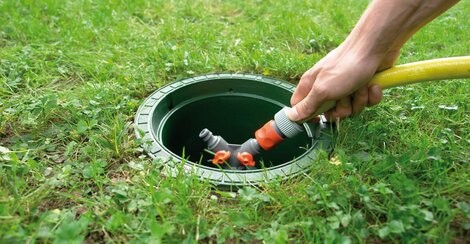
😕
You can easily make something yourself, for example a small wooden box with a lid. I wouldn’t find your example very attractive either. We will have a water tap on the house, and I’m also planning to install 1-2 additional outdoor faucets in the garden connected by underground piping. I’ll have to check the details once the house is built, but ideally, I don’t want to constantly run a 20m (65 feet) hose across the yard.
Similar topics