
ᐅ Retrofitting a Smart Home in a Single-Family House: Experiences
Created on: 9 Mar 2022 00:35
O
ostseekindO
ostseekind9 Mar 2022 00:35Hello everyone,
I have spent some time browsing the forum, reading posts, and researching online. But in the end, I am still faced with an overwhelming range of options when it comes to smart homes. I believe I understand the difference between smart as remote control and smart as intelligent automation. I still need to decide what I really need and would like to present my ideas and starting point as follows.
I look forward to your suggestions and information on how to get started and what I would need to implement the described minimum and maximum or how the path from minimum to maximum could look over time.
Best regards,
Thomas
I have spent some time browsing the forum, reading posts, and researching online. But in the end, I am still faced with an overwhelming range of options when it comes to smart homes. I believe I understand the difference between smart as remote control and smart as intelligent automation. I still need to decide what I really need and would like to present my ideas and starting point as follows.
- Purchase of an existing detached single-family house, built in 1994, prefabricated timber frame construction, 120 sqm (1300 sq ft) over 2 floors, no basement, gas heating system from Vaillant with a central controller and thermostats on the radiators, no underfloor heating
- Family of four, with two small children who will be active in the house, (currently) no pets and unlikely to have any
- The house already includes some more or less smart components that came with the purchase:
- Most of the roller shutters on both floors are equipped with motors from Schellenberg and are controlled via radio remote
- Two Velux roof windows with solar-powered exterior sun protection awnings controlled via the Velux app KIG 300
- In the bedroom, there are Occhio lights, which are controlled via "Occhio Air" for lighting and scene settings
- Husqvarna AM 315X robotic lawnmower, although I have not researched yet how independently it operates or whether it can be controlled or monitored
- Outside there are one or two motion sensors for lighting, but I’ve not looked into those in detail yet
- What do I need in terms of smart home... a difficult question. After much reading, there are many great things (or just gimmicks) and it seems appetizing, but as of now I don’t want to make it a hobby and prefer to keep it simple, set up myself, and remain in control. Depending on the use cases, I would like to define or program some logic (I used to be a software developer), but at a level where after 3 months without constant attention, I still understand what I did and can adjust it if needed.
- Lighting control / scenes: I mainly see a need on the ground floor in the living and dining areas; for other rooms, I can manage without it. If possible, I would also like to include the bedroom lighting with the existing Occhio lights, but that wouldn’t be a priority or a reason to invest extra, especially across floors.
- Heating control (lowering temperature at night and when away, heating the bathroom earlier in the morning than other rooms)
- Roller shutter control
- Retrofitting remote control for all roller shutters – continue with Schellenberg or replace everything at once?
- Close all shutters at once when leaving the house – voice control would be sufficient for me
- Timed opening and closing would be enough
- Nice-to-have features include timing aligned with sunrise/sunset, energy efficiency by reacting to sunlight, automatic closure when leaving the house without manual command
- I am unsure how useful parallel manual control via wall switches is, for example, when the children (when older) want to raise the shutters independently of any automation. Maybe manual control shouldn’t require a phone app. Also, the Velux windows are still operated separately
- Add control for the Velux sun awnings so they can be lowered together with the shutters
- Detect open windows and warn when leaving the house – this would be a bit more intelligent, but maybe just checking the phone or asking a voice assistant is enough... although as I write this, it is not really that smart 🙂
- Nice-to-have: continuous ventilation warning at cold outside temperatures, which happens quite often at home
- The old carport is planned to be replaced by a garage in the mid-term
- Minimum would be to open the garage door by voice command from inside when getting dressed; on returning from work, a remote control from the car would suffice
- Nice to have: the delivery person rings the bell, places the package inside, and I close the garage door remotely from the office. But that probably involves much more, like the door system, which I’d rather leave as is
- Open questions: I haven’t understood yet why and how a photovoltaic system and associated charging station should or must be integrated into a smart home, but since our current petrol car will soon be replaced, an electric vehicle will certainly become a topic, along with photovoltaics in general
- Presence simulation during holidays
- Cut power to rooms/floors to reduce unnecessary consumption, although I don’t know if all devices can handle that well
- Nice-to-have for later: lawn irrigation based on measured soil dryness
- Nice-to-have: smoke detectors that notify me when I am not at home
- Framework conditions
- Most of the upstairs (first floor) has already been renovated, so in some rooms we will hardly do anything, meaning rewiring is rather out of the question. My question is whether a wired small solution only on the ground floor makes sense and could be extended to the upper floor later? The only upgrade planned upstairs is adding downlights in the hallway. A renovation might also be critical in terms of timing, effort, and availability of craftsmen, so retrofit solutions like wired DigitalStrom or wireless systems are options.
- Overall, I would rather start small and grow into the topic. But from what I have read, this may make it difficult later when new use cases come up.
- Schellenberg offers a solution with the Smartfriends Box (or integrated in Magenta Home), but this seems more like a niche product with a small active forum, so maybe not the best starting point?
- I don’t feel comfortable adding dozens of switches and sockets controlled wirelessly in addition to the many existing devices in the household such as phones, tablets, TVs, etc. From a building biology standpoint, it is recommended to use only certain protocols to keep exposure low.
- Real smart solutions require more rather than fewer sensors in the house. Since we have a minimalist design and value aesthetics, we don’t want sensors placed on every wall corner or ceiling. I would appreciate recommendations for sensors that don’t look like Big Brother’s eyes and can be well hidden.
- Currently, we mostly use Apple devices, although I don’t want to be locked into this ecosystem. We also have Sonos for voice control in the house.
- EnOcean is ruled out for us as a wireless solution; as someone in the forum mentioned, "Ok for the garage," but the clicking noise of the switches is not acceptable (I checked on YouTube).
- I also don’t want to commit to proprietary systems.
- I have no insight so far into potential interference and how, if a component, Wi-Fi, or internet fails, the most important functions can still be maintained. For example, I am not home but my wife can still turn the lights on or raise the shutters. Remote control from outside the house may be necessary for some current or future use cases, but it should not be essential for basic functions.
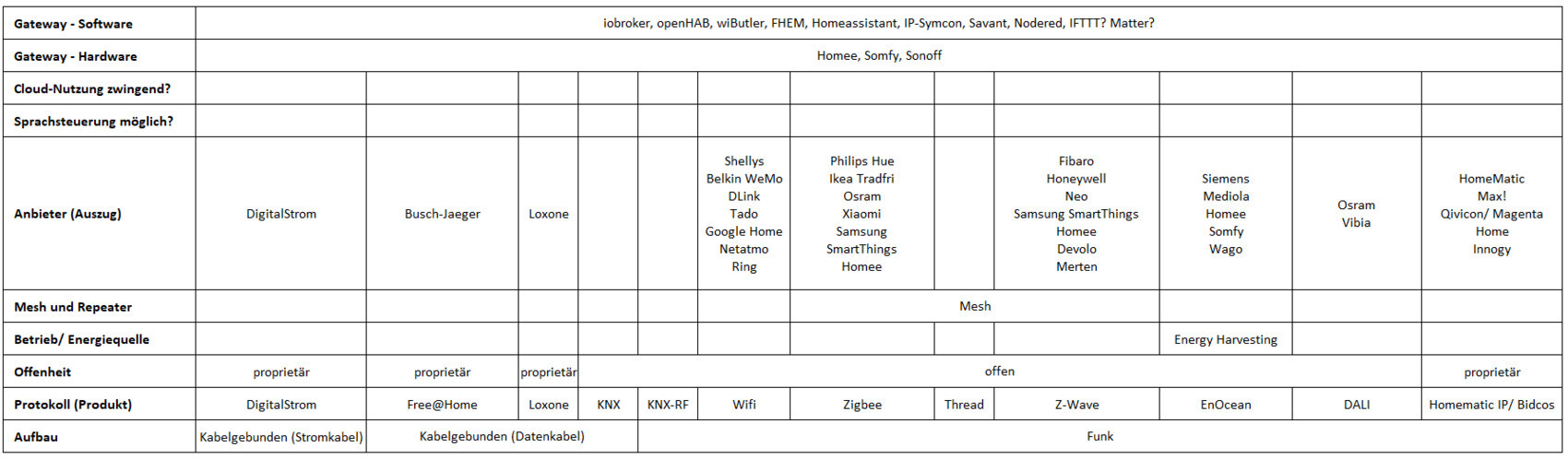
- With these rough ideas, I have stepped into the smart home jungle and am picking up one term after another. I want to better understand this jungle, but the dependencies and compatibilities are hard to grasp. For instance, how do I program logic and control what, how powerful or limited is each solution – e.g. integrating devices from different manufacturers using various protocols, which devices/software work together, and how can these be controlled by phone or voice (if not fully smart).
- So I tried to create an overview that certainly mixes up quite a bit, but maybe someone can support me with the various dimensions and layers and bring some clarity into this jungle 🙂
I look forward to your suggestions and information on how to get started and what I would need to implement the described minimum and maximum or how the path from minimum to maximum could look over time.
Best regards,
Thomas
K
karl.jonas10 Mar 2022 00:33Linking is not allowed, but Sascha König published a personal experience report titled "Why Not Everything Needs to Be Controllable" on 7.3.22 on golem.de. Maybe it contains some interesting ideas?

Just as a suggestion... I stopped reading at point 4.3 because I "completely lost understanding." It’s too much, written too “compactly,” and too unstructured.
Probably your expectations of the forum / collective knowledge are very (too) optimistic.
Given the scope, only a paid consultant will likely be able to help you. But I could be wrong... 😳
Probably your expectations of the forum / collective knowledge are very (too) optimistic.
Given the scope, only a paid consultant will likely be able to help you. But I could be wrong... 😳
O
ostseekind10 Mar 2022 08:22karl.jonas schrieb:
Linking is not allowed, but Sascha König published a personal experience report titled "Why not everything needs to be controllable" on golem.de on 7 March 2022. Maybe it offers some interesting ideas?Thanks, I saw the link before your post was deleted ;-)
For me, the article remains rather superficial regarding practical applications (an aquarium is not exactly a common use case) and mainly discusses reducing devices with new possibilities and the fact that individual providers don’t cover everything, but without going into specifics. As I mentioned, I would like to start small and simple rather than use a sledgehammer to crack a nut—but the question is what potential limitations this might cause?
i_b_n_a_n schrieb:
Just as a suggestion... I stopped reading at point 4.3 because "now I don’t understand anything anymore."
Too much, too densely written, too unstructured.
Your expectations of the forum / collective knowledge might be (too) optimistic.
Given the scope, only a paid consultant might be able to help you. But I might be wrong... 😳That wasn’t really my expectation, and for now it’s just a way to get my thoughts down. I was hoping for a few pointers to help me understand how different solutions and terms relate to each other and where I can start. Then I want to get hands-on, and more specific questions will come up...
K
karl.jonas10 Mar 2022 10:50ostseekind schrieb:
What do I need in a smart home... difficult question Many people ask themselves that here and elsewhere. That’s why I’ve advertised it as a seminar project. If a student wants to apply, I would appreciate support from this forum.
ostseekind schrieb:
Rewiring is generally out of the question The typical retrofit problem.
ostseekind schrieb:
Whether a wired small solution only makes sense on the ground floor Definitely: anyone familiar with wireless chooses wired.
ostseekind schrieb:
At least from a building biology perspective, it’s advised to use only certain protocols to keep exposure low. That’s the first time I’ve read that. Can you provide a reliable source?
ostseekind schrieb:
Currently, we are heavily invested in Apple devices, although I don’t really want to commit fully. If ease of use is the goal, it can make sense to put all your trust in one manufacturer.
ostseekind schrieb:
And I don’t want to get involved with proprietary systems. You already have with Apple. Even if you use an “open” wireless standard, that doesn’t guarantee devices from different manufacturers will work together. There are many solutions here, but it will require effort.
ostseekind schrieb:
I have no insight yet into what interference potentials exist and how to keep the most important functions working if a component, the Wi-Fi, or the internet fail. Very few systems allow the (understandably desired) combination of old (works without smart features) and new. The internet issue is separate; everyone must decide how important privacy protection is.
ostseekind schrieb:
So I tried to make an overview, Nice start. You can see how quickly it becomes confusing. And again: the wireless standards you listed are your smallest problem. There is nothing wrong with using five of them simultaneously, since each only covers a small part of the connection (e.g., from the switch to the controller) and doesn’t affect the logic (which runs on top). When traveling and changing transport twice, it doesn’t matter if you use train three times or combine bike, train, and bus. The connections just have to be right.
O
ostseekind11 Mar 2022 00:06Thank you very much for all your answers 🙂
I can’t fully assess how reliable and up-to-date this is either. But since linking is not allowed, I will only refer to common search engines with the keywords Smart Home, exposure, building biology...
"Building-biologically acceptable systems seem, according to current knowledge, most feasible with providers such as Homematic, EnOcean, or KNX-RF."
"ZigBee, Z-Wave, EQ3, and RWE Smart Home do not achieve quite as good results as EnOcean – mainly because EnOcean radio sends the shortest radio telegrams. However, they are orders of magnitude better than the DECT, Wi-Fi, and mobile communication devices described here."
Not even if both use the same protocol? That would have been my expectation, that this works? Otherwise, okay, I’ll need a layer on top.
Okay, but what exactly represents the logic then? What can HomeKit on the iPhone do (not very much) that Homee or ioBroker can do (just examples)?
And for example: at home, I use Sonos with Alexa. It seems that speaking to Sonos via Siri or HomeKit is not possible? (I’m currently failing to register Sonos in HomeKit to test the other way around and play music on Sonos via iPhone Siri). Does that mean that standing in front of the Sonos speaker and saying, “Hey Siri/HomeKit/Apple, lower the blinds” is not an option?
I’d like to understand these dependencies and limitations so I know which direction I can even take.
karl.jonas schrieb:
This is the first time I’m reading that. Can you provide a reliable source for it?
I can’t fully assess how reliable and up-to-date this is either. But since linking is not allowed, I will only refer to common search engines with the keywords Smart Home, exposure, building biology...
"Building-biologically acceptable systems seem, according to current knowledge, most feasible with providers such as Homematic, EnOcean, or KNX-RF."
"ZigBee, Z-Wave, EQ3, and RWE Smart Home do not achieve quite as good results as EnOcean – mainly because EnOcean radio sends the shortest radio telegrams. However, they are orders of magnitude better than the DECT, Wi-Fi, and mobile communication devices described here."
karl.jonas schrieb:
Even if you use an "open" radio standard, that doesn’t mean two devices from different manufacturers will work together. There are many solutions here, but it will be some work.
Not even if both use the same protocol? That would have been my expectation, that this works? Otherwise, okay, I’ll need a layer on top.
karl.jonas schrieb:
Nice start. You can see how quickly it becomes confusing. And again: the radio standards you mentioned are your smallest problem. There is nothing wrong with using five of them in parallel because they only cover a small part of the distance (e.g., from the switch to the controller) and do not affect the logic (which runs on top). When you change transport twice on a trip, it doesn’t matter if you take the train three times or combine bike, train, and bus. The connections just have to fit.
Okay, but what exactly represents the logic then? What can HomeKit on the iPhone do (not very much) that Homee or ioBroker can do (just examples)?
And for example: at home, I use Sonos with Alexa. It seems that speaking to Sonos via Siri or HomeKit is not possible? (I’m currently failing to register Sonos in HomeKit to test the other way around and play music on Sonos via iPhone Siri). Does that mean that standing in front of the Sonos speaker and saying, “Hey Siri/HomeKit/Apple, lower the blinds” is not an option?
I’d like to understand these dependencies and limitations so I know which direction I can even take.
Similar topics