
ᐅ Increase the supply temperature from 40°C to 35°C or not?
Created on: 5 Mar 2022 00:47
H
HoisleBauer22H
HoisleBauer225 Mar 2022 00:47Hello everyone,
My home construction company specified a flow temperature of 40 degrees Celsius (104°F) in the contract "to save money," meaning a larger pipe spacing, probably increasing from 10-15 cm (4-6 inches) to 20 cm (8 inches).
The key data for the house (planned): KfW 55 standard, Daikin Altherma 3 R ECH2O 308/508, annual performance factor around 4, living area 145 m² (1560 ft²) with the basement also heated (this was required for KfW), the basement itself has 80 m² (860 ft²) of usable/floor space, but is not considered living space according to standards due to insufficient natural light.
We have a controlled ventilation system with heat recovery. We also plan to install a photovoltaic system of about 10 kW peak on the roof at some point.
Now I’m wondering if it would be worthwhile to reduce the flow temperature from 40 degrees Celsius (104°F) to 35 degrees Celsius (95°F) given an assumed electricity price of around 45 cents per kWh. The additional costs are about €15 per m² for the upgrade. The crucial point is how much energy savings percentage is achieved per degree of reduction. It is usually assumed to be 2.5 percent per degree, which would amount to 10–12.5 percent savings at 5 degrees lower flow temperature.
Does anyone have any ideas on how to calculate this or if there is a website available for such calculations?
My home construction company specified a flow temperature of 40 degrees Celsius (104°F) in the contract "to save money," meaning a larger pipe spacing, probably increasing from 10-15 cm (4-6 inches) to 20 cm (8 inches).
The key data for the house (planned): KfW 55 standard, Daikin Altherma 3 R ECH2O 308/508, annual performance factor around 4, living area 145 m² (1560 ft²) with the basement also heated (this was required for KfW), the basement itself has 80 m² (860 ft²) of usable/floor space, but is not considered living space according to standards due to insufficient natural light.
We have a controlled ventilation system with heat recovery. We also plan to install a photovoltaic system of about 10 kW peak on the roof at some point.
Now I’m wondering if it would be worthwhile to reduce the flow temperature from 40 degrees Celsius (104°F) to 35 degrees Celsius (95°F) given an assumed electricity price of around 45 cents per kWh. The additional costs are about €15 per m² for the upgrade. The crucial point is how much energy savings percentage is achieved per degree of reduction. It is usually assumed to be 2.5 percent per degree, which would amount to 10–12.5 percent savings at 5 degrees lower flow temperature.
Does anyone have any ideas on how to calculate this or if there is a website available for such calculations?
Here in the forum, you will find references to a specialist planner who calculates the heating load for each room individually.
I find the general contractor's statement absolutely outrageous. 40°C (104°F) is acceptable for a gas boiler, but for a heat pump, 35°C (95°F) is really the absolute maximum limit.
The underfloor heating should be designed according to the room-specific heating load calculation with a flow temperature of 30°C (86°F) for natural circulation systems.
I find the general contractor's statement absolutely outrageous. 40°C (104°F) is acceptable for a gas boiler, but for a heat pump, 35°C (95°F) is really the absolute maximum limit.
The underfloor heating should be designed according to the room-specific heating load calculation with a flow temperature of 30°C (86°F) for natural circulation systems.

4-8 kW... this unit is almost twice as oversized for 150m2 (1,615 sq ft).
For a heat pump, the spacing inside living rooms should be around 10-15 cm (4-6 inches), and in the bathroom 7.5-10 cm (3-4 inches), but even then, there is still a lack of power. That means additional heating or heating the walls as well.
Your general contractor is either trying to fool you or simply doesn’t know better. I tend to believe the former.
For a heat pump, the spacing inside living rooms should be around 10-15 cm (4-6 inches), and in the bathroom 7.5-10 cm (3-4 inches), but even then, there is still a lack of power. That means additional heating or heating the walls as well.
Your general contractor is either trying to fool you or simply doesn’t know better. I tend to believe the former.
H
HoisleBauer225 Mar 2022 14:02Thank you for your feedback. For me, the main issue is financial, specifically whether the additional cost of 3375€ would be offset by energy savings over, say, 10 years.
A calculation attempt:
Assuming a heat demand of 55 kWh/year per square meter and an area of 225 m² (including the basement, even though it’s not living space), that results in 12,375 kWh per year. With a seasonal performance factor (SPF) of about 4, the electricity consumption would be 12,375 ÷ 4 = 3,094 kWh. Assuming an electricity price of 45 cents per kWh, this amounts to roughly 1,392€ in electricity costs. With an estimated 10% energy savings (about 2% per degree) due to a lower flow temperature (35°C (95°F)), the savings would be around 139€ annually. At that rate, the investment would pay off after approximately 24 years. Probably even longer in reality, since about 30% of my electricity/heating demand would be covered by photovoltaics, reducing the electricity cost savings accordingly. Does my calculation seem reasonable?
A calculation attempt:
Assuming a heat demand of 55 kWh/year per square meter and an area of 225 m² (including the basement, even though it’s not living space), that results in 12,375 kWh per year. With a seasonal performance factor (SPF) of about 4, the electricity consumption would be 12,375 ÷ 4 = 3,094 kWh. Assuming an electricity price of 45 cents per kWh, this amounts to roughly 1,392€ in electricity costs. With an estimated 10% energy savings (about 2% per degree) due to a lower flow temperature (35°C (95°F)), the savings would be around 139€ annually. At that rate, the investment would pay off after approximately 24 years. Probably even longer in reality, since about 30% of my electricity/heating demand would be covered by photovoltaics, reducing the electricity cost savings accordingly. Does my calculation seem reasonable?
H
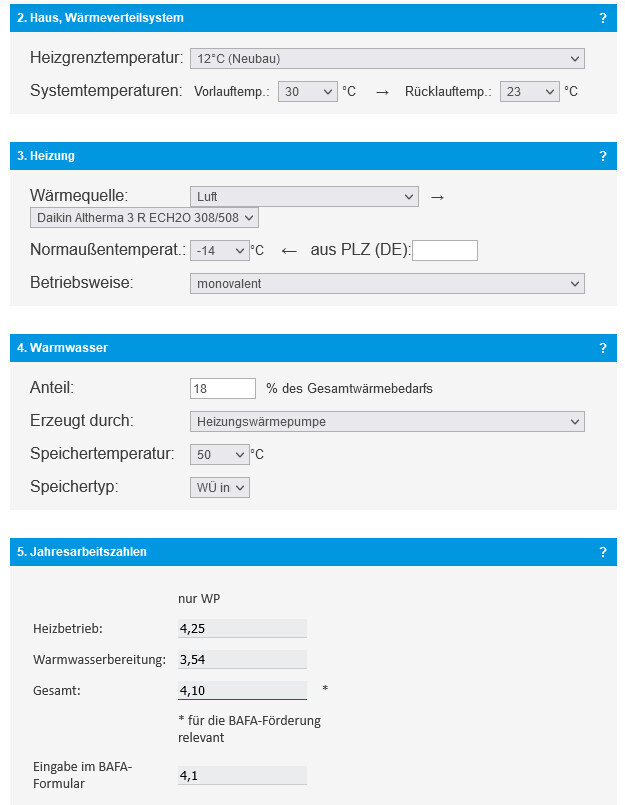
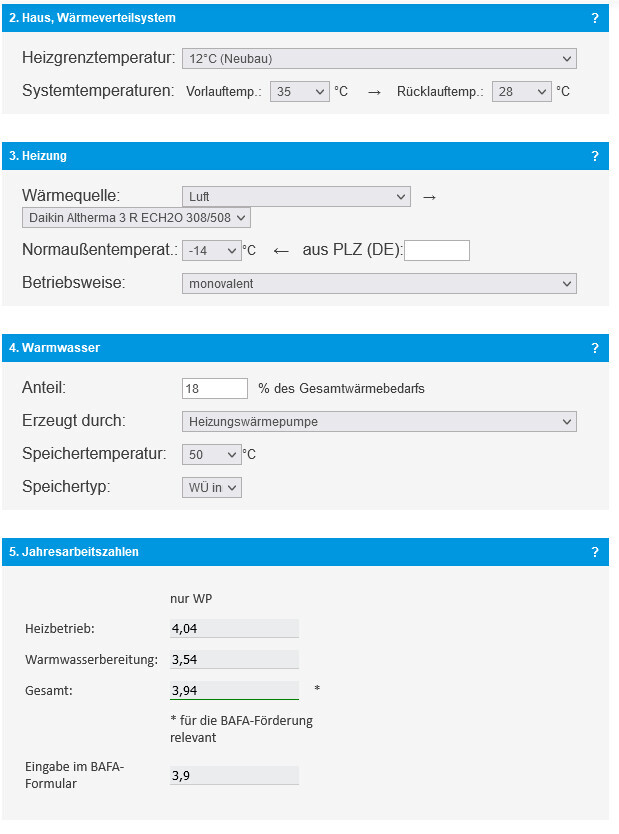
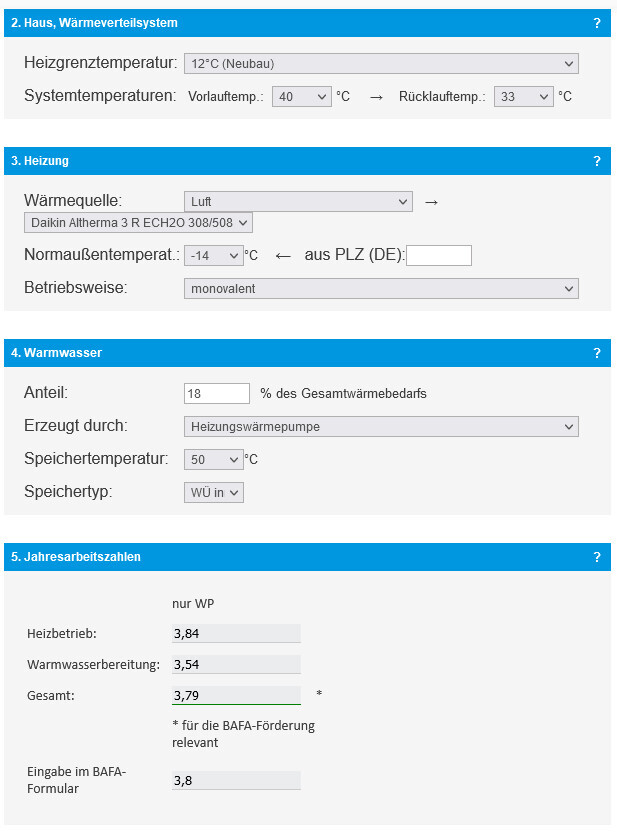
HoisleBauer225 Mar 2022 14:43Attached is the calculation of the seasonal performance factor using the Daikin Bafa online calculator. The Daikin calculator is identical to the one from the German Heat Pump Association (BWP). Of course, this is not a neutral source and probably somewhat optimistic. For some inputs, I have no idea if they are accurate...
30 degrees: 4.1
35 degrees: 3.9
40 degrees: 3.8
The difference between 30 degrees and 40 degrees (i.e., a COP difference of 0.3) corresponds to about 238 kWh, or approximately 107€/year (at 0.45 €/kWh).
30 degrees: 4.1
35 degrees: 3.9
40 degrees: 3.8
The difference between 30 degrees and 40 degrees (i.e., a COP difference of 0.3) corresponds to about 238 kWh, or approximately 107€/year (at 0.45 €/kWh).
Similar topics