
ᐅ Photovoltaic Panels on a Terrace Roof – Does It Make Sense?
Created on: 14 Feb 2022 20:54
H
HoisleBauer22H
HoisleBauer2214 Feb 2022 20:54At some point, we plan to install a glass patio roof (facing south-southwest, with little risk of shading). Now I’m wondering if it might be worthwhile to use glass integrated with photovoltaic modules instead of regular glass. Does anyone here have experience with this? Is the technology mature enough that it makes sense economically, even with the unfavorable, shallow angle? (Additional installation costs are minimal since we need the patio roof anyway...)
I definitely want to have a conduit installed leading to the utility room in the basement, where the battery would be located.
I definitely want to have a conduit installed leading to the utility room in the basement, where the battery would be located.
P
pagoni202014 Feb 2022 21:54Our idea was similar. However, it will now be a standard flat roof, and solar panels may be placed on top, which can likely be adjusted as needed. These roofs, for example, are offered by Solarwatt here in Dresden. We don’t really like that you basically have the pattern right in front of your face or on the ground underneath; at least, I don’t imagine that would be very pleasant. Otherwise, we probably would have done it that way for the same reasons you mentioned.
 HausiKlausi14 Feb 2022 21:55
First of all, I don’t have this myself. From my point of view, photovoltaic systems always provide some benefit. How much and after what time depends less on the installation angle and more on the overall concept you integrate it into. If you are already going to have photovoltaic panels, storage, etc., on or in the house and it doesn’t affect the aesthetics, why not get a few kilowatts peak (kWp) out of it there as well? I would shade a terrace on the south side anyway. Why not do it with photovoltaic panels?

I'm not exactly sure what you mean—are you referring to semi-transparent panels, something like these?
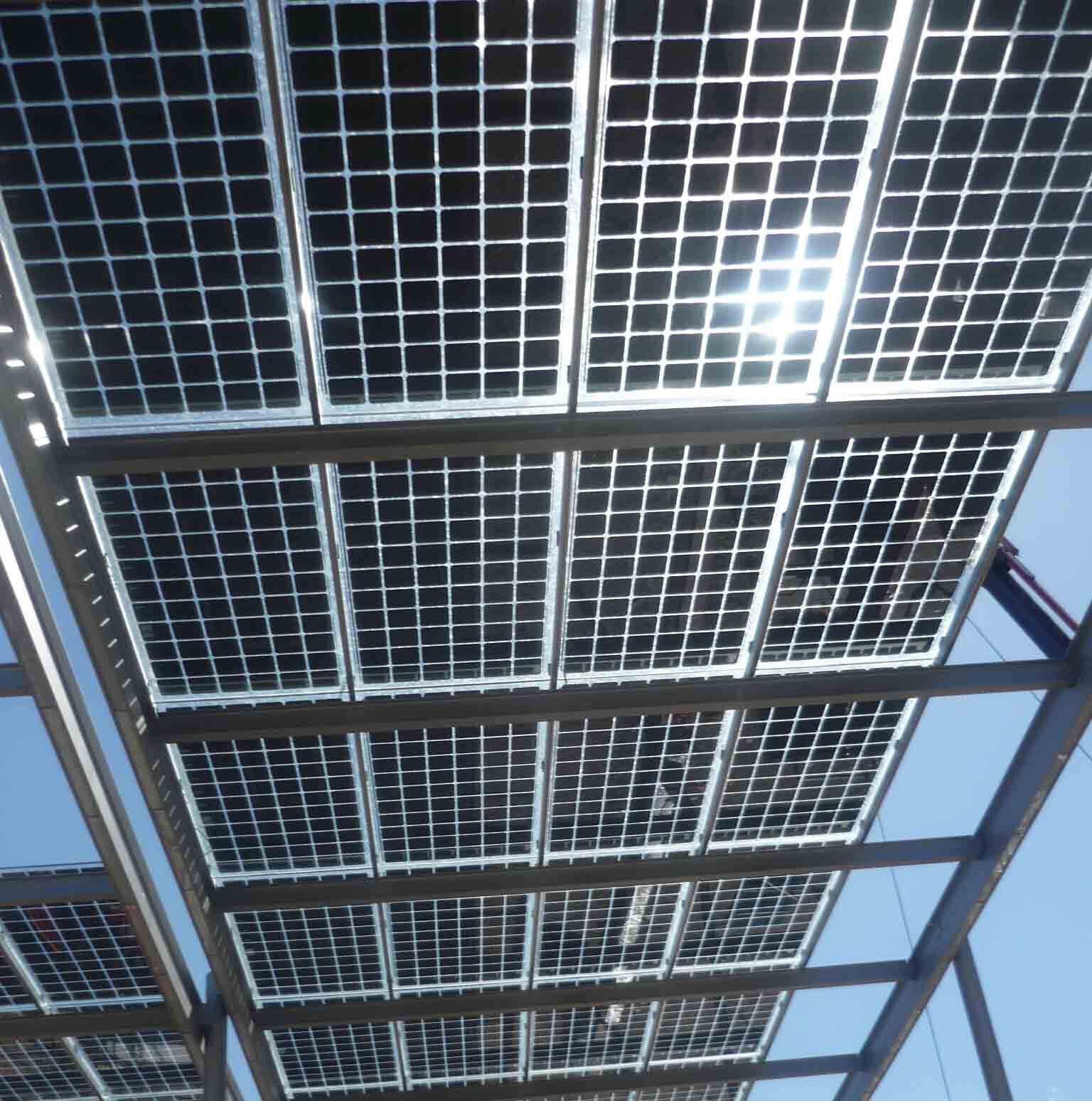
Either way, your questions are quite straightforward to answer:
A standard photovoltaic system will be installed by the solar specialist (Elli) with standard materials. They usually do this often, which is good because they know what they’re doing.
However, the roofer does not install photovoltaic systems, and the solar specialist does not do roofing. That’s where significant problems can arise, which you either pay for with reduced quality or higher prices. Sometimes, but not rarely, both.
So if you don’t have a dedicated photovoltaic roof specialist on hand or can’t handle much of the work yourself, expect considerable additional effort.
A flat angle doesn’t affect output that much. In fact, it can even be better if the panels receive sunlight throughout most of the day.
However, if you choose transparent panels instead of standard ones, you will have to accept considerable performance losses.
There are additional arguments against your idea.
If you don’t plan for a 100 m² (1,076 ft²) array, the surface area is quite small, which increases the cost per kWp even further. On a larger patio roof, you might fit about 12 panels. With standard modules, that’s roughly 4.5 kWp. Due to transparency, you’ll lose about 12%, bringing you down to around 4.0 kWp. I actually expect these panels to perform somewhat worse than regular ones, so you probably won’t get more than 3 kWp on the roof.
Such a small system is hardly economical anymore. (*I found a transparent module on eBay—nowhere else quickly. It costs 290 EUR for 260 W output—compare that to standard modules: available for 200 EUR with 405 W output.)
Cost comparison without installation and additional materials:
Transparent (3.1 kWp): 12 modules = 3,500 EUR; inverter: 1,200 EUR = 4,700 EUR → 1,516 EUR/kWp
Conventional (4.8 kWp): 12 modules = 2,400 EUR; inverter: 1,300 EUR = 3,700 EUR → 770 EUR/kWp
On top of that come the extra efforts with the transparent option (see above). Costs will quickly get out of hand, and transparent photovoltaics simply won’t pay off.
In summary, transparent modules are in most cases an expensive novelty. There are definitely great applications on a larger scale, but their economic viability comes from scale and repetition.
In my opinion, there are three sensible options for you:
a.) Build a nice roof and forgo photovoltaics.
b.) Build a simple roof and install a conventional photovoltaic system on it.
c.) Invest in a not-so-economical art project.
Searching for _transparent solar modules: pros and cons_ is worth a try.
Either way, your questions are quite straightforward to answer:
HoisleBauer22 schrieb:I certainly don’t.
Does anyone here have this?
HoisleBauer22 schrieb:Don’t underestimate that. A standard roof will be installed by the metal worker or whoever with standard materials. They usually do this often, which is good because they know what they’re doing.
Additional assembly costs are minimal if you need a patio roof anyway...
A standard photovoltaic system will be installed by the solar specialist (Elli) with standard materials. They usually do this often, which is good because they know what they’re doing.
However, the roofer does not install photovoltaic systems, and the solar specialist does not do roofing. That’s where significant problems can arise, which you either pay for with reduced quality or higher prices. Sometimes, but not rarely, both.
So if you don’t have a dedicated photovoltaic roof specialist on hand or can’t handle much of the work yourself, expect considerable additional effort.
HoisleBauer22 schrieb:Photovoltaic systems are basically quite mature. Modules and inverters are continuously improving, but efficiency gains are not as steep as they were five to ten years ago.
Is the technology mature enough that it’s worthwhile and economically viable despite the unfavorable, flat angle?
A flat angle doesn’t affect output that much. In fact, it can even be better if the panels receive sunlight throughout most of the day.
However, if you choose transparent panels instead of standard ones, you will have to accept considerable performance losses.
There are additional arguments against your idea.
If you don’t plan for a 100 m² (1,076 ft²) array, the surface area is quite small, which increases the cost per kWp even further. On a larger patio roof, you might fit about 12 panels. With standard modules, that’s roughly 4.5 kWp. Due to transparency, you’ll lose about 12%, bringing you down to around 4.0 kWp. I actually expect these panels to perform somewhat worse than regular ones, so you probably won’t get more than 3 kWp on the roof.
Such a small system is hardly economical anymore. (*I found a transparent module on eBay—nowhere else quickly. It costs 290 EUR for 260 W output—compare that to standard modules: available for 200 EUR with 405 W output.)
Cost comparison without installation and additional materials:
Transparent (3.1 kWp): 12 modules = 3,500 EUR; inverter: 1,200 EUR = 4,700 EUR → 1,516 EUR/kWp
Conventional (4.8 kWp): 12 modules = 2,400 EUR; inverter: 1,300 EUR = 3,700 EUR → 770 EUR/kWp
On top of that come the extra efforts with the transparent option (see above). Costs will quickly get out of hand, and transparent photovoltaics simply won’t pay off.
In summary, transparent modules are in most cases an expensive novelty. There are definitely great applications on a larger scale, but their economic viability comes from scale and repetition.
In my opinion, there are three sensible options for you:
a.) Build a nice roof and forgo photovoltaics.
b.) Build a simple roof and install a conventional photovoltaic system on it.
c.) Invest in a not-so-economical art project.
Searching for _transparent solar modules: pros and cons_ is worth a try.
HausiKlausi schrieb:
If you already have or plan to install photovoltaic panels, storage, etc. on or in the house and it doesn't affect the aesthetics, why not get a few more kWp out of that as well? I would shade any south-facing terrace anyway. Why not use photovoltaic panels for that. Because in most cases, you can’t just expand like that. Additional modules must be matched to the inverter or the overall system. The project is considered a separate installation.
H
HoisleBauer2214 Feb 2022 22:35@PhiIipp
Your information along with the cost calculation is really impressive. It opened my eyes (and tightened my wallet :-) )
Your information along with the cost calculation is really impressive. It opened my eyes (and tightened my wallet :-) )
Similar topics