
ᐅ Hallway / Kitchen and Guest Bathroom – Random or One-Third Staggered Pattern
Created on: 11 Feb 2022 10:58
H
HubiTrubi40H
HubiTrubi4011 Feb 2022 10:58Hello everyone,
I have a quick question about tile patterns. I know it’s a matter of personal taste, but I’m wondering what would make the most sense for our situation. We are having 60x30 cm (24x12 inches) light beige tiles installed. In the hallway, which is narrow and long (about 1.8 m by 6 m (6 ft by 20 ft)), and in the adjacent small guest bathroom and storage room (where the pattern will probably be least noticeable). Then there is the connected kitchen, roughly 11 square meters (120 square feet) in size, which is slightly rectangular or almost square. We are undecided between a random (wild) pattern and a one-third offset (staggered) pattern. I think the visual difference might not be that big, but based on your experience, what do you think is more practical? I do not want a grid pattern (cross joints). For additional info, the tiles are rectified.
I have a quick question about tile patterns. I know it’s a matter of personal taste, but I’m wondering what would make the most sense for our situation. We are having 60x30 cm (24x12 inches) light beige tiles installed. In the hallway, which is narrow and long (about 1.8 m by 6 m (6 ft by 20 ft)), and in the adjacent small guest bathroom and storage room (where the pattern will probably be least noticeable). Then there is the connected kitchen, roughly 11 square meters (120 square feet) in size, which is slightly rectangular or almost square. We are undecided between a random (wild) pattern and a one-third offset (staggered) pattern. I think the visual difference might not be that big, but based on your experience, what do you think is more practical? I do not want a grid pattern (cross joints). For additional info, the tiles are rectified.


Hello questioner,
This is a difficult topic you are bringing up, as it is closely linked to the aspect of aesthetics. What looks visually appealing to one person may be rejected by another. Therefore, no answer can be given to your question, since only your personal taste will determine which tile installation pattern will be used.
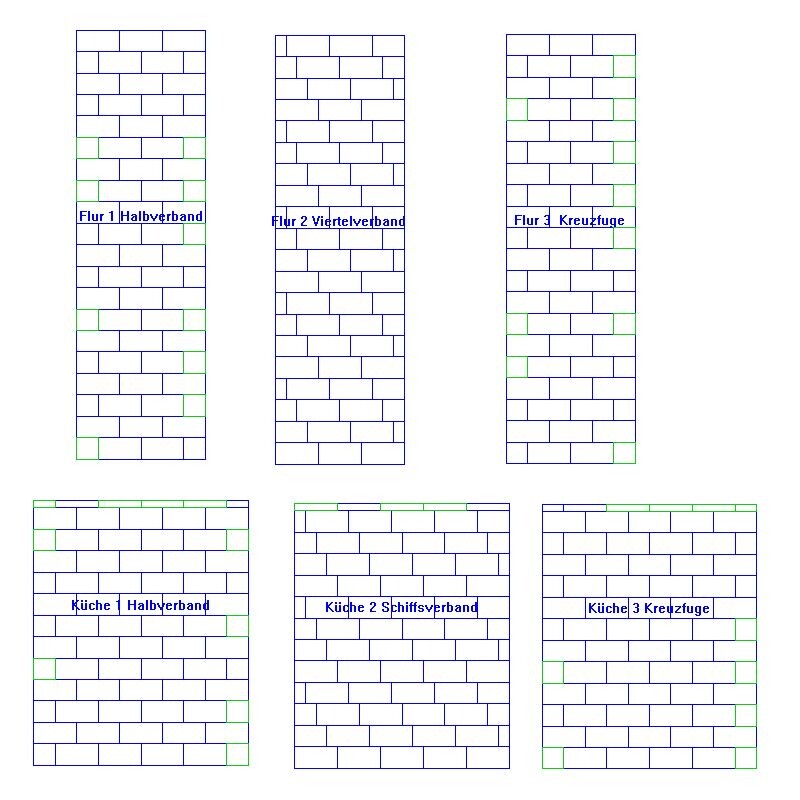
I have prepared the hallway and kitchen areas based on the room and tile dimensions you provided (see attached photo). The proportions correspond largely to your living space.
Now you can decide for yourself which laying pattern you prefer.
If you are interested in my personal opinion:
The grid joint pattern gives a certain sense of order visually. The half-bond pattern creates a more dynamic overall look, while the quarter-bond and herringbone patterns make the surface appear very busy. The latter seems to me to be a way to wake up immediately in the morning when looking at the tile surface 🙂
The aspect of “extra material consumption depending on the installation pattern” is actually minimal! Since this question came up from another source, I quickly calculated it.
For “Hallway 1” and “Hallway 3,” you will need 60 tiles each; “Hallway 2” requires 65 tiles.
For “Kitchen 1” and “Kitchen 3,” I calculated 62 tiles each; “Kitchen 2” requires 65 tiles.
------------------------------------
Wishing you a good decision: KlaRa
This is a difficult topic you are bringing up, as it is closely linked to the aspect of aesthetics. What looks visually appealing to one person may be rejected by another. Therefore, no answer can be given to your question, since only your personal taste will determine which tile installation pattern will be used.
I have prepared the hallway and kitchen areas based on the room and tile dimensions you provided (see attached photo). The proportions correspond largely to your living space.
Now you can decide for yourself which laying pattern you prefer.
If you are interested in my personal opinion:
The grid joint pattern gives a certain sense of order visually. The half-bond pattern creates a more dynamic overall look, while the quarter-bond and herringbone patterns make the surface appear very busy. The latter seems to me to be a way to wake up immediately in the morning when looking at the tile surface 🙂
The aspect of “extra material consumption depending on the installation pattern” is actually minimal! Since this question came up from another source, I quickly calculated it.
For “Hallway 1” and “Hallway 3,” you will need 60 tiles each; “Hallway 2” requires 65 tiles.
For “Kitchen 1” and “Kitchen 3,” I calculated 62 tiles each; “Kitchen 2” requires 65 tiles.
------------------------------------
Wishing you a good decision: KlaRa
M
motorradsilke11 Feb 2022 13:23Just lay them out on a piece first and then decide.
I think it’s hard to give advice on this; it’s a matter of personal taste.
I think it’s hard to give advice on this; it’s a matter of personal taste.
H
HubiTrubi4011 Feb 2022 16:23motorradsilke schrieb:
Just lay them out on a piece of floor and then decide.
I think it’s hard to give advice on this, it’s a matter of personal taste. @KlaRa Thank you so much for your response! That’s really great. And thanks also to @Tolentino, @netuser, and @motorradsilke for your replies. I spoke with the tiler today while he’s preparing, and he advised against a "random" pattern because the tiles are apparently not perfectly flat and have a slight curve. He said that a 1/3 offset pattern would also work, but the risk of interlocking (?) would be higher. I didn’t buy the tiles at a big-box store, but from a specialist tile retailer, though he said it’s quite common for tiles not to be completely flat. He sent me two pictures showing the difference between a 1/3 offset and a random pattern (see attachments). The 1/3 pattern looks more orderly, but if the installation turns out better with the random pattern, I might prefer that. In the kitchen, a good portion will be covered by kitchen units anyway. It might be different in the hallway.
Similar topics