
Hello everyone,
maybe this thread is a bit early since we don’t have a planned floor plan yet. But we would still appreciate your advice. First of all, because this is probably the most important information: We are planning with a budget of 600,000 euros for the house plus additional building-related costs. We have received approval to purchase the plot shown here. We will sign the purchase contract at the end of next week. Now to our problem:
We are very uncertain about which is the better decision for our plot: a (partial) basement with a smaller floor plan (about 130 – 140 m² (1400 – 1500 sq ft)) (Option A), or a slab foundation with a slightly larger floor plan (about 170 m² (1800 sq ft)) (Option B).
I will list the pros and cons as we see them for each option.
Option A:
+ Utility room in the basement frees up space on the ground floor; no noise issues
+ More usable space overall
+ Hobby room can also be used flexibly for gatherings
+ Storage space!
+ Possibility of a double parking space
- Expensive (a full basement is probably unrealistic with our budget; is a partial basement more sensible?)
- Less space on the ground and upper floors
Option B:
+ More living space on the ground and upper floors
+ High potential for cost savings!
+ Possible to use the attic for storage?
- Is there still enough space for a double parking space?
- Possible issues with the plot ratio? If we understand correctly, the footprint of the house may be limited to 143 m² (1540 sq ft) plus 70 m² (750 sq ft) for driveway, garage, etc. My feeling is that the developed area might easily be underestimated and reach the limit quickly.
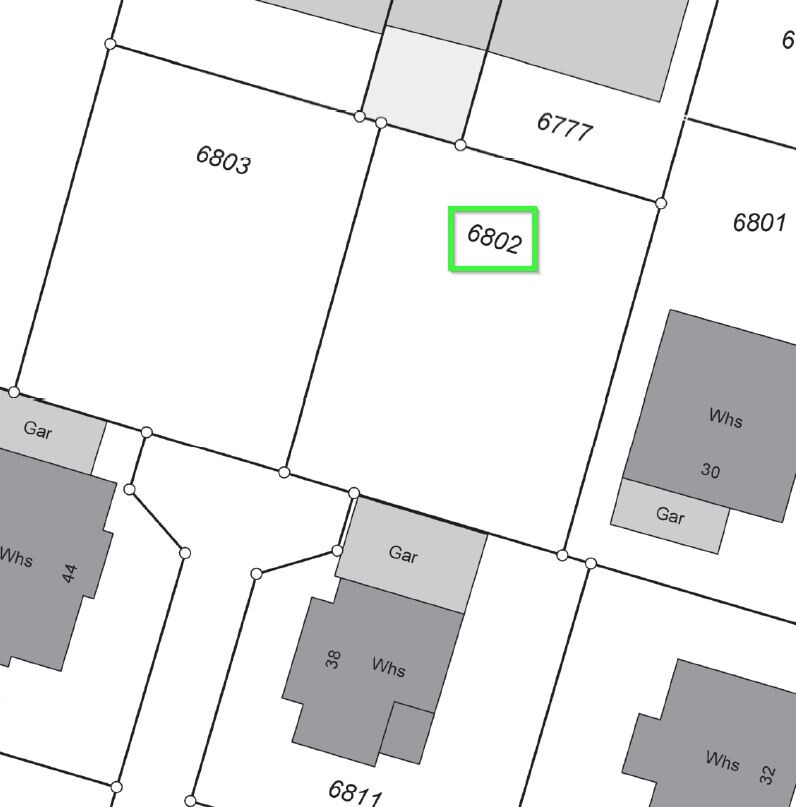
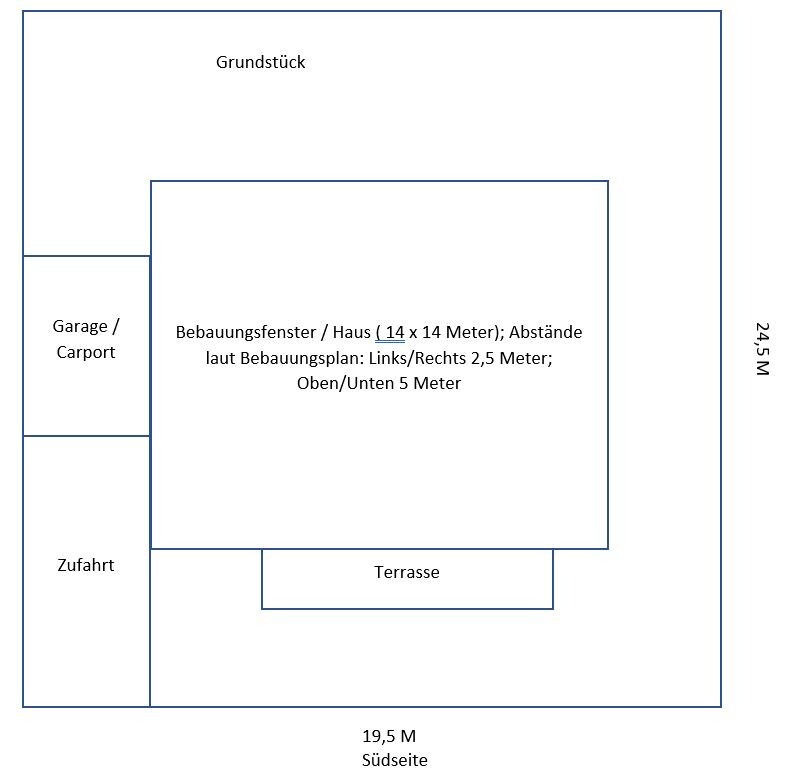
We would be interested in your opinion on how you would build on this plot. I have made a very rough sketch of how we imagine the orientation of the house and placement of parking spaces, etc. I have also attached the site plan and development plan. The questionnaire is mostly filled out, but a “final” floor plan is still missing, as mentioned. This will also largely depend on the question of whether to have a basement or not.
I hope I haven’t forgotten anything...
Best regards
Development Plan / Restrictions
Plot size 477 m² (5130 sq ft)
Slope Minimal
Plot ratio (ground coverage ratio) 0.3
Floor area ratio 0.8
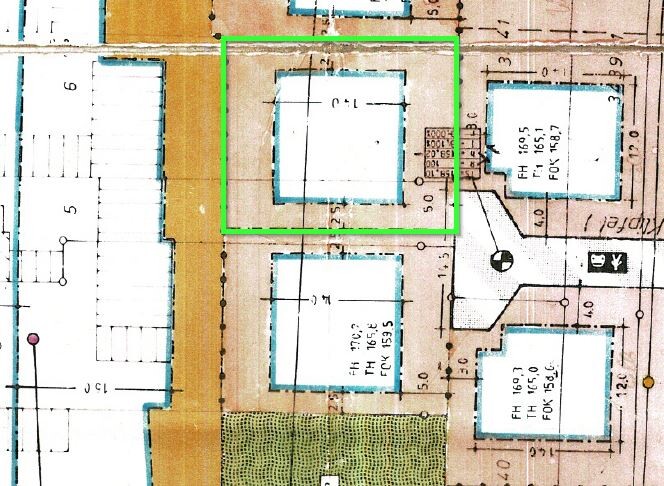
Building envelope, building line, boundary 14 x 14 meters (see image)
Edge development see image
Number of parking spaces unknown
Building height up to 2 full stories
Roof type Hip roof or gable roof 30-40 degrees
Architectural style unknown
Orientation unknown
Maximum height / limits unknown
Other requirements unknown
Homeowners’ Requirements
Architectural style, Roof type Gable or hip roof (open to either)
Basement, number of floors Basement yes/no is the big question. 1.5 – 2 full stories
Number of occupants, ages 2 adults (32 and 33), 1 child (1), 1 more child planned
Room requirements on ground and upper floors Utility room, guest toilet with shower, guest room, study (a study nook might also be sufficient), 2 children’s rooms, master bedroom, bathroom
Office: family use or home office? Both
Overnight guests per year Parents-in-law should be able to stay regularly (about once a month)
Open or closed layout Open kitchen / living / dining area
Conservative or modern design Exterior should be clean and simple – relatively straightforward
Open kitchen, kitchen island Yes, at least a peninsula
Number of dining places in the kitchen No dining space needed in the kitchen; the dining room should have space for a large table
Fireplace If budget allows; not mandatory
Music / sound wall 11.2.4 sound system + TV to be integrated into the study (or guest room)
Balcony, roof terrace Not necessary
Garage, carport Double carport or double garage would be nice if space allows; otherwise 2 parking spaces in tandem
Utility garden, greenhouse Not planned
Other wishes / special features / daily routine, including reasons why some options are preferred or rejected Smart home with KNX (or Loxone); controlled ventilation system, photovoltaic system (+ possibly battery storage), air-to-water heat pump
House Design
Who did the planning:
- Planner from a construction company
- Architect
- Do-it-yourself
What do you especially like? Why?
What do you dislike? Why?
Estimated cost according to architect/planner:
Personal budget limit for the house, including equipment:
Preferred heating technology: Air-to-water heat pump + photovoltaic system (+ possibly small battery storage)
If you have to give up something, which details or features
- can you do without:
- cannot do without:
maybe this thread is a bit early since we don’t have a planned floor plan yet. But we would still appreciate your advice. First of all, because this is probably the most important information: We are planning with a budget of 600,000 euros for the house plus additional building-related costs. We have received approval to purchase the plot shown here. We will sign the purchase contract at the end of next week. Now to our problem:
We are very uncertain about which is the better decision for our plot: a (partial) basement with a smaller floor plan (about 130 – 140 m² (1400 – 1500 sq ft)) (Option A), or a slab foundation with a slightly larger floor plan (about 170 m² (1800 sq ft)) (Option B).
I will list the pros and cons as we see them for each option.
Option A:
+ Utility room in the basement frees up space on the ground floor; no noise issues
+ More usable space overall
+ Hobby room can also be used flexibly for gatherings
+ Storage space!
+ Possibility of a double parking space
- Expensive (a full basement is probably unrealistic with our budget; is a partial basement more sensible?)
- Less space on the ground and upper floors
Option B:
+ More living space on the ground and upper floors
+ High potential for cost savings!
+ Possible to use the attic for storage?
- Is there still enough space for a double parking space?
- Possible issues with the plot ratio? If we understand correctly, the footprint of the house may be limited to 143 m² (1540 sq ft) plus 70 m² (750 sq ft) for driveway, garage, etc. My feeling is that the developed area might easily be underestimated and reach the limit quickly.
We would be interested in your opinion on how you would build on this plot. I have made a very rough sketch of how we imagine the orientation of the house and placement of parking spaces, etc. I have also attached the site plan and development plan. The questionnaire is mostly filled out, but a “final” floor plan is still missing, as mentioned. This will also largely depend on the question of whether to have a basement or not.
I hope I haven’t forgotten anything...
Best regards
Development Plan / Restrictions
Plot size 477 m² (5130 sq ft)
Slope Minimal
Plot ratio (ground coverage ratio) 0.3
Floor area ratio 0.8
Building envelope, building line, boundary 14 x 14 meters (see image)
Edge development see image
Number of parking spaces unknown
Building height up to 2 full stories
Roof type Hip roof or gable roof 30-40 degrees
Architectural style unknown
Orientation unknown
Maximum height / limits unknown
Other requirements unknown
Homeowners’ Requirements
Architectural style, Roof type Gable or hip roof (open to either)
Basement, number of floors Basement yes/no is the big question. 1.5 – 2 full stories
Number of occupants, ages 2 adults (32 and 33), 1 child (1), 1 more child planned
Room requirements on ground and upper floors Utility room, guest toilet with shower, guest room, study (a study nook might also be sufficient), 2 children’s rooms, master bedroom, bathroom
Office: family use or home office? Both
Overnight guests per year Parents-in-law should be able to stay regularly (about once a month)
Open or closed layout Open kitchen / living / dining area
Conservative or modern design Exterior should be clean and simple – relatively straightforward
Open kitchen, kitchen island Yes, at least a peninsula
Number of dining places in the kitchen No dining space needed in the kitchen; the dining room should have space for a large table
Fireplace If budget allows; not mandatory
Music / sound wall 11.2.4 sound system + TV to be integrated into the study (or guest room)
Balcony, roof terrace Not necessary
Garage, carport Double carport or double garage would be nice if space allows; otherwise 2 parking spaces in tandem
Utility garden, greenhouse Not planned
Other wishes / special features / daily routine, including reasons why some options are preferred or rejected Smart home with KNX (or Loxone); controlled ventilation system, photovoltaic system (+ possibly battery storage), air-to-water heat pump
House Design
Who did the planning:
- Planner from a construction company
- Architect
- Do-it-yourself
What do you especially like? Why?
What do you dislike? Why?
Estimated cost according to architect/planner:
Personal budget limit for the house, including equipment:
Preferred heating technology: Air-to-water heat pump + photovoltaic system (+ possibly small battery storage)
If you have to give up something, which details or features
- can you do without:
- cannot do without:

As a non-professional, there is a 90% chance that you will not prepare a tender in a way that fully considers everything to completely rule out the need for additional costs, potential conflicts regarding the interfaces between trades, or even having your bid rejected because it is not taken seriously.
SandyBlack schrieb:
If you want a basement and the prefab house provider doesn’t offer it – would that be a dealbreaker when choosing? No. Even if they offer a basement, you can bring in your own basement contractor, and if they don’t offer one, then even more so.
The interface just needs to fit properly.

Durran schrieb:
I’d like to politely ask the group why the architect should handle individual contracting? The architect does not actually award contracts; they only support the process. The client awards the contracts, while the architect prepares the invitations to tender. If the architect and client are smart, first, each trade is treated as a separate contract package, and second, bidders are allowed to submit offers for multiple or all packages as a general contractor (GC).
Durran schrieb:
I assume you can also do this yourself. The architect creates the project and, as the person authorized to submit building applications, files the documents with the building authority. Then the client receives the building permit/planning permission and can do whatever they want. Exactly. In a free country, it is perfectly legal to choose drywall haphazardly instead of detailed planning and to spend as much on hourly labor charges as on an entire trade. You can certainly have fun doing that, but then you’re essentially applying the second gastronomical law 🙂
https://www.instagram.com/11antgmxde/
https://www.linkedin.com/company/bauen-jetzt/
B
blubbernase10 Feb 2022 15:00SandyBlack schrieb:
@blubbernase Did you ultimately decide on a prefabricated house provider? Or are you building with an architect? What was the deciding factor for you?We have the special situation that we are moving 500 km (310 miles) away and are already building at the future location. For this reason, using an architect with separate tenders as a complete package was never an option for us because we didn’t want to deal with managing many different trades at the same time. Also, solid construction wasn’t really suitable because we can’t check the construction progress every day over several months. That’s why we ended up choosing a “one-stop shop” provider (Gussek Haus, who also have their own basement construction and for almost everything their own teams). We also considered a local carpenter for a long time, but in the end, their price was €3200 per square meter (approximately $300 per square foot), which we couldn’t afford.At the very beginning, we made the usual lists (what we want, etc.) and tried to find an architect who would just help us with the floor plan—unfortunately without success. So we went to a floor plan service. That actually worked well because we dropped the idea of a separate apartment. Unfortunately, they completely ghosted us at one point, and we never received an invoice. We continued planning a bit based on their work and then approached several providers. Two providers quickly stood out: Gussek Haus and Schwörerhaus. In the end, the Gussek Haus salesperson really pushed hard for us.
If I could do something differently today, I wouldn’t rely on the salesperson’s claim that the Gussek Haus architect would solve our problem areas, and I would have sought a second opinion earlier. My thread might have more details on this (just overlook some of the rudeness from certain members).
blubbernase schrieb:
We went with a floor plan service for this. [...] Unfortunately, they completely ghosted us at some point, and we never even received an invoice....It could have been worse, see: https://www.hausbau-forum.de/threads/ausfuehrungsplaene-geaendert-ohne-absprache.41669/https://www.instagram.com/11antgmxde/
https://www.linkedin.com/company/bauen-jetzt/
S
SandyBlack10 Feb 2022 17:4311ant schrieb:
Please don’t expect that it would be easy to pull cables later on! Today, we had another initial consultation where we also discussed the topic of the "installation cavity." For us, the installation cavity mainly means being able to hang pictures and cabinets on the exterior wall without worry and also having the option to install new outlets etc. in the future if needed.
We understand that it won’t be easy just because of the installation cavity—but we thought this cavity would make it possible in the first place.
However, yesterday we were told that an installation cavity is not even necessary for this. What matters is that no foil ("vapor barrier") is installed in the exterior wall, but rather something like a fleece ("vapor retarder"). If a vapor retarder is used, it doesn’t matter at all if it is pierced by new outlets, nails, or whatever. Simply put: with a vapor retarder, an installation cavity isn’t necessary (almost pointless). The reasoning didn’t sound far-fetched.
Would you agree with that?
11ant schrieb:
Yes, I usually recommend having design, detailed planning, tendering, and construction management all handled by the same party. In the tender, it’s obviously not just about materials, quantities, and volumes, but also about execution timeframes and fixed price deadlines. I don’t know who keeps putting the idea into prospective builders’ heads that price guarantees only exist with general contractors. Thanks—that’s very interesting to read. With a general contractor, the fixed price period probably starts earlier—namely at signing—but you’re not completely exposed to price increases with an architect either. Are all trades tendered simultaneously by the architect? Or is this done gradually as needed?
11ant schrieb:
It’s no surprise that apples and oranges aren’t the same size: the architect means the total cost, while the turnkey provider (regardless of type) means only the money you’re willing to pay them (like hoping you’d get a little cash from grandma for the parts you provide yourself). Also, these are like pre-marital promises from used car dealers—you shouldn’t believe them too much. They don’t care if you have to sell the house later to pay for it. They know from experience that the one with the sweetest promises wins the contract. They don’t use your bathroom themselves—so they don’t care if you have to downgrade the tiles later to keep within budget. So, we planned with both for additional costs and the kitchen. But we are still waiting for the architect’s first design. He said he could then also provide us with a closer cost estimate (still roughly, of course).
11ant schrieb:
Also, check out “Changing a floor plan’s size,” where I explained it in detail. It wasn’t so much that it’s not always easy, but that with all providers who only offer catalog homes, you might get lucky if one of their houses fits the plot well. But if not, it gets disproportionately expensive with those suppliers. At least that has been our experience/feeling.
Similar topics