
Hello everyone,
maybe this thread is a bit early since we don’t have a planned floor plan yet. But we would still appreciate your advice. First of all, because this is probably the most important information: We are planning with a budget of 600,000 euros for the house plus additional building-related costs. We have received approval to purchase the plot shown here. We will sign the purchase contract at the end of next week. Now to our problem:
We are very uncertain about which is the better decision for our plot: a (partial) basement with a smaller floor plan (about 130 – 140 m² (1400 – 1500 sq ft)) (Option A), or a slab foundation with a slightly larger floor plan (about 170 m² (1800 sq ft)) (Option B).
I will list the pros and cons as we see them for each option.
Option A:
+ Utility room in the basement frees up space on the ground floor; no noise issues
+ More usable space overall
+ Hobby room can also be used flexibly for gatherings
+ Storage space!
+ Possibility of a double parking space
- Expensive (a full basement is probably unrealistic with our budget; is a partial basement more sensible?)
- Less space on the ground and upper floors
Option B:
+ More living space on the ground and upper floors
+ High potential for cost savings!
+ Possible to use the attic for storage?
- Is there still enough space for a double parking space?
- Possible issues with the plot ratio? If we understand correctly, the footprint of the house may be limited to 143 m² (1540 sq ft) plus 70 m² (750 sq ft) for driveway, garage, etc. My feeling is that the developed area might easily be underestimated and reach the limit quickly.
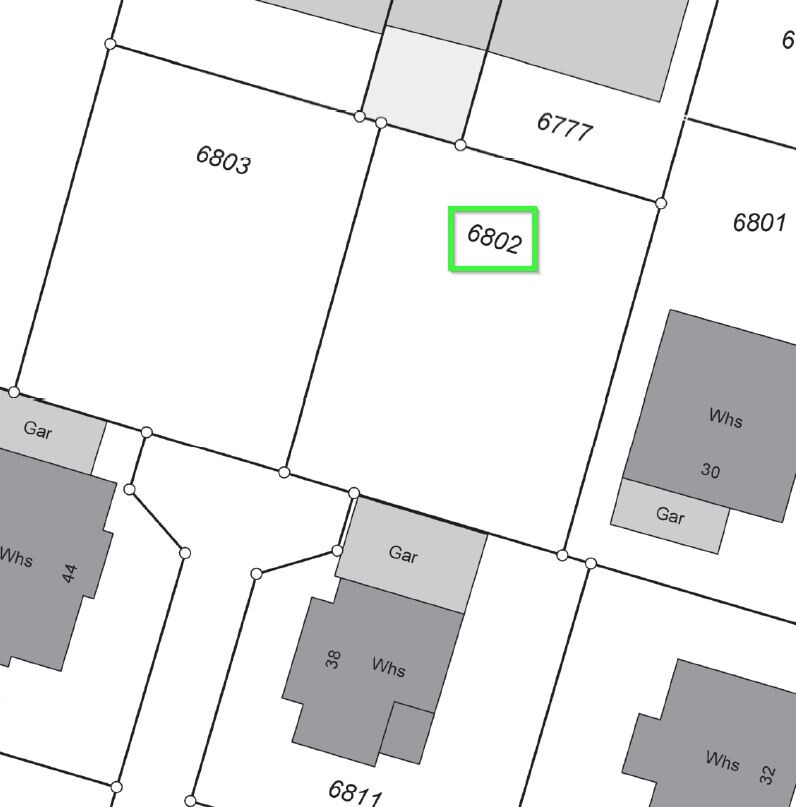
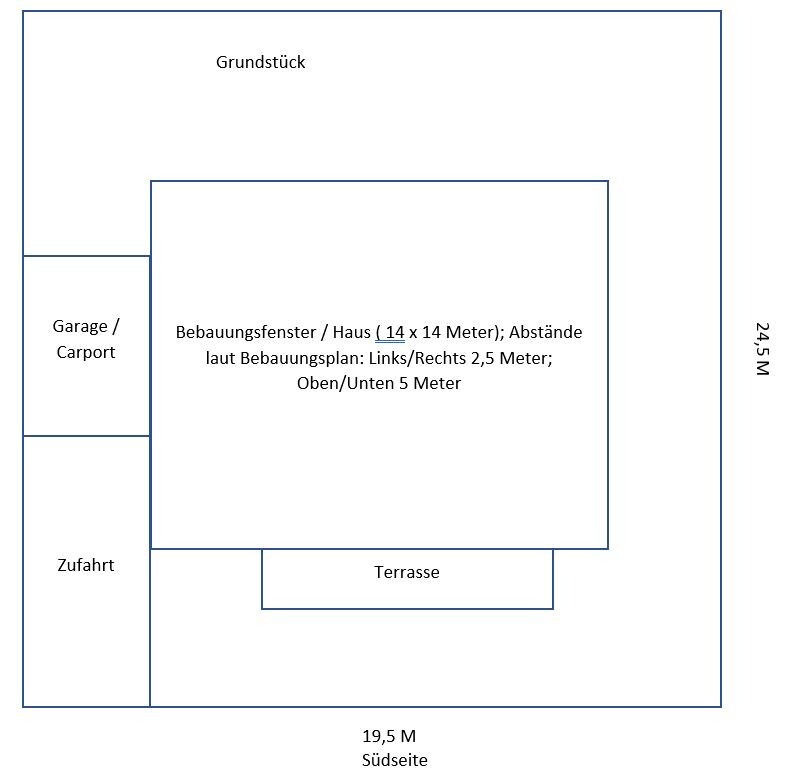
We would be interested in your opinion on how you would build on this plot. I have made a very rough sketch of how we imagine the orientation of the house and placement of parking spaces, etc. I have also attached the site plan and development plan. The questionnaire is mostly filled out, but a “final” floor plan is still missing, as mentioned. This will also largely depend on the question of whether to have a basement or not.
I hope I haven’t forgotten anything...
Best regards
Development Plan / Restrictions
Plot size 477 m² (5130 sq ft)
Slope Minimal
Plot ratio (ground coverage ratio) 0.3
Floor area ratio 0.8
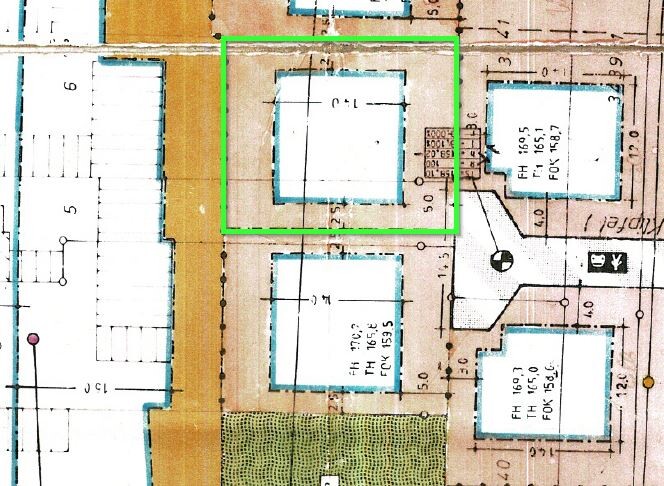
Building envelope, building line, boundary 14 x 14 meters (see image)
Edge development see image
Number of parking spaces unknown
Building height up to 2 full stories
Roof type Hip roof or gable roof 30-40 degrees
Architectural style unknown
Orientation unknown
Maximum height / limits unknown
Other requirements unknown
Homeowners’ Requirements
Architectural style, Roof type Gable or hip roof (open to either)
Basement, number of floors Basement yes/no is the big question. 1.5 – 2 full stories
Number of occupants, ages 2 adults (32 and 33), 1 child (1), 1 more child planned
Room requirements on ground and upper floors Utility room, guest toilet with shower, guest room, study (a study nook might also be sufficient), 2 children’s rooms, master bedroom, bathroom
Office: family use or home office? Both
Overnight guests per year Parents-in-law should be able to stay regularly (about once a month)
Open or closed layout Open kitchen / living / dining area
Conservative or modern design Exterior should be clean and simple – relatively straightforward
Open kitchen, kitchen island Yes, at least a peninsula
Number of dining places in the kitchen No dining space needed in the kitchen; the dining room should have space for a large table
Fireplace If budget allows; not mandatory
Music / sound wall 11.2.4 sound system + TV to be integrated into the study (or guest room)
Balcony, roof terrace Not necessary
Garage, carport Double carport or double garage would be nice if space allows; otherwise 2 parking spaces in tandem
Utility garden, greenhouse Not planned
Other wishes / special features / daily routine, including reasons why some options are preferred or rejected Smart home with KNX (or Loxone); controlled ventilation system, photovoltaic system (+ possibly battery storage), air-to-water heat pump
House Design
Who did the planning:
- Planner from a construction company
- Architect
- Do-it-yourself
What do you especially like? Why?
What do you dislike? Why?
Estimated cost according to architect/planner:
Personal budget limit for the house, including equipment:
Preferred heating technology: Air-to-water heat pump + photovoltaic system (+ possibly small battery storage)
If you have to give up something, which details or features
- can you do without:
- cannot do without:
maybe this thread is a bit early since we don’t have a planned floor plan yet. But we would still appreciate your advice. First of all, because this is probably the most important information: We are planning with a budget of 600,000 euros for the house plus additional building-related costs. We have received approval to purchase the plot shown here. We will sign the purchase contract at the end of next week. Now to our problem:
We are very uncertain about which is the better decision for our plot: a (partial) basement with a smaller floor plan (about 130 – 140 m² (1400 – 1500 sq ft)) (Option A), or a slab foundation with a slightly larger floor plan (about 170 m² (1800 sq ft)) (Option B).
I will list the pros and cons as we see them for each option.
Option A:
+ Utility room in the basement frees up space on the ground floor; no noise issues
+ More usable space overall
+ Hobby room can also be used flexibly for gatherings
+ Storage space!
+ Possibility of a double parking space
- Expensive (a full basement is probably unrealistic with our budget; is a partial basement more sensible?)
- Less space on the ground and upper floors
Option B:
+ More living space on the ground and upper floors
+ High potential for cost savings!
+ Possible to use the attic for storage?
- Is there still enough space for a double parking space?
- Possible issues with the plot ratio? If we understand correctly, the footprint of the house may be limited to 143 m² (1540 sq ft) plus 70 m² (750 sq ft) for driveway, garage, etc. My feeling is that the developed area might easily be underestimated and reach the limit quickly.
We would be interested in your opinion on how you would build on this plot. I have made a very rough sketch of how we imagine the orientation of the house and placement of parking spaces, etc. I have also attached the site plan and development plan. The questionnaire is mostly filled out, but a “final” floor plan is still missing, as mentioned. This will also largely depend on the question of whether to have a basement or not.
I hope I haven’t forgotten anything...
Best regards
Development Plan / Restrictions
Plot size 477 m² (5130 sq ft)
Slope Minimal
Plot ratio (ground coverage ratio) 0.3
Floor area ratio 0.8
Building envelope, building line, boundary 14 x 14 meters (see image)
Edge development see image
Number of parking spaces unknown
Building height up to 2 full stories
Roof type Hip roof or gable roof 30-40 degrees
Architectural style unknown
Orientation unknown
Maximum height / limits unknown
Other requirements unknown
Homeowners’ Requirements
Architectural style, Roof type Gable or hip roof (open to either)
Basement, number of floors Basement yes/no is the big question. 1.5 – 2 full stories
Number of occupants, ages 2 adults (32 and 33), 1 child (1), 1 more child planned
Room requirements on ground and upper floors Utility room, guest toilet with shower, guest room, study (a study nook might also be sufficient), 2 children’s rooms, master bedroom, bathroom
Office: family use or home office? Both
Overnight guests per year Parents-in-law should be able to stay regularly (about once a month)
Open or closed layout Open kitchen / living / dining area
Conservative or modern design Exterior should be clean and simple – relatively straightforward
Open kitchen, kitchen island Yes, at least a peninsula
Number of dining places in the kitchen No dining space needed in the kitchen; the dining room should have space for a large table
Fireplace If budget allows; not mandatory
Music / sound wall 11.2.4 sound system + TV to be integrated into the study (or guest room)
Balcony, roof terrace Not necessary
Garage, carport Double carport or double garage would be nice if space allows; otherwise 2 parking spaces in tandem
Utility garden, greenhouse Not planned
Other wishes / special features / daily routine, including reasons why some options are preferred or rejected Smart home with KNX (or Loxone); controlled ventilation system, photovoltaic system (+ possibly battery storage), air-to-water heat pump
House Design
Who did the planning:
- Planner from a construction company
- Architect
- Do-it-yourself
What do you especially like? Why?
What do you dislike? Why?
Estimated cost according to architect/planner:
Personal budget limit for the house, including equipment:
Preferred heating technology: Air-to-water heat pump + photovoltaic system (+ possibly small battery storage)
If you have to give up something, which details or features
- can you do without:
- cannot do without:

Pinkiponk schrieb:
The clause "We reserve the right to make changes ..." is included in every building service description we know and gives the builder/supplier significant leeway in their favor. However, this reservation is mainly for technical reasons and is therefore commonly found even among reputable providers. I do not see it as a loophole for unscrupulous parties—problematic general contractors like Fleischerhaus are rather isolated cases.
Pinkiponk schrieb:
The difficulty is probably that there are no (?) providers who offer material selection prior to signing the contract. That is why I recommend actively creating your building service description together with your own architect. The fact that this excludes large providers from the options is actually an advantage in my view.
Pinkiponk schrieb:
Furthermore, you cannot rely on something you see in a show home or in a brochure from the builder/supplier being actually executed. For this, I recommend reading a post I published elsewhere (When Show Homes "Lie"). In short: a show home neither guarantees the construction standard of the provider at the time of your visit, nor does it have to have been built by that provider at all; in addition, "it may contain special features."
https://www.instagram.com/11antgmxde/
https://www.linkedin.com/company/bauen-jetzt/
S
SandyBlack8 Feb 2022 19:0511ant schrieb:
Haha, practically @Gerddieter approved ;-)
Then go with that one, it doesn’t get any greener!
(if they’re not great at designing, the pale purple floor plans are back again).
“Upgrades” and “revisions” of specifications logically only occur where the general contractor routinely follows their own scope of work description. This excludes (regardless of construction method) all major suppliers. But it makes sense to always have your own scope of work description when working with an architect.What do you mean by pale purple floor plans? Isn’t designing supposed to be the architect’s core competence?
To have a complete scope of work description, would you need to hire the architect for at least up to phase 5 (design development)? To avoid upgrades, you’d also have to specify exactly which sanitary fixtures, which model of the air-to-water heat pump, etc., you want or don’t want, right?
11ant schrieb:
Within the load-bearing masonry house community, that is indeed the best approach, but with “prefab” house builders (regardless of wall material) it’s rather unrealistic; then the timber frame house only works with an independent carpenter (or the architect really needs to know the system well). I don’t quite understand that yet. Shouldn’t it be irrelevant to the architect’s design whether the house is later built as timber frame or solid construction? The architect recommended to us also said upfront that he only designs solid construction.
What would you consider the realistically best approach if you want to build with a prefab house supplier? Letting the supplier design the house themselves?
In general, we are concerned about paying architect fees twice, for example, if we hire an architect for phases 1 to 4 or 5 and then approach prefab house suppliers with these results to get quotes. Of course, they will hopefully deduct the architect’s fees from their offer, but it’s hard for us to judge whether they do this “correctly.” The independent architect will probably be significantly more expensive than the architect costs factored into the prefab supplier’s pricing, right?
P.S.: I found the contact method 🙂
@Pinkiponk We have at least spoken with suppliers who did not rule it out. One even provided us with the full upgrade catalog including prices in advance. Unfortunately, that really is the absolute exception.
A
altoderneu8 Feb 2022 19:17SandyBlack schrieb:
Shouldn't it be irrelevant to the architect whether the house is later built using timber frame construction or solid construction? ..., for example, if we hire an architect for services phase 1 to 4 or 5 And how is the architect supposed to calculate the structural engineering, for example, without knowing the materials?
B
blubbernase8 Feb 2022 20:21netuser schrieb:
Energy consulting and architectural services are included as standard with most of the large prefabricated house providers I know of anyway. Included architectural service does not necessarily mean that someone sits down and provides you with "design" architectural services, but simply obtains a building permit for your project... the draftsman that @11ant often emphasizes. Especially with prefab house companies, you often have them. They just do their job and help very little in the worst case.
I can share a bit of our experience, although I am by no means an expert.
We encountered the following variants:
1) Partnership between independent architect and company: the prefab house supplier connects you with an architect familiar with their construction method. You plan the house together up to design phase 4 (according to the German HOAI phases), then the company takes over. In both companies where we encountered this, the architect’s fee was later charged separately – if you don’t build with the company, a deduction applies: we have seen amounts between 4,000 and 10,000 Euros.
2) Employed architect who does a preliminary design with you – similar to option 1, but a bit cheaper.
3) Similar to 1) but the architect only gets involved after the contract is signed. The downside is that you have already signed for a house. If you already have your “dream floor plan,” usually it’s no problem, but if you still need help, it can be difficult. By the way, with Schwörerhaus, it is an independent architect that is provided, but I haven’t heard much positive about this from social media groups.
4) Like 2), but the architect is basically just a draftsman and is supposed to prepare the building application.
I see the added value of an architect mainly in planning more cost-effectively. They might make your house 20m² (215 sq ft) smaller, which can save you 20 * 2,500 Euros = 50,000 Euros. Whether the design is “nice” or not is up to each person to decide. Some people have very clear preferences on things they want to avoid (for example, we absolutely do not want the staircase entrance at the front), which might not be an issue for others.
If you have essentially found a floor plan that suits you (for example, from the company’s catalog) and only want to make a few small changes, it can be worthwhile to find an architect who can help optimize that floor plan. Last year, we found conceptual work quite hard to obtain if that was all we wanted. We had both good and bad experiences with “floor plan optimization.”
altoderneu schrieb:
And how is the architect supposed to calculate the statics without knowledge of the materials, for example? Does the architect actually need to do that? That usually happens in the prefab company’s specialist department. They then say: beam here and there, or add a post here.
SandyBlack schrieb:
What do you mean by pale purple floor plans? Shouldn't designing be the core competency of the architect?Pale purple floor plans were temporarily unavailable in this forum ;-) but now they are back. So you are no longer left empty-handed if the architect’s creativity isn’t bright enough. You can often (though not always) tell where an architect sees their core competency by their glasses and car, which is a polite way of saying it’s “not standardized.” SandyBlack schrieb:
To have a complete scope of work description, you would need to hire the architect at least through design phase 5, right? To avoid cost overruns, you would also need to specify exactly which sanitary fixtures, which model of the air-to-water heat pump, etc., you want or don’t want?I see the creation of the bill of quantities more as part of design phase 6. There are no cost overruns with your own detailed scope of work, since you specify from the start even the exact percentage of silk content in the marble 🙂SandyBlack schrieb:
I don’t quite understand this yet. Shouldn't it be the same to the architect when designing the house whether it will later be built as a timber frame structure or solid construction? The architect recommended to us said upfront that he only builds with solid construction. What would you say is realistically the best approach if you want to build with a prefab house supplier? Should you let the supplier design the house themselves?The building method is only open at the very beginning; by the end of the preliminary design phase, you must have made a decision, because the design then becomes specific. Architects who specialize in “masonry” construction are the easiest to find, as it is the most common method – the type of stone doesn’t affect the planning grid or similar details, and the exterior walls are interlocked. With prefab houses, each manufacturer has their usual framing module, their wall assembly recipe, and their right-of-way rules at exterior corners. The architect must be familiar with the manufacturer’s building system and cannot easily transfer the design to a competitor’s system. Detailed knowledge is also helpful here, which manufacturers are reluctant to widely share. This – regardless of the contractual relationship between manufacturer and architect – essentially leads to an “in-house planner.” So it’s basically what, in a traditional masonry general contractor setup, would be the draftsman – only with a much shorter fuse to the CNC milling machine. SandyBlack schrieb:
In general, we worry that we might pay architectural fees twice if, for example, we hire an architect for phases 1 to 4 or 5 and then go to prefab house suppliers with the results to get offers. Of course, they will hopefully exclude the architect’s fees from their quotes, but it’s hard for us to judge if they do that “correctly.” The independent architect will probably be considerably more expensive than the architectural fees included by the prefab house suppliers, right?I already answered that in another thread today: 11ant schrieb:
Yes and no. With your own architect, it’s usually slightly cheaper or the same cost, so that it can effectively be considered cost-neutral. However, there is indeed a “trend” toward the safer option of spending more with your own architect – and it’s so simple that one has to say “Debededehakape” must be a bestseller: namely, hiring your own architect only up to the building permit stage (i.e., skipping the important design phase 5 that also protects against poorly executed drywall work) and then, of course (because without phase 5 there is no phase 6, etc.), fumbling around with self-made request-for-proposals instead of proper tendering. Naturally, you end up paying more just for this, because you accumulate a huge amount of hourly rates. But that is the essence of being an apprentice wizard.. blubbernase schrieb:
If you have more or less found a suitable floor plan (e.g., from a company catalog) and only want to make a few minor changes, it can be worthwhile to find an architect who can help optimize the floor plan. From our experience last year, conceptual work is quite hard to find if that’s all you want. We had both good and bad experiences with “floor plan optimization.”Feel free to share more about your experiences 🙂https://www.instagram.com/11antgmxde/
https://www.linkedin.com/company/bauen-jetzt/
S
SandyBlack9 Feb 2022 08:0811ant schrieb:
Pale purple floor plans were temporarily unavailable in this forum ;-) and now they are back. So you’re no longer left empty-handed if the architect’s creativity doesn’t shine brightly enough. Where an architect sees their core competence can often (but not always) be guessed by their glasses and their car, which is a polite way of saying it’s “not standardized.”Okay, the search has enlightened me – now I understand your point 🙂.11ant schrieb:
I see the creation of the bill of quantities rather in work phase 6. There are no additions in self-prepared descriptions of construction services, because you specify from the start, for example, what percentage of silk the marble should contain 🙂And if you’re going all the way to work phase 6 anyway, wouldn’t it make little sense not to also commission phases 7 and 8? But if we do take the full process with the architect, then we run the risk of exploding prices again. Or how do you see it? Would you counteract that by awarding phase 7 to a general contractor and then negotiating a price guarantee with them starting from that point? What surprises me is that in our initial meeting with the mentioned architect, the consensus was that we could build a house of about 140 m² (without basement) for around 600,000 euros. In the preliminary talks with prefab home suppliers, they always said that without a basement, 170 to 180 m² would be possible. One even said that whether the house is 10 m² larger or smaller wouldn’t make much difference (about 16,000 euros). And if I do a very rough calculation, 170 m² times 3,000 euros comes to 510,000 euros – so very comfortably within our budget. Alternatively, 135 m² times 3,000 euros would be 405,000 euros plus a basement for 120,000 euros, totaling 525,000 euros. Incidentally, additional building costs are already considered included in the price per square meter in my opinion. Where is my error in thinking?
11ant schrieb:
The construction method is only still open at the beginning; by the end of the preliminary design phase, you have to have decided, because it becomes specific in the design phase. Architects for “masonry” construction are the easiest to find because it’s the most widespread – the type of masonry has no impact on the design grid and such, and the exterior walls are tied together. For prefab homes, each manufacturer has its usual frame grid, its wall construction recipe, and its customs for corner details on exterior walls. The architect must be familiar with the manufacturer’s building system and cannot easily transfer details from one manufacturer to another. Detailed knowledge is also helpful here, which manufacturers don’t tend to share widely. This ultimately results – leaving aside the contractual relationship between manufacturer and architect – in basically having an “in-house planner." So basically what would be the draftsman in a masonry general contractor’s team – only with a shorter fuse for the CNC milling machine.Okay, understood. Is it rather unlikely to encounter a good, qualified architect at a prefab home supplier? 😉 Does this mean, conversely, that the only thing I can do is to already specify the desired floor plan when dealing with prefab home providers, in order to at least be able to compare the house layouts somewhat?
11ant schrieb:
I already answered this in another thread today:Understood – although you’re assuming masonry construction again here, right? Our idea was to commission phases 1 through 4 and then take the result to prefab home suppliers. Or did you mean “fiddling around with self-made request-for-quotations”? 😉
Similar topics