
G
Gecko19276 Feb 2022 17:43Hello everyone,
Our situation:
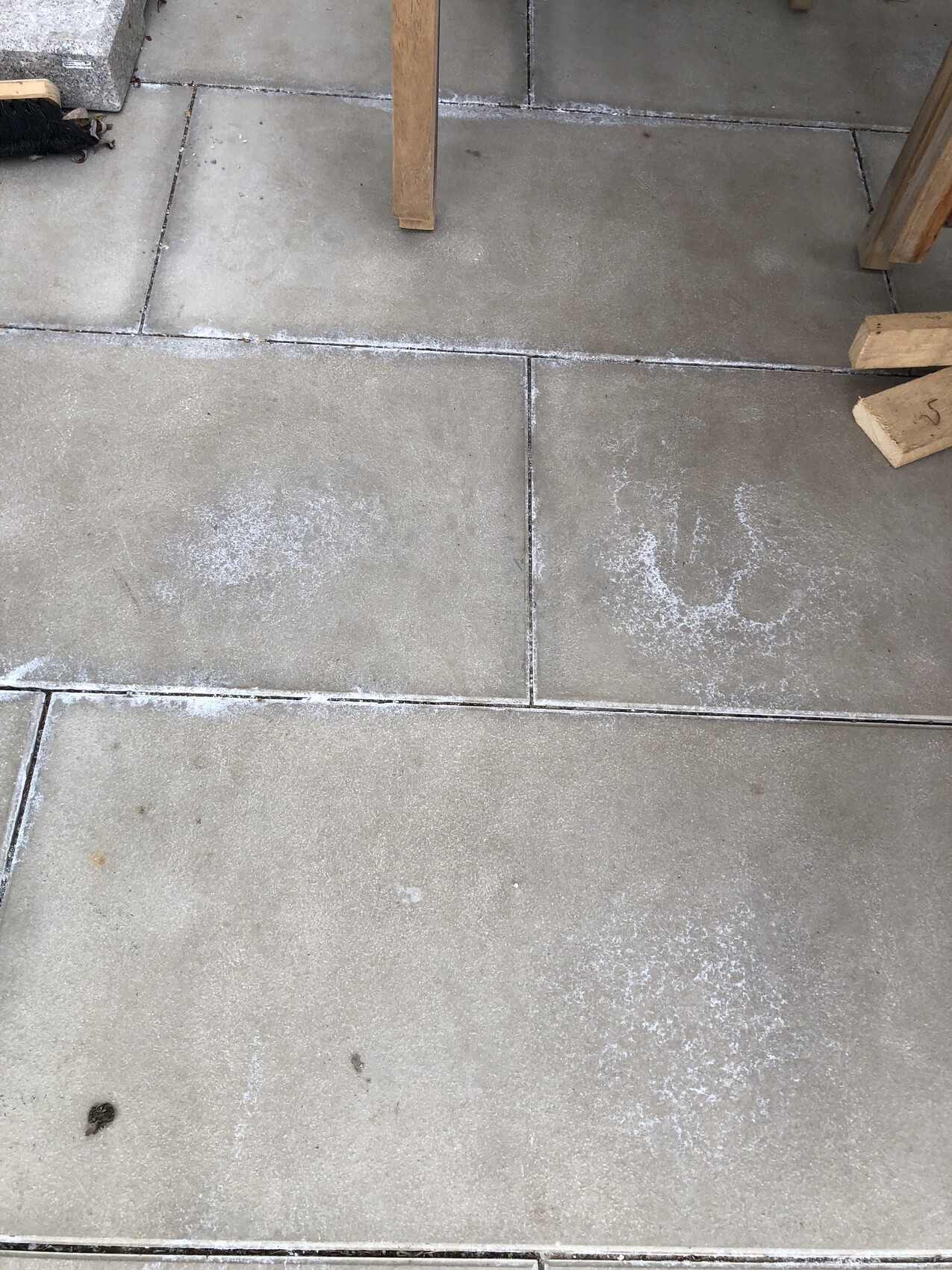
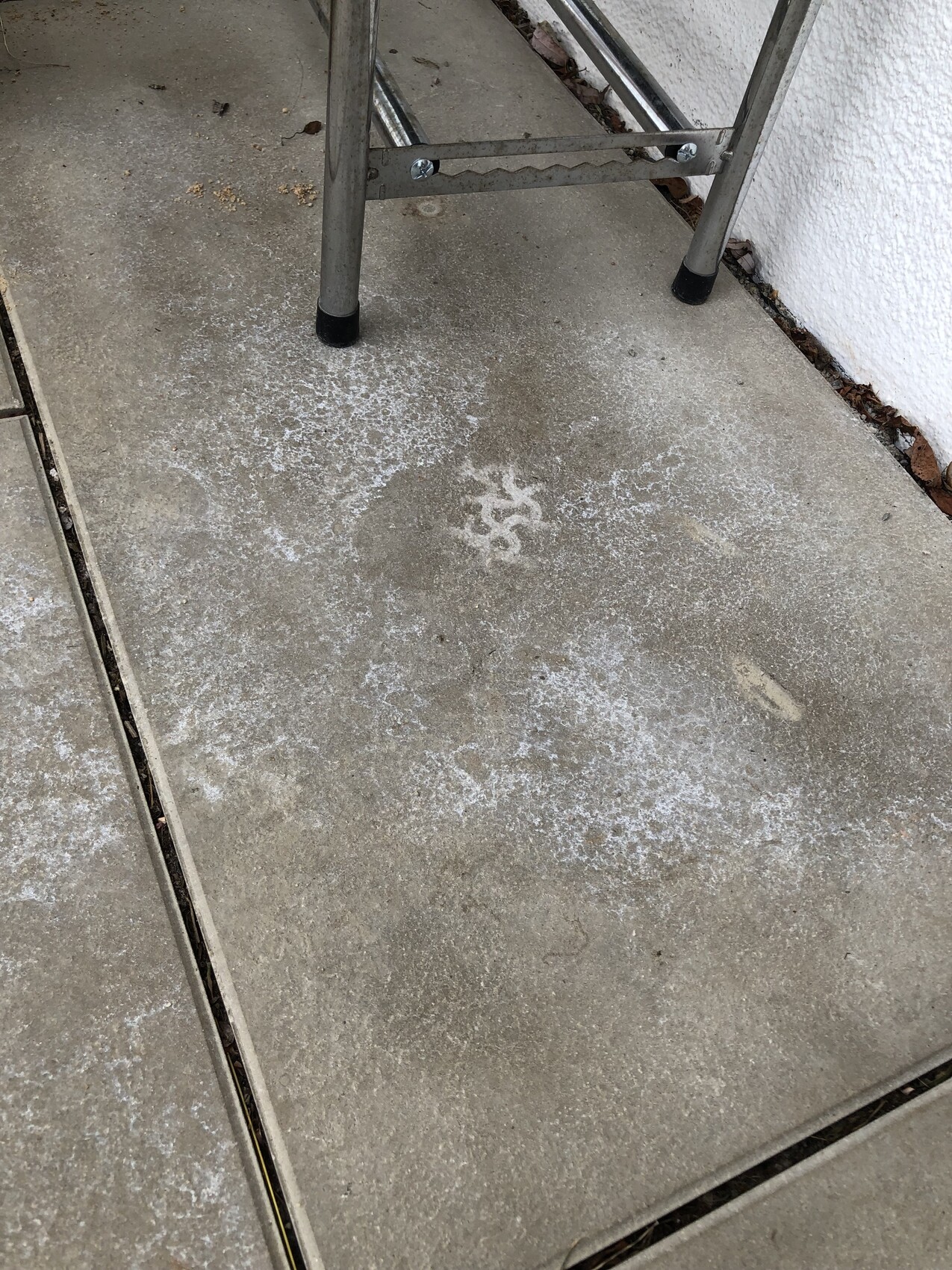
Two years ago, we had new Godelmann Gabano smooth slabs installed in beige (80x40x5 cm (31.5x15.7x2 inches)). However, the slabs aren’t beige but gray like regular concrete, and they regularly show cement efflorescence. The slabs also absorb every grease stain, for example from food. The cement residue was supposed to be washed away by rain, but now we have a roof over it. I have already removed the residue twice using the Godelmann cleaner (hydrochloric acid), but the residue keeps coming back (see attached photos from today).
We want to install a wooden deck made from local or Siberian larch on top of the slabs. Since the slabs are already (almost) level and have a slope, I don’t have to do much in that regard.
Problem: We only have 6 cm (2.4 inches) of clearance up to the door.
1. What is the best approach here? I will need about 28 mm (1.1 inches) for the decking boards, plus about 3-4 mm (0.1-0.2 inches) for pads for leveling. That leaves 28 mm (1.1 inches) for the substructure.
Can I build the substructure from the decking boards themselves, or is it better to use aluminum? Aluminum has the advantage of handling moisture well but is more expensive and harder to work with than wood.
The substructure could almost rest fully on the slabs, so there shouldn’t be any mechanical issues.
2. Does the structure have to be fastened to the slabs, or is a floating installation possible? I’d rather avoid drilling into the expensive Godelmann slabs in case the wooden floor turns out to be unsuitable for us for any reason.
Alternatively, I would have to remove the Godelmann slabs and replace them with inexpensive paving slabs. I would prefer to avoid that effort if possible. Otherwise, the Godelmann slabs are just lying around unused.
3. It is recommended to lay the boards away from the house so water can run off along the boards. However, since there is a roof, only the edge gets wet and discolored. If I install the boards parallel to the house wall, the boards at the edge could be replaced after a few years. Also, the substructure would then run perpendicular to the house wall, allowing water to drain better off the slabs.
What do you think?
Our situation:
Two years ago, we had new Godelmann Gabano smooth slabs installed in beige (80x40x5 cm (31.5x15.7x2 inches)). However, the slabs aren’t beige but gray like regular concrete, and they regularly show cement efflorescence. The slabs also absorb every grease stain, for example from food. The cement residue was supposed to be washed away by rain, but now we have a roof over it. I have already removed the residue twice using the Godelmann cleaner (hydrochloric acid), but the residue keeps coming back (see attached photos from today).
We want to install a wooden deck made from local or Siberian larch on top of the slabs. Since the slabs are already (almost) level and have a slope, I don’t have to do much in that regard.
Problem: We only have 6 cm (2.4 inches) of clearance up to the door.
1. What is the best approach here? I will need about 28 mm (1.1 inches) for the decking boards, plus about 3-4 mm (0.1-0.2 inches) for pads for leveling. That leaves 28 mm (1.1 inches) for the substructure.
Can I build the substructure from the decking boards themselves, or is it better to use aluminum? Aluminum has the advantage of handling moisture well but is more expensive and harder to work with than wood.
The substructure could almost rest fully on the slabs, so there shouldn’t be any mechanical issues.
2. Does the structure have to be fastened to the slabs, or is a floating installation possible? I’d rather avoid drilling into the expensive Godelmann slabs in case the wooden floor turns out to be unsuitable for us for any reason.
Alternatively, I would have to remove the Godelmann slabs and replace them with inexpensive paving slabs. I would prefer to avoid that effort if possible. Otherwise, the Godelmann slabs are just lying around unused.
3. It is recommended to lay the boards away from the house so water can run off along the boards. However, since there is a roof, only the edge gets wet and discolored. If I install the boards parallel to the house wall, the boards at the edge could be replaced after a few years. Also, the substructure would then run perpendicular to the house wall, allowing water to drain better off the slabs.
What do you think?
M
Martial.white6 Feb 2022 17:50First of all, I’m sorry that the panels look like this. I’m sure you expected something different.
I like the idea for the solution! The wooden substructure needs to be kept out of the water, but maybe 6cm (2.4 inches) clearance is enough. Possibly more substructure with thinner elements.
Alternatively, and with more effort:
What is underneath the panels? Is it possible to lift individual panels and place the substructure supports on the gravel or even the foundation, or remove all panels and set them aside for later, then build on top?
Is there another photo from the front? That would help better assess the installation situation.
I like the idea for the solution! The wooden substructure needs to be kept out of the water, but maybe 6cm (2.4 inches) clearance is enough. Possibly more substructure with thinner elements.
Alternatively, and with more effort:
What is underneath the panels? Is it possible to lift individual panels and place the substructure supports on the gravel or even the foundation, or remove all panels and set them aside for later, then build on top?
Is there another photo from the front? That would help better assess the installation situation.
B
Benutzer2006 Feb 2022 18:43Gecko1927 schrieb:
1. What is the best way to do this? I need about 28mm (1.1 inches) for the decking boards, plus around 3-4mm (0.1-0.2 inches) for the pads to level them. That leaves 28mm (1.1 inches) for the substructure.With a proper substructure, that won’t work. You could gain a few millimeters with 21mm (0.8 inches) boards.Gecko1927 schrieb:
Is it absolutely necessary to screw the structure to the panels?No, it’s not necessary. It almost always just rests on them “without fixing.”Gecko1927 schrieb:
It is recommended to lay the decking boards away from the house so water can run off along the boards.Use boards without grooves. The direction of the boards doesn’t really matter, since no water will stand on them anyway. A slope wouldn’t be necessary either (even if formally required).My suggestion: Remove the panels and sell them locally. Lay the substructure on small cement bags plus pads (to keep it off the ground and dry). You already have a solid substructure under the panels, so you can shave off a few centimeters (inches) if needed. Then lay the decking boards without visible screws — there are special clips and similar fittings for this, preventing the boards from sitting in water on the substructure.
G
Gecko19277 Feb 2022 09:34@Martial.white and @Benutzer200 thanks for your comments.
Construction: gravel – crushed stone (no idea how much) – 5 thick concrete slabs.
We will definitely use smooth decking boards, without grooves.
If I remove the slabs, I gain about 5cm (2 inches), but I can’t place adjustable pedestals directly on the crushed stone, so I will need a base layer again.
Unfortunately, I don’t know how thick the crushed stone layer under the slabs is, but since I always need a plate-like support, it must always rest on the crushed stone, right?
There is, for example, an aluminum system from Kahrs with 2cm (0.8 inch) high profiles. What is the reason not to place these directly on the slabs? Alternatively, I would consider getting a cheaper aluminum rectangular tube measuring 60x20x2mm.
Construction: gravel – crushed stone (no idea how much) – 5 thick concrete slabs.
We will definitely use smooth decking boards, without grooves.
If I remove the slabs, I gain about 5cm (2 inches), but I can’t place adjustable pedestals directly on the crushed stone, so I will need a base layer again.
Unfortunately, I don’t know how thick the crushed stone layer under the slabs is, but since I always need a plate-like support, it must always rest on the crushed stone, right?
There is, for example, an aluminum system from Kahrs with 2cm (0.8 inch) high profiles. What is the reason not to place these directly on the slabs? Alternatively, I would consider getting a cheaper aluminum rectangular tube measuring 60x20x2mm.
 schubert7917 Feb 2022 20:12
This is not a beige color… words words

Similar topics