
Hello everyone,
In about three weeks, we are supposed to finalize our electrical planning on site. Unfortunately, our electrician is somewhat old-fashioned, which makes it difficult for me to collaboratively plan a future-proof electrical setup with him. Therefore, I am currently educating myself to ensure that the networking in our single-family home is fundamentally future-proof.
Basically, it’s about the LAN network... LAN wall outlets are relatively expensive, so proper planning is even more important.
About us:
- Mid to late 20s – couple without children. Planning for 2 children in the near future.
- Single-family house with a usable basement, 2 full floors, and fully equipped with concrete ceilings
- Utility room in the basement with air-to-water heat pump, ventilation system, photovoltaic system
- The router is planned to be located in the office on the ground floor
- The upper floor includes bathroom / bedroom / 2 children’s rooms
- No satellite dish or cable TV — we will use Internet TV exclusively!
Now, I am struggling to network our single-family home sensibly but as cost-effectively as possible.
I have the following questions:
1. Slightly off-topic: In the living room, I would like to have an in-wall conduit installed on the TV wall (the TV will be wall-mounted) so that no cables are visible. Is this sensible and affordable? I will get exact prices from my electrician if this makes sense at all. Would it also make sense to install power outlets at TV height? How do you plan the connections on your media wall reasonably? What should be considered?
Since we plan to use a Magenta TV box and thus IP-TV, a total of four LAN ports in the living room area would presumably be useful, right?
2. How many LAN outlets and especially where should LAN outlets be installed? Mainly: which cable? Is CAT6 sufficient?
→ Such a double LAN outlet certainly costs close to €200, so planning must be really sensible.
Is it really necessary to install 2 double LAN outlets in each children’s room? I always wonder: what is actually going to be plugged in there?
One port for the TV and one port for a multimedia device should be enough, right? So four connections would probably be overkill, correct?
The fact is: It will certainly take years or decades before our children actually use these outlets... Who knows what changes might happen by then? Therefore, could we not cost-effectively use empty conduits (empty pipes) instead?
Is it also possible to “branch off” from an existing double outlet afterward to add more ports for the room? What should be considered here? Or should we consider having an empty conduit prepared in another spot in the room so that a socket can be installed later?
3. How do you solve the “router problem”? Should the one router be placed in the office (ground floor) with LAN outlets in the existing bedrooms upstairs to ensure a stable LAN connection? Or is a router upstairs absolutely necessary?
4. How important are LAN outlets in the utility room? Should the router possibly even be located in the utility room? Because of the concrete ceiling between basement and ground floor, a second router would almost certainly be needed. How should this situation be handled with a basement?
5. What do you think about installing empty conduits for CAT cables in the kitchen / hallway etc. to enable later retrofitting? Is this relatively affordable in new builds?
I would appreciate any feedback so we can make the best possible plans 🙂
In about three weeks, we are supposed to finalize our electrical planning on site. Unfortunately, our electrician is somewhat old-fashioned, which makes it difficult for me to collaboratively plan a future-proof electrical setup with him. Therefore, I am currently educating myself to ensure that the networking in our single-family home is fundamentally future-proof.
Basically, it’s about the LAN network... LAN wall outlets are relatively expensive, so proper planning is even more important.
About us:
- Mid to late 20s – couple without children. Planning for 2 children in the near future.
- Single-family house with a usable basement, 2 full floors, and fully equipped with concrete ceilings
- Utility room in the basement with air-to-water heat pump, ventilation system, photovoltaic system
- The router is planned to be located in the office on the ground floor
- The upper floor includes bathroom / bedroom / 2 children’s rooms
- No satellite dish or cable TV — we will use Internet TV exclusively!
Now, I am struggling to network our single-family home sensibly but as cost-effectively as possible.
I have the following questions:
1. Slightly off-topic: In the living room, I would like to have an in-wall conduit installed on the TV wall (the TV will be wall-mounted) so that no cables are visible. Is this sensible and affordable? I will get exact prices from my electrician if this makes sense at all. Would it also make sense to install power outlets at TV height? How do you plan the connections on your media wall reasonably? What should be considered?
Since we plan to use a Magenta TV box and thus IP-TV, a total of four LAN ports in the living room area would presumably be useful, right?
2. How many LAN outlets and especially where should LAN outlets be installed? Mainly: which cable? Is CAT6 sufficient?
→ Such a double LAN outlet certainly costs close to €200, so planning must be really sensible.
Is it really necessary to install 2 double LAN outlets in each children’s room? I always wonder: what is actually going to be plugged in there?
One port for the TV and one port for a multimedia device should be enough, right? So four connections would probably be overkill, correct?
The fact is: It will certainly take years or decades before our children actually use these outlets... Who knows what changes might happen by then? Therefore, could we not cost-effectively use empty conduits (empty pipes) instead?
Is it also possible to “branch off” from an existing double outlet afterward to add more ports for the room? What should be considered here? Or should we consider having an empty conduit prepared in another spot in the room so that a socket can be installed later?
3. How do you solve the “router problem”? Should the one router be placed in the office (ground floor) with LAN outlets in the existing bedrooms upstairs to ensure a stable LAN connection? Or is a router upstairs absolutely necessary?
4. How important are LAN outlets in the utility room? Should the router possibly even be located in the utility room? Because of the concrete ceiling between basement and ground floor, a second router would almost certainly be needed. How should this situation be handled with a basement?
5. What do you think about installing empty conduits for CAT cables in the kitchen / hallway etc. to enable later retrofitting? Is this relatively affordable in new builds?
I would appreciate any feedback so we can make the best possible plans 🙂
M
majuhenema2 Jan 2022 14:57Thank you all for your feedback!
For these reasons, my current plan looks like this so far:
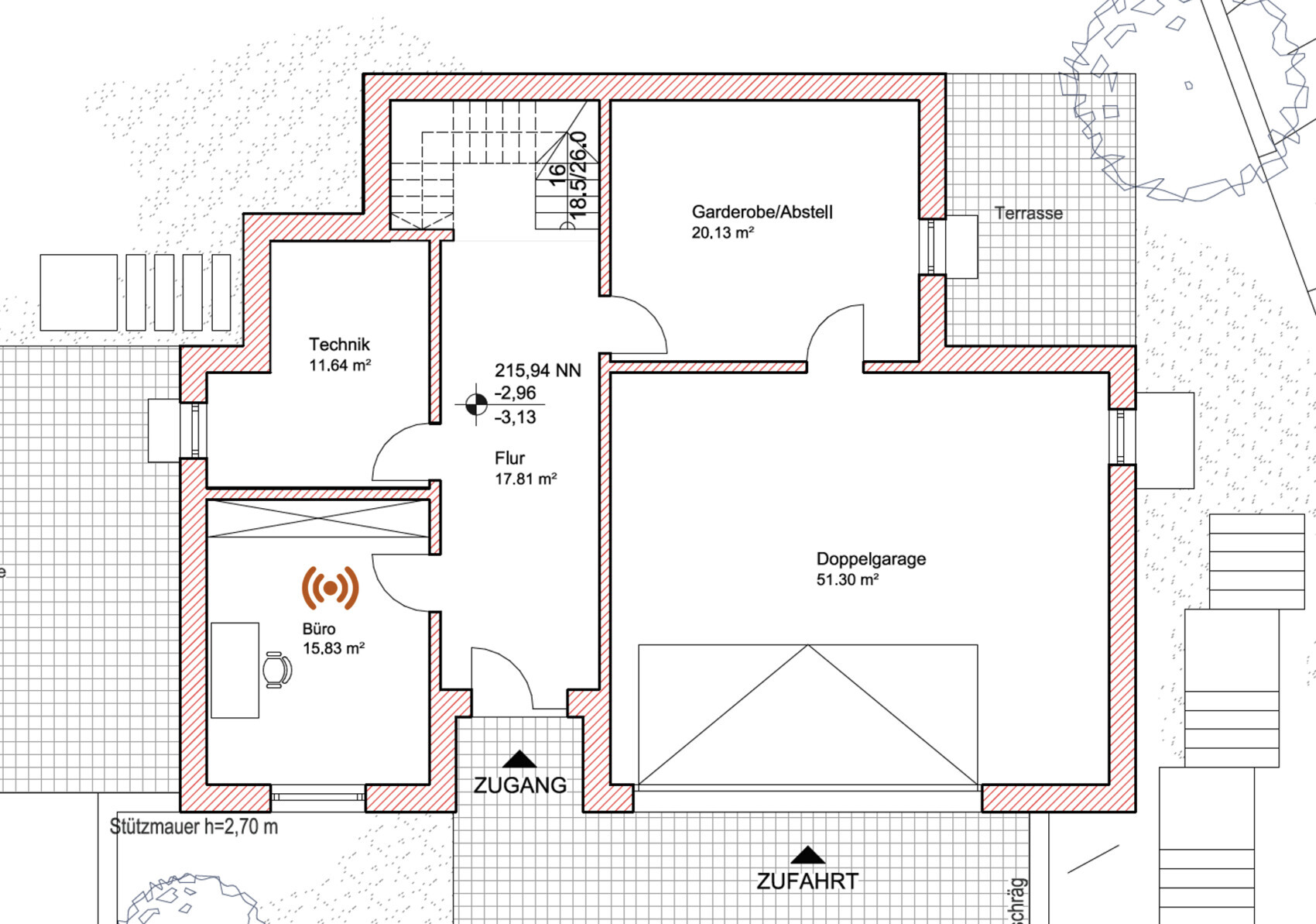
1. The basement (UG) will have the access point in the office because I work there with my laptop and printer. Otherwise, Wi-Fi is generally not needed in the basement.
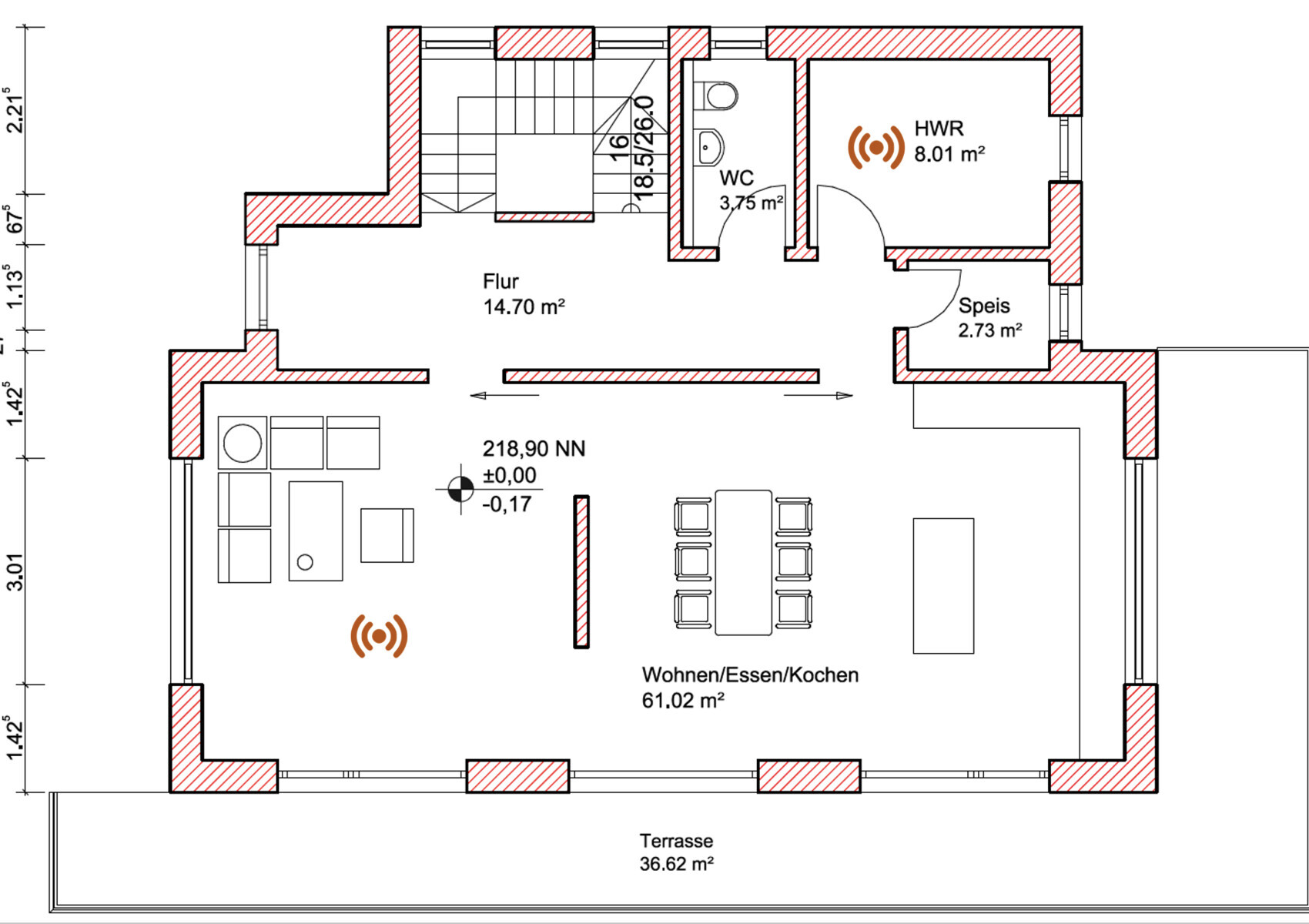
2. The ground floor (EG) will have the access point in the living room, since we spend most of our time there, and the signal should also cover the terrace on the left side of the plan and the dining/kitchen area.
3. A second access point will be installed in the utility room because my wife works there from home with her laptop and printer, and the signal should sufficiently cover the terrace on the right side of the plan.
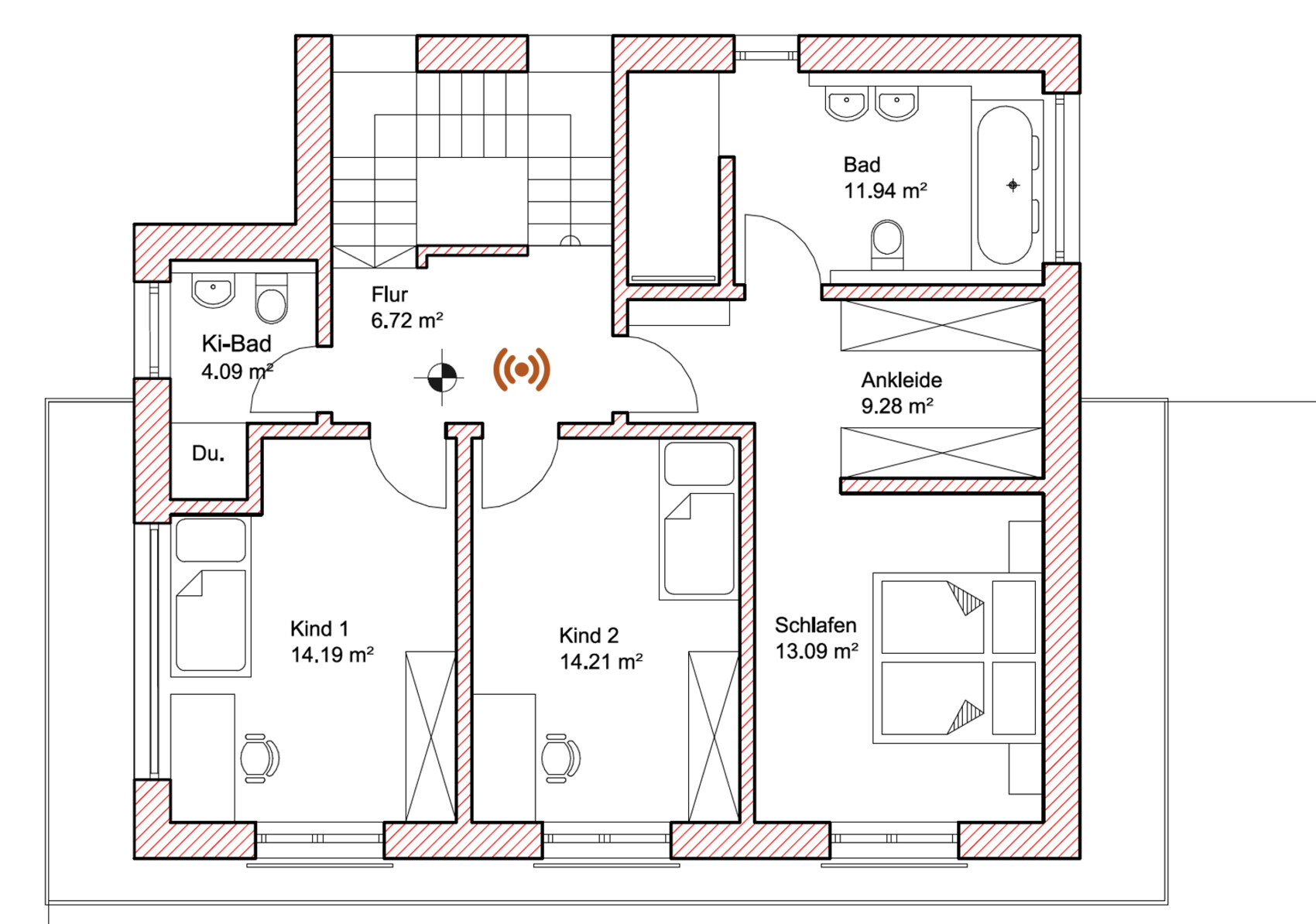
4. An access point in the hallway on the upper floor (OG) for the children's bedrooms. We don’t use phones in the bedrooms and rarely or never need internet there.
Could you please briefly explain the advantage of placing the access point in the basement hallway instead of in the office?
I did not consider placing the first access point on the ground floor between the partition wall and external wall to be practical, as it would have a smaller coverage radius and be further from the terrace on the left side of the plan. However, in my version, there is also a partition wall between the living and kitchen areas.
For these reasons, my current plan looks like this so far:
1. The basement (UG) will have the access point in the office because I work there with my laptop and printer. Otherwise, Wi-Fi is generally not needed in the basement.
2. The ground floor (EG) will have the access point in the living room, since we spend most of our time there, and the signal should also cover the terrace on the left side of the plan and the dining/kitchen area.
3. A second access point will be installed in the utility room because my wife works there from home with her laptop and printer, and the signal should sufficiently cover the terrace on the right side of the plan.
4. An access point in the hallway on the upper floor (OG) for the children's bedrooms. We don’t use phones in the bedrooms and rarely or never need internet there.
Could you please briefly explain the advantage of placing the access point in the basement hallway instead of in the office?
I did not consider placing the first access point on the ground floor between the partition wall and external wall to be practical, as it would have a smaller coverage radius and be further from the terrace on the left side of the plan. However, in my version, there is also a partition wall between the living and kitchen areas.

1. That works fine.
2. It’s possible to do it that way. However, I would still place it between the partition wall and the exterior wall and prepare a cable for the terrace access point. There could potentially be issues with semi-closed or closed blinds/shutters. I did it that way, and it was the right decision.
3. That’s doable.
4. If Wi-Fi is not needed in the bedroom, that should be sufficient.
2. It’s possible to do it that way. However, I would still place it between the partition wall and the exterior wall and prepare a cable for the terrace access point. There could potentially be issues with semi-closed or closed blinds/shutters. I did it that way, and it was the right decision.
3. That’s doable.
4. If Wi-Fi is not needed in the bedroom, that should be sufficient.
M
majuhenema2 Jan 2022 15:43AMNE3IA schrieb:
2. That’s doable. I would still place it between the partition wall and the exterior wall and prepare a cable for an access point on the terrace.
There could possibly be issues with semi-closed or closed venetian blinds/shutters.
I did it that way, and it was the right decision. That makes sense. The terrace faces southwest. Accordingly, we will spend a lot of time there in summer with the venetian blinds closed. But that would mean either a third access point or leaving out the access point in the utility room.
You wouldn’t skip an access point in the office/hallway despite the FritzBox in the equipment room and the low Wi-Fi demand in the basement, right?

majuhenema schrieb:
That makes sense. The terrace faces southwest. Accordingly, we will spend a lot of time there in the summer with the shutters closed. However, that would mean adding a third access point or giving up the access point in the utility room.
You wouldn’t skip an access point in the office/hallway despite the Fritzbox in the technical room and the low Wi-Fi demand in the basement, right?Which access points are you planning to use? Or have you already mentioned that? The AVM ones require a power outlet, so you can simply try them out. With other brands, it is generally recommended to disable the Wi-Fi on the Fritzbox to prevent interference between the devices.
1. I wouldn’t skip the utility room. Definitely prepare network cables for the terrace from the start and install a third access point if needed.
2. I would also not want to skip it. With the Fritzbox, you then have a separate network. It’s annoying when Wi-Fi switches back and forth between two networks.
2. I would also not want to skip it. With the Fritzbox, you then have a separate network. It’s annoying when Wi-Fi switches back and forth between two networks.
Similar topics