
Hello,
I would appreciate some good input and collective knowledge, as we are currently stuck with the planning of our parking spaces and carport, but we need some kind of concept if we want to create a somewhat solid cost estimate.
Attached you will hopefully find all the necessary documents needed for brainstorming.
As you can see in the elevation plan, the house as well as (in the original version) the placement of the carport are already planned. The depicted carport is 4 x 8 m (including storage room). The distance from the house to the right property boundary is 6.5 m (minimum distance 6 m due to building easement, but we didn’t want more so that enough garden space remains). Originally, a 4 m wide carport with one parking space in front was planned, but the municipality requires 2 separately drivable parking spaces, each 2.5 x 5 m. There are no exceptions to this rule. Therefore, for the permit, a second parking space was initially placed between the sidewalk and driveway (which fit well with the 6.5 m distance), but as you can see on the elevation plan, there is a slope there. The carport at the boundary may have a maximum average height of 3 m, so the plan includes a ramp there. In the original plan, it would not have been a problem to plant on the neighbor side and between the sidewalk and driveway. Now this is no longer possible. In addition, the slope goes downward and there is no planting strip between the parking spaces and the sidewalk. However, the house is at street level, so a slope or wall will form there. You would almost have to install a railing, as planting is not even possible.
This is all not optimal and also not attractive. We have been thinking all the time about how to solve this.
For example, we could place a 5 x 5 m carport directly at the boundary, but we don’t like this regarding the main entrance. Also, it would be very tight in front of the door. We could also place a parking space crosswise in front of the house, but I don’t find that ideal either since the car would be openly visible from the street. I believe fencing it is not allowed because otherwise, there wouldn’t be enough maneuvering space at the rear?
Alternatively, the carport could be placed in the far northeast, but the problem is that soil will be filled up for the house and the fill slopes out 1 to 2 m sideways. The carport would have to be almost at the original ground level to be allowed on the boundary (because of the 3 m height limit).
So... now it gets difficult. Actually, we like the first plan best, but we have no good idea how to design it nicely if the sidewalk and driveway are not at the same height… and you’re not even allowed to put a plant there.
I look forward to ideas, and if anything is missing... I can hopefully provide most of it later.
Thank you very much.
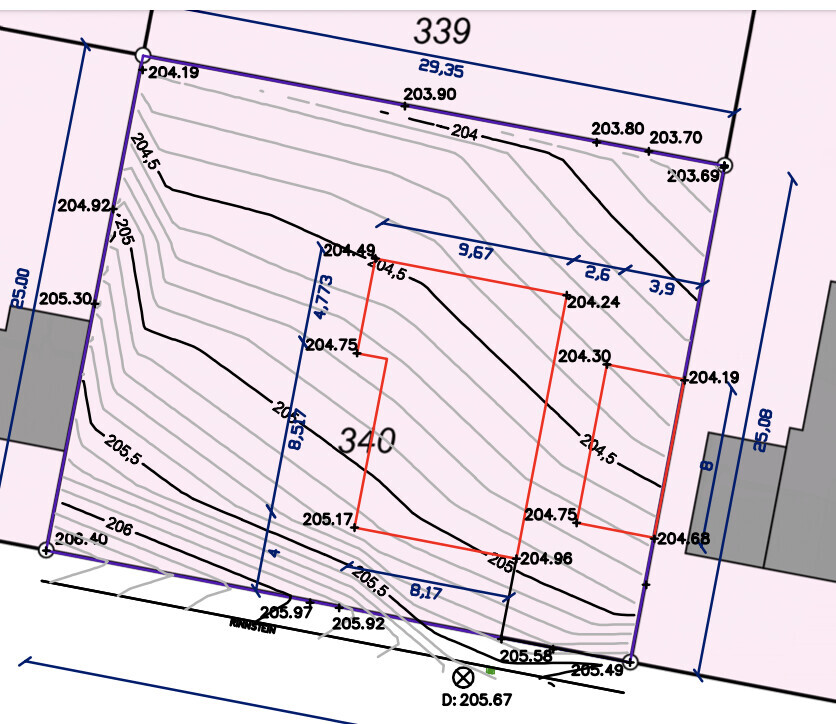
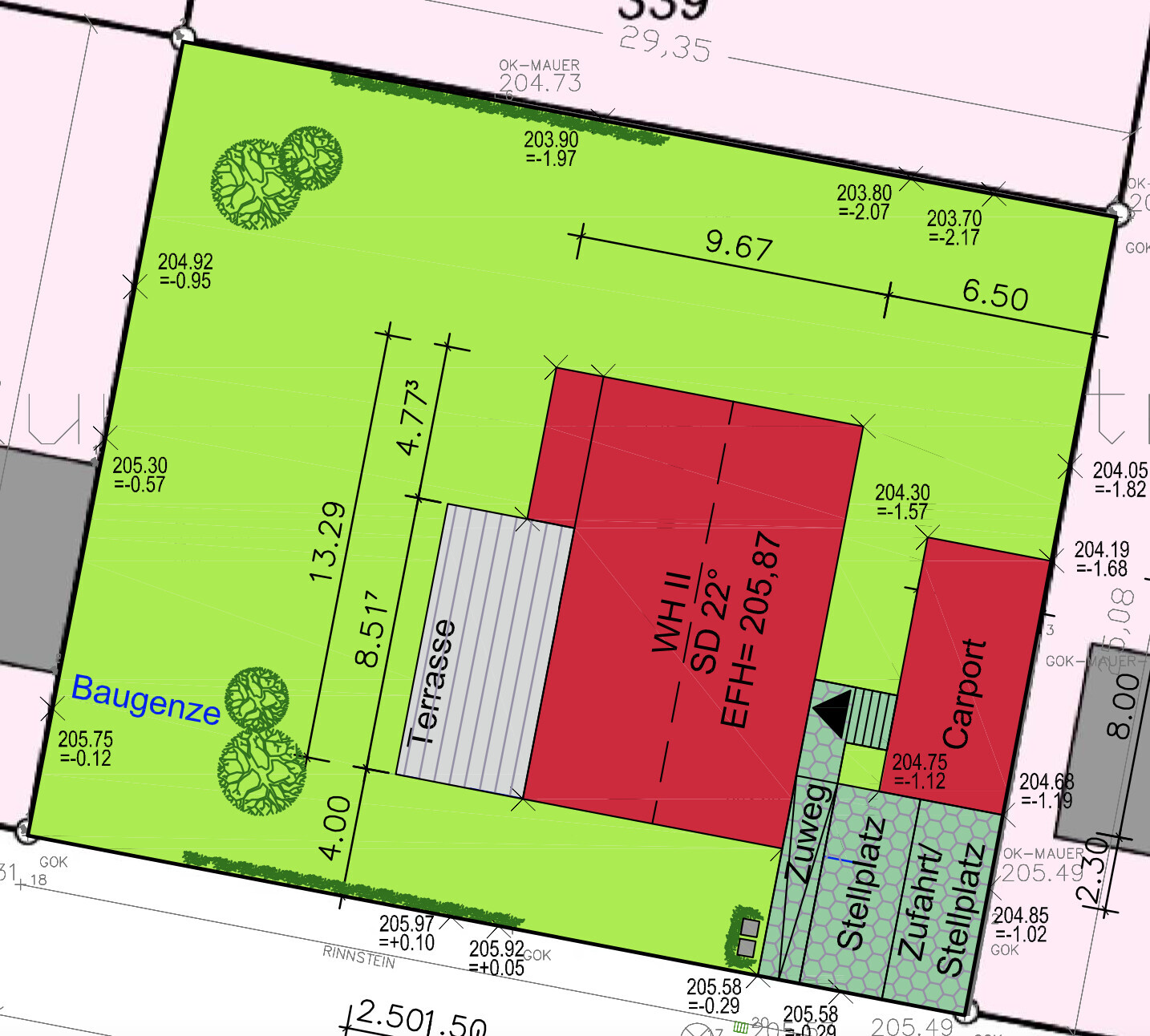
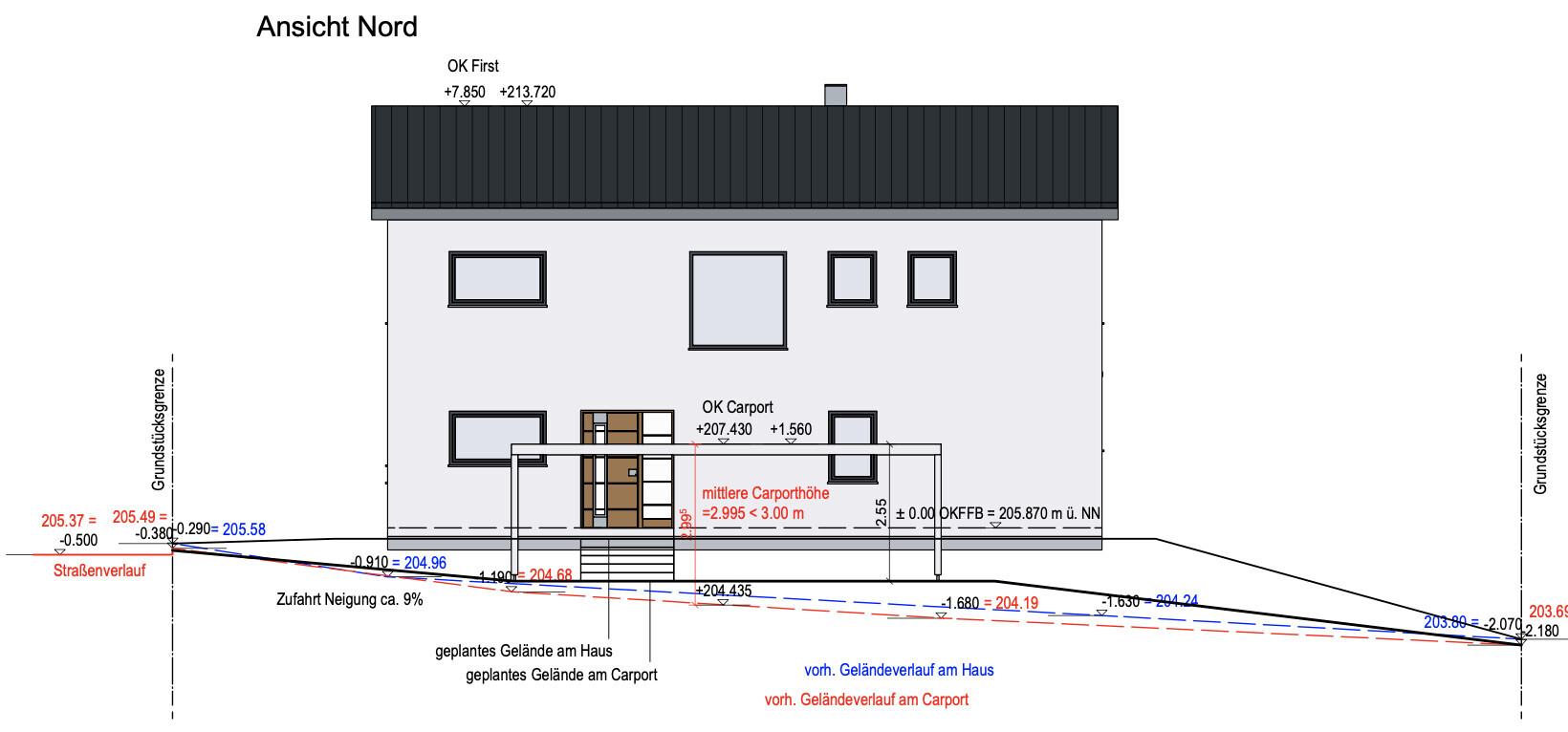
I would appreciate some good input and collective knowledge, as we are currently stuck with the planning of our parking spaces and carport, but we need some kind of concept if we want to create a somewhat solid cost estimate.
Attached you will hopefully find all the necessary documents needed for brainstorming.
As you can see in the elevation plan, the house as well as (in the original version) the placement of the carport are already planned. The depicted carport is 4 x 8 m (including storage room). The distance from the house to the right property boundary is 6.5 m (minimum distance 6 m due to building easement, but we didn’t want more so that enough garden space remains). Originally, a 4 m wide carport with one parking space in front was planned, but the municipality requires 2 separately drivable parking spaces, each 2.5 x 5 m. There are no exceptions to this rule. Therefore, for the permit, a second parking space was initially placed between the sidewalk and driveway (which fit well with the 6.5 m distance), but as you can see on the elevation plan, there is a slope there. The carport at the boundary may have a maximum average height of 3 m, so the plan includes a ramp there. In the original plan, it would not have been a problem to plant on the neighbor side and between the sidewalk and driveway. Now this is no longer possible. In addition, the slope goes downward and there is no planting strip between the parking spaces and the sidewalk. However, the house is at street level, so a slope or wall will form there. You would almost have to install a railing, as planting is not even possible.
This is all not optimal and also not attractive. We have been thinking all the time about how to solve this.
For example, we could place a 5 x 5 m carport directly at the boundary, but we don’t like this regarding the main entrance. Also, it would be very tight in front of the door. We could also place a parking space crosswise in front of the house, but I don’t find that ideal either since the car would be openly visible from the street. I believe fencing it is not allowed because otherwise, there wouldn’t be enough maneuvering space at the rear?
Alternatively, the carport could be placed in the far northeast, but the problem is that soil will be filled up for the house and the fill slopes out 1 to 2 m sideways. The carport would have to be almost at the original ground level to be allowed on the boundary (because of the 3 m height limit).
So... now it gets difficult. Actually, we like the first plan best, but we have no good idea how to design it nicely if the sidewalk and driveway are not at the same height… and you’re not even allowed to put a plant there.
I look forward to ideas, and if anything is missing... I can hopefully provide most of it later.
Thank you very much.
For your information: The foundation slab, including insulation, is 32 cm (12.6 inches) thick plus approximately 16 cm (6.3 inches) of insulation/screed/final flooring. This means:
FFP 205.87 - 16 equals the rough floor level (RFL) and essentially the bottom of the plinth. From there, the slab extends 32 cm (12.6 inches) down to the underside of the foundation slab. This creates a plinth area where the ground can be shaped between 205.39 and 204.71.
FFP 205.87 - 16 equals the rough floor level (RFL) and essentially the bottom of the plinth. From there, the slab extends 32 cm (12.6 inches) down to the underside of the foundation slab. This creates a plinth area where the ground can be shaped between 205.39 and 204.71.

wullewuu schrieb:
We are now leaning towards 5 to 5.5 m (16 to 18 feet) inside, which leaves about 7 m (23 feet) to the neighbor on the north side. There, I would support the house with L-shaped retaining walls at a 1.5 m (5 feet) distance and plan for waterproof render and planting near the house. The plot below will be raised to 204.6 m (672 feet) elevation, just like the foundation for the carport, for example, so everything is level and there will be a 90 cm (35 inches) wall at the back. That should be fine. The entire western part of the plot will be divided into two plateaus. One in the northwest will be at the mentioned 204.6 m (672 feet) or slightly increasing, and roughly at terrace level there will be a rise to about 205.x m (673 feet), which creates the second plateau at the top. In the northeast, behind the garage/carport, there could be a large shed extending to the eastern boundary for extra storage.
What do you think? Sounds good to me. Would you place the house flush with the carport? Or keep a 1.5 m (5 feet) overhang so it aligns with the L-walls? I’ll make a drawing…
The eastern boundary can be raised too, since it’s planned as the southeast (the neighbor already has a wall there and has raised their ground), but it can’t be raised along the entire length because of the slope. Sounds like a plan 🙂 I’d recommend going with 5.5 m (18 feet). Even that is tight, since you don’t want to accidentally touch the plaster with the bumper every time. I’d position the carport as far south as possible. Neither you nor the neighbor really benefits if the carport is moved further north. If the neighbor can overlook it, that’s fine for them, plus they still have an open view (and winter sun) towards the southwest. You can make good use of your northeast corner for additional storage, compost or leaf piles, a shady summer spot, or something similar. I’d try to keep that area free as much as possible. In short, I’d base the layout on the entrance height or similar and stay as far forward as possible. Basically, this brings you back to your original plans, and with this setup, you could again consider extending to 8 m (26 feet) or more (including carport and storage). What I’m still not clear about is how you will handle the different levels between the entrance and the carport.
I can imagine the varying ground levels on the plot. You have to do something about the slope, after all. Whether you sharply define it architecturally with L-walls or create a more organic transition is a matter of taste. The levels don’t have to be perfectly flat. With a 20–30 cm (8 to 12 inches) slope on each level you can almost even out the difference. Regarding the foundation, you will need to have a soil survey done if you haven’t already. For us, the results meant we needed a minimum 2.6 m (8.5 feet) flat plateau on the downhill side of the house to properly distribute the load.
As for the eastern boundary: of course, you can raise the entire length, but then you have to step it down towards the north following the terrain.
Hangman schrieb:
Sounds like a plan 🙂 Better to go with 5.5 m (18 feet). Even that is a tight fit since you don’t want to touch the plaster every time with the bumper. I would place the carport as far south as possible. Neither you nor the neighbor benefit from moving the carport further north. If the neighbor can overlook it, that’s fine for them, and they still have an open view (and winter sun) to the southwest. You can make good use of your northeast corner for extra storage, compost or leaf piles, a shady summer spot, or something similar. I would try to keep that area as clear as possible. In short, I would align with the heights, the front door, or similar, and stay as far forward as possible. Basically, we’re back to the original plan, and with this arrangement, you could also go back to 8+ m (26 feet plus) including the carport and storage room. What still isn’t clear to me is how you plan to handle the different levels between the entrance and the carport.
I can imagine the different ground levels on the property. You have to do something because of the slope. Whether you strictly separate the levels architecturally with retaining walls or go for a more organic approach is a matter of taste. The levels don’t have to be perfectly flat. With 20-30 cm (8-12 inches) slope on each level, you can almost even out the difference. Regarding the foundation, you will need to get a soil report if you haven’t already. For example, in our case, the result was that we needed a minimum 2.6 m (8.5 feet) level plateau on the downhill side of the house to properly transfer the load.
Regarding the east boundary: of course, you can raise the whole length. You will just need to step it down following the terrain toward the north.Thanks. One thing worries me: the foundation will be without frost protection footings, which is technically fine, but results in the gravel extending beyond the base slab. That’s no problem in front of the house or on the east/west sides because of paths and such, but on the north side, I would like to plant near the house so it doesn’t look like such a bare corner, especially since I will probably retain 1.5-2 m (5-6.5 feet) there with retaining walls. Is that possible? Nothing will grow on gravel… but I also can’t just remove the gravel (about 1 meter (3 feet) from the house wall) and fill it with soil, right? Wouldn’t that make the foundation unstable? Or am I just overthinking this as a layperson? I also don’t want a 2 m (6.5 feet) death strip of gravel around the house…

Hangman schrieb:
You have to do something about the slope anyway. Whether you strictly define it architecturally with L-shaped retaining walls or choose a more organic approach is a matter of personal preference. The levels don’t have to be perfectly flat. With a 20-30cm (8-12 inches) slope on each level, you can almost balance out the offset. Regarding the foundation, you will need to have a soil survey done (if you haven’t already). In our case, the result was that we needed a minimum 2.6m (8.5 feet) level platform on the downhill side of the house to carry the required load. I would recommend anyone building a house with special slope stabilization needs to study two fields that provide valuable guidance: first, dike construction; and second, the boundary reinforcement from a forty-year long field experiment on socialism in Germany. In this context, “L-shaped retaining walls” are just walls without floodlights.
https://www.instagram.com/11antgmxde/
https://www.linkedin.com/company/bauen-jetzt/
As an alternative to the dike master, you could (and should) discuss this with your planner. It is not uncommon here for a house to extend about 1 meter (3 feet) beyond the terrain. Whether this is done with frost-protected shallow foundations, strip footings, blind masonry, or something else, I’m not sure... but it seems to work. You could also slightly raise the northern part of the house and cover this area with plants (as it is called here). Based on intuition alone, I would prefer that to having a gravel mound that I hope won’t erode over the next several decades.
Hangman schrieb:
As an alternative to the Deichgrafen, you could (and should) discuss this with your planner. It’s not uncommon here for a house to extend about 1m (3 feet) beyond the terrain. Whether this is done with frost skirts, strip foundations, lost formwork masonry, or something else, I don’t know... but it seems to work. So you could also slightly “raise” the north part of the house and “landscape away” that area (as it’s called here). From a gut feeling, I would prefer that over a gravel mound that I hope won’t erode over the next decades.By “raising” do you mean what I think: brickwork or L-shaped blocks to level the height? The question is whether you can simply plant there then ♂️
Similar topics