
Hello everyone,
we have decided on a central controlled residential ventilation system for our new build.
The rough installation is now complete.
We did not interfere beforehand and trusted our installer.
However, we now have a few questions to better understand the setup and would also appreciate a brief confirmation on whether the installation was carried out correctly, if it can be done this way, or if there are alternative options.
--> The system is located in the laundry room because the technical room, due to the kitchen above, was not suitable for it (according to the installer).
So, we chose to separate the ventilation system and the air-to-water heat pump.
1. Is this feasible? Can the devices still communicate with each other (important for BAFA funding)? So far, I have not seen any wired connection between the two rooms (the rough installation has been completed since yesterday evening).
Unfortunately, I don’t have a picture of the laundry room at the moment, but logically the pipes come out of the ceiling in the basement in the same arrangement.
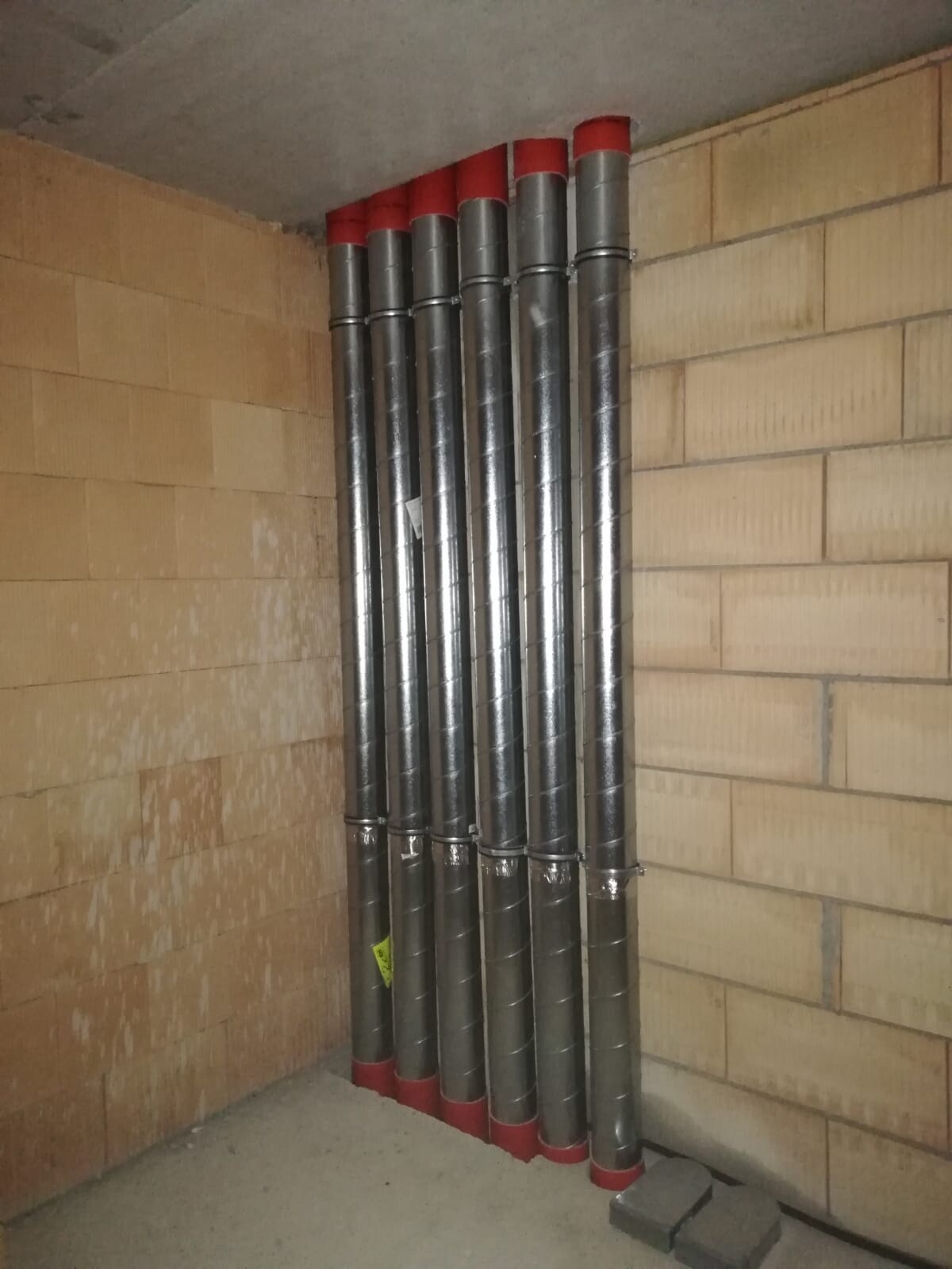
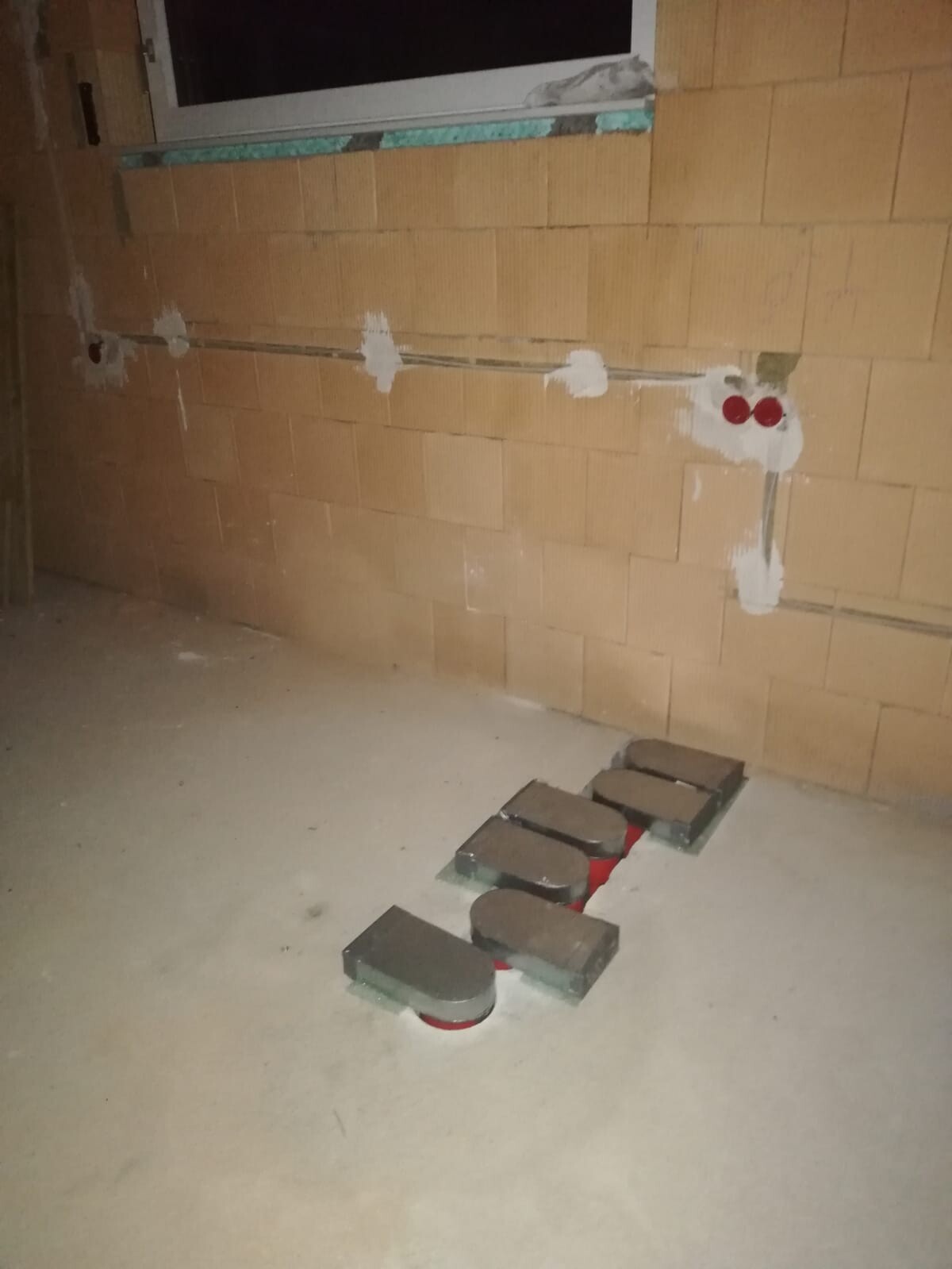
2. How should the piping be installed? Are additional pipes laid on the floor from the respective pipe outlets, possibly together with the underfloor heating pipes? These would then connect to the respective connection points (we have ventilation outlets either at the ceiling or high up on the wall).
3. Is it necessary or usual to install 6 such pipes—and is it “no problem” if all of them run directly underneath my bed? This can be seen in the second picture, where our bed is located.
I would appreciate some brief feedback and, if possible, pictures of your controlled residential ventilation installations.
We have not dealt with the rough installation at all and would like to gather some information from other sources before discussing again with our installer.
Thanks in advance!
we have decided on a central controlled residential ventilation system for our new build.
The rough installation is now complete.
We did not interfere beforehand and trusted our installer.
However, we now have a few questions to better understand the setup and would also appreciate a brief confirmation on whether the installation was carried out correctly, if it can be done this way, or if there are alternative options.
--> The system is located in the laundry room because the technical room, due to the kitchen above, was not suitable for it (according to the installer).
So, we chose to separate the ventilation system and the air-to-water heat pump.
1. Is this feasible? Can the devices still communicate with each other (important for BAFA funding)? So far, I have not seen any wired connection between the two rooms (the rough installation has been completed since yesterday evening).
Unfortunately, I don’t have a picture of the laundry room at the moment, but logically the pipes come out of the ceiling in the basement in the same arrangement.
2. How should the piping be installed? Are additional pipes laid on the floor from the respective pipe outlets, possibly together with the underfloor heating pipes? These would then connect to the respective connection points (we have ventilation outlets either at the ceiling or high up on the wall).
3. Is it necessary or usual to install 6 such pipes—and is it “no problem” if all of them run directly underneath my bed? This can be seen in the second picture, where our bed is located.
I would appreciate some brief feedback and, if possible, pictures of your controlled residential ventilation installations.
We have not dealt with the rough installation at all and would like to gather some information from other sources before discussing again with our installer.
Thanks in advance!
Mycraft schrieb:
Well, the 180 unit can circulate up to a maximum of 250 m³/h (147 cubic feet per minute), which in my opinion is really pushing the limit. What was the minimum ventilation requirement calculated for your house? If I were in your position, I would at least go for the 280 model, which delivers up to 350 m³/h (206 cubic feet per minute). That would be a bit more relaxed and should run more quietly under normal operation. The thing is: we had no involvement at all in the ventilation planning. It was done by the installer together with Tecalor.
That’s how the 180 was chosen.
But the square meter specifications from Tecalor for the different ventilation systems should be roughly correct, right?
I think if a single-family house up to 250 m² (2700 square feet) of living space can be operated with that, then it shouldn’t be too far off, should it?
Wouldn’t a 280 be oversized?
Of course, I’m not very familiar with this topic.
Besides, the ventilation system is unfortunately already on site and installed in the basement 😀
D
Deliverer22 Dec 2021 11:50Prager91 schrieb:
TTL 9.5 Can your small house really have such a high heating load?
netuser schrieb:
So far, I have assumed that this would at least be necessary for efficient heat recovery? The ventilation system recovers heat from the exhaust air and transfers it to the supply air. What does the water in the underfloor heating have to do with that? There is no connection between them.
D
Deliverer22 Dec 2021 11:52Oh God, I just realized this is a new build! Please do everything you can to get a room-by-room heating load calculation, and then work with the plumber to select a suitable heat pump.
Roughly estimated, the one you mentioned is about 2.5 times too large. And yes, that is a problem.
At first glance, I don’t find the sizing of the ventilation system too critical. However, there is also a room-by-room calculation for that. If the system is already running at its limit just for the minimum airflow, it is obviously too small.
Roughly estimated, the one you mentioned is about 2.5 times too large. And yes, that is a problem.
At first glance, I don’t find the sizing of the ventilation system too critical. However, there is also a room-by-room calculation for that. If the system is already running at its limit just for the minimum airflow, it is obviously too small.
Deliverer schrieb:
Oh my, I just realized this is a new build! Please do everything you can to obtain a room-by-room heating load calculation, and then select a suitable heat pump together with the plumbing specialist.
Roughly estimated, the one you mentioned is oversized by a factor of about 2.5. And yes, that’s a problem.
At first glance, I don’t find the sizing of the ventilation system so critical. But there is also a room-by-room calculation for that. If the system is already running at its limit for the minimum required volume, then it is definitely too small.The heat pump is already ready for installation in the basement...
This unit was recommended to us instead of the combined device, since we have a PURE indoor installation—no split system.
Is this unit completely wrongly sized? What else should or could have been chosen?
What disadvantages could this cause for me?
D
Deliverer22 Dec 2021 12:09Prager91 schrieb:
Is this device completely oversized? What else could or should have been chosen?
What disadvantages does this cause for me? As mentioned above, you only know which models are suitable once you know your exact heating load. A new building of your size should manage with about 3 kW (10,200 BTU/h) in lowland areas. Allow for 4 kW (13,600 BTU/h) to be safe. But definitely not 10 kW (34,100 BTU/h).
The disadvantage is continuous cycling. This leads to much higher wear and tear on the system and increased energy consumption. In addition, it is very likely that a large heat storage buffer was installed to compensate for this planning error. Both together result in additional costs easily amounting to €6,000–7,000. Over the years, the losses, inefficiency, and higher wear accumulate to at least the same amount again.
So, I would take action... At least open a new thread here to get more opinions on this.
Similar topics