
Hello everyone,
we have decided on a central controlled residential ventilation system for our new build.
The rough installation is now complete.
We did not interfere beforehand and trusted our installer.
However, we now have a few questions to better understand the setup and would also appreciate a brief confirmation on whether the installation was carried out correctly, if it can be done this way, or if there are alternative options.
--> The system is located in the laundry room because the technical room, due to the kitchen above, was not suitable for it (according to the installer).
So, we chose to separate the ventilation system and the air-to-water heat pump.
1. Is this feasible? Can the devices still communicate with each other (important for BAFA funding)? So far, I have not seen any wired connection between the two rooms (the rough installation has been completed since yesterday evening).
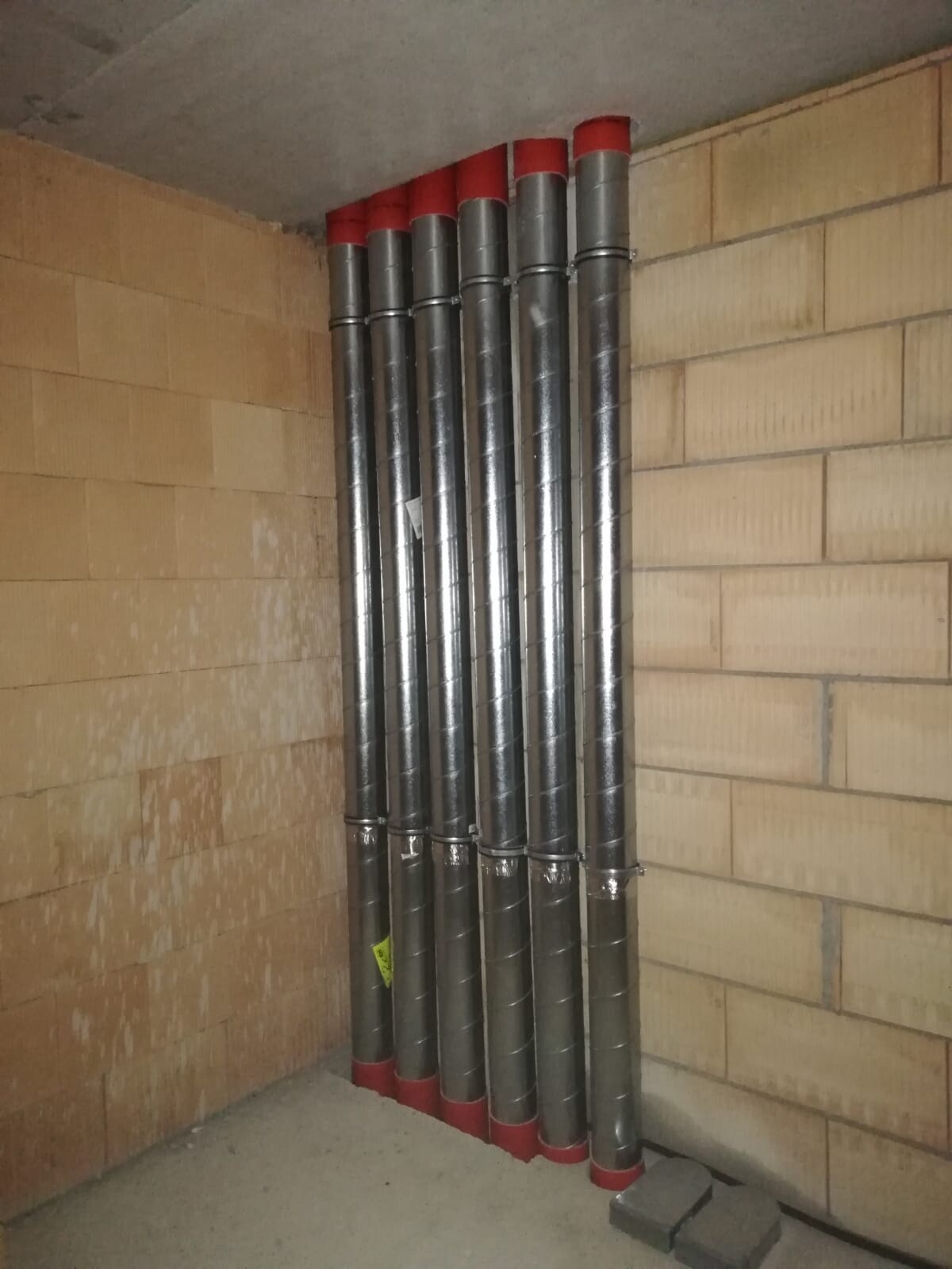
Unfortunately, I don’t have a picture of the laundry room at the moment, but logically the pipes come out of the ceiling in the basement in the same arrangement.
2. How should the piping be installed? Are additional pipes laid on the floor from the respective pipe outlets, possibly together with the underfloor heating pipes? These would then connect to the respective connection points (we have ventilation outlets either at the ceiling or high up on the wall).
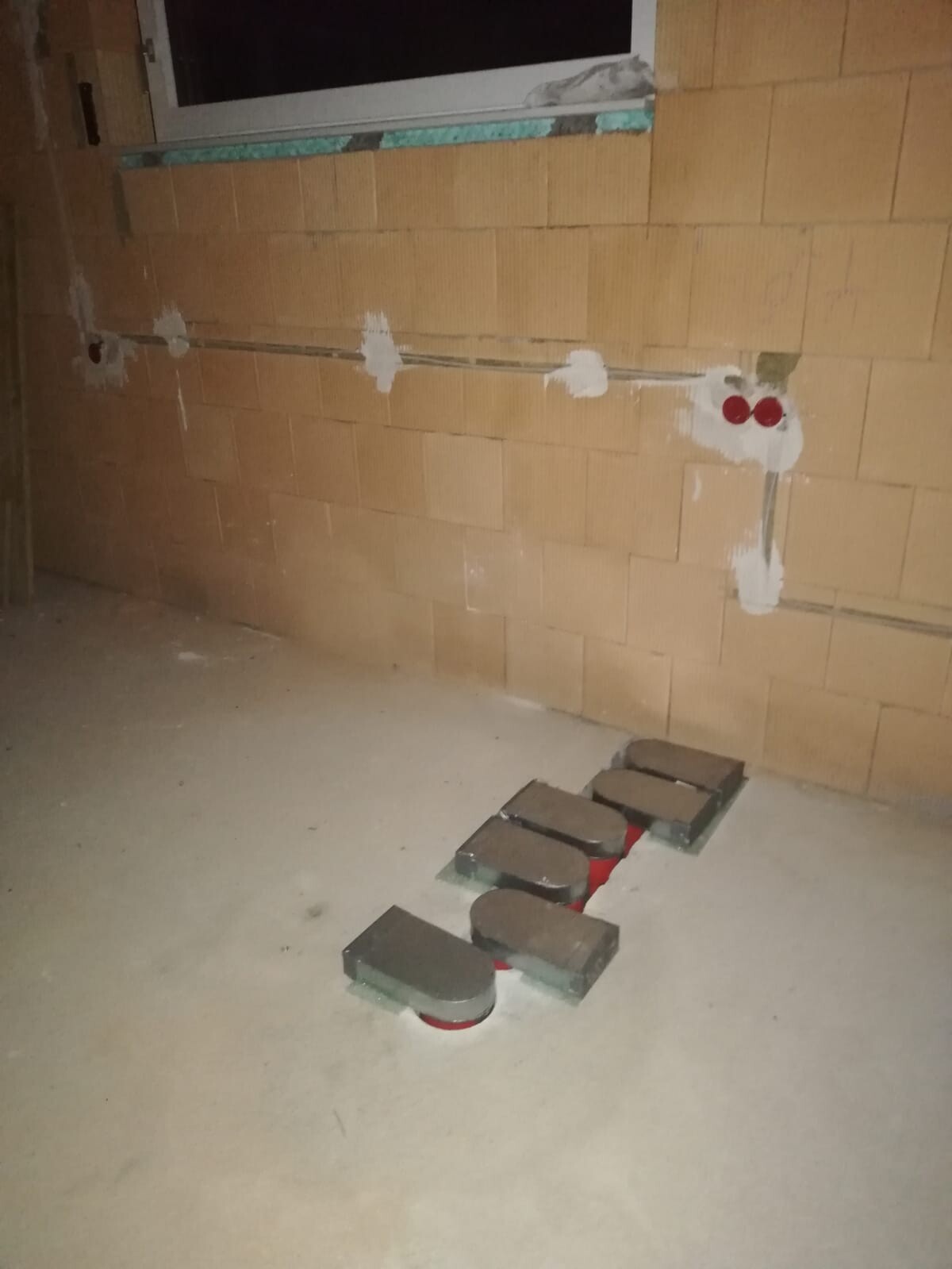
3. Is it necessary or usual to install 6 such pipes—and is it “no problem” if all of them run directly underneath my bed? This can be seen in the second picture, where our bed is located.
I would appreciate some brief feedback and, if possible, pictures of your controlled residential ventilation installations.
We have not dealt with the rough installation at all and would like to gather some information from other sources before discussing again with our installer.
Thanks in advance!
we have decided on a central controlled residential ventilation system for our new build.
The rough installation is now complete.
We did not interfere beforehand and trusted our installer.
However, we now have a few questions to better understand the setup and would also appreciate a brief confirmation on whether the installation was carried out correctly, if it can be done this way, or if there are alternative options.
--> The system is located in the laundry room because the technical room, due to the kitchen above, was not suitable for it (according to the installer).
So, we chose to separate the ventilation system and the air-to-water heat pump.
1. Is this feasible? Can the devices still communicate with each other (important for BAFA funding)? So far, I have not seen any wired connection between the two rooms (the rough installation has been completed since yesterday evening).
Unfortunately, I don’t have a picture of the laundry room at the moment, but logically the pipes come out of the ceiling in the basement in the same arrangement.
2. How should the piping be installed? Are additional pipes laid on the floor from the respective pipe outlets, possibly together with the underfloor heating pipes? These would then connect to the respective connection points (we have ventilation outlets either at the ceiling or high up on the wall).
3. Is it necessary or usual to install 6 such pipes—and is it “no problem” if all of them run directly underneath my bed? This can be seen in the second picture, where our bed is located.
I would appreciate some brief feedback and, if possible, pictures of your controlled residential ventilation installations.
We have not dealt with the rough installation at all and would like to gather some information from other sources before discussing again with our installer.
Thanks in advance!

1. Which devices are being used?
2. I see you managed to get someone who really knows how to work with metal ducts and actually uses them.
Yes, you are imagining it correctly. Flat ducts will be installed on the hoods leading to the respective vents. Next to them, there will be electrical wiring and water pipes, followed by insulation and impact sound insulation mats, and only then the underfloor heating and screed.
3. It is probably necessary because you chose this type of installation in the laundry room. The 6 pipes are most likely there to save space and avoid building height increases. At the same time, this also reduces noise levels. You shouldn’t hear anything later on.
2. I see you managed to get someone who really knows how to work with metal ducts and actually uses them.
Yes, you are imagining it correctly. Flat ducts will be installed on the hoods leading to the respective vents. Next to them, there will be electrical wiring and water pipes, followed by insulation and impact sound insulation mats, and only then the underfloor heating and screed.
3. It is probably necessary because you chose this type of installation in the laundry room. The 6 pipes are most likely there to save space and avoid building height increases. At the same time, this also reduces noise levels. You shouldn’t hear anything later on.
Mycraft schrieb:
1. What equipment is being used?
2. I see you got one of the better ones who knows about sheet metal ducts and uses them.
Yes, you imagine it correctly. Flat ducts will be connected to the hoods, leading to the respective valves. Next to them will be electrical wiring and water pipes, then insulation and impact sound mats, followed by underfloor heating and screed.
3. It’s probably necessary because you chose that type of installation in the laundry room. The six pipes are most likely there to save space and avoid installation height issues. At the same time, this also reduces noise. You shouldn’t hear anything later on. Thanks for your answer – that reassures me for now!!! 🙂
Regarding 1.
Air-to-water heat pump designed for indoor installation, Tecalor TTL 9.5.
Unfortunately, I can’t tell you the exact ventilation system model right now! It’s also from Tecalor – it’s already installed in the basement, but I don’t have the paperwork handy. I even wanted to set on a specific model back then (although that was already six months ago… xD).
What’s important for the BaFa subsidy is the combined control – that is still worrying us. It seems neither the general contractor nor the installer cared much about this… Now we are seeing the “consequences.”
Nevertheless, we were smart enough to have everything documented clearly in the construction and service specifications, so nobody can come back at us later. The subsidy application, including the ventilation system, was submitted through the general contractor. I just hope that coordinating this communication is still fairly straightforward – even now!
Do you know if this is relatively easy to set up? On the internet I read the following:
"Subsidy also for ventilation unit
Basically, the current BaFa subsidy is intended for heating heat pumps. However, if the heat pump and ventilation unit are controlled together via the heat pump controller, the entire system is subsidized. By coupling the devices, various functions of the ventilation units (including intensive ventilation) can be activated via the heat pump control. Eligible costs include not only the devices themselves but also the distribution system, installation, and other related measures. A good combination with an eligible Stiebel Eltron heat pump is, for example, the manufacturer’s central ventilation unit LWZ 180/280."
D
Deliverer22 Dec 2021 11:09If LAN sockets are installed near both devices, a common control should not be a problem. In an emergency, other bus systems can also be connected via the cable.
By the way, the control is really only important for the Bafa. During operation, the devices are completely independent. Any communication can only reduce efficiency.
By the way, the control is really only important for the Bafa. During operation, the devices are completely independent. Any communication can only reduce efficiency.
Prager91 schrieb:
1. Is this feasible? Can the devices still communicate with each other (important for BaFa funding)? So far, I have not been able to detect any wired connection between the two rooms (the rough installation has been completed since yesterday evening).
Hello!
BaFa requires an existing "communication" between the heating system and the ventilation unit. This is a condition for funding.
How this communication is implemented in your case, you need to discuss with the installer or make sure to check.