
Hello everyone,
My wife and I recently purchased a subdivided existing plot of land. The plot is 450 square meters (4,844 square feet) and is located in the southern Rhine-Main area.
We would of course like to start building on the plot as soon as possible, but we still need to connect the plot to utilities, and these costs must be included in our financing.
The connection costs will be significantly higher than usual, so we are considering how to approach this most effectively and cost-efficiently.
Currently, the following service lines would need to be installed with the approximate lengths:
- Potable water: about 56 meters (185 feet)
- Wastewater/sewer: about 6 meters (20 feet)
- Electricity: about 25 meters (82 feet)
- Telecommunications: about 25 meters (82 feet)
- Gas: about 25 meters (82 feet) — which we would likely not install due to our plan to use a heat pump as the heating system.
Before purchasing, we spoke with the authorities and obtained rough cost estimates. We expect the total for a “standard” connection to public utility networks to be around €70,000. The main cost driver will be the potable water line, estimated at around €40,000 to €50,000 because of the 56-meter length. Our question is, how can we reduce these costs?
Idea 1: Connect to the potable water supply through the neighboring plot. We have not yet spoken to the neighbors, but the authorities informed us that about three years ago they connected to their other neighbor’s supply. The complexity and costs of the potable water connection should be known to them and perhaps they would be open to this.
Idea 2: A well plus filtration system. This is known in technical terms as a domestic well or small installation for self-supply. Has anyone here had experience with a domestic well? We are aware that this entails certain obligations under drinking water regulations. Unfortunately, there is little information about this topic online. Based on my research, a filtration system costs between €8,000 and €15,000. On top of that comes the well drilling. I estimate that everything could be done for about €20,000, which is only half the price of connecting to the public water supply. The savings would allow me to send many water samples for testing.
I would appreciate any further ideas or information.
Regards,
Jochen
My wife and I recently purchased a subdivided existing plot of land. The plot is 450 square meters (4,844 square feet) and is located in the southern Rhine-Main area.
We would of course like to start building on the plot as soon as possible, but we still need to connect the plot to utilities, and these costs must be included in our financing.
The connection costs will be significantly higher than usual, so we are considering how to approach this most effectively and cost-efficiently.
Currently, the following service lines would need to be installed with the approximate lengths:
- Potable water: about 56 meters (185 feet)
- Wastewater/sewer: about 6 meters (20 feet)
- Electricity: about 25 meters (82 feet)
- Telecommunications: about 25 meters (82 feet)
- Gas: about 25 meters (82 feet) — which we would likely not install due to our plan to use a heat pump as the heating system.
Before purchasing, we spoke with the authorities and obtained rough cost estimates. We expect the total for a “standard” connection to public utility networks to be around €70,000. The main cost driver will be the potable water line, estimated at around €40,000 to €50,000 because of the 56-meter length. Our question is, how can we reduce these costs?
Idea 1: Connect to the potable water supply through the neighboring plot. We have not yet spoken to the neighbors, but the authorities informed us that about three years ago they connected to their other neighbor’s supply. The complexity and costs of the potable water connection should be known to them and perhaps they would be open to this.
Idea 2: A well plus filtration system. This is known in technical terms as a domestic well or small installation for self-supply. Has anyone here had experience with a domestic well? We are aware that this entails certain obligations under drinking water regulations. Unfortunately, there is little information about this topic online. Based on my research, a filtration system costs between €8,000 and €15,000. On top of that comes the well drilling. I estimate that everything could be done for about €20,000, which is only half the price of connecting to the public water supply. The savings would allow me to send many water samples for testing.
I would appreciate any further ideas or information.
Regards,
Jochen

Before diving into similar threads, you might want to first provide some pictures to show exactly which situation is being discussed here.
https://www.instagram.com/11antgmxde/
https://www.linkedin.com/company/bauen-jetzt/
https://www.instagram.com/11antgmxde/
https://www.linkedin.com/company/bauen-jetzt/
K
karl.jonas29 Nov 2021 20:58We have a domestic well with a filtration system. In the medium term, I plan to replace it with a connection to the public water supply about 1.5 km (1 mile) long. The reason is that our groundwater contains high levels of iron and manganese, and the filtration technology (for small systems) is ineffective. Over 15 years, we have gone through three filtration systems using different methods. There was no support from the authorities, and the system installers mostly worked by trial and error. We used systems with backflushing using potassium permanganate (poor results) or salt (better). The good news: the equipment costs alone were between 3,000 and 4,000 euros. I would only consider building a private well if I first knew the quality of the groundwater. By the way, drilling (40 m (130 ft) into rock) cost around 6,000 euros at that time.
Why is your water line so expensive? Are you required to allow city contractors to do the work? Digging 56 m (184 ft) frost-free trench and laying the pipe should be significantly cheaper if done by a contractor you select yourself.
If you have to lay your water line along the street: I have an agreement with the local energy provider (RWE) that I can install my water line when they next lay power lines (scheduled within the next three years).
Why is your water line so expensive? Are you required to allow city contractors to do the work? Digging 56 m (184 ft) frost-free trench and laying the pipe should be significantly cheaper if done by a contractor you select yourself.
If you have to lay your water line along the street: I have an agreement with the local energy provider (RWE) that I can install my water line when they next lay power lines (scheduled within the next three years).
H
hampshire29 Nov 2021 21:29jopfadle schrieb:
The question we are asking ourselves is: how can we reduce the costs here?The better you coordinate the contractors, the less often the road has to be opened and closed for you. That can really save money. The rest simply costs what it costs. We managed with just one road opening for fresh water, wastewater, electricity, and communication.Hello everyone,
Thank you very much for the posts and the information about the house well.
Attached is a picture of the utility provider responsible for electricity and gas in our area. Water and sewage are operated by the city itself.
We own plot 324/4. The previous building has already been removed, in case that question comes up.
The house on plot 323/1 is also relatively "new." They have been supplied with fresh water through the neighbor at house 323/3. This neighbor, in turn, is directly connected to the main road above, which is no longer visible in the section shown. Plot 323/3 is a corner plot at the intersection of the main road and Am Heimgesberg street.
If we carry out a regulated infrastructure connection, as is typically provided by the city, the entire Am Heimgesberg street would have to be excavated to install the fresh water line (56 meters (185 feet)).
Electricity is already extended up to plot 323/1, as shown in the pictures. Therefore, about 20 to 25 meters (65 to 82 feet) are missing, which could be installed at the same time if the street is already open.
The sewage line, however, comes from below (plot 324/3) and would need to be extended by about 6 meters (20 feet).
Am Heimgesberg street has a slight gradient running from south to north. It should not be more than 1 to 2%. Therefore, a pumping station or similar should not be an issue. The wastewater will naturally flow downhill, and the fresh water will come from uphill as well.
When we made our inquiry, the utility company was already aware of the issue because the homeowners of plot 323/1 apparently had problems during infrastructure connection. I do not know the exact details, but since Am Heimgesberg street is the main access and exit road of the community leading to the federal highway and no lines are installed there, it seems unusual. I assume the homeowners (plot 323/1) were surprised a few years ago during construction and had not dealt with the topic in detail beforehand.
Perhaps because of the "unusual" conditions in the street, the city might be willing to let us carry out the installation through a contractor of our choice.
According to city regulations = YES
Are there any benchmark values for this? I read something like 1000€ per meter, but that was for a shorter distance of about 5 to 10 meters (16 to 33 feet).
I am aware of that, which is why I want to create a detailed plan now before approaching the utility company.
Best regards
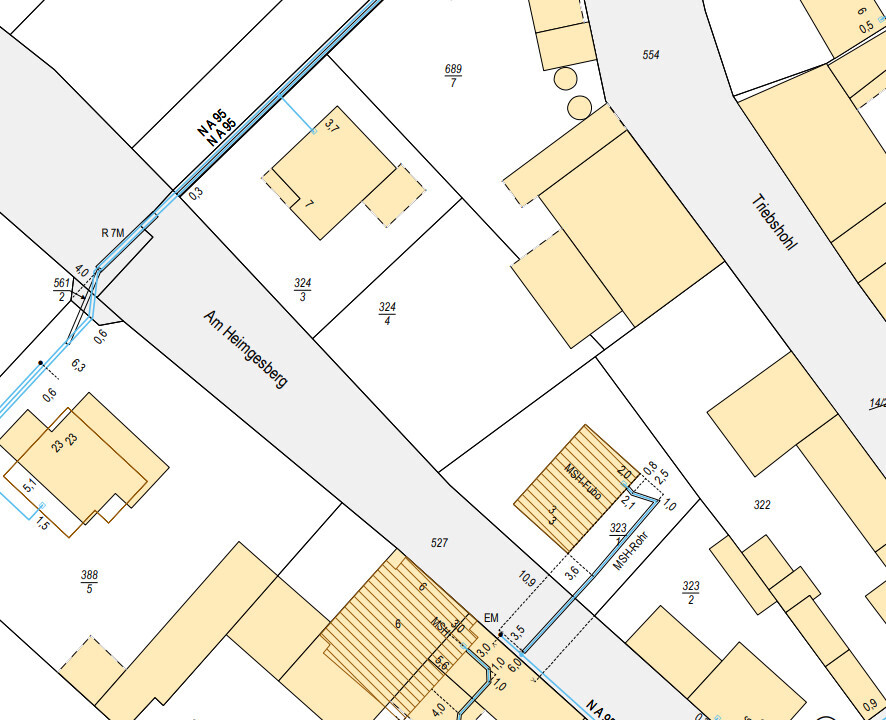
Thank you very much for the posts and the information about the house well.
Attached is a picture of the utility provider responsible for electricity and gas in our area. Water and sewage are operated by the city itself.
We own plot 324/4. The previous building has already been removed, in case that question comes up.
The house on plot 323/1 is also relatively "new." They have been supplied with fresh water through the neighbor at house 323/3. This neighbor, in turn, is directly connected to the main road above, which is no longer visible in the section shown. Plot 323/3 is a corner plot at the intersection of the main road and Am Heimgesberg street.
If we carry out a regulated infrastructure connection, as is typically provided by the city, the entire Am Heimgesberg street would have to be excavated to install the fresh water line (56 meters (185 feet)).
Electricity is already extended up to plot 323/1, as shown in the pictures. Therefore, about 20 to 25 meters (65 to 82 feet) are missing, which could be installed at the same time if the street is already open.
The sewage line, however, comes from below (plot 324/3) and would need to be extended by about 6 meters (20 feet).
Am Heimgesberg street has a slight gradient running from south to north. It should not be more than 1 to 2%. Therefore, a pumping station or similar should not be an issue. The wastewater will naturally flow downhill, and the fresh water will come from uphill as well.
When we made our inquiry, the utility company was already aware of the issue because the homeowners of plot 323/1 apparently had problems during infrastructure connection. I do not know the exact details, but since Am Heimgesberg street is the main access and exit road of the community leading to the federal highway and no lines are installed there, it seems unusual. I assume the homeowners (plot 323/1) were surprised a few years ago during construction and had not dealt with the topic in detail beforehand.
Perhaps because of the "unusual" conditions in the street, the city might be willing to let us carry out the installation through a contractor of our choice.
karl.jonas schrieb:
Why is your water line so expensive? Are you forced to have the city do the work?
According to city regulations = YES
karl.jonas schrieb:
Digging frost-free 56 meters (185 feet) and laying the line should be significantly cheaper if done by a contractor of your choice.
Are there any benchmark values for this? I read something like 1000€ per meter, but that was for a shorter distance of about 5 to 10 meters (16 to 33 feet).
hampshire schrieb:
The better you coordinate the service providers, the less often someone has to open and close the street for you. There’s something to that. The rest just costs what it costs. We managed with a single street opening for fresh water, sewage, electricity, and communications.
I am aware of that, which is why I want to create a detailed plan now before approaching the utility company.
Best regards
K
karl.jonas30 Nov 2021 00:40jopfadle schrieb:
Are there any standard reference values for this?A quick Google search shows costs ranging from 15 to 50 € per meter (approximately 16 to 54 USD per meter). But this is always for installation on private property. If the street needs to be excavated, the process is naturally much more complex.Similar topics