
ᐅ Basement for Utility Use: Insulation, Heating, Raising the Ceiling?
Created on: 18 Nov 2021 10:43
B
blubbernase
Hello,
We’re a bit overwhelmed and I’d like to organize my thoughts here and also hear other opinions. Unfortunately, our architect and basement builder haven’t been much help so far— all we get is “You need to know what you want.” Our building inspector won’t be back for another two weeks.
Let me start from the beginning:
Since our space requirements would exceed the allowable floor area ratio, we planned a partial basement outside the thermal envelope of our KfW55 house, intended for technical equipment, storage, and a small workout room. The basement is completely underground.
This was the initial plan (room layout is not final yet, please ignore):
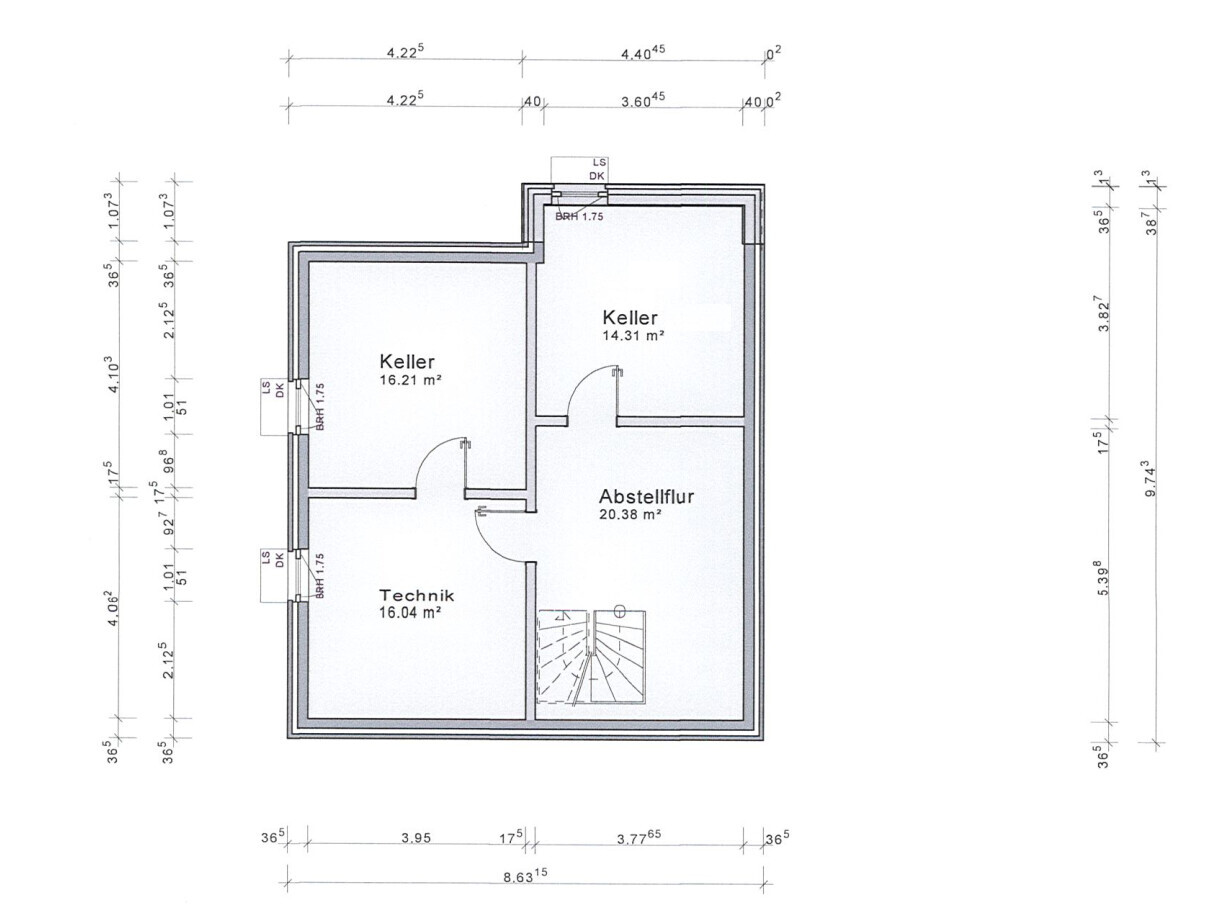
It then became clear that we would switch directly to the full basement, with the same specifications as the partial basement.
Well—suddenly we have much more space, and the workshop we had planned attached to the garage could fit inside the basement. This also makes an external basement entrance useful, as well as a possible living area where multimedia equipment could be set up or where kids could be noisy without disturbing others.
This brings up the question: Should we still leave everything uninsulated and unheated? We originally planned to install perimeter insulation ourselves, but the basement builder said doing it ourselves would affect the warranty. Now we have an offer for an insulated basement here, though the room layout is also not finalized...
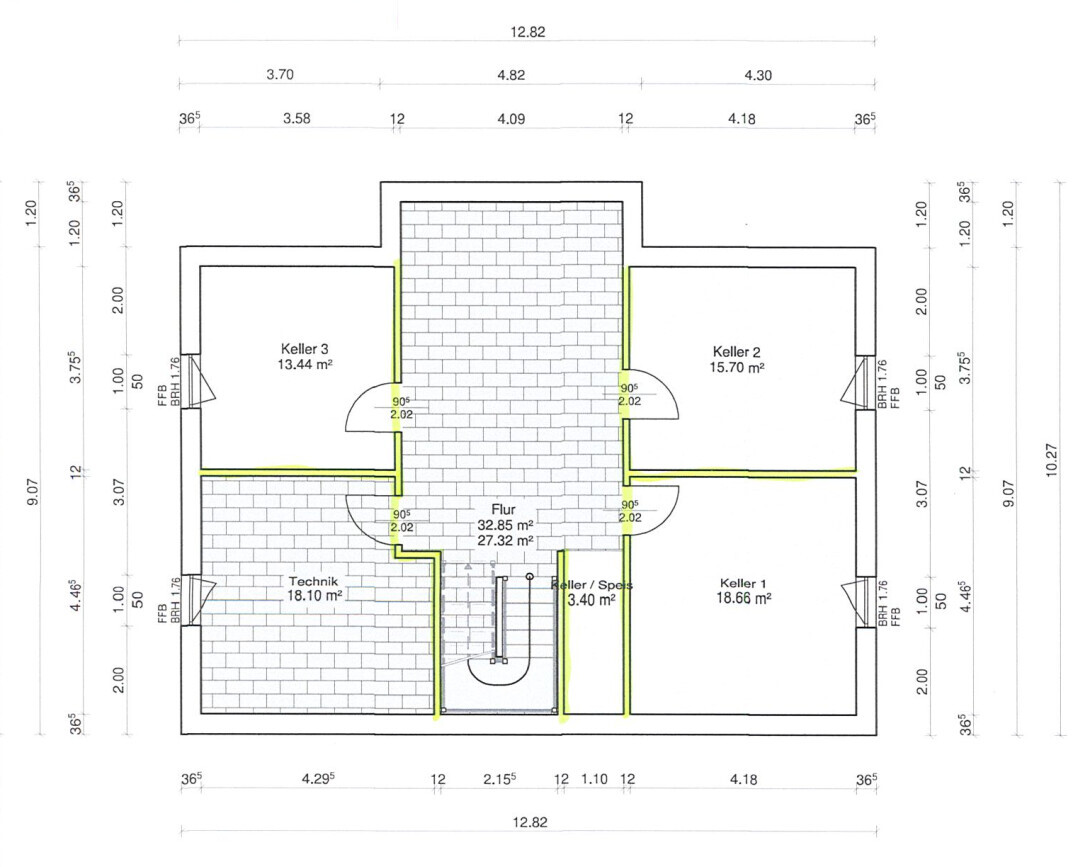
If we choose insulation below the basement slab, a separation within the thermal envelope is no longer necessary, and the interior basement stairs would not need to be closed off and insulated for the KfW standard.
The remaining question concerns heating. The basement builder insists on underfloor heating, but that seems oversized to me because the basement will be used too infrequently: the technical room doesn’t need heating, and for the few hours per month spent in the workshop or workout room, an infrared heater might be sufficient? In my current workout room, which is uninsulated and has two exterior walls, temperatures range between 16 and 19°C (61 and 66°F), which is completely fine. However, that room adjoins heated and insulated interior rooms.
I just don’t know what the best solution is for KfW standards and what actually makes sense. Off the top of my head, I’d say:
- Choose insulated walls with core insulation but without insulation under the basement slab
- Keep the interior basement stairs insulated
- In rooms that will be used more often, plan for infrared heaters (or similar) — right now, our workshop is in the garage, and my wife, the main user, just wears a thick sweater
Bonus question: External basement entrance— is the investment worth it? I haven’t yet received a formal offer but have heard a ballpark figure of €7,000 to €10,000.
That’s where we stand now. Any opinions?
We’re a bit overwhelmed and I’d like to organize my thoughts here and also hear other opinions. Unfortunately, our architect and basement builder haven’t been much help so far— all we get is “You need to know what you want.” Our building inspector won’t be back for another two weeks.
Let me start from the beginning:
Since our space requirements would exceed the allowable floor area ratio, we planned a partial basement outside the thermal envelope of our KfW55 house, intended for technical equipment, storage, and a small workout room. The basement is completely underground.
This was the initial plan (room layout is not final yet, please ignore):
- Room height 2.25m (7 ft 5 in)
- Technical room downstairs
- Basement exterior walls: The exterior walls are prefabricated double-shell concrete elements, C25/30, wall thickness 36.5 cm (14 in), including built-in reinforcement. The cavity between the elements is filled with ready-mixed concrete on site.
- Uninsulated
- Unheated
- Water exposure class W 1.1-E (groundwater is at 30 meters (100 ft) depth here)
- Interior insulated basement stairs
- Price: approximately €66,500
It then became clear that we would switch directly to the full basement, with the same specifications as the partial basement.
Well—suddenly we have much more space, and the workshop we had planned attached to the garage could fit inside the basement. This also makes an external basement entrance useful, as well as a possible living area where multimedia equipment could be set up or where kids could be noisy without disturbing others.
This brings up the question: Should we still leave everything uninsulated and unheated? We originally planned to install perimeter insulation ourselves, but the basement builder said doing it ourselves would affect the warranty. Now we have an offer for an insulated basement here, though the room layout is also not finalized...
- Room height 2.40m (7 ft 10 in)
- Technical room downstairs
- Insulation under basement slab (€5,605)
- 120 mm (5 inches) load-bearing perimeter insulation (XPS) below the basement slab
- 120 mm (5 inches) perimeter insulation (XPS) single-layer on the front edge in the base area
- Basement exterior walls with core insulation, 120 mm (5 inches) thick. U-value: 0.25 W/m²K. The exterior walls are made of C25/30 concrete, wall thickness about 36.5 cm (14 in), including built-in reinforcement; wall construction as shown
- Water exposure class W 1.1-E
- Price: €96,800
If we choose insulation below the basement slab, a separation within the thermal envelope is no longer necessary, and the interior basement stairs would not need to be closed off and insulated for the KfW standard.
The remaining question concerns heating. The basement builder insists on underfloor heating, but that seems oversized to me because the basement will be used too infrequently: the technical room doesn’t need heating, and for the few hours per month spent in the workshop or workout room, an infrared heater might be sufficient? In my current workout room, which is uninsulated and has two exterior walls, temperatures range between 16 and 19°C (61 and 66°F), which is completely fine. However, that room adjoins heated and insulated interior rooms.
I just don’t know what the best solution is for KfW standards and what actually makes sense. Off the top of my head, I’d say:
- Choose insulated walls with core insulation but without insulation under the basement slab
- Keep the interior basement stairs insulated
- In rooms that will be used more often, plan for infrared heaters (or similar) — right now, our workshop is in the garage, and my wife, the main user, just wears a thick sweater
Bonus question: External basement entrance— is the investment worth it? I haven’t yet received a formal offer but have heard a ballpark figure of €7,000 to €10,000.
That’s where we stand now. Any opinions?

Fuchur schrieb:
Just checked the data: Outside temperature 1.1°C (34°F), supply air 16.1°C (61°F), basement 18.4°C (65°F). Yes, there is some heat loss, but at least regarding humidity there is no problem. On the contrary, I am removing moisture—and at the same time using the waste heat from the mechanical room in the basement. Just to make sure we are on the same page: it is clear that the mechanical ventilation with heat recovery unit can be installed in the basement, as well as the ductwork for outside and exhaust air. But an uninsulated and unheated basement outside the building envelope, and still having the house’s ventilation supply and exhaust air also running through that basement? Personally, I wouldn’t dare to do that...
Our mechanical ventilation system is located in the attic. All basement rooms are connected to supply or exhaust air ducts. The basement hallway is part of the thermal envelope due to the open stairwell. Otherwise, there is only perimeter insulation on the outside, which I believe is 10cm (4 inches), and Styrofoam insulation under the screed; there is no insulation beneath the floor slab. In the largest room, we even installed underfloor heating, which is used occasionally as needed.
What are you worried about? I don’t want to rule out that heat losses could cause issues when aiming for standards like KFW-40 or similar, but we built according to the regular energy saving ordinance.
What are you worried about? I don’t want to rule out that heat losses could cause issues when aiming for standards like KFW-40 or similar, but we built according to the regular energy saving ordinance.
B
blubbernase25 Nov 2021 10:18Fuchur schrieb:
Oh dear, I’ve just had my own experience with Gussek Haus regarding building services, and we canceled our construction contract after six months. I hope you have better luck. Oh wow, would you like to share more details? I need to take a closer look at this topic myself.I can do that gladly, but not publicly in the forum. If you have specific questions, just send me a message.
An example:
We wanted a KNX installation. The planning was all completed, the room layout was set, it was basically just a matter of running the correct cables to the right places. After weeks of discussions, there was a conference call between the electrician, the "salesperson," and the planning department that lasted a full four hours—without me, mind you. The result: They literally told me, "We don’t really know exactly what you want, but we can say for sure that the wiring alone will cost at least €50,000 (about $55,000) extra, not including the technology. And we’d have to do planning with the electrician here with you for that, which we estimate will take 5 days billed at €1,000 (about $1,100) per day."
In other words: We can’t do it, but the company philosophy is to make everything possible. We just have to make sure the customer voluntarily doesn’t want it anymore.
We were only able to get out of the construction contract because we had a self-formulated cancellation clause included in the contract. Shortly after confirming the termination, our local salesperson was no longer working for Gussek Haus...
An example:
We wanted a KNX installation. The planning was all completed, the room layout was set, it was basically just a matter of running the correct cables to the right places. After weeks of discussions, there was a conference call between the electrician, the "salesperson," and the planning department that lasted a full four hours—without me, mind you. The result: They literally told me, "We don’t really know exactly what you want, but we can say for sure that the wiring alone will cost at least €50,000 (about $55,000) extra, not including the technology. And we’d have to do planning with the electrician here with you for that, which we estimate will take 5 days billed at €1,000 (about $1,100) per day."
In other words: We can’t do it, but the company philosophy is to make everything possible. We just have to make sure the customer voluntarily doesn’t want it anymore.
We were only able to get out of the construction contract because we had a self-formulated cancellation clause included in the contract. Shortly after confirming the termination, our local salesperson was no longer working for Gussek Haus...

Fuchur schrieb:
Our mechanical ventilation system with heat recovery is located in the attic. All basement rooms are connected to supply or exhaust air. The basement hallway is part of the thermal envelope because of the open staircase. [...], we built according to the standard energy-saving regulations. When it comes to energy-saving regulations, connecting a cold cellar to the shared mechanical ventilation system is a private decision – in the higher KfW efficiency classes, I would expect (with or without heat recovery) two separate mechanical ventilation circuits.
https://www.instagram.com/11antgmxde/
https://www.linkedin.com/company/bauen-jetzt/
Fuchur schrieb:
There is only perimeter insulation on the outside, I believe 10cm (4 inches), and the polystyrene insulation under the screed, but no insulation under the concrete slab. In the largest room, we even had underfloor heating installed, which is only activated when needed.Fuchur schrieb:
Just checked the data: outside temperature 1.1°C (34°F), supply air 16.1°C (61°F), basement 18.4°C (65°F). Yes, some heat is lost, but at least regarding moisture, there is no problem. On the contrary, I am removing moisture – and at the same time using the waste heat from the mechanical room in the basement.Your setup and the 18.4°C (65°F) basement temperature clearly indicate that it is not uninsulated and unheated. I have no idea how @blubbernase will ultimately decide, but if it will be a purely utility basement without perimeter insulation, without insulation under the concrete slab or screed, and without heating, I would have concerns about condensation moisture on cold basement walls during summer. Ignoring influences and possible requirements related to KfW standards.
11ant schrieb:
From my point of view, this only implies that the controlled mechanical ventilation systems for the basement and living areas should be separated, meaning installing two central controlled mechanical ventilation systems in the house.Yes, that is certainly an option. In my opinion, though, it is using a sledgehammer to crack a nut. For ventilation with moisture protection, the mentioned Maico AKE units are probably the more practical solution.
Similar topics