
ᐅ Fireplace and Underfloor Heating – Is Forced Air or Heat Storage More Efficient?
Created on: 21 Nov 2021 17:36
E
erazorlll
Hello dear forum members,
We have planned a masonry fireplace as a divider between the living room and dining room in our new build.
=> Link to the planning thread
(the planned fireplace extends further into the room, unlike the current layout)
The primary goal is purely aesthetic (fire) and creating a cozy atmosphere. Heating is secondary since we have underfloor heating. Additionally, there is a controlled ventilation system. I am aware of the cost versus benefit issue and that this is purely a luxury feature.
The room where the stove will be installed is approximately 50m² (540 sq ft) with large windows.
I have repeatedly read about overheating problems in rooms when the stove is oversized or when there is simultaneous underfloor heating. Opening a window to compensate doesn’t really make sense.
I have now received two offers from stove builders, but they gave me different advice and would construct the fireplace differently.
Option 1: 12 kW as a convective fireplace (air intake, passing by the stove to be heated, then released back into the room) plus firebrick (refractory brick) storage.
Option 2: 11 kW as a storage fireplace with firebricks, without any convective air circulation.
Both fireplaces seem quite powerful at 11 and 12 kW. I raised the issue of overheating with both providers.
Option 1 says that with the air circulation, the room can heat up quickly when the outside temperature drops and the underfloor heating can’t keep up fast enough. The storage bricks would then release heat after the fire goes out. Without the convective air, the fireplace would be ineffective because it would take too long to warm up. Overheating is not a problem.
Option 2 says the underfloor heating is sufficient to heat the room, so a convective system would heat the room too quickly and cause overheating. The storage fireplace would deliver heat slowly and evenly, helping to prevent overheating. The glass door of the fireplace provides enough heat for short-term needs, so no additional convective air is required.
Now I wonder: who is correct, or which solution is more reasonable?
Thank you for your assessment and help.
We have planned a masonry fireplace as a divider between the living room and dining room in our new build.
=> Link to the planning thread
(the planned fireplace extends further into the room, unlike the current layout)
The primary goal is purely aesthetic (fire) and creating a cozy atmosphere. Heating is secondary since we have underfloor heating. Additionally, there is a controlled ventilation system. I am aware of the cost versus benefit issue and that this is purely a luxury feature.
The room where the stove will be installed is approximately 50m² (540 sq ft) with large windows.
I have repeatedly read about overheating problems in rooms when the stove is oversized or when there is simultaneous underfloor heating. Opening a window to compensate doesn’t really make sense.
I have now received two offers from stove builders, but they gave me different advice and would construct the fireplace differently.
Option 1: 12 kW as a convective fireplace (air intake, passing by the stove to be heated, then released back into the room) plus firebrick (refractory brick) storage.
Option 2: 11 kW as a storage fireplace with firebricks, without any convective air circulation.
Both fireplaces seem quite powerful at 11 and 12 kW. I raised the issue of overheating with both providers.
Option 1 says that with the air circulation, the room can heat up quickly when the outside temperature drops and the underfloor heating can’t keep up fast enough. The storage bricks would then release heat after the fire goes out. Without the convective air, the fireplace would be ineffective because it would take too long to warm up. Overheating is not a problem.
Option 2 says the underfloor heating is sufficient to heat the room, so a convective system would heat the room too quickly and cause overheating. The storage fireplace would deliver heat slowly and evenly, helping to prevent overheating. The glass door of the fireplace provides enough heat for short-term needs, so no additional convective air is required.
Now I wonder: who is correct, or which solution is more reasonable?
Thank you for your assessment and help.
Snowy36 schrieb:
On the one hand, it’s true that during the transitional season the underfloor heating just can’t keep up… It simply senses that it’s still too warm outside to turn on, and then when it finally does start, it takes some time to warm everything up. During that time, as a woman, I was freezing my backside off. That’s unfortunate. Don’t you have a control that lets you switch the heating on manually? Like a little kick in the pants?
Snowy36 schrieb:
I do find the thermal storage bricks useful because they absorb some of the heat. Do they absorb or take away heat? (Serious question)
Snowy36 schrieb:
On the one hand, it’s just the case that during the transitional season the underfloor heating can't keep up… It simply detects that it’s still too warm outside to switch on, and when it finally does, it takes some time to heat everything up—in that time, as a woman, I was freezing my butt off. Just turn on the stove, and that’s it.Then you just have to set the heating properly.E
erazorlll22 Nov 2021 09:21Benutzer200 schrieb:
If it’s just about appearance, then at most a convection system and preferably no heat-retaining bricks.
We had a see-through stove with more output, but also a 75sqm (800 sq ft) living/dining area. Fire on, temperature slightly up (max. +3°C (5°F) in the evening), most of the heat lost through the chimney. Everything relaxed.Serious question: shouldn’t a convection system actually make the room "warmer" than heat-retaining bricks?
I imagine it like this: the stove gets hot on the inside from the fire.
Convection variant: cold air from the room is drawn in, passed directly by the heat source, warmed, and then returned to the room. This heats the air relatively quickly—almost like putting a fan heater in the room. However, it cools down pretty quickly once the heat source (fire) is out.
Heat-retaining variant: the bricks start off cold or at room temperature. It takes some time for the bricks to warm up and they heat up slowly. This means heat is released gradually, until eventually the "full" temperature is reached. When the heat source is off, the bricks cool down slowly.
Or am I misunderstanding something here?
ypg schrieb:
We have 50sqm (540 sq ft) of living space with a large open space to the upper floor. With our 7 kW stove, we basically heat the whole house, all reachable rooms included. Because the stove is operated depending on the situation, you don’t really have to intervene much with the underfloor heating, so when it gets too warm during operation, you just briefly ventilate or go out to the terrace. Your room is also closed off—you will open all the doors 😉What kind of stove do you have? Or which of the variants I described?
Snowy36 schrieb:
So, we have the second variant and are very satisfied with it.
On the one hand, during transition seasons the underfloor heating can’t keep up… It simply says it’s still too warm outside to turn on, and when it finally does, it takes a while to warm everything up—in that time, I’ve personally been freezing. Just turn on the stove and that’s it.
I do find the heat-retaining bricks very useful because they absorb some of the heat and prevent the room from suddenly reaching 800°C (1470°F).
My father has a regular Swedish stove in his KfW 55 house, and you can’t stand it when he lights it.Thanks for sharing your experience. What kind of stove do you have or how much output does it have?
Many thanks to everyone for your answers.
R
RotorMotor22 Nov 2021 09:2611kW is simply 11kW to start with, just to have a comparison, what is the output of your heating system?
B
Benutzer20022 Nov 2021 09:36erazorlll schrieb:
Serious question: shouldn’t circulating air actually warm the room more than thermal storage stones?It’s “just” a bit of air that’s drawn in at the bottom of the chimney and then directed past the firebox/ flue pipe, before returning to the room at the top (without a fan or anything similar). Most of the energy—heat—is lost through the chimney.Thermal storage stones, on the other hand, absorb a lot of heat and then release it slowly over a longer period. Additionally, the room is also warmed normally by the chimney.
So it’s like blowing warm air (which you can quickly lose again by simply opening a patio door) compared to a sort of second heating system (like underfloor heating when the screed is heated and then slowly releases warmth, versus a radiator that you turn on for a short time and then it cools down again).
As I said, we had the warm air system with—after checking—16 kW on a 75 m² (807 ft²) area. The heat output was quite moderate. An increase of 3°C (5°F) in the evening didn’t feel like “a sudden sauna.” Apart from the firebricks used as protection in the firebox, there were no thermal storage stones.
Hello,
we have also decided on a fireplace and consulted with a recommended stove builder, with whom we reached an agreement. We also discussed the issue of room overheating as well as the controlled ventilation system. The fireplace will definitely be smaller than yours. However, we will only have a 30sqm (320 square feet) living room and a semi-open kitchen of 15sqm (160 square feet). The fireplace will be lined with heat-retaining bricks. I will share the offer and a picture of the fireplace. The price is net. The gross amount is €7,500.
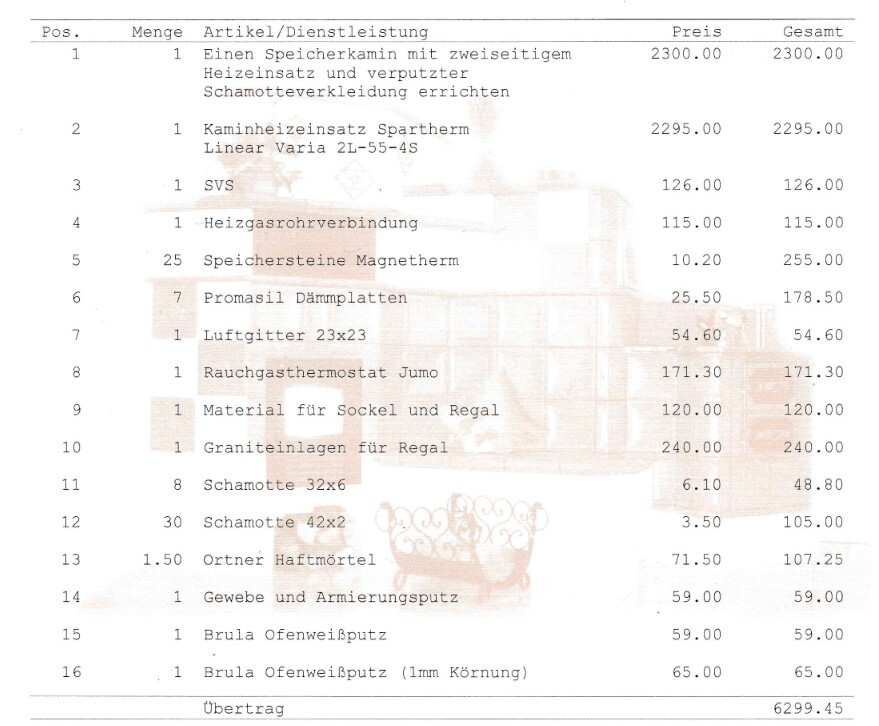
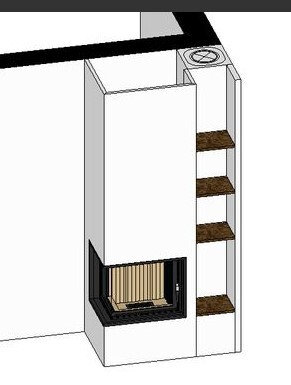
we have also decided on a fireplace and consulted with a recommended stove builder, with whom we reached an agreement. We also discussed the issue of room overheating as well as the controlled ventilation system. The fireplace will definitely be smaller than yours. However, we will only have a 30sqm (320 square feet) living room and a semi-open kitchen of 15sqm (160 square feet). The fireplace will be lined with heat-retaining bricks. I will share the offer and a picture of the fireplace. The price is net. The gross amount is €7,500.
Similar topics