
ᐅ Floor plan of a new rectangular bungalow with 130 m² of living space
Created on: 11 Oct 2021 20:42
R
Rampelzampel
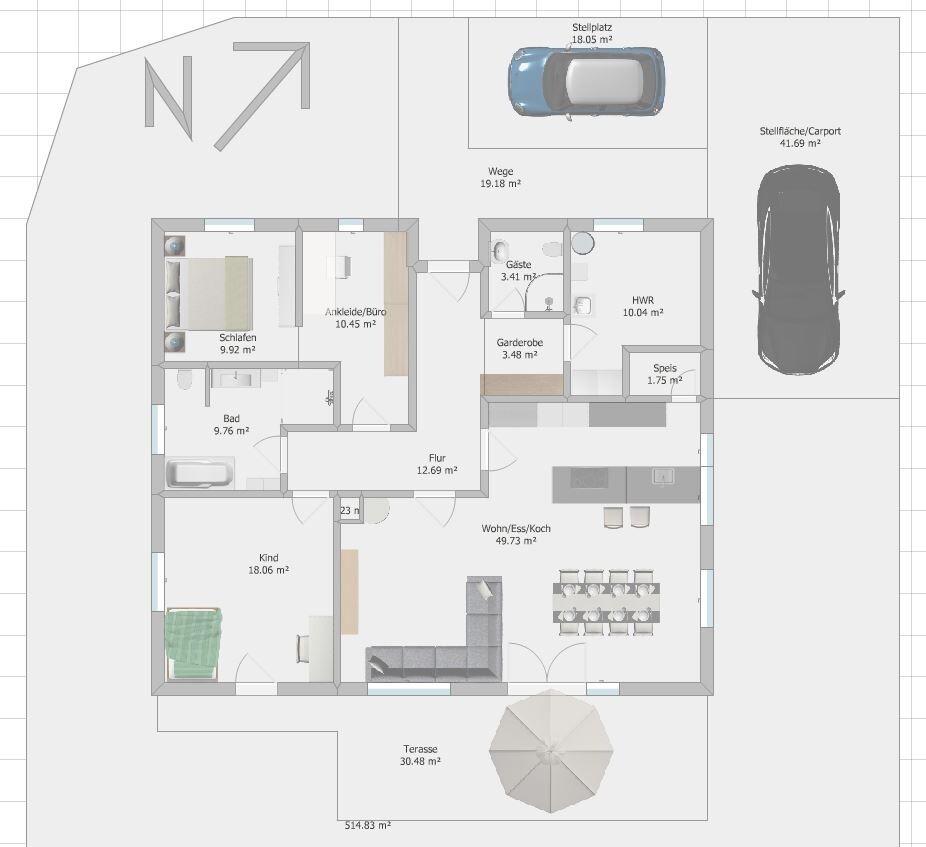
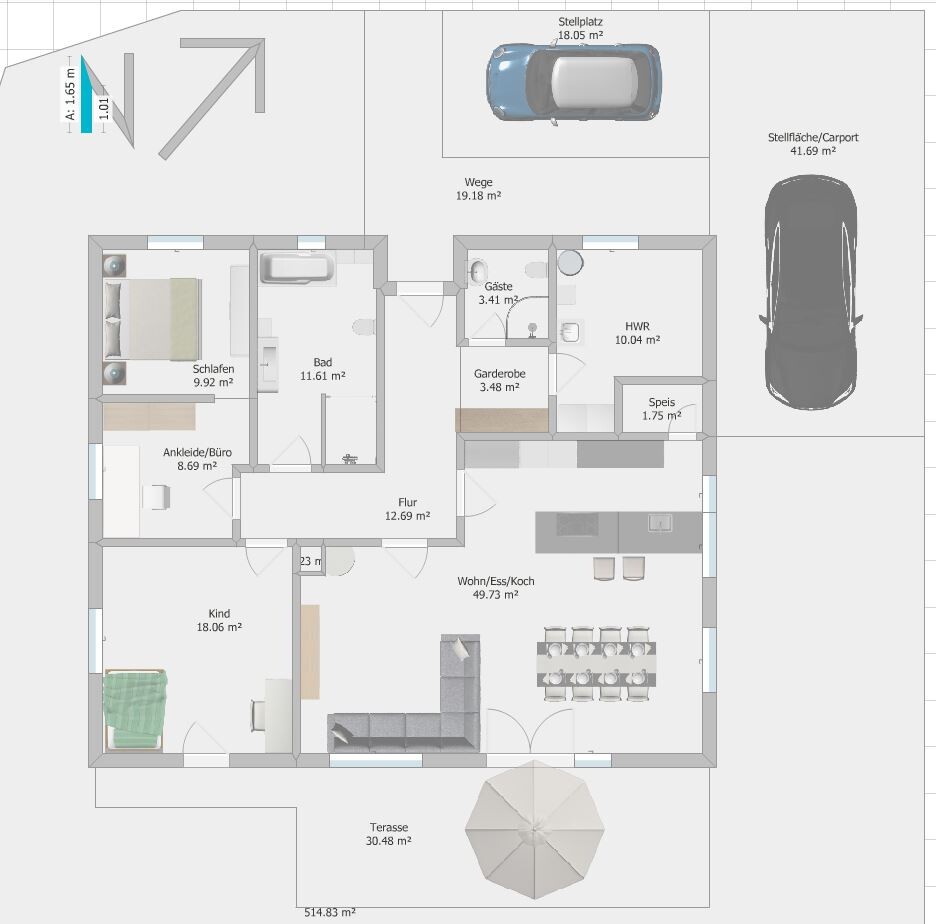
Hello, after just over a year I’m getting back in touch. Now, after many delays due to political issues and the pandemic, the development area is finally being prepared, and it should be possible to start building from March 22. Meanwhile, our desired child has arrived, and since we plan to have only one, one child’s bedroom will be enough for us.
Furthermore, we now prefer a bungalow instead of a 1.5-story house because the price is similar and we like having everything on one level better.
We will probably build with Town & Country since the company (the franchiser) is located directly in the town and has already built half of the houses in previous new developments here, as well as the house of good friends of ours. Based on conversations with residents so far, we have not heard any significant negative experiences (of course, there are always some minor issues).
Development Plan / Restrictions
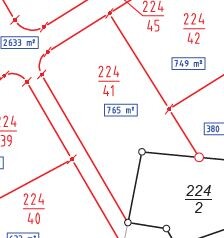
Plot size: 766m² (width at street 20.5m (67 ft 3 in)) / No. 28, drawing is oriented north, precise survey to be done soon
Slope: none
Site occupancy index: 0.4
Floor area ratio: II
Building envelope, building line, and boundaries
Edge development: no
Number of parking spaces: 2
Number of floors: up to 2 full stories
Roof type: gable or hip roof
Style: modern
Orientation:
Maximum heights/limits: ridge height 9.5m (31 ft 2 in), eaves height 6.5m (21 ft 4 in)
Other regulations: rainwater infiltration on site; internal walls mandatory
Homeowner Requirements
Style, roof type, building type: modern, bungalow, hip roof
Basement, floors: no basement
Number of residents, ages: 2 adults (28 and 34), 1 baby
Space requirement ground floor, upper floor: total about 130m² (1,399 sq ft)
Office: family use
Number of guest sleepers per year: 10
Open or closed layout: open living-dining area desired
Conservative or modern construction: modern
Open kitchen, cooking island: yes, would be nice but not essential
Number of dining seats: 6-8 (daily need 3-4)
Fireplace: yes
Music/speaker wall: no
Balcony, roof terrace: no
Garage, carport: 1 carport, 1 outdoor parking space
Kitchen garden, greenhouse: no
Other wishes/special features/daily routine, including reasons why this or that is preferred or excluded:
- Central ventilation system due to allergies
House Design
Designed by: combination of the builder and self-developed ideas
What do you particularly like? Why? The right side and the living/dining/kitchen area are quite appealing to me
What do you not like? Why? The left side with the child’s bedroom, bathroom, etc. could work but needs improvement; the child’s room should, if possible, be on the south side and be somewhat separate from ours, so the bathroom is currently planned in between
Estimated price according to architect/planner: 250,000
Personal price limit for the house including fixtures: 300,000
Preferred heating technology: gas + solar thermal
If you have to give up anything, which details or extensions
-Can you do without: pantry, possibly second shower in guest bathroom, L-shaped living/dining/kitchen area if not otherwise possible
-Can you not do without: walk-in closet/office, child’s room in the south - not directly next to the parents’ bedroom
Why is the design the way it is now?
At first, we had decided on an L-shaped bungalow, but since the extra cost compared to a simple rectangular shape was very high, we reconsidered what we actually need, studied other floor plans, and finally settled on this one. However, having been away from the topic for over a year because it looked like the development might not happen, this is now the first layout out of many we’ve drawn that we generally like. Unfortunately, we’ve only been able to visit two model bungalows, both somewhat smaller.
According to Town & Country, 17.5cm (7 inches) interior walls are now mandatory for bungalows due to previous cracking issues. Therefore, all interior walls in the plan are 17.5cm, and the exterior walls are currently planned at 30cm (12 inches). I am still considering increasing them to 36.5cm (14 inches) or 42.5cm (17 inches) but am unsure whether that would be worthwhile.
Since the tool used does not provide free dimensioning, here are the rough basic dimensions: 13.5m (44 ft 3 in) wide at the street side at the front and 11.1m (36 ft 5 in) deep. I will try another tool with dimensioning in the coming days, but for rough planning this should do for now.
Thanks in advance for your help.
Furthermore, we now prefer a bungalow instead of a 1.5-story house because the price is similar and we like having everything on one level better.
We will probably build with Town & Country since the company (the franchiser) is located directly in the town and has already built half of the houses in previous new developments here, as well as the house of good friends of ours. Based on conversations with residents so far, we have not heard any significant negative experiences (of course, there are always some minor issues).
Development Plan / Restrictions
Plot size: 766m² (width at street 20.5m (67 ft 3 in)) / No. 28, drawing is oriented north, precise survey to be done soon
Slope: none
Site occupancy index: 0.4
Floor area ratio: II
Building envelope, building line, and boundaries
Edge development: no
Number of parking spaces: 2
Number of floors: up to 2 full stories
Roof type: gable or hip roof
Style: modern
Orientation:
Maximum heights/limits: ridge height 9.5m (31 ft 2 in), eaves height 6.5m (21 ft 4 in)
Other regulations: rainwater infiltration on site; internal walls mandatory
Homeowner Requirements
Style, roof type, building type: modern, bungalow, hip roof
Basement, floors: no basement
Number of residents, ages: 2 adults (28 and 34), 1 baby
Space requirement ground floor, upper floor: total about 130m² (1,399 sq ft)
Office: family use
Number of guest sleepers per year: 10
Open or closed layout: open living-dining area desired
Conservative or modern construction: modern
Open kitchen, cooking island: yes, would be nice but not essential
Number of dining seats: 6-8 (daily need 3-4)
Fireplace: yes
Music/speaker wall: no
Balcony, roof terrace: no
Garage, carport: 1 carport, 1 outdoor parking space
Kitchen garden, greenhouse: no
Other wishes/special features/daily routine, including reasons why this or that is preferred or excluded:
- Central ventilation system due to allergies
House Design
Designed by: combination of the builder and self-developed ideas
What do you particularly like? Why? The right side and the living/dining/kitchen area are quite appealing to me
What do you not like? Why? The left side with the child’s bedroom, bathroom, etc. could work but needs improvement; the child’s room should, if possible, be on the south side and be somewhat separate from ours, so the bathroom is currently planned in between
Estimated price according to architect/planner: 250,000
Personal price limit for the house including fixtures: 300,000
Preferred heating technology: gas + solar thermal
If you have to give up anything, which details or extensions
-Can you do without: pantry, possibly second shower in guest bathroom, L-shaped living/dining/kitchen area if not otherwise possible
-Can you not do without: walk-in closet/office, child’s room in the south - not directly next to the parents’ bedroom
Why is the design the way it is now?
At first, we had decided on an L-shaped bungalow, but since the extra cost compared to a simple rectangular shape was very high, we reconsidered what we actually need, studied other floor plans, and finally settled on this one. However, having been away from the topic for over a year because it looked like the development might not happen, this is now the first layout out of many we’ve drawn that we generally like. Unfortunately, we’ve only been able to visit two model bungalows, both somewhat smaller.
According to Town & Country, 17.5cm (7 inches) interior walls are now mandatory for bungalows due to previous cracking issues. Therefore, all interior walls in the plan are 17.5cm, and the exterior walls are currently planned at 30cm (12 inches). I am still considering increasing them to 36.5cm (14 inches) or 42.5cm (17 inches) but am unsure whether that would be worthwhile.
Since the tool used does not provide free dimensioning, here are the rough basic dimensions: 13.5m (44 ft 3 in) wide at the street side at the front and 11.1m (36 ft 5 in) deep. I will try another tool with dimensioning in the coming days, but for rough planning this should do for now.
Thanks in advance for your help.
R
Rampelzampel12 Nov 2021 13:38Hello,
I have now reconsidered and placed the house with the shorter side facing the street, in the dimensions of 15m x 10.2m (49 ft 3 in x 33 ft 6 in). Since there are streets to the north and west, this layout would have the driveway and entrance from the west. I will redraw it today or tomorrow with measurements and update the post accordingly, but perhaps we can already discuss possible changes or improvements.
At least now everything is included as we roughly wanted: an open living/dining area facing southeast, the bedroom with a walk-in closet on the north side, and the children’s room as a compromise towards the northwest, as well as a small separate office this time.
@micric3
What exactly are you referring to? The interior walls will probably still need to be built with 17.5cm (7 inches) thickness—I can’t avoid that. Otherwise, I haven’t heard of any restrictions regarding 30cm (12 inches) walls. However, I will likely increase the thickness to 36.5cm (14 inches) anyway.
We were actually supposed to have another meeting about the financing on Tuesday with the current offer for the house, but this will unfortunately be postponed due to illness. There should still be enough flexibility for thicker exterior walls.
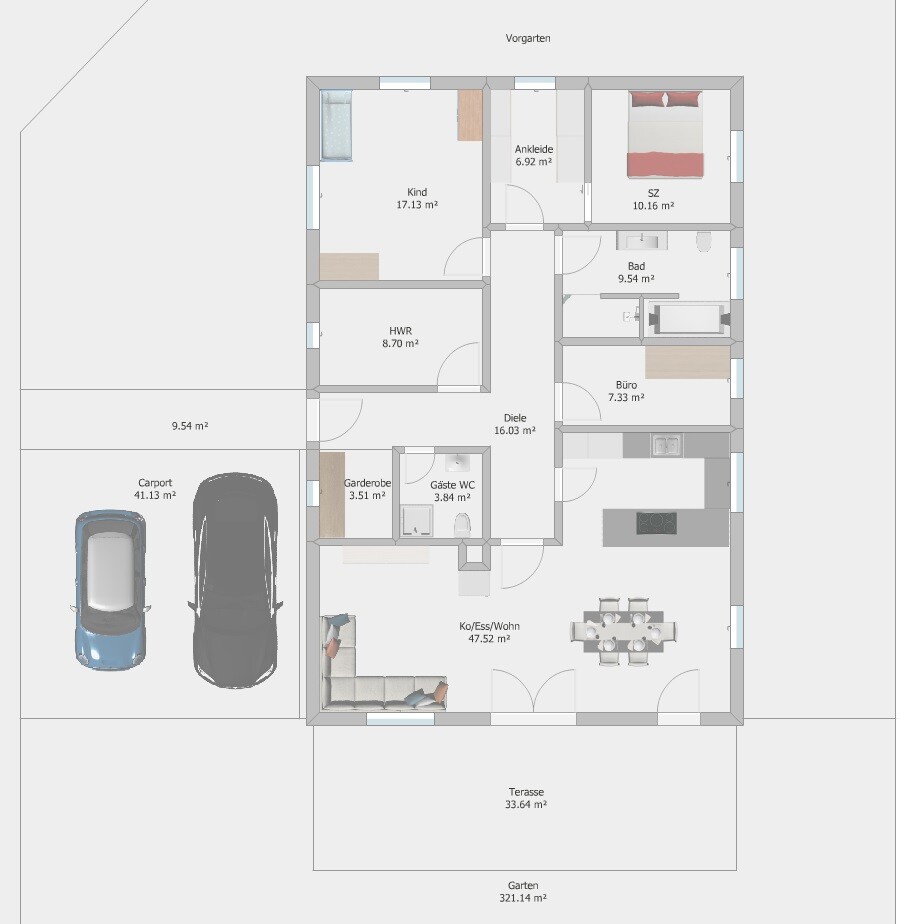
I have now reconsidered and placed the house with the shorter side facing the street, in the dimensions of 15m x 10.2m (49 ft 3 in x 33 ft 6 in). Since there are streets to the north and west, this layout would have the driveway and entrance from the west. I will redraw it today or tomorrow with measurements and update the post accordingly, but perhaps we can already discuss possible changes or improvements.
At least now everything is included as we roughly wanted: an open living/dining area facing southeast, the bedroom with a walk-in closet on the north side, and the children’s room as a compromise towards the northwest, as well as a small separate office this time.
@micric3
What exactly are you referring to? The interior walls will probably still need to be built with 17.5cm (7 inches) thickness—I can’t avoid that. Otherwise, I haven’t heard of any restrictions regarding 30cm (12 inches) walls. However, I will likely increase the thickness to 36.5cm (14 inches) anyway.
We were actually supposed to have another meeting about the financing on Tuesday with the current offer for the house, but this will unfortunately be postponed due to illness. There should still be enough flexibility for thicker exterior walls.

Rampelzampel schrieb:
I have now taken another look and positioned the house with the shorter side facing the street, in the dimensions 15m x 10.2m (49ft 3in x 33ft 6in).... and now it somewhat reminds me of https://www.hausbau-forum.de/threads/grundriss-bungalow-150qm-mit-garage.41703/https://www.instagram.com/11antgmxde/
https://www.linkedin.com/company/bauen-jetzt/
R
Rampelzampel12 Nov 2021 14:50I was not familiar with that and don’t really find it very similar, but alright. You can usually find some similarities to others in any case.
Our interior walls are 11.5cm (4.5 inches) thick. Using 17.5cm (7 inches) might make sense for some walls, but structurally it doesn't provide any advantage.
I would design the hallway as an L-shaped corridor. The short section with the two doors isn’t clear to me. We use the corridor extension simply as a passage through the living room, which adds more volume to the living room. Plus, you save a door that way.
A bedroom of 10m² (108 sq ft) would be too small for me; it’s better to skip the walk-in closet or integrate it into the bedroom.
You could give the utility room and the walk-in closet larger windows.
Next time, providing dimensions would be helpful. Also, start the bathroom planning early.
Good luck
Mic
I would design the hallway as an L-shaped corridor. The short section with the two doors isn’t clear to me. We use the corridor extension simply as a passage through the living room, which adds more volume to the living room. Plus, you save a door that way.
A bedroom of 10m² (108 sq ft) would be too small for me; it’s better to skip the walk-in closet or integrate it into the bedroom.
You could give the utility room and the walk-in closet larger windows.
Next time, providing dimensions would be helpful. Also, start the bathroom planning early.
Good luck
Mic
We consistently have 17.5cm (7 inches) walls. The exterior walls are also 36.5cm (14 inches) Poroton blocks. What I wouldn’t do is have the entrance to the kitchen and living room about 2m (6.5 feet) apart.
Another thing to consider is the drywall construction in the bathroom, which moves the shower/bathtub and, on the other side, the toilet further into the room. This raises the question of whether there will still be enough space.
Another thing to consider is the drywall construction in the bathroom, which moves the shower/bathtub and, on the other side, the toilet further into the room. This raises the question of whether there will still be enough space.
Rampelzampel schrieb:
You can usually find some similarities to others. I just wanted to give you a hint: take a look at the "twin" thread, maybe some of the aspects discussed there will also be relevant to you.
micric3 schrieb:
Our interior walls are 11.5cm (4.5 inches) thick. 17.5cm (7 inches) might make sense for some walls, but currently it doesn’t contribute to the structural support. As long as we are not talking about calcium silicate bricks, the difference between 17.5cm (7 inches) and 11.5cm (4.5 inches) is basically the difference between a load-bearing wall and one that is at best stabilizing. And you yourself said,
micric3 schrieb:
with a wall thickness of 36.5cm (14.5 inches), the house supports the roof, so no additional load-bearing elements are needed and you have freedom in planning the interior spaces. … which, by the way, is somewhat misleading since exterior walls with 17.5cm (7 inches) or, as far as I know, the standard 24cm (9.5 inches) thickness in Town & Country houses already support the roof on their own—the decisive factor is the roof construction (with trusses). This point determines whether the interior walls need to participate in transferring the roof load.
https://www.instagram.com/11antgmxde/
https://www.linkedin.com/company/bauen-jetzt/