
W
WilderSueden8 Nov 2021 00:35Our development plan requires permeable paving for the driveway and parking spaces. In principle, there's nothing wrong with that, but the problem is that the soil underneath is very clayey and hardly suitable for allowing water to simply drain away. Even days after the last rain, a layer of mud several centimeters thick sticks to boots, and the infrastructure work was probably delayed because every hole filled up during this wonderful summer. During heavy rain, a stream often runs through the neighbors’ gardens in the first construction phase as well.
I just reviewed the soil survey again; it states loess-bearing fluvial clay with a kf value of 9.5*10^-8 m/s (approximately ~10^-7). According to Wikipedia, soil with a permeability of 10^-6 or less is considered impermeable.
Now the question is how to deal with this situation. I see the following problems here:
- Originally, I planned to use the same paving for the path from the driveway to the front door, but now I worry that this could direct water underneath the foundation.
- An additional problem is that the road is located almost at the highest point of the property, and with a connected substructure, the water will likely follow the path of least resistance.
- Where should the water that seeps through the paving go? Probably less of an issue with light rain, but heavy rain could cause significant ponding.
- How to handle frost? The subsoil itself is classified as F3 and is already somewhat problematic, and having trapped water on top sounds like a recipe for problems. Our property is at 666 meters (The Number of the Beast... 😉 ), so we can expect significant frost.
- The neighbors to the east and northeast are at higher elevations, and depending on their construction, heavy rain could flow toward our front door. That’s exactly why permeable paving in front of the house was appealing.
Of course, I have already considered possible solutions:
- For the path to the house and the terrace, maybe avoid permeable paving so that rainwater flows away from the house on the surface and is directed by a slight slope into the lawn?
- Some sort of water barrier within the substructure using deep edge restraints between the driveway and the path so that each substructure is reasonably separated? The paths need much less sub-base than the driveway anyway.
- Or simply use permeable paving all the way up to the house but excavate extra deep under the driveway so that all water drains and infiltrates there? The driveway will be about 30cm (12 inches) higher than the ground floor level, so that would indeed mean excavating quite deep and probably extra cost.
- Or is diverting all this water unnecessary, and would a standard 30cm (12 inches) base layer plus 30cm (12 inches) frost protection under permeable paving be sufficient?
- Does it make a difference whether porous stones are used or if infiltration happens through the joints? I’m not really a fan of wide joints because they always seem to become completely covered with moss.
I just reviewed the soil survey again; it states loess-bearing fluvial clay with a kf value of 9.5*10^-8 m/s (approximately ~10^-7). According to Wikipedia, soil with a permeability of 10^-6 or less is considered impermeable.
Now the question is how to deal with this situation. I see the following problems here:
- Originally, I planned to use the same paving for the path from the driveway to the front door, but now I worry that this could direct water underneath the foundation.
- An additional problem is that the road is located almost at the highest point of the property, and with a connected substructure, the water will likely follow the path of least resistance.
- Where should the water that seeps through the paving go? Probably less of an issue with light rain, but heavy rain could cause significant ponding.
- How to handle frost? The subsoil itself is classified as F3 and is already somewhat problematic, and having trapped water on top sounds like a recipe for problems. Our property is at 666 meters (The Number of the Beast... 😉 ), so we can expect significant frost.
- The neighbors to the east and northeast are at higher elevations, and depending on their construction, heavy rain could flow toward our front door. That’s exactly why permeable paving in front of the house was appealing.
Of course, I have already considered possible solutions:
- For the path to the house and the terrace, maybe avoid permeable paving so that rainwater flows away from the house on the surface and is directed by a slight slope into the lawn?
- Some sort of water barrier within the substructure using deep edge restraints between the driveway and the path so that each substructure is reasonably separated? The paths need much less sub-base than the driveway anyway.
- Or simply use permeable paving all the way up to the house but excavate extra deep under the driveway so that all water drains and infiltrates there? The driveway will be about 30cm (12 inches) higher than the ground floor level, so that would indeed mean excavating quite deep and probably extra cost.
- Or is diverting all this water unnecessary, and would a standard 30cm (12 inches) base layer plus 30cm (12 inches) frost protection under permeable paving be sufficient?
- Does it make a difference whether porous stones are used or if infiltration happens through the joints? I’m not really a fan of wide joints because they always seem to become completely covered with moss.
F
fach1werk8 Nov 2021 08:05Our conditions are quite similar.
The execution was as follows:
Standard paving but with wider joints. And yes, the joints become mossy.
The substructure is the same as the driveway, meaning it is permeable.
Wherever a component is at or below the level of the path, we installed barrier channels.
What I find missing in your building description is passive flood protection.
We raised the subbase under the foundation slab, so the entire house was built slightly higher. There is a step at the entrance door—a construction flaw from an accessibility perspective, but necessary as protection against water intrusion.
You have to be careful that passive flood protection is not completely removed out of misunderstanding.
If the house then sits somewhat higher than the surrounding ground level, the slope must be properly retained.
Best regards,
Gabriele
The execution was as follows:
Standard paving but with wider joints. And yes, the joints become mossy.
The substructure is the same as the driveway, meaning it is permeable.
Wherever a component is at or below the level of the path, we installed barrier channels.
What I find missing in your building description is passive flood protection.
We raised the subbase under the foundation slab, so the entire house was built slightly higher. There is a step at the entrance door—a construction flaw from an accessibility perspective, but necessary as protection against water intrusion.
You have to be careful that passive flood protection is not completely removed out of misunderstanding.
If the house then sits somewhat higher than the surrounding ground level, the slope must be properly retained.
Best regards,
Gabriele

It is similar in our case.
The fence facing the street has a waterproof base, and the gate features a stone edge that is higher than the middle of the street.
The paving is standard, made on recycled material with multiple changes in slope; the entrance doors are the highest points, while the connections to the lawn are the lowest. The lawn is uneven with areas where water can accumulate.
For our own roof water, we have a 12m3 (3,170 gallons) cistern under the terrace.
For two years now, there has been no water pooling on the path during heavy rain; the lawn absorbs the water fully.
The fence facing the street has a waterproof base, and the gate features a stone edge that is higher than the middle of the street.
The paving is standard, made on recycled material with multiple changes in slope; the entrance doors are the highest points, while the connections to the lawn are the lowest. The lawn is uneven with areas where water can accumulate.
For our own roof water, we have a 12m3 (3,170 gallons) cistern under the terrace.
For two years now, there has been no water pooling on the path during heavy rain; the lawn absorbs the water fully.

Our house is 70 cm (28 inches) lower than street level, and we also have extremely water-resistant soil along with a damp, cold region prone to frost. Here is what we have done:
- Used the smallest possible paving stones to increase the joint ratio,
- Wider joints (though I find the moss growth there quite attractive...),
- Kept sealed surfaces as small as possible,
- Directed water away from the house with a cross slope towards green areas,
- Where necessary (allowed in our case), drained through channels connected to the sewer system,
- All foundations generously protected against frost.
Our entrance is step-free despite the timber frame construction. For this, we installed a very large drainage channel (Brink Stabile Air) between the paved area and the door threshold, which is connected both to the hillside drainage and the main drainage system. During heavy rain, not all water infiltrates through the paving; some also flows off the surface. However, most of it does not reach the house at all but is guided into green spaces/plant beds – the tiny remaining amount goes into the Brink channel.
However – and this makes it easier for us – both the neighboring properties and the street itself have excellent drainage. So, we only really had to worry about our own 30 sqm (323 sq ft).
- Used the smallest possible paving stones to increase the joint ratio,
- Wider joints (though I find the moss growth there quite attractive...),
- Kept sealed surfaces as small as possible,
- Directed water away from the house with a cross slope towards green areas,
- Where necessary (allowed in our case), drained through channels connected to the sewer system,
- All foundations generously protected against frost.
Our entrance is step-free despite the timber frame construction. For this, we installed a very large drainage channel (Brink Stabile Air) between the paved area and the door threshold, which is connected both to the hillside drainage and the main drainage system. During heavy rain, not all water infiltrates through the paving; some also flows off the surface. However, most of it does not reach the house at all but is guided into green spaces/plant beds – the tiny remaining amount goes into the Brink channel.
However – and this makes it easier for us – both the neighboring properties and the street itself have excellent drainage. So, we only really had to worry about our own 30 sqm (323 sq ft).
W
WilderSueden8 Nov 2021 22:56That makes me a bit more relieved. I discussed the topic today with the engineer responsible for the building application, and he also sees no problem. Not much water would run under the house. As a precaution, he suggested side drains along the path, but I suppose that’s not necessary with permeable paving here.
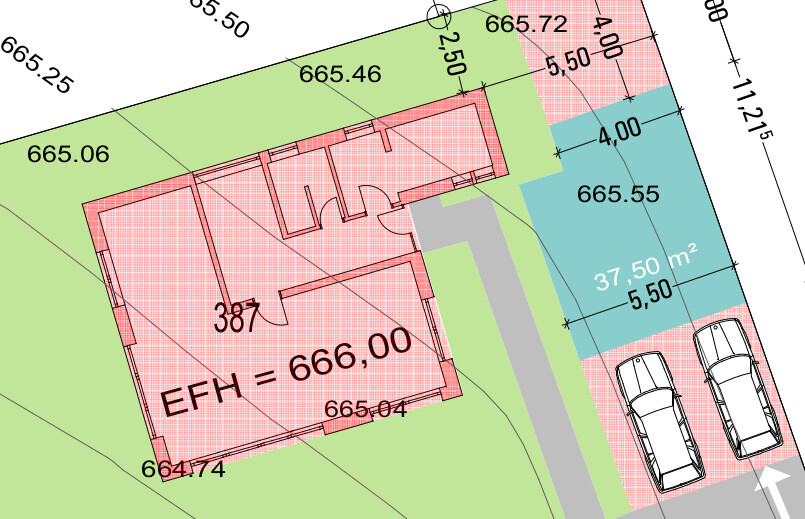
I’ve attached the elevation profile. Unlike in the picture, we will go to 665.5 m (2,182 ft) now, which still places the front door above the ground edge, and with a proper gutter that should be okay. The critical area really is just around the front door; the rest should be unproblematic if the filling is done sensibly.
Hangman schrieb:What does “small” mean in this case? My preferred size currently is 30x20 or 30x15 cm (12x8 or 12x6 inches), does that already count as small?
- as small paving stones as possible to increase the joint ratio,
fach1werk schrieb:That’s a bit of a problem. The road is quite elevated and this only became clear late in the development process. In addition, the plot is a bit steeper than originally expected (which of course only became clear after surveying). If we now raise the house significantly above the ground edge to street level (666 m (2,185 ft)), we would have to build up massively under the house and then the terrace door would be more than 1 m (3.3 ft) above the terrain, which requires a lot of fill. In hindsight, a basement wouldn’t have been a bad idea at all; you could have reached the elevation easily and used the excavation soil to fill in…
What I find missing in your building description is passive flood protection. We have a raised substructure for the slab foundation, meaning the whole house was built slightly higher.
I’ve attached the elevation profile. Unlike in the picture, we will go to 665.5 m (2,182 ft) now, which still places the front door above the ground edge, and with a proper gutter that should be okay. The critical area really is just around the front door; the rest should be unproblematic if the filling is done sensibly.
Our paving stones measure 16x12cm (6.3x4.7 inches). This is partly because our parking space and access path are irregularly shaped and more spread out, and the slope and cross slope have been modeled in a somewhat uneven way. Smaller stones naturally handle this better. In your case, since the layout is quite rectangular and straight, larger formats should actually work well.
If you want to protect the area directly next to the house with a channel drain, it should have a high capacity and be connected to the sewer system (if allowed). I’m not trying to advertise, but you can find a full range of options under drainage systems by Richard Brink.
If you want to protect the area directly next to the house with a channel drain, it should have a high capacity and be connected to the sewer system (if allowed). I’m not trying to advertise, but you can find a full range of options under drainage systems by Richard Brink.
Similar topics