
Hello everyone,
we are planning a prefabricated house using timber frame construction. It will have 180 sqm (1,937 sq ft) of living space with underfloor heating, and about 230 sqm (2,475 sq ft) of usable area.
So far, the offer included an air-to-water heat pump from Daikin (Altherma 3R, formerly Rotex HPSU compact Ultra).
Now it seems that this unit might not have enough capacity (?) and as an alternative (additional cost around 4,000) we have been offered a "Wolf heat pump CHC Monoblock 10/300-35".
The Daikin is available in the 4-9 kW version—would that really be insufficient for this size? And what do you think about this offer?
I have the energy-saving regulation heat protection certification and a renewable energy heat law document available, if any information from those is needed.
Thank you very much!
Best regards
we are planning a prefabricated house using timber frame construction. It will have 180 sqm (1,937 sq ft) of living space with underfloor heating, and about 230 sqm (2,475 sq ft) of usable area.
So far, the offer included an air-to-water heat pump from Daikin (Altherma 3R, formerly Rotex HPSU compact Ultra).
Now it seems that this unit might not have enough capacity (?) and as an alternative (additional cost around 4,000) we have been offered a "Wolf heat pump CHC Monoblock 10/300-35".
The Daikin is available in the 4-9 kW version—would that really be insufficient for this size? And what do you think about this offer?
I have the energy-saving regulation heat protection certification and a renewable energy heat law document available, if any information from those is needed.
Thank you very much!
Best regards
B
Benutzer2003 Nov 2021 11:50Smirnoff1983 schrieb:
Wouldn't it be simpler to contractually specify: "all rooms 10cm (4 inches) & bathroom 5cm (2 inches)"???No. That’s just a typical shortcut. Everything must be properly calculated and designed. Anything else is basically poor workmanship or “we’ve always done it this way.” Who tells you that a) the desired temperatures will be achieved or b) the heating system will even have a reasonable hydraulic balance with that?
S
Smirnoff19833 Nov 2021 11:55Benutzer200 schrieb:
No. That’s just standard procedure again. It’s calculated and designed properly. Anything else is basically a botched job or just “we’ve always done it this way.”
Who tells you that a) the desired temperatures will be reached, or b) the heating system will even get a proper hydraulic balance with that? So it’s more complicated than I thought. 🙁
R
RotorMotor3 Nov 2021 12:17I also value proper design of underfloor heating systems, but I’m not a fan of some of the calculations I’ve seen. Often, too much emphasis is placed on specific details (floor coverings, desired temperatures, ventilation systems, etc.) and calculations are done down to the last decimal point, while other factors are completely ignored—such as the fact that floor coverings can change or that a carpet might be laid, furniture, waste heat from appliances, solar gains, and the reality that within the thermal envelope, there are simply no large differences to achieve.
I have studied and calculated these aspects myself to understand the impact of each change.
In my opinion, following some basic rules—which can be stated as requirements and verified—is often better than trying to "over-optimize":
- Circuits approximately the same length (small rooms like guest toilets, hallways, and storage rooms often pose a problem. Here, combining circuits can be considered)
- No circuit longer than 100 meters (330 feet)
- Manifolds should not be placed in areas where it is not meant to be warm, such as bedrooms or pantries
- Maximum spacing between pipes no more than 15 cm (6 inches)
- Smaller spacing in bathrooms
- Ideally, cover an exterior wall in bathrooms (often the warmest room with the smallest heating surface due to frequently omitted bathtubs and showers), since a larger heating surface is much more effective than closer pipe spacing.
I have studied and calculated these aspects myself to understand the impact of each change.
In my opinion, following some basic rules—which can be stated as requirements and verified—is often better than trying to "over-optimize":
- Circuits approximately the same length (small rooms like guest toilets, hallways, and storage rooms often pose a problem. Here, combining circuits can be considered)
- No circuit longer than 100 meters (330 feet)
- Manifolds should not be placed in areas where it is not meant to be warm, such as bedrooms or pantries
- Maximum spacing between pipes no more than 15 cm (6 inches)
- Smaller spacing in bathrooms
- Ideally, cover an exterior wall in bathrooms (often the warmest room with the smallest heating surface due to frequently omitted bathtubs and showers), since a larger heating surface is much more effective than closer pipe spacing.
B
Benutzer2003 Nov 2021 12:30RotorMotor schrieb:
In my opinion, it’s often better to follow simple basic rules that can be clearly communicated as preferences and verified, rather than trying to “over-optimize”:
- Circuits of approximately equal length (small rooms like guest toilets, hallways, and storage rooms often cause issues. Here, combining circuits can be attempted)
- No circuit longer than 100m (330 feet)
- Manifolds should not be placed in areas that are not meant to be heated, such as bedrooms or pantries
- Maximum spacing between pipes of 15cm (6 inches)
- Smaller spacing in bathrooms
- Ideally install underfloor heating on exterior walls in bathrooms (often the warmest room with the smallest heating surface due to frequently omitted bathtubs and showers), because larger coverage area has a much greater impact than closer pipe spacing. As a basic requirement, this is not bad except for one point. The spacing should not exceed 10cm (4 inches). Fifteen centimeters (6 inches) is no longer up to current standards.
OWLer schrieb:
So, since one window has been removed in our house, we now need 45 watts less heating load in the living-dining room. Therefore, I had the system design updated and also worked on the large overlap. This is how it looks now.
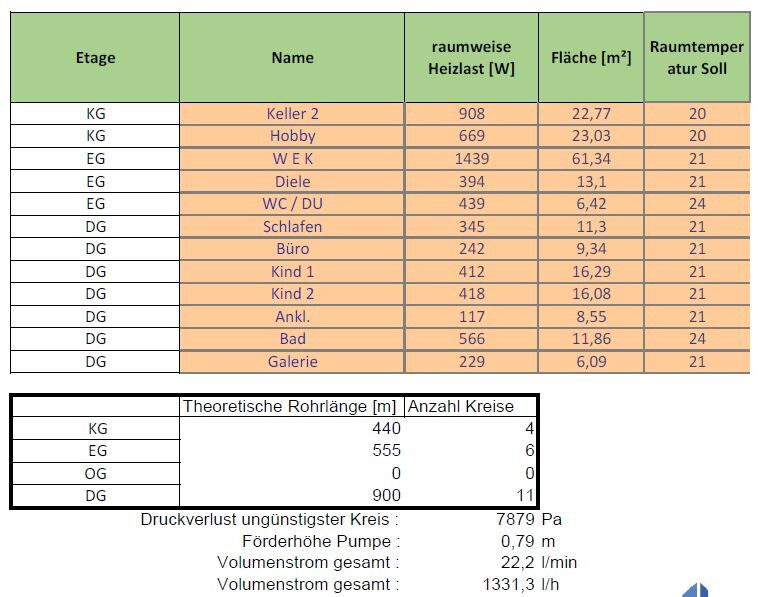
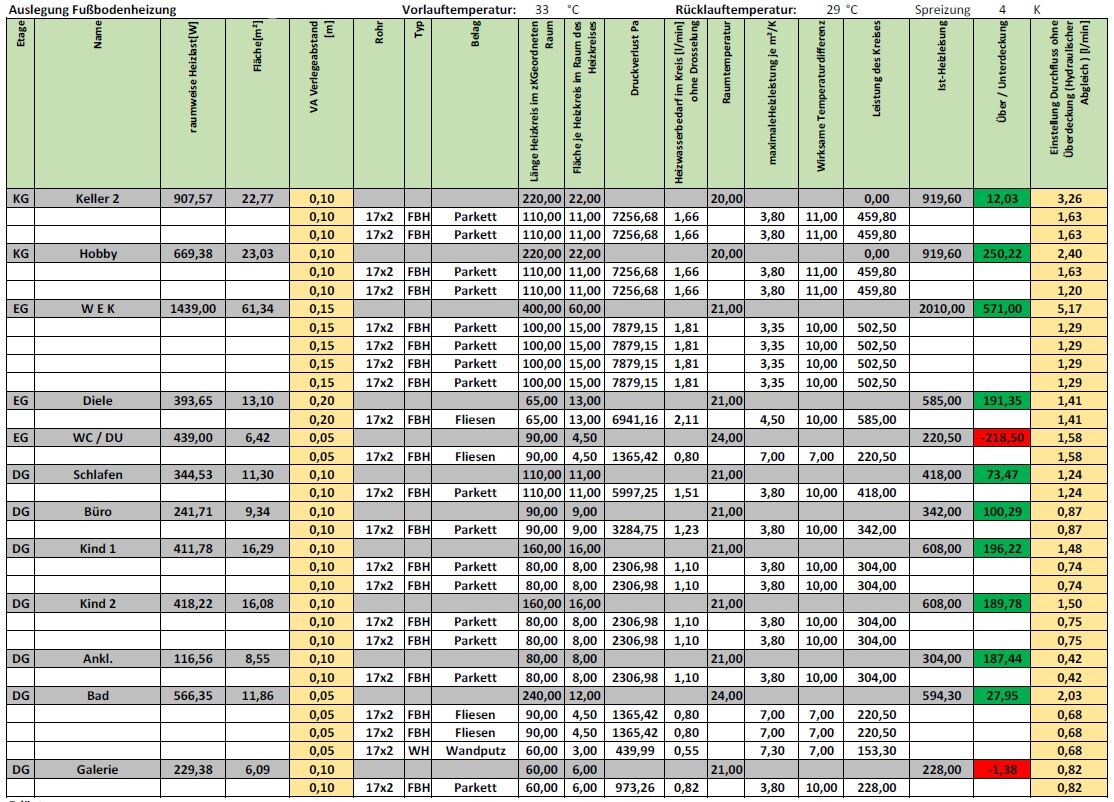
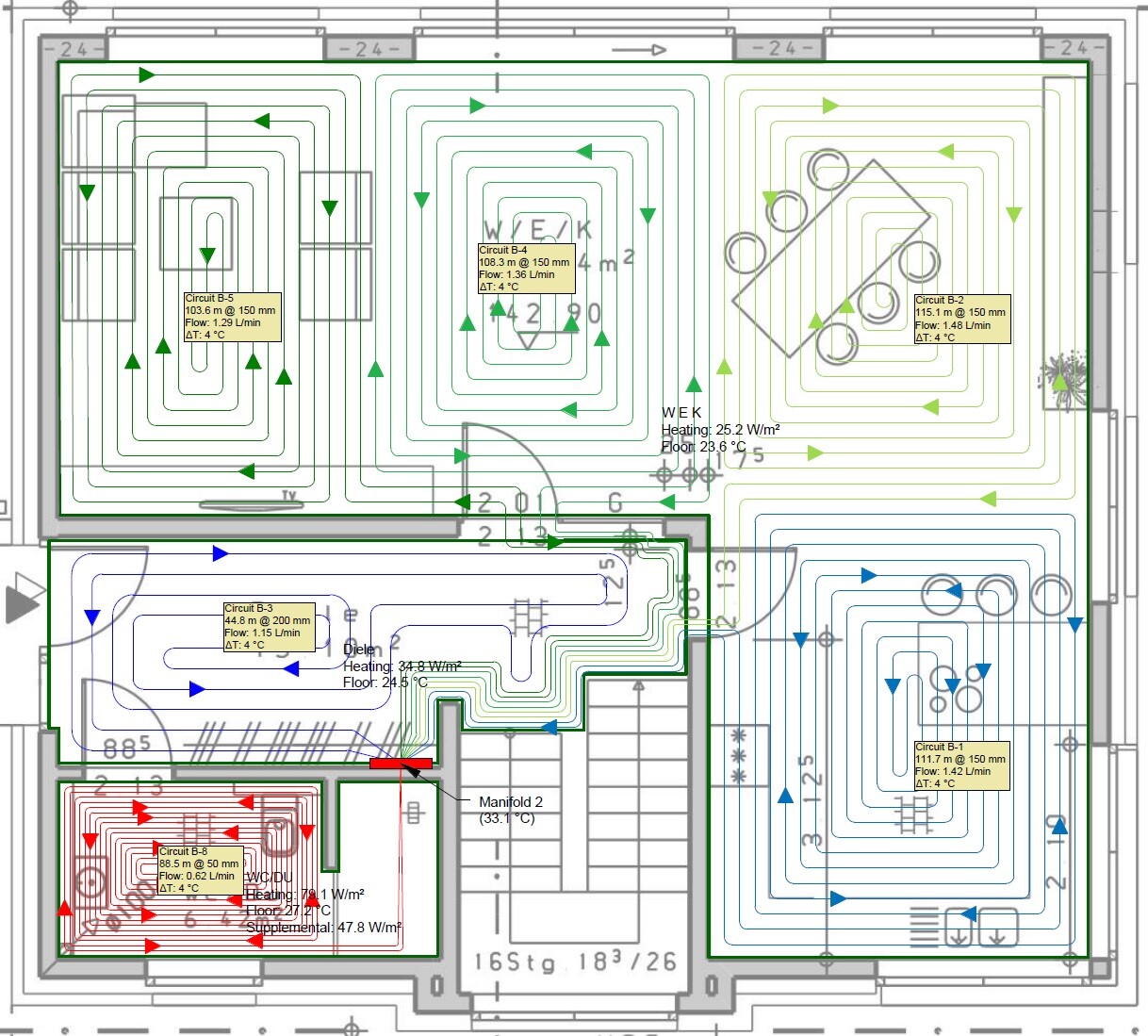
I now see this as a concession to the heating installer, so he can install much more easily on the ground floor. Fewer heating circuits and significantly larger pipe spacing.
A strong recommendation from the engineering firm was to definitely pay attention to the compliance with the floor area and pipe spacing on the upper floor, especially the wall heating in the upper floor bathroom.
@Daniel-Sp you really know your stuff and you are currently supporting @Alessandro . You are discussing the pressure losses and the pump flow rate there. Does this look unusual here?
I hope that when construction starts soon and I get to work on the hydraulic balancing, I will be as much of a pro as you. I already see myself spending weeks in winter optimizing the heating curve and flow rates. Would it be possible to get your Excel sheet as a template? That would be great 🙂
R
RotorMotor3 Nov 2021 12:40Benutzer200 schrieb:
As a basic requirement, not bad except for one point. The spacing should not exceed 10cm (4 inches). 15cm (6 inches) is outdated. Well, in my calculations—for example in the "Living Dining Kitchen" area, which covers a large part of the house—it didn’t make any difference. I already had more capacity than needed. Making it tighter caused more issues with long loops.
In the bedroom and storage rooms, 10cm (4 inches) doesn’t help either.
The bathrooms were already considered “tighter.”
That leaves a few corridors and the children’s rooms.
You can go with 10cm (4 inches) or 15cm (6 inches) there; maybe I’ll experiment with this again tonight to see exactly what difference it makes. ;-)
Similar topics