
ᐅ Floor Plan Optimization, Single-Family Home, Urban Villa 12x12 m
Created on: 15 Oct 2021 00:59
L
Lia_Home
Hello everyone,
We visited several model homes, spoke with different construction companies, and reviewed a number of floor plans. Unfortunately, many of the designs didn’t meet our expectations. As a result, we drew the floor plan ourselves using a 3D home design program.
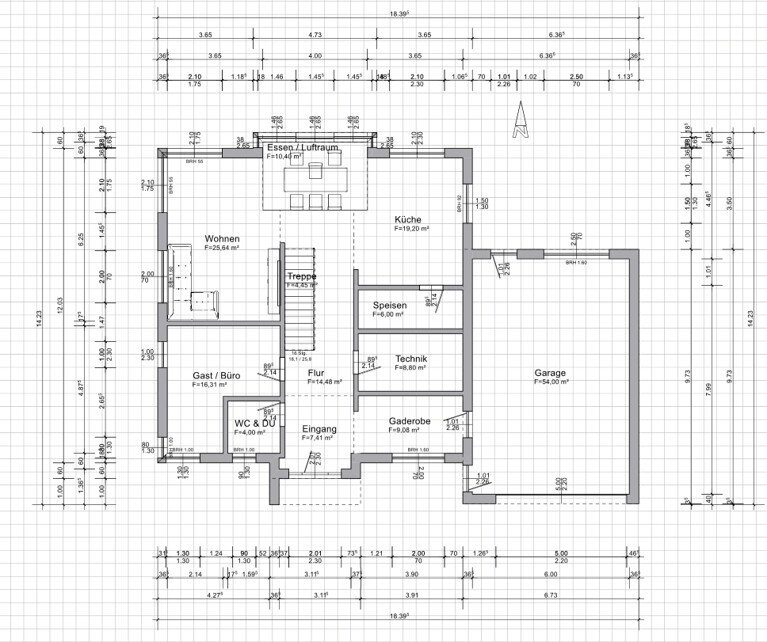
We are quite satisfied with the upper floor. However, we see room for improvement on the ground floor. For example, is the hallway too large or too narrow? Also, the layout of the guest room and the guest bathroom needs reconsideration. Would it be possible to convert this room (with shower toilet) into a small separate apartment?
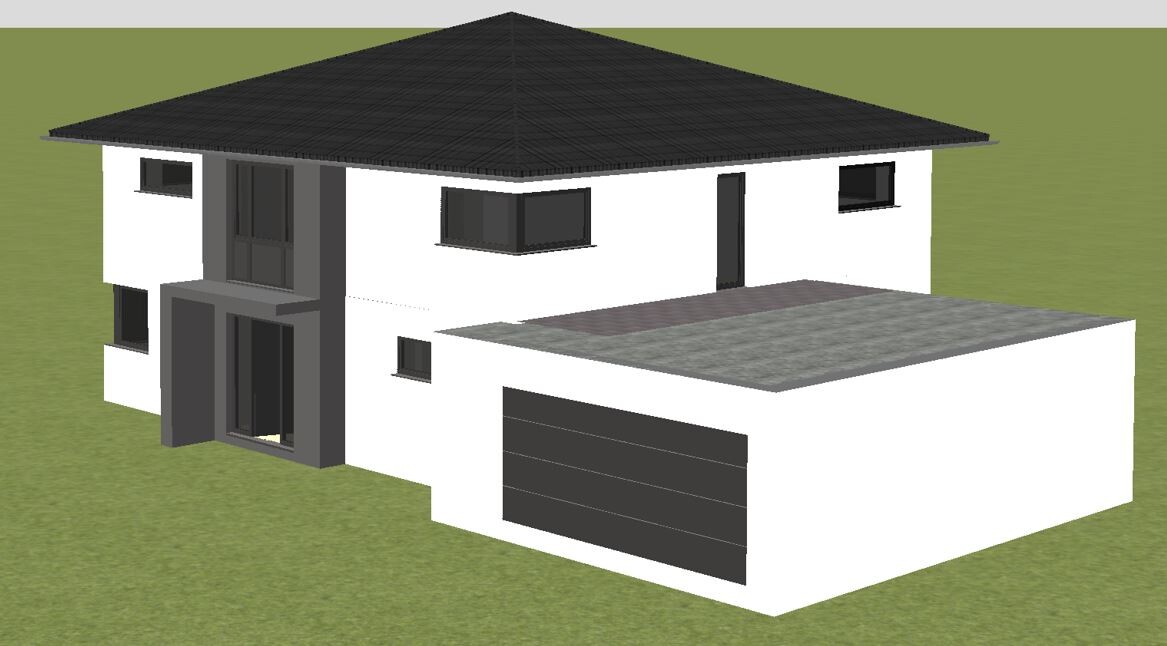
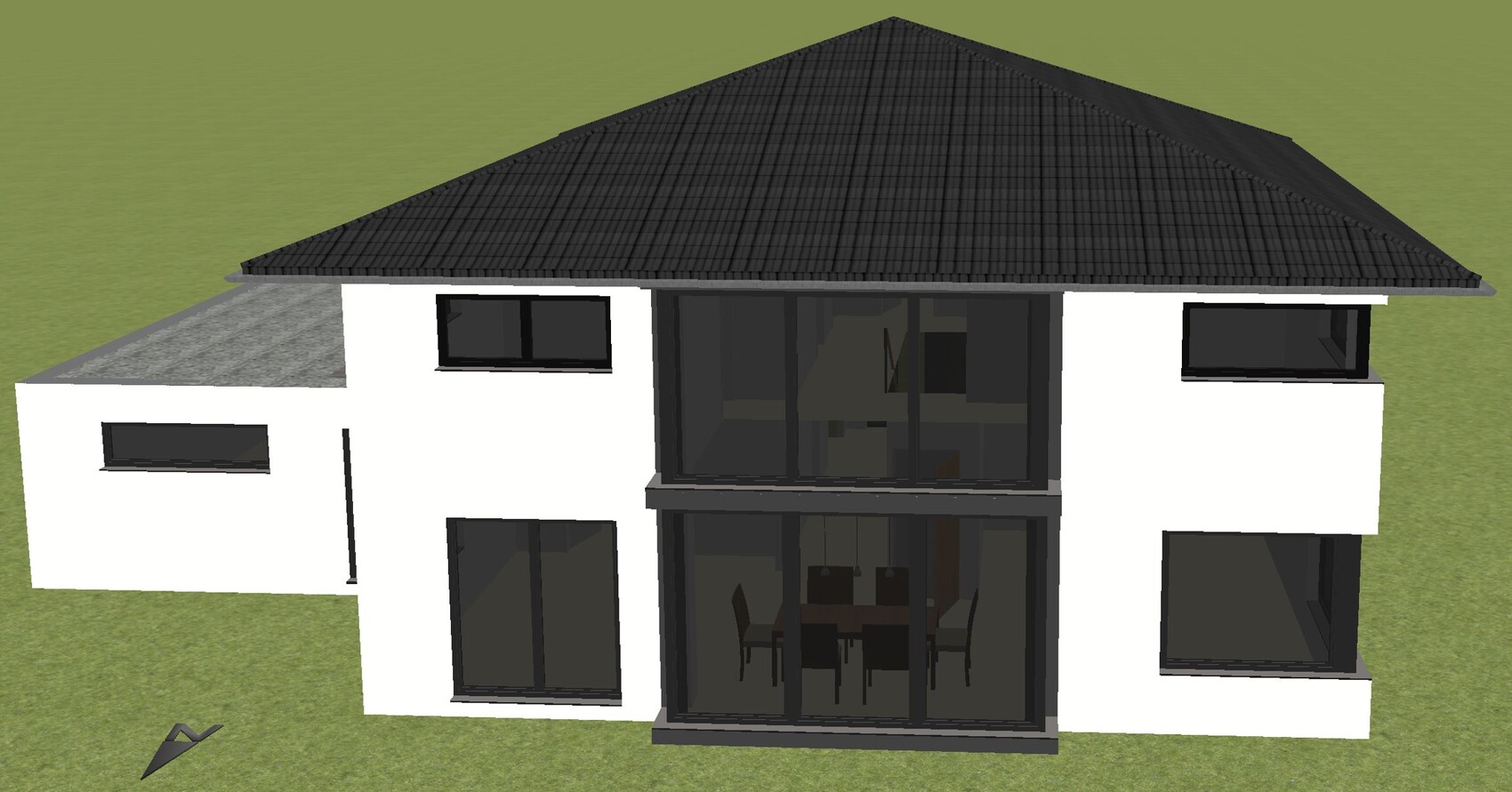
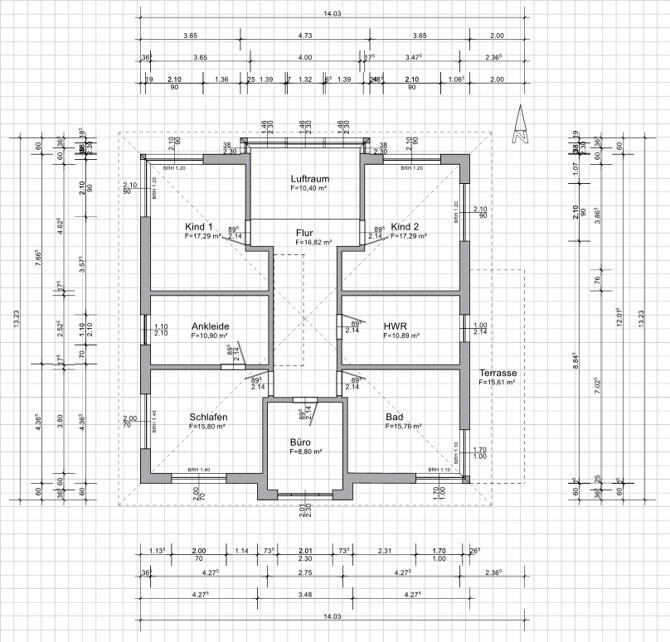
Attached are both floor plans as well as two perspective images.
We look forward to your feedback.
Thank you very much! Lia
Building regulations/restrictions
Plot size: 821 m2 (approx. 21 m (69 feet) wide and 35 m (115 feet) deep, not quite rectangular)
Slope: none
Site coverage ratio: 0.4
Building setback: 5 meters (16 feet) from the street, 4 meters (13 feet) from neighbors
Number of stories: max. 2
Roof type: hipped roof
Architectural style: modern
Maximum height restrictions: eaves height 6 m (20 feet), ridge height 8.5 m (28 feet)
Client requirements
Style, roof form, building type: modern, hipped roof
Basement, number of floors: 2 full floors
Household size and ages: 2 adults in their mid-30s, 1 child, 2 years old
Space requirements on ground floor: cloakroom, guest room, guest shower WC, utility/technical room, kitchen, pantry, living-dining room
Space requirements on upper floor: 2 children’s rooms, master bedroom, dressing room, laundry room, bathroom, office
Office: home office
Number of overnight guests per year: several times a year
Open or closed layout: open
Traditional or modern construction: modern
Open kitchen, kitchen island: open kitchen with work island
Seats at dining table: usually 4-6, at celebrations at least 15
Fireplace: yes
Balcony, roof terrace: roof terrace above garage
Garage or carport: garage
Kitchen garden, greenhouse: no
Additional wishes/particulars/daily routine, reasons for including or excluding certain features:
- open space/void
- large west-facing windows due to no neighbors
- cloakroom
- covered entrance
House design
Who designed the plan:
- ourselves
What do you like most?
- spacious, open living and dining area
What do you dislike? Why?
Estimated cost according to builder: approx. 550,000
Hallway (takes up too much space?), guest room on the ground floor (too awkwardly shaped)
If you had to give up some details or extensions
- hallway space
Why was the design made this way? For example:
We arranged the rooms so they made sense to us and took room sizes into account.
What is your main question about the floor plan in 130 characters?
Are there any possible optimizations for the floor plan?
We visited several model homes, spoke with different construction companies, and reviewed a number of floor plans. Unfortunately, many of the designs didn’t meet our expectations. As a result, we drew the floor plan ourselves using a 3D home design program.
We are quite satisfied with the upper floor. However, we see room for improvement on the ground floor. For example, is the hallway too large or too narrow? Also, the layout of the guest room and the guest bathroom needs reconsideration. Would it be possible to convert this room (with shower toilet) into a small separate apartment?
Attached are both floor plans as well as two perspective images.
We look forward to your feedback.
Thank you very much! Lia
Building regulations/restrictions
Plot size: 821 m2 (approx. 21 m (69 feet) wide and 35 m (115 feet) deep, not quite rectangular)
Slope: none
Site coverage ratio: 0.4
Building setback: 5 meters (16 feet) from the street, 4 meters (13 feet) from neighbors
Number of stories: max. 2
Roof type: hipped roof
Architectural style: modern
Maximum height restrictions: eaves height 6 m (20 feet), ridge height 8.5 m (28 feet)
Client requirements
Style, roof form, building type: modern, hipped roof
Basement, number of floors: 2 full floors
Household size and ages: 2 adults in their mid-30s, 1 child, 2 years old
Space requirements on ground floor: cloakroom, guest room, guest shower WC, utility/technical room, kitchen, pantry, living-dining room
Space requirements on upper floor: 2 children’s rooms, master bedroom, dressing room, laundry room, bathroom, office
Office: home office
Number of overnight guests per year: several times a year
Open or closed layout: open
Traditional or modern construction: modern
Open kitchen, kitchen island: open kitchen with work island
Seats at dining table: usually 4-6, at celebrations at least 15
Fireplace: yes
Balcony, roof terrace: roof terrace above garage
Garage or carport: garage
Kitchen garden, greenhouse: no
Additional wishes/particulars/daily routine, reasons for including or excluding certain features:
- open space/void
- large west-facing windows due to no neighbors
- cloakroom
- covered entrance
House design
Who designed the plan:
- ourselves
What do you like most?
- spacious, open living and dining area
What do you dislike? Why?
Estimated cost according to builder: approx. 550,000
Hallway (takes up too much space?), guest room on the ground floor (too awkwardly shaped)
If you had to give up some details or extensions
- hallway space
Why was the design made this way? For example:
We arranged the rooms so they made sense to us and took room sizes into account.
What is your main question about the floor plan in 130 characters?
Are there any possible optimizations for the floor plan?
A
Alessandro21 Oct 2021 09:40I would rather move into an apartment right in the city center as I get older than have to take care of a large house. But that’s what I say now at 34. We’ll see :p
My plan is to do it like my great-grandmother did: farm chores, birthday celebrations, chatting with the mayor, going to sleep, and not waking up.
Later on, this shouldn’t be forgotten, but the focus when planning should clearly be on the present. Perhaps it’s normal to downsize as you get older; maybe in 40 years, it will be common for extended families with three or four generations to live under one roof. Who knows.
What’s definite is that the future is not the dominant factor here. This is clearly a home designed for a family, regardless of its size.
Later on, this shouldn’t be forgotten, but the focus when planning should clearly be on the present. Perhaps it’s normal to downsize as you get older; maybe in 40 years, it will be common for extended families with three or four generations to live under one roof. Who knows.
What’s definite is that the future is not the dominant factor here. This is clearly a home designed for a family, regardless of its size.
I don’t want to say anything more about the floor plan as long as an upper floor is arranged purely for aesthetic symmetry 😉
I agree!
Many people don’t have guests or hobbies until the children have moved out. But I think that’s something you have to consider yourself. While the argument of a granny flat / in-law apartment for potential family members (children) is often made, in my opinion, you should just consider the simplest scenario before cutting the house in half by separating the usual upper floor and then living in 80 sqm (860 sq ft) with a small shower bathroom. Namely, that the children will move to another city, live in their own house with their family, and later one or two rooms—namely the old children’s bedrooms—can be used for visits from grandchildren and new hobbies, for which there will also be time and inspiration.
Many people here no longer think about the obvious. They only consider the extreme worst-case scenarios: convenience and luxury/size as the top priority, and when the children are grown, then a granny flat / in-law apartment for them, while restricting themselves to 30–40% of the space from 200 sqm (2,150 sq ft).
In my experience, very few actually choose this option. …
Phew, that’s another extreme. When the children leave home, as a couple you usually have another 20 years or so to enjoy your own house and garden. Having children under one roof is only a phase.
My parents built quite well: fairly large on the ground floor, no basement, but the attic only for the child, with sloping ceilings and a storage room—they enjoy their 1,500 sqm (16,150 sq ft) plot, especially during the Corona period. I have long given up trying to encourage them to look for something smaller. As long as Dad can keep fit in the garden every day and Mom can still drive, everything is fine. The 160 sqm (1,720 sq ft) is not too much for them. Mom has her yoga mat and a second TV in the old children’s room for some alone time. Everything’s good.
In this respect, when building a house, you should consider all the scenarios that might realistically come up.
exto1791 schrieb:
It also depends on the type of person.
I agree!
Ypsi aus NI schrieb:
As long as I live in the house with my family, I don’t have the space, and for me, that would be too tight!
Many people don’t have guests or hobbies until the children have moved out. But I think that’s something you have to consider yourself. While the argument of a granny flat / in-law apartment for potential family members (children) is often made, in my opinion, you should just consider the simplest scenario before cutting the house in half by separating the usual upper floor and then living in 80 sqm (860 sq ft) with a small shower bathroom. Namely, that the children will move to another city, live in their own house with their family, and later one or two rooms—namely the old children’s bedrooms—can be used for visits from grandchildren and new hobbies, for which there will also be time and inspiration.
Many people here no longer think about the obvious. They only consider the extreme worst-case scenarios: convenience and luxury/size as the top priority, and when the children are grown, then a granny flat / in-law apartment for them, while restricting themselves to 30–40% of the space from 200 sqm (2,150 sq ft).
In my experience, very few actually choose this option. …
Ypsi aus NI schrieb:
that the old widowed ladies won’t give up their large houses in favor of younger families
Phew, that’s another extreme. When the children leave home, as a couple you usually have another 20 years or so to enjoy your own house and garden. Having children under one roof is only a phase.
Myrna_Loy schrieb:
Our parents live in houses that are far too large (both around 240 sqm (2,600 sq ft) of living space plus a lot of utility space) and that’s a problem. Not at 60, but from 70 onwards.
My parents built quite well: fairly large on the ground floor, no basement, but the attic only for the child, with sloping ceilings and a storage room—they enjoy their 1,500 sqm (16,150 sq ft) plot, especially during the Corona period. I have long given up trying to encourage them to look for something smaller. As long as Dad can keep fit in the garden every day and Mom can still drive, everything is fine. The 160 sqm (1,720 sq ft) is not too much for them. Mom has her yoga mat and a second TV in the old children’s room for some alone time. Everything’s good.
In this respect, when building a house, you should consider all the scenarios that might realistically come up.

exto1791 schrieb:
But with the typical single-family house in the 140-170m² (1505-1830 sq ft) range, I really do see a need to live in it well into old age.It may be that the suitability of a retirement home is not so much due to it being smaller than the mid-life house.Ypsi aus NI schrieb:
@11ant has mentioned it often enough. The trend is to build a new home close to retirement, smaller and single-story. Although we are preparing to separate part of the house as an independent apartment, I don’t see later selling and rebuilding as unrealistic!Last week I explained this in more detail in two posts when looking up “Baulotse Hoffmann Altersbauen.” Separating a separate apartment is not fundamentally wrong. However, overall, by trying to design one house for both today and later, the dilemma easily arises that you either build a jack-of-all-trades home (which strains the budget) or make compromises that can result in tight spaces for “living with a walker.”https://www.instagram.com/11antgmxde/
https://www.linkedin.com/company/bauen-jetzt/
H
hampshire21 Oct 2021 16:03Lia_Home schrieb:
The main topics we identified from your comments are:
1. Children’s rooms next to the void / the void itself The children’s rooms are a good size and are well positioned facing the garden. However, the adjoining void, especially with the dining table directly below it, creates an acoustic funnel effect. This can be disruptive when trying to fall asleep and can impact privacy. Conversely, you will likely hear your children’s music tastes more clearly in the living area during their teenage years than you might prefer, and the children will have less privacy when friends visit. I’ll leave the judgment to you — it’s just good to be aware of this possibility.
I like the idea of a void — but only if it enhances living comfort. Unfortunately, I don’t see that in your design.
Lia_Home schrieb:
2. Budget / Costs If you have financial reserves, going over budget is possible. If your budget is tight, I recommend not investing additional effort in design changes.
Lia_Home schrieb:
3. Dining area too small
We will also try to improve this in the next update. Don’t underestimate acoustic comfort. Sit with a few people at a dining table under a void in a model home and “enjoy” the echo and noise. Managing this aspect needs to be considered in the architectural planning. We have a fairly large void and invested the equivalent of a small new car into acoustic optimization — yet the dining table still doesn’t feel like it’s “outdoors” underneath, which simply makes it much more comfortable.
Lia_Home schrieb:
4. No children’s bathroom
We discussed this extensively and decided against it, but thank you for the suggestion. We have two boys who did not become fans of tidiness or hygiene during puberty. During that time, we were grateful to have a separate bathroom for them. You might think you can solve most issues through upbringing — but puberty inherently includes a degree of rebellion. We found it helpful to structurally minimize conflict areas. Perhaps this offers a new perspective.
Lia_Home schrieb:
6. Architect
We are in talks with interior architects, but unfortunately they are very busy.
Can you recommend architects or interior architects who would suit our building project? Finding the right architect is much more about “chemistry” than just expertise. If an architect is willing to engage with you and is genuinely interested in how you want to live, you are almost there. This may also involve a methodological skill to help you communicate your lifestyle preferences clearly, creating a holistic picture.
Other remarks:
Exits leading outdoors have proven extremely practical for our lifestyle habits. I can only encourage this.
A window seat will only be enjoyed if it’s extremely comfortable. It’s better to plan this generously.
Personal impression:
In planning the floor layout, a detailed requirements list was worked through. I can understand many of the ideas very well. However, some things were overlooked because they were not explicitly on the list. Corridors became very large, acoustics were not considered, and space needed for furniture (dining table...) was underestimated. Experience is helpful for many aspects — it’s not something you can just pick up quickly if you want to achieve good results. Focus on the non-functional requirements and consult an architect.
Ypsi aus NI schrieb:
I can never understand how someone can expect a house to fit perfectly for their entire life. I don’t understand how someone could not have that expectation if it’s what they wish for. Designing for the future begins in the mindset — and that needs no boundaries. Don’t underestimate people’s imagination. Sometimes everyone says something can’t be done — until someone comes along who doesn’t accept that (or knows otherwise :p) and suddenly it can be done.
B
Bamboochaa21 Oct 2021 16:24@hampshire I’m curious about the measures you have taken regarding acoustics to prevent the open space from negatively affecting the adjacent rooms too much?
I would agree with your further explanations as well.
Thank you very much 🙂
I would agree with your further explanations as well.
Thank you very much 🙂
Similar topics