
Hello
we are currently building a new semi-detached house
I am considering installing underfloor heating in the basement.
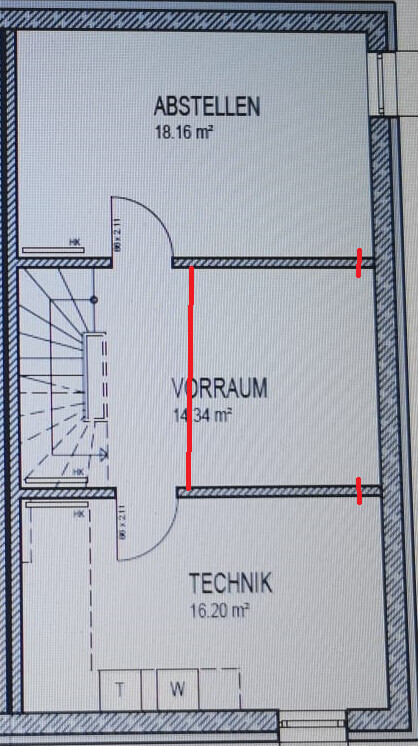
Our basement comes standard with conventional radiators under the stairs in the utility and storage rooms. As a special request, we will (red line) partition off this area as a separate room (of course with a door). The two lines at the back of the room will be ventilation slots to allow airflow since the other two rooms have windows.
The new room is intended as a pantry/storage room, and the storage room might be used as a workout room.
I have a few questions:
1: What do you think about installing underfloor heating throughout the entire basement? What are the advantages and disadvantages? The additional cost is 2700€.
2: In the underfloor heating package, the two rooms in the middle (hallway and newly partitioned room) will share a single heating circuit manifold, meaning the underfloor heating would be controlled by one thermostat and would heat both rooms. The underfloor heating would run beneath the new wall (a sand-lime brick wall).
My option would be, for an additional cost (amount unknown), to give the new room its own heating circuit, or to omit underfloor heating in that room altogether (which would of course reduce the extra cost of 2700€), or to have the hallway and new room share one heating circuit.
What would you recommend?
we are currently building a new semi-detached house
I am considering installing underfloor heating in the basement.
Our basement comes standard with conventional radiators under the stairs in the utility and storage rooms. As a special request, we will (red line) partition off this area as a separate room (of course with a door). The two lines at the back of the room will be ventilation slots to allow airflow since the other two rooms have windows.
The new room is intended as a pantry/storage room, and the storage room might be used as a workout room.
I have a few questions:
1: What do you think about installing underfloor heating throughout the entire basement? What are the advantages and disadvantages? The additional cost is 2700€.
2: In the underfloor heating package, the two rooms in the middle (hallway and newly partitioned room) will share a single heating circuit manifold, meaning the underfloor heating would be controlled by one thermostat and would heat both rooms. The underfloor heating would run beneath the new wall (a sand-lime brick wall).
My option would be, for an additional cost (amount unknown), to give the new room its own heating circuit, or to omit underfloor heating in that room altogether (which would of course reduce the extra cost of 2700€), or to have the hallway and new room share one heating circuit.
What would you recommend?
I definitely wouldn’t want to miss the underfloor heating in my basement living area and would choose it again every time…
We left out the laundry room and storage room… I think leaving the laundry room out was a mistake —> feet get cold on the tiles…
I would have to wear shoes specifically when I want to hang laundry…
I would accept the additional cost in favor of comfort.
We left out the laundry room and storage room… I think leaving the laundry room out was a mistake —> feet get cold on the tiles…
I would have to wear shoes specifically when I want to hang laundry…
I would accept the additional cost in favor of comfort.
P
Pwnage61911 Oct 2021 20:04We can't decide between standard radiators with a 60°C (140°F) supply temperature and underfloor heating with a 30°C (86°F) supply temperature for the basement.
The rest of the house has underfloor heating throughout.
The builder recommended using radiators because the basement is well insulated and, in their opinion, it is heated occasionally.
We are connected to a district heating network and do not have our own heating system (this was mandatory).
If we had our own heating system, underfloor heating would definitely be better, but is that also the case with district heating?
What would you recommend: install underfloor heating for €2700 or stick with the standard radiators?
We use the basement as a storage room, laundry room, and exercise room (small home gym).
The rest of the house has underfloor heating throughout.
The builder recommended using radiators because the basement is well insulated and, in their opinion, it is heated occasionally.
We are connected to a district heating network and do not have our own heating system (this was mandatory).
If we had our own heating system, underfloor heating would definitely be better, but is that also the case with district heating?
What would you recommend: install underfloor heating for €2700 or stick with the standard radiators?
We use the basement as a storage room, laundry room, and exercise room (small home gym).
D
Deliverer11 Oct 2021 20:18I have already shared my recommendation above. May I ask what type of local heating this is? Where does it come from? What generates the energy?
R
RotorMotor11 Oct 2021 20:29Pwnage619 schrieb:
What would you recommend for a budget of 2700€: underfloor heating or standard radiators?
We will use the basement as a storage room, laundry room, and gym (small home gym)For a gym and laundry room, underfloor heating is definitely much more comfortable. For the storage room, it’s not really necessary, but considering the cost, I wouldn’t make an exception just for that!I would recommend setting the supply temperature to 30°C (86°F), as for the rest of the house, and then install either underfloor heating or the largest possible radiator on the wall. If the basement is within the building envelope like ours, we rarely see temperatures below 18°C (64°F) down there even without heating, so only a small heating output is necessary.
The plumber should calculate the system sizing based on the worst-case scenario and usually adds a safety margin. Take their concerns into account, but rather install the low heating output designed for the 30°C (86°F) supply temperature. This way, the heating system remains consistent, and you could easily switch to geothermal or an air-to-water heat pump later on. It’s better to have more capacity than to need it.
The plumber should calculate the system sizing based on the worst-case scenario and usually adds a safety margin. Take their concerns into account, but rather install the low heating output designed for the 30°C (86°F) supply temperature. This way, the heating system remains consistent, and you could easily switch to geothermal or an air-to-water heat pump later on. It’s better to have more capacity than to need it.
P
Pwnage61911 Oct 2021 21:04The local heating is generated by a combined heat and power unit (for 76 units).
We can also leave the small storage room without underfloor heating so there will be no heating in that area.
The developer told us that the underfloor heating will have a room temperature controller that automatically turns off when the set room temperature is reached.
We can also leave the small storage room without underfloor heating so there will be no heating in that area.
The developer told us that the underfloor heating will have a room temperature controller that automatically turns off when the set room temperature is reached.
Similar topics