
ᐅ Single-family house floor plan, 2 full stories, approximately 180 m², on a 600 m² plot of land
Created on: 6 Oct 2021 00:29
M
Masterle25
Hello dear members,
like most others, I have also been quietly following along for quite some time. There are many great pieces of advice here.
The building application has been submitted, and the exterior dimensions as well as the number of windows are fixed. Positioning is still negotiable in consultation, though only to a limited extent. Inside, we basically still have almost all options. The general contractor (GC) is a local family business and has been operating for over 20 years. They are consistently found in the surrounding new development areas, along with two other GCs, and their reputation is quite remarkable. (In fact, we spent quite some time interviewing the newly settled homeowners around us... *g*) One GC was excluded because of the building method (exclusively KfW 40+ standard), and another after submitting a proposal. The process so far has taken about 10 months, starting with graph paper, heating technology, necessary rooms, house positioning, and so on. There are great guides on this topic in the forum!
So, I hope these words were inviting enough to read through the list of questions. If I have forgotten anything, please let me know. I look forward to your feedback, critical comments are also welcome!
Development plan / Restrictions
No development plan
Plot size – 598 sqm (6,435 sq ft)
Slope – no
Floor area ratio – 0.3
Building window, building line and boundary – 3 m (10 feet) distance on all sides
Other stipulations – orientation aligned with neighboring buildings
The building project, including documents, has already been approved by the relevant building authority.
Homeowners’ requirements
Style, roof type, building type – gable roof / 30° pitch facing south with a 10 kWp photovoltaic system, KfW 55 EE standard
Basement, floors – slab-on-grade foundation, 2 full floors, unheated attic
Number of occupants, ages – currently 3 people, planned 4; ages 38, 35, 1
Space requirements on ground floor and upper floor – Ground floor: living/dining, closed kitchen, study/guest room, WC/bathroom, utility/technical room, guest WC including shower
Upper floor: bedroom, dressing room (emergency room if 3rd child), 2 children’s rooms, bathroom
Office: 2 home office workstations
Guests per year: max. 5, excluding drunken friends, who usually make do with the couch *g*
Open or closed architecture: rather closed architecture
Conservative or modern construction: conservative
Open kitchen, island: closed kitchen, island only used as a workspace
Number of dining seats: 6
Fireplace: no
Music/speaker wall: TV wall
Balcony, roof terrace: none
Garage, carport: garage plus carport cover
House design
Who created the plan:
Planner from a construction company, based on our draft floor plan
What do you particularly like? Why? All necessary rooms are present in sufficient size
What do you not like? Why? Office entrance difficult to use, lack of space due to guest WC and living room widening
Fixed price: approx. 450,000€
Personal price limit for house, including fittings: 550,000€
Preferred heating technology: air-to-water heat pump + underfloor heating
If you had to give up something, which details/extensions:
- can give up: size of the dressing room
- cannot give up: office / two children’s rooms
Why did the design turn out like it is now?
Which wishes were implemented by the planner?
- We have already planned and commissioned the kitchen; floor plan adjusted accordingly (changes still possible)
We hesitated a long time over open vs. closed kitchen and, after deciding, debated for a long time over whether to have a pantry behind the kitchen front or not; it is now behind sliding elements on the right side (see attachment)
- Storage space under the stairs
- Bedroom window removed on the east side because of bedroom closet
- Living room widened due to TV wall and to gain space
What makes it particularly good or bad in your opinion?
All rooms are suitable for everyday use, and living on the ground floor later with minimal alterations is possible
What is the most important / fundamental question about the floor plan in 130 characters?
Are the individual rooms adequately lit? I have no sense of this at all. Any obvious flaws?
PS: North is at the top on the site plan as well as on both floor plans!
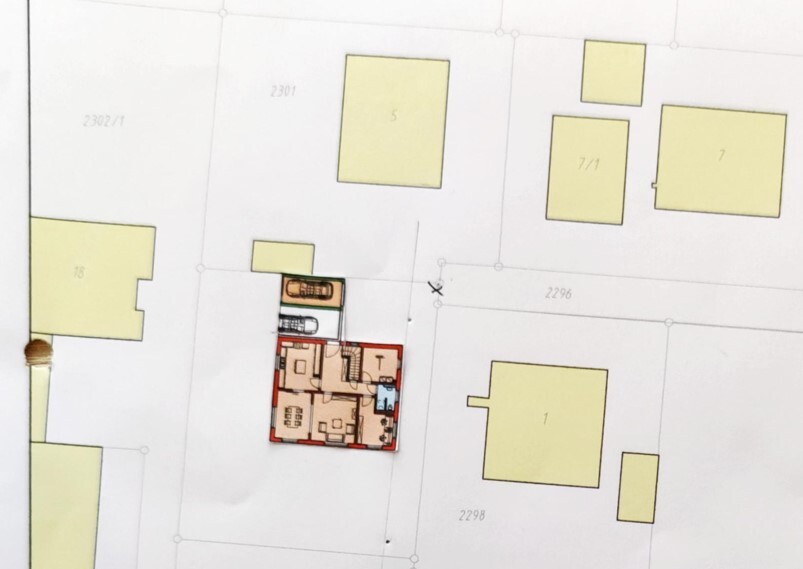
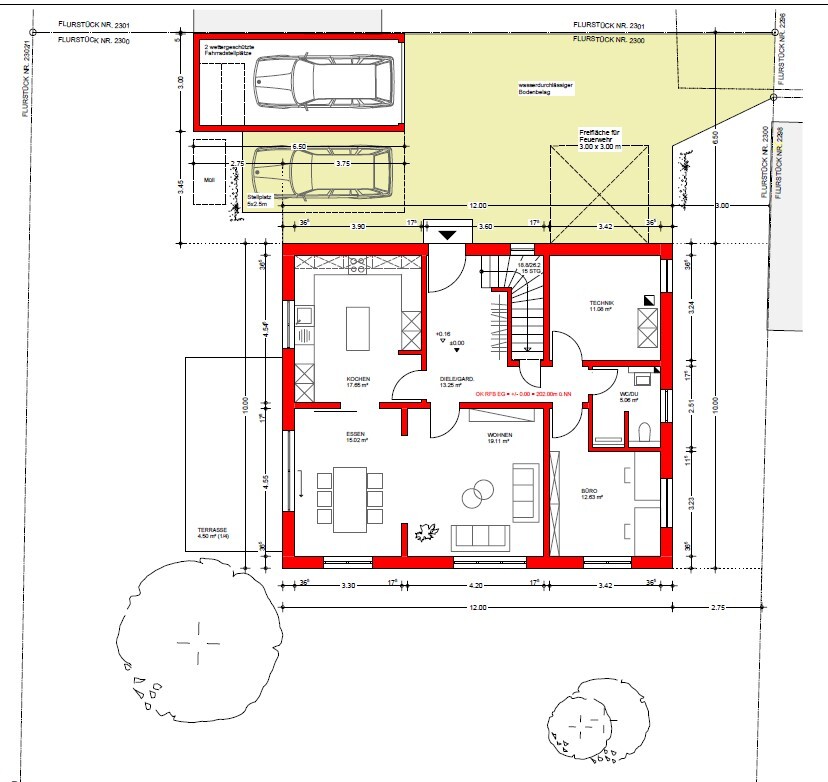
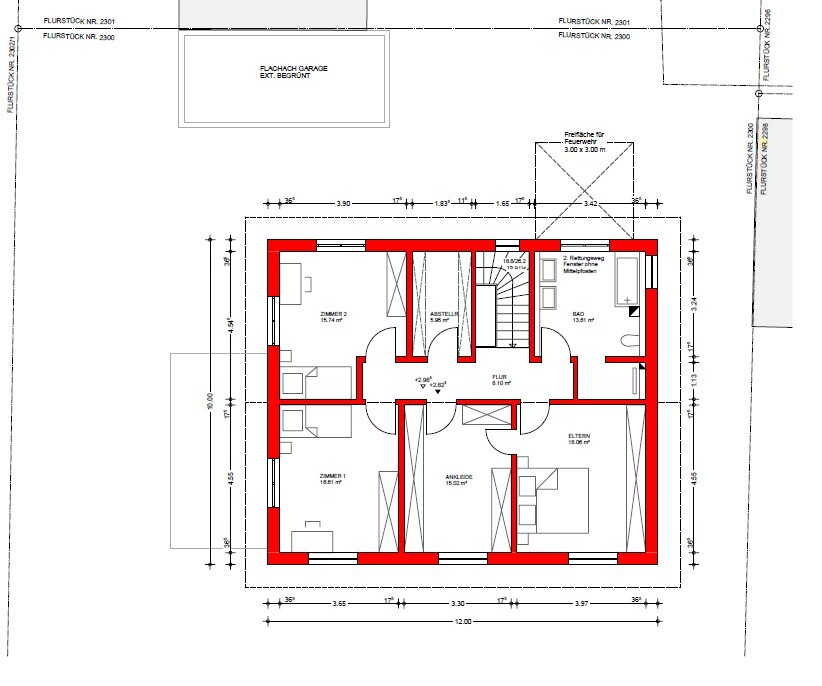
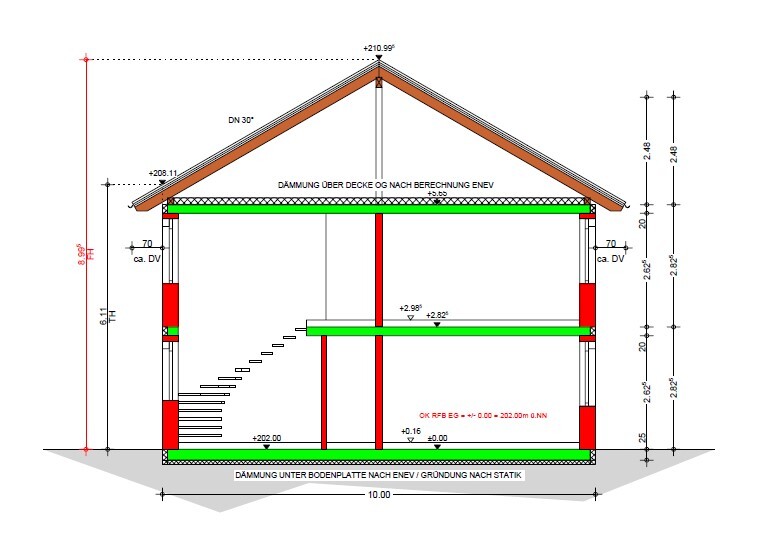
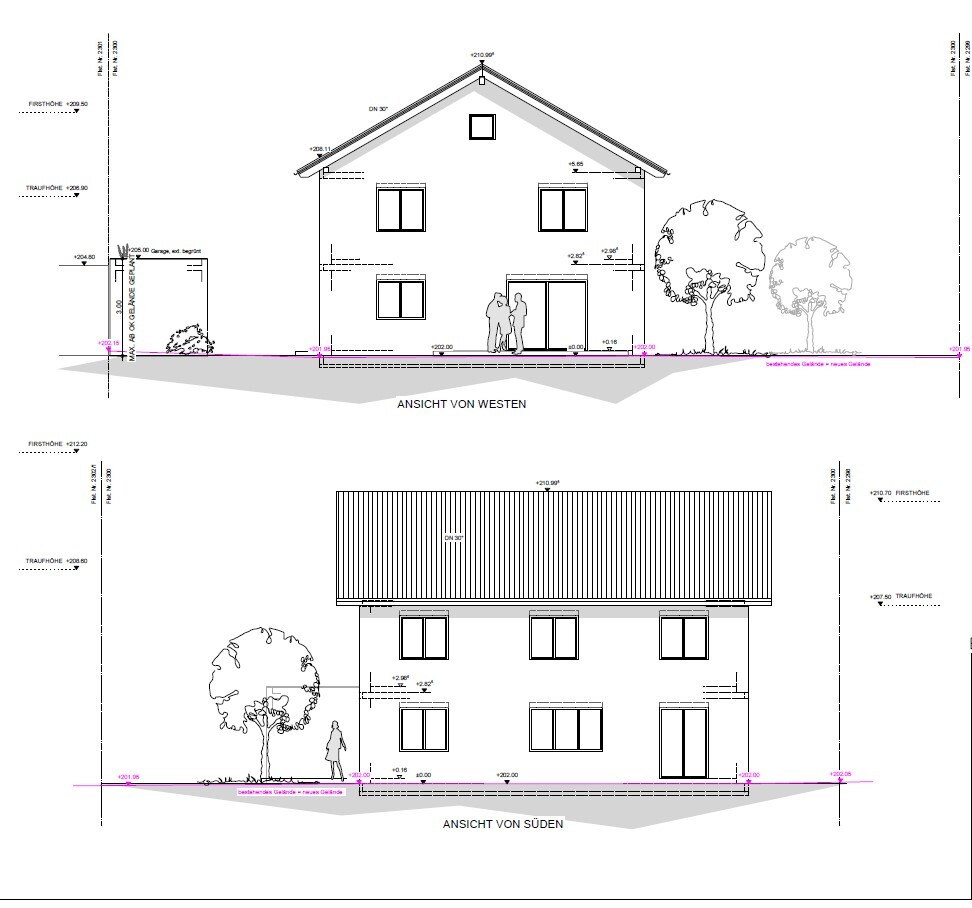
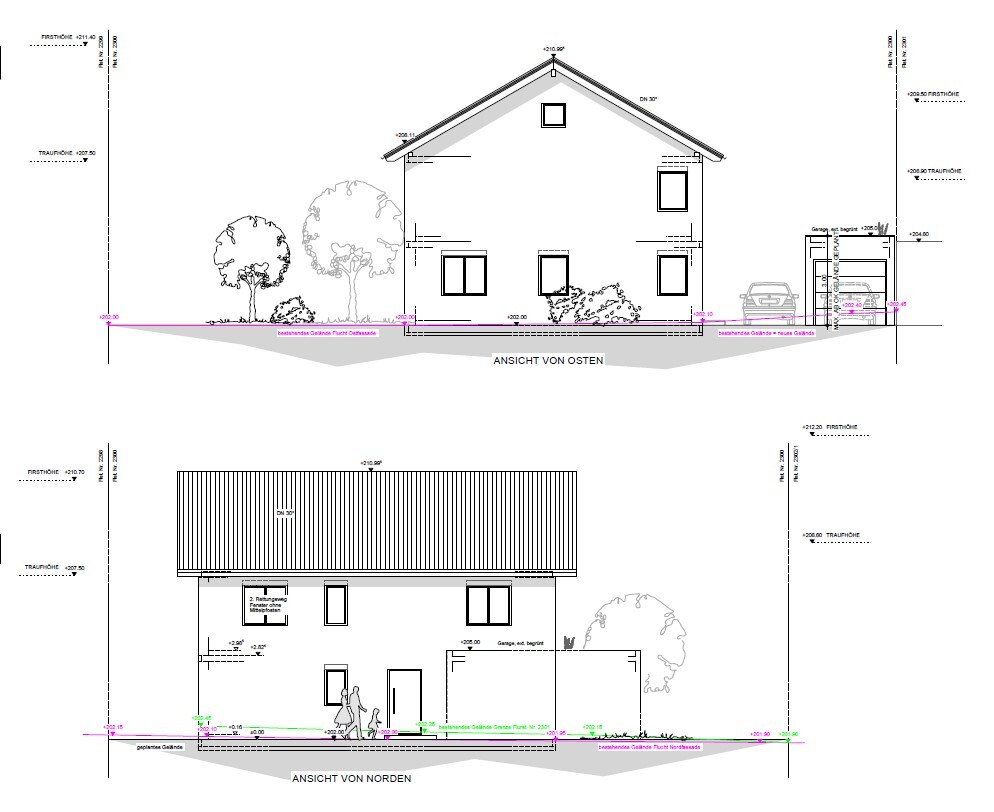
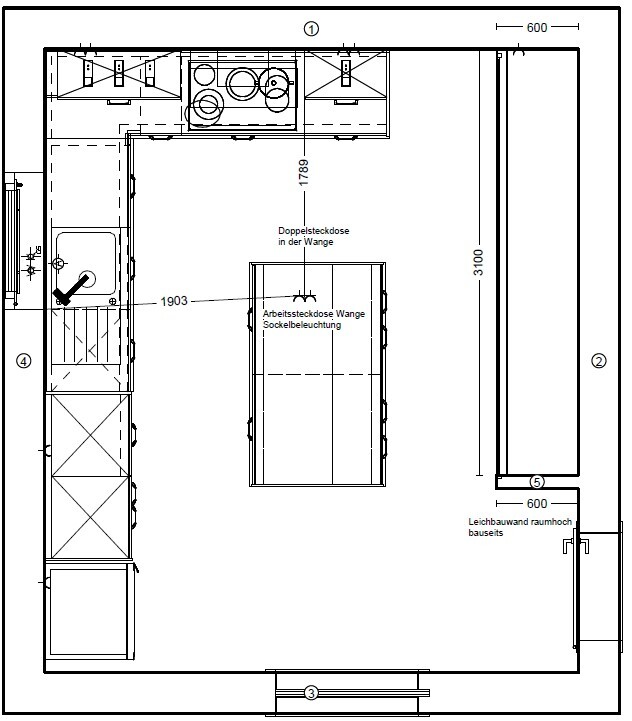
like most others, I have also been quietly following along for quite some time. There are many great pieces of advice here.
The building application has been submitted, and the exterior dimensions as well as the number of windows are fixed. Positioning is still negotiable in consultation, though only to a limited extent. Inside, we basically still have almost all options. The general contractor (GC) is a local family business and has been operating for over 20 years. They are consistently found in the surrounding new development areas, along with two other GCs, and their reputation is quite remarkable. (In fact, we spent quite some time interviewing the newly settled homeowners around us... *g*) One GC was excluded because of the building method (exclusively KfW 40+ standard), and another after submitting a proposal. The process so far has taken about 10 months, starting with graph paper, heating technology, necessary rooms, house positioning, and so on. There are great guides on this topic in the forum!
So, I hope these words were inviting enough to read through the list of questions. If I have forgotten anything, please let me know. I look forward to your feedback, critical comments are also welcome!
Development plan / Restrictions
No development plan
Plot size – 598 sqm (6,435 sq ft)
Slope – no
Floor area ratio – 0.3
Building window, building line and boundary – 3 m (10 feet) distance on all sides
Other stipulations – orientation aligned with neighboring buildings
The building project, including documents, has already been approved by the relevant building authority.
Homeowners’ requirements
Style, roof type, building type – gable roof / 30° pitch facing south with a 10 kWp photovoltaic system, KfW 55 EE standard
Basement, floors – slab-on-grade foundation, 2 full floors, unheated attic
Number of occupants, ages – currently 3 people, planned 4; ages 38, 35, 1
Space requirements on ground floor and upper floor – Ground floor: living/dining, closed kitchen, study/guest room, WC/bathroom, utility/technical room, guest WC including shower
Upper floor: bedroom, dressing room (emergency room if 3rd child), 2 children’s rooms, bathroom
Office: 2 home office workstations
Guests per year: max. 5, excluding drunken friends, who usually make do with the couch *g*
Open or closed architecture: rather closed architecture
Conservative or modern construction: conservative
Open kitchen, island: closed kitchen, island only used as a workspace
Number of dining seats: 6
Fireplace: no
Music/speaker wall: TV wall
Balcony, roof terrace: none
Garage, carport: garage plus carport cover
House design
Who created the plan:
Planner from a construction company, based on our draft floor plan
What do you particularly like? Why? All necessary rooms are present in sufficient size
What do you not like? Why? Office entrance difficult to use, lack of space due to guest WC and living room widening
Fixed price: approx. 450,000€
Personal price limit for house, including fittings: 550,000€
Preferred heating technology: air-to-water heat pump + underfloor heating
If you had to give up something, which details/extensions:
- can give up: size of the dressing room
- cannot give up: office / two children’s rooms
Why did the design turn out like it is now?
Which wishes were implemented by the planner?
- We have already planned and commissioned the kitchen; floor plan adjusted accordingly (changes still possible)
We hesitated a long time over open vs. closed kitchen and, after deciding, debated for a long time over whether to have a pantry behind the kitchen front or not; it is now behind sliding elements on the right side (see attachment)
- Storage space under the stairs
- Bedroom window removed on the east side because of bedroom closet
- Living room widened due to TV wall and to gain space
What makes it particularly good or bad in your opinion?
All rooms are suitable for everyday use, and living on the ground floor later with minimal alterations is possible
What is the most important / fundamental question about the floor plan in 130 characters?
Are the individual rooms adequately lit? I have no sense of this at all. Any obvious flaws?
PS: North is at the top on the site plan as well as on both floor plans!
M
Masterle257 Oct 2021 22:48Zubi123 schrieb:
You misunderstood me.
The upper floor (OG) doesn’t become lower because of this, only the attic (DG) does! And that should be unproblematic.
This is feasible both technically and visually without issues. The attic must not become lower under any circumstances. We increased the roof pitch from 25° to 30° so that you can stand upright freely at the ridge and nearby. After all, I don’t want to keep bumping my head or crawling around in the loft for the next 40 years... 😉
Actually, raising the ceiling height is not my top priority. So far, I feel comfortable with the standard dimensions; we don’t have a huge ballroom, and the additional costs are not negligible. Given current prices, I’m just glad if my financing goes through—I’m optimistic about the budget so far. 🙂
M
Masterle257 Oct 2021 23:05Climbee schrieb:
Is the garage really supposed to stay there? So far back on the property and therefore so far from the street?
We have neighbors, and I hear him swearing every winter morning when he first has to shovel the driveway clear before he can get out of the garage. I would reconsider that.
At least move it closer to the street, possibly plan the garage a bit longer overall and include two or three meters as a shed, which can then stay there because there is access from the garden. Originally, the garage was planned further forward, you can still see that on the site plan. However, I had forgotten the entrance platform, and with an overall width of 6.50m (21 feet 4 inches), it would constantly be right in front of the driver’s side, or the children would jump up and down on the platform when getting out of the car... We didn’t want to increase to 7m (23 feet), as the garden area is too important to us.
Is a covered walkway planned between the house and the garage, like a carport? If it extends over the entrance, you have a sheltered entry. Personally, I would find that comfortable. Between the garage and the house, there is indeed a carport with a covered entrance planned. The exact design is still being developed. The garage will probably be limited to 6m (20 feet) with a wooden shed or similar attached to the back. This looks more appealing from the garden side compared to the concrete wall of the garage. That’s also why the decision was made to have a garage/carport combination rather than a double garage.
We have neighbors, and I hear him swearing every winter morning when he first has to shovel the driveway clear before he can get out of the garage. I would reconsider that.
At least move it closer to the street, possibly plan the garage a bit longer overall and include two or three meters as a shed, which can then stay there because there is access from the garden. Here in the southern lowlands, we get snow on maybe two days at most, so we can manage that 😉 The street is just a small dead-end road, and the driveway is a bit tricky, which the drawing doesn’t really show. That’s why we positioned the house slightly further into the eastern minimum building setback zone, to have enough space for maneuvering. We’ve already marked the spots in a parking lot and tested the turning maneuvers.

Congratulations on the maneuvering test; unfortunately, this is something that is often clearly overlooked in some designs.
In execution, the defect caused by the shoddy pocket construction is hardly fixable, as its root cause lies in the planning stage. I am always amazed at how many planners cannot evenly divide one meter (3.3 feet) into eight equal parts. Or were these imaginary measurements invented by you, and simply adopted by a draftsman?
The mason can only correct this with great effort and time if the planner apparently has no idea about the practical process from the staking out to the finished wall.
If no load-bearing wall thickness is planned between room 1 and the dressing room, the beam between the living and dining areas could become unnecessary. Personally, I would find it inconvenient to have to move the car out first in order to access the bicycles. A side door could be helpful in this case, but it would require relocating the garbage bin enclosure to another spot.
https://www.instagram.com/11antgmxde/
https://www.linkedin.com/company/bauen-jetzt/
Masterle25 schrieb:
Perhaps the building inspector could also take a closer look at this.
In execution, the defect caused by the shoddy pocket construction is hardly fixable, as its root cause lies in the planning stage. I am always amazed at how many planners cannot evenly divide one meter (3.3 feet) into eight equal parts. Or were these imaginary measurements invented by you, and simply adopted by a draftsman?
The mason can only correct this with great effort and time if the planner apparently has no idea about the practical process from the staking out to the finished wall.
If no load-bearing wall thickness is planned between room 1 and the dressing room, the beam between the living and dining areas could become unnecessary. Personally, I would find it inconvenient to have to move the car out first in order to access the bicycles. A side door could be helpful in this case, but it would require relocating the garbage bin enclosure to another spot.
https://www.instagram.com/11antgmxde/
https://www.linkedin.com/company/bauen-jetzt/
M
Masterle258 Oct 2021 00:0211ant schrieb:
In terms of execution, the flaw of the botched pockets is nearly impossible to fix; their root cause lies in the planning stage. I’m always amazed at how many planners can’t divide a meter into eight equal parts. Or were the arbitrary dimensions invented by you, and a draftsman just copied them? That’s exactly how it was. We measured the plot, sketched it on graph paper to the millimeter, and tried different house sizes and garage options, moving them around to decide how we wanted to position the house. 12 by 10 meters (39 by 33 feet) was ideal in size, so we adapted a floor plan we liked to those dimensions and have kept tweaking it without changing the exterior dimensions.
The masonry work is still handled by the general contractor, so they might be used to draftsmen like that...
Personally, I would find it inconvenient to have to move the car out first to access the bikes. A side door could help, but that would require relocating the trash bin enclosure. We agree, which is why the garage is only drawn like this for the building permit/planning permission. It will later be the standard 6 meters (20 feet) wide and the shed at the back will be mainly for storing garden tools and stuff. We plan to build a separate bike shed a bit lower down on the southeast side.
Masterle25 schrieb:
12 by 10 meters (39 by 33 feet) was ideal in size, so we adapted a floor plan we liked to those dimensions and have been tweaking it repeatedly since, but we haven’t changed the external dimensions...Tell us which house model the floor plan is based on, and what the original dimensions are. [Don’t forget: just say, don’t link!]Masterle25 schrieb:
The masonry work is still under the general contractor, they might be used to that from the draftsman...If not from their draftsman, then whose work have you shown here?https://www.instagram.com/11antgmxde/
https://www.linkedin.com/company/bauen-jetzt/
M
Masterle258 Oct 2021 18:1111ant schrieb:
Can you tell me which house model the floor plan is from, and what the original dimensions were? [Don’t forget: just say it, don’t link!]
If not from the draftsman himself, then whose work is it that you’ve shown here?Oh dear, I honestly can’t tell you anymore. We actually had catalogs from all well-known prefab house suppliers here and went through several rounds selecting the floor plan that suited us best. However, it has since been considerably changed because we realized we needed to adapt it to the plot and the conditions. I think it was Hanse Haus, but I’ll have to check… maybe I can still find the original floor plan somewhere.Maybe I wasn’t clear enough. What you see here is the result of our initial planning and the improvement suggestions from the draftsman/salesperson of the general contractor. Now we are working with an architect from the general contractor who is also handling our building permit/planning permission application.
Could you explain the consequences of the “Pfuschertaschen” to me? Nothing is built yet, the planned start of construction is in March, and we still have some time buffer…
PS: Attached is one of the first floor plans I traced or redrew, the original looked quite similar…
Similar topics