
Hello
we are currently building a new semi-detached house
I am considering installing underfloor heating in the basement.
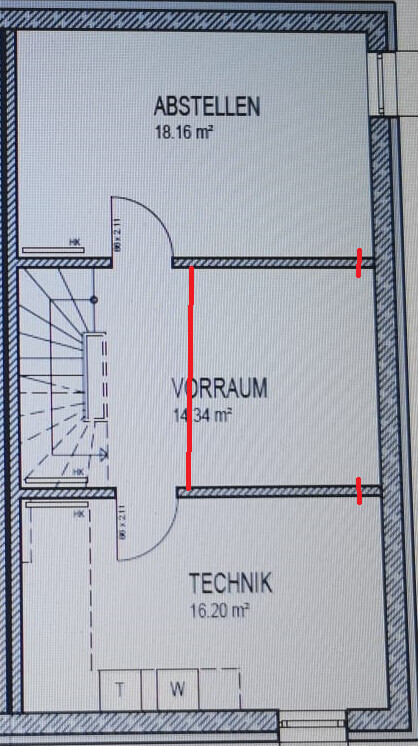
Our basement comes standard with conventional radiators under the stairs in the utility and storage rooms. As a special request, we will (red line) partition off this area as a separate room (of course with a door). The two lines at the back of the room will be ventilation slots to allow airflow since the other two rooms have windows.
The new room is intended as a pantry/storage room, and the storage room might be used as a workout room.
I have a few questions:
1: What do you think about installing underfloor heating throughout the entire basement? What are the advantages and disadvantages? The additional cost is 2700€.
2: In the underfloor heating package, the two rooms in the middle (hallway and newly partitioned room) will share a single heating circuit manifold, meaning the underfloor heating would be controlled by one thermostat and would heat both rooms. The underfloor heating would run beneath the new wall (a sand-lime brick wall).
My option would be, for an additional cost (amount unknown), to give the new room its own heating circuit, or to omit underfloor heating in that room altogether (which would of course reduce the extra cost of 2700€), or to have the hallway and new room share one heating circuit.
What would you recommend?
we are currently building a new semi-detached house
I am considering installing underfloor heating in the basement.
Our basement comes standard with conventional radiators under the stairs in the utility and storage rooms. As a special request, we will (red line) partition off this area as a separate room (of course with a door). The two lines at the back of the room will be ventilation slots to allow airflow since the other two rooms have windows.
The new room is intended as a pantry/storage room, and the storage room might be used as a workout room.
I have a few questions:
1: What do you think about installing underfloor heating throughout the entire basement? What are the advantages and disadvantages? The additional cost is 2700€.
2: In the underfloor heating package, the two rooms in the middle (hallway and newly partitioned room) will share a single heating circuit manifold, meaning the underfloor heating would be controlled by one thermostat and would heat both rooms. The underfloor heating would run beneath the new wall (a sand-lime brick wall).
My option would be, for an additional cost (amount unknown), to give the new room its own heating circuit, or to omit underfloor heating in that room altogether (which would of course reduce the extra cost of 2700€), or to have the hallway and new room share one heating circuit.
What would you recommend?
D
Deliverer7 Oct 2021 11:23Please describe your heating system. I’m sure we can find something to improve together here. ;-)
D
Deliverer7 Oct 2021 11:29Of course, the original poster has the opportunity and even the responsibility to listen to all opinions here and then conduct independent research. There are plenty of scientific studies available on heat pump systems and well-insulated buildings that explain the best practices and what should be avoided. We are only providing a summary of the current state of scientific knowledge.
@FloHB123 — what exactly triggered you? Which of the mentioned mistakes have you incorporated in your build?
@FloHB123 — what exactly triggered you? Which of the mentioned mistakes have you incorporated in your build?

Well, the concept was laid out by the developer. The heating contractor here is just the subcontractor carrying out the work, who has to put on a good face despite the situation. However, the client and paying partner is the developer in this case, so things are done their way, even if there might be better solutions.
But even the average heating installer for single-family homes doesn't necessarily have an interest in installing the most efficient heating system. That usually means extra effort for them, which they aren’t always compensated for. They also don’t have the time or willingness to show up every couple of days for 5 minutes over one or two weeks to carry out a hydraulic balancing.
Therefore, what is often installed is what works, causes as few warranty claims and follow-up visits as possible, and is affordable enough for the customer to approve the order.
Of course, there’s also the “Heizi” type, who considers themselves the ultimate authority and simply does not accept any other expert opinions.
It should be noted that much of what is posted here by non-experts was not made up by them, but thoroughly discussed in specialized forums and planned by professionals, including engineers.
Does district heating or a gas boiler work in the sense that it produces heat? Sure!
Is it, in the medium to long term, one of the most efficient systems you should install in a single-family home? In my opinion, no.
But even the average heating installer for single-family homes doesn't necessarily have an interest in installing the most efficient heating system. That usually means extra effort for them, which they aren’t always compensated for. They also don’t have the time or willingness to show up every couple of days for 5 minutes over one or two weeks to carry out a hydraulic balancing.
Therefore, what is often installed is what works, causes as few warranty claims and follow-up visits as possible, and is affordable enough for the customer to approve the order.
Of course, there’s also the “Heizi” type, who considers themselves the ultimate authority and simply does not accept any other expert opinions.
It should be noted that much of what is posted here by non-experts was not made up by them, but thoroughly discussed in specialized forums and planned by professionals, including engineers.
Does district heating or a gas boiler work in the sense that it produces heat? Sure!
Is it, in the medium to long term, one of the most efficient systems you should install in a single-family home? In my opinion, no.
Tolentino schrieb:
...Does district heating or a gas boiler work in the sense that they provide heat? Of course!
Are they medium- to long-term among the most efficient systems to install in a single-family home? In my opinion, no.No contradiction!
Still:
one of the most efficient systems
is a political debate.
Because energy prices are politically determined.
Does that mean efficient equals cost-effective?
In France, electricity prices are relatively low because the nuclear power-based electricity from EDF is subsidized.
(That’s why there are proportionally many direct electric heating systems there.)
And that is because the entire nuclear technology chain was needed for the development of atomic weapons.
Does that make it efficient?
Gas prices have more than doubled in recent months.
Is gas still efficient, even though the doubling is purely politically driven?
The gas supply is supposed to increasingly shift to higher hydrogen blending
(currently about 10% hydrogen content in some cases).
Does that make gas heating more efficient or less efficient?
Ecologically, that certainly makes sense!?!?
Also because the efficiency of direct hydrogen gas heating is better than the detour through
an indirect electric heating system.
What I mean to say:
cost minimization can only be pragmatically used as a measure of efficiency.
However, what seems like “better efficiency” doesn’t necessarily have to be sensible.
D
Deliverer7 Oct 2021 14:50konibar schrieb:
Still:
one of the most efficient systems
is a political debate. Efficient means producing a lot of heat with little energy. Currently, that would be the heat pump; then, for a long time, nothing else. Efficiency is not related to cost.
konibar schrieb:
In France, electricity prices are relatively low because of nuclear power...
Does that make it efficient? Of course not. No one claimed that either.
konibar schrieb:
Is gas still efficient, even though the price doubling is purely politically determined? No. But it never was...
konibar schrieb:
Gas supply is increasingly being shifted towards higher hydrogen blending
Also because the efficiency of direct hydrogen gas heating is better than the indirect route via electric heating. Hydrogen will never be available for residential homes. No one can afford that. Therefore, the question is pointless.
konibar schrieb:
I mean:
cost minimization can only pragmatically be used for efficiency assessment.
However, so-called "better efficiency" does not necessarily mean it is sensible. Costs still have nothing to do with the efficiency of a heating system. Higher efficiency is mainly important for preserving our living environment.
Similar topics